


The most effective way to lift a sagging jawline isn't always to pull the skin tighter, but to re-architect its internal foundation through medical-grade thermal energy. If you've noticed a loss of definition around your chin or a crepey texture developing on your neck, you're likely seeking a solution that offers visible results without the risks of a surgical facelift. Choosing radiofrequency microneedling for sagging skin in London allows you to address these concerns at a structural level, stimulating the production of new, resilient collagen fibres within the dermis.
At our Marylebone clinic, we understand the desire for natural-looking rejuvenation that avoids an overfilled or artificial appearance. This clinical guide provides a comprehensive overview of how this technology works as a medical-grade solution for skin laxity and jowls under the supervision of a GMC-registered specialist. We'll explore the biological processes behind skin tightening, compare RF microneedling with other modalities like HIFU, and explain why a precise, doctor-led approach is essential for achieving a refined, youthful profile.
Key Takeaways
- Understand the dual-action mechanism of radiofrequency microneedling, which combines physical dermal remodelling with thermal energy to stimulate deep collagen production.
- Learn why choosing radiofrequency microneedling for sagging skin london offers a medical-grade solution for improving jawline definition and treating neck laxity.
- Discover the clinical importance of a professional skin analysis and a medical-grade environment led by a GMC-registered specialist in Marylebone.
- Compare the structural benefits of skin tightening against volume-based treatments like dermal fillers to determine the most effective approach for your specific concerns.
- Gain insights into the clinical journey, including the preparation phase and the protocols used to ensure patient comfort throughout the procedure.
How Radiofrequency Microneedling Rebuilds Sagging Skin Structure
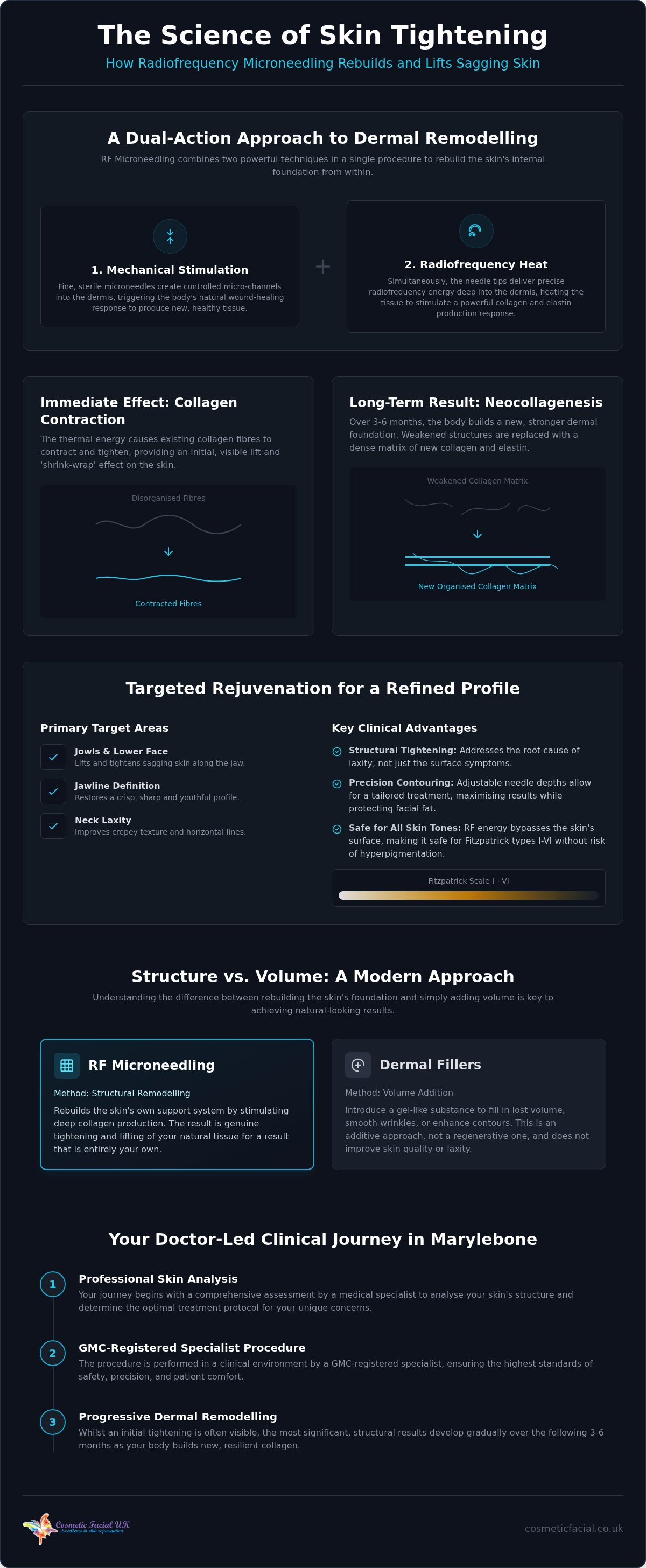
Radiofrequency (RF) microneedling is a sophisticated, dual-action procedure designed for dermal remodelling. It combines mechanical stimulation with thermal energy to address the structural causes of skin laxity. Unlike traditional microneedling, which relies solely on the creation of micro-channels to trigger a wound-healing response, this advanced modality integrates Radio-frequency skin tightening technology. When performing radiofrequency microneedling for sagging skin in London, the objective is to initiate a cascade of biological repairs that restore the skin's architecture from within.
The physical microneedles penetrate the epidermis to reach the dermis, creating controlled micro-injuries. These injuries activate the body's natural healing mechanisms, prompting fibroblasts to produce new structural proteins. Simultaneously, the needles act as conductors for radiofrequency energy. This energy is delivered directly into the deeper dermal layers, bypassing the surface to provide intense thermal heat where it's most needed. This synergy is particularly effective for treating jowls and sagging tissue, as it addresses both the surface texture and the underlying support system.
The Biological Mechanism of Neocollagenesis
The application of heat to the dermal tissues results in the immediate contraction of existing collagen fibres. This provides a subtle, initial tightening effect that patients often notice shortly after treatment. However, the most significant results occur through neocollagenesis. Over a period of three to six months, the body organises new, stronger collagen and elastin fibres, replacing the weakened structures responsible for laxity. Dermal remodelling is the structural reorganisation of skin tissues to improve density and resilience.
Why Depth Matters for Skin Tightening
Precision is paramount when addressing sagging skin. Our clinical approach utilises adjustable needle depths to ensure the energy reaches the specific structural layers of the skin. By targeting different dermal levels, we can address fine lines near the surface whilst simultaneously tightening the deeper scaffolding that supports the jawline. It's crucial to manage these depths with medical expertise to maximise tightening without causing unintended fat loss in the face. This level of control is why radiofrequency microneedling for sagging skin in London is considered a superior non-surgical option for restoring facial contours.
Targeting Jowls and Neck Laxity: Why RF Microneedling Excels
The loss of a defined jawline and the gradual appearance of jowls represent the primary concerns for many patients seeking aesthetic intervention. Topical treatments often fail to address these structural changes because they can't penetrate the dermal layers where laxity originates. Choosing radiofrequency microneedling for sagging skin in London provides a targeted approach to these specific anatomical regions, a treatment pathway also offered by leading clinics such as Vie Aesthetics to ensure optimal patient outcomes. Unlike certain laser therapies that carry risks for darker complexions, this technology is safe and effective for all skin tones, covering Fitzpatrick types I through VI. This inclusivity is possible because the energy is delivered beneath the surface, protecting the melanocytes in the epidermis from heat damage.
Restoring the Jawline and Contouring the Jowls
The sub-mental area and the jawline are particularly responsive to the combination of mechanical needling and thermal energy. As the RF energy is emitted at the needle tip, it creates a "shrink-wrap" effect on the loose skin by causing immediate contraction of the connective tissues. This process provides a subtle lift to the jowls and restores the crispness of the facial contours. Key advantages for the lower face include:
- Structural Tightening: Direct energy delivery to the dermal-subcutaneous junction for improved support.
- Precision Contouring: Targeted treatment of the sub-mental region to reduce mild laxity and sharpen the profile.
- Immediate Contraction: Thermal effect on existing collagen fibres for a visible, initial response.
A Clinical Review of RF Microneedling supports the efficacy of this approach in remodelling the lower face. For patients requiring a more comprehensive structural lift, we often integrate this technology into our non-surgical facelift protocols to achieve a more pronounced result.
Addressing Crepey Skin on the Neck and Décolletage
The skin on the neck and décolletage is significantly thinner and contains fewer sebaceous glands than facial skin, making it particularly prone to a "crepey" texture and premature ageing. Microneedling excels in this area by creating thousands of precise micro-channels that trigger the release of growth factors and initiate the wound-healing cascade. When combined with controlled thermal stimulation, the skin becomes visibly thicker and more resilient over several months. This dual-action approach is superior for delicate areas because it strengthens the dermal matrix without the aggression of more invasive procedures. Patients interested in a bespoke plan for these regions may benefit from a Private Dermatologist Consultation London to assess their specific skin quality and history. Our clinicians at Cosmetic Facial prioritise precision when treating these sensitive zones to ensure optimal safety and patient outcomes.
The Clinical Journey: Professional RF Microneedling in Marylebone
Achieving optimal results with radiofrequency microneedling for sagging skin in London requires a structured clinical approach rather than a one-size-fits-all application. At our Marylebone clinic, we treat this procedure as a medical intervention that must be tailored to the individual's unique dermal thickness and degree of laxity. A professional skin analysis and consultation serves as the foundation of your treatment plan, ensuring that the technology is applied safely and effectively to meet your specific aesthetic goals.
Your Specialist Consultation with Dr Faramarz Didar
Every clinical journey begins with a detailed assessment led by Dr Faramarz Didar. His MSc in Dermatology Skills and Treatment informs a bespoke strategy that goes beyond surface-level improvements. During this initial meeting, Dr Didar evaluates the levels of skin laxity in the jowls and neck to determine the appropriate depth of needle penetration and energy intensity. We also conduct a thorough review of your medical history and current skin health. This ensures the procedure is appropriate for you and helps us estimate the number of sessions required, which typically ranges from three to five depending on the severity of the sagging tissue.
Step-by-Step Procedure and Recovery
The procedure is designed with patient comfort and clinical precision in mind. We follow a rigorous protocol to ensure the best possible environment for dermal remodelling. The steps include:
- Cleansing: The treatment area is thoroughly prepared and sanitised.
- Numbing: We apply a high-strength topical anaesthetic for approximately 30 to 45 minutes to minimise discomfort.
- RF Passes: The device is systematically applied across the target areas, delivering controlled energy pulses.
- Soothing: Specialised serums or cooling masks are applied to calm the skin and enhance the healing response.
Most patients describe the sensation as a light prickling combined with a deep heat. Following the session, you'll experience what we term "social downtime". Your skin will likely appear red and feel slightly tight, similar to a mild sunburn, for 24 to 48 hours. Minor swelling is common but usually subsides within two days, allowing most individuals to return to their regular work schedule quickly. To protect the newly treated tissue, you must follow a strict aftercare regimen:
- Apply SPF 50 sun protection daily without exception.
- Avoid direct sun exposure and heat treatments like saunas for 48 hours.
- Refrain from using active skincare ingredients, such as retinols or acids, for at least five days.
- Keep the skin hydrated with the recommended clinical moisturisers.
By adhering to these professional protocols, patients at our Marylebone centre can expect a safe recovery and a more resilient, tightened complexion over the following months.
Radiofrequency Microneedling vs HIFU and Dermal Fillers
Selecting the appropriate non-surgical intervention for facial rejuvenation requires a clear understanding of how different technologies interact with various tissue layers. Whilst several modalities are available, radiofrequency microneedling for sagging skin in London is often confused with High-Intensity Focused Ultrasound (HIFU) or dermal fillers. Each treatment addresses distinct aspects of the ageing process. Understanding the specific mechanism of each is essential for achieving a result that appears natural and refined.
When to Choose RF Microneedling over HIFU
The primary distinction between these two energy-based devices lies in the depth of their target tissue. HIFU face lifting utilises focused ultrasound energy to reach the Superficial Muscular Aponeurotic System (SMAS), which is the same fibrous layer manipulated during a surgical facelift. This makes HIFU superior for deep structural lifting of heavy jowls. In contrast, RF microneedling focuses on the dermis and epidermis. It's the preferred choice for patients with moderate laxity who also wish to improve surface texture, pore size, and fine lines. For a detailed comparison of these technologies in other contexts, you can refer to our analysis on HIFU vs Radiofrequency: Best Stomach Treatment?.
The Role of Dermal Fillers in Sagging Skin
It's a common misconception that dermal fillers can technically tighten skin. Fillers are designed to replace lost volume in areas such as the cheeks or temples, which can provide a lifting effect by restoring the underlying support. However, they don't improve the quality or elasticity of the skin tissue itself. RF microneedling provides a more biological lift by physically thickening the dermis through neocollagenesis. If your primary concern is volume depletion rather than skin laxity, our Dermal Fillers London guide explains how these injectables restore facial contours.
In clinical practice, combination therapy often yields the most superior results. A patient might receive HIFU for deep structural support, followed by RF microneedling to tighten the skin envelope and improve texture. This stacking approach addresses the multi-layered nature of facial ageing. Generally, younger patients with early-stage laxity benefit most from the skin-quality improvements of RF, whilst those with more significant sagging may require the deeper reach of HIFU or the volume restoration of fillers.
Expert-Led Skin Tightening at Cosmetic Facial London
Cosmetic Facial operates as a centre of clinical excellence within the medical district of Marylebone. Our approach to radiofrequency microneedling for sagging skin in London is defined by a commitment to medical precision rather than aesthetic trends. We utilise advanced, medical-grade energy-based devices that allow for granular control over depth and thermal intensity. This technical rigour ensures that every patient receives a treatment profile matched to their specific dermal requirements. Our primary objective is to produce a refreshed, natural-looking result that respects the patient's original facial anatomy.
The Importance of a Medically Qualified Practitioner
A deep understanding of skin anatomy is vital when administering treatments that involve thermal energy and dermal penetration. Dr Faramarz Didar holds an MSc in Dermatology Skills and Treatment, awarded with Commendation, which provides the academic and clinical foundation for his practice. He is a GMC-registered practitioner (5200505) and has undergone extensive training with the European College of Aesthetic Medicine & Surgery (ECAMS). This expertise ensures safety. Dr Didar’s background in surgical dermatology provides him with the technical proficiency required to manage complex clinical cases. It allows for the precise identification of treatment zones and the mitigation of risks associated with high-energy devices. When you choose a doctor-led clinic, you're prioritising expertise that understands the complex biological responses of the skin to controlled injury and heat.
Bespoke Treatment Plans for London Clients
We recognise that skin laxity is rarely an isolated concern. Therefore, we often develop integrated protocols that combine radiofrequency microneedling with other medical-grade modalities. When designing a protocol involving radiofrequency microneedling for sagging skin in London, we prioritise long-term skin health over quick fixes. For instance, we might incorporate chemical peels or laser therapies to address surface pigment issues alongside deeper structural tightening. This unhurried, clinical approach ensures that we address the skin's health comprehensively.
Every patient journey begins with a thorough assessment to ensure the chosen pathway is biologically appropriate. We don't believe in rushed consultations. Instead, we provide a calm environment where your questions are answered with clinical honesty and precision. By integrating different technologies, we can achieve a multi-dimensional rejuvenation that addresses both the structural foundation and the surface aesthetics. This methodical approach rewards the patient with a more resilient and youthful skin profile.
Restoring Facial Contours with Clinical Precision
Addressing skin laxity requires a deep understanding of dermal architecture and the precise application of thermal energy. Choosing radiofrequency microneedling for sagging skin london provides a sophisticated, medical-grade solution for those seeking to redefine the jawline and improve neck texture without the risks of invasive surgery. This treatment initiates neocollagenesis while providing an immediate contraction of existing tissue, resulting in a more resilient and youthful skin profile over several months.
At our Marylebone clinic, Dr Faramarz Didar ensures that every procedure is tailored to the patient's unique skin health. As a specialist in non-surgical facial rejuvenation with an MSc in Dermatology, awarded with Commendation, Dr Didar prioritises clinical safety and natural-looking outcomes. By focusing on the structural foundation of the skin, we help you achieve lasting improvements in skin thickness and elasticity through evidence-based protocols.
We look forward to guiding you through a personalised treatment plan that delivers a refreshed and confident appearance in a professional, clinical environment.
Frequently Asked Questions
How many sessions of radiofrequency microneedling are needed for sagging skin?
Most patients require a course of three to five sessions to achieve optimal results for skin laxity. The exact number depends on the initial degree of sagging and the individual's biological response to thermal stimulation. These appointments are usually spaced four to six weeks apart to allow the dermal matrix to begin its repair process. Dr Didar assesses your progress after each session to refine the treatment depth and energy intensity for your specific needs.
Is radiofrequency microneedling painful?
While the procedure involves dermal penetration and heat, discomfort is minimised through the application of a high-strength topical anaesthetic. Patients generally describe the sensation as a series of light prickles accompanied by a deep, manageable warmth. We prioritise patient comfort in our Marylebone clinic by ensuring the numbing agent has sufficient time to take effect before the procedure begins. Most individuals find the treatment well-tolerated without the need for injectable local anaesthesia.
How long does it take to see results from RF microneedling for jowls?
You may notice an initial contraction effect due to heat, but the definitive results for jowls typically appear after three to six months. This timeline reflects the biological reality of neocollagenesis, as the body takes several months to organise and strengthen new collagen fibres. Improvements in skin density and jawline definition continue to develop as the structural re-architecting of the dermis progresses. Consistency with the recommended session count is vital for long-term success.
What is the recovery time after RF microneedling in London?
The recovery period for radiofrequency microneedling for sagging skin in London is relatively brief, often referred to as "social downtime". You can expect mild redness and slight swelling for approximately 24 to 48 hours, similar to the appearance of a moderate sunburn. Most patients return to their professional duties the following day. We provide a specific aftercare protocol, including the use of medical-grade SPF 50, to protect the skin while the micro-channels close and the healing response initiates.
Is radiofrequency microneedling safe for dark skin tones?
Radiofrequency microneedling is highly suitable for dark skin tones, including Fitzpatrick types V and VI. Unlike some laser treatments that target melanin in the epidermis, RF energy is delivered directly into the deeper dermis via insulated needles. This bypasses the surface pigment, significantly reducing the risk of post-inflammatory hyperpigmentation or thermal damage to the outer skin layers. It's a safe, effective option for patients of all ethnicities seeking non-surgical skin tightening.
How much does radiofrequency microneedling cost in London?
Per-session fees for cosmetic treatments at our clinic are determined by the size of the treatment area and the complexity of the protocol required. While prices across London vary based on clinic location and practitioner expertise, we provide a transparent fee structure during your initial clinical skin analysis. Choosing a doctor-led facility ensures that your investment covers medical-grade technology and the oversight of a GMC-registered specialist with advanced postgraduate qualifications in dermatology.
Can I combine RF microneedling with Botox or fillers?
It's common and often beneficial to combine RF microneedling with Botox or dermal fillers to address multiple signs of ageing simultaneously. This multi-layered approach allows us to treat skin laxity, volume loss, and dynamic wrinkles in a single overarching plan. We typically recommend waiting at least two weeks between injectable treatments and energy-based procedures to ensure the products have settled and the skin has fully recovered from any minor inflammation.
How long do the skin-tightening results last?
The results of a complete course of treatment generally last between 12 and 18 months, depending on your age, lifestyle, and skin quality. Because the procedure stimulates your body's natural collagen production, the improvements are long-lasting but not permanent. We often suggest a single maintenance session every year to sustain the skin's resilience and counteract the ongoing natural ageing process. Protecting your skin from UV damage is also essential for preserving the tightening effects, as is maintaining a healthy skin barrier with innovative, natural products like Mono Skincare.
Disclaimer
All content on cosmetic Facial website, including blogs, graphics, logos, images, and software, is the property of CosmeticFacial UK or its content suppliers and is protected by applicable copyright laws. Unauthorized use, reproduction, distribution, or modification of any content without prior written permission is strictly prohibited.


