


Selecting the correct modality for abdominal contouring is a clinical decision that depends entirely on whether your primary concern is subcutaneous adipose tissue or dermal laxity. While the abdomen is the most common target area for body sculpting, representing over 35 percent of the global market, many patients remain confused about which energy-based device actually delivers results for the body rather than the face. You may feel frustrated by stubborn stomach fat that resists exercise or concerned about the appearance of crepey skin following significant weight loss.
This article offers a detailed clinical comparison of hifu vs radiofrequency for stomach applications to help you choose the most effective non-invasive treatment for your profile. We will analyse the precise mechanisms of High-Intensity Focused Ultrasound and Radiofrequency, examining how they target different layers of the anatomy. By understanding the distinction between deep-tissue architectural fat reduction and surface-level skin refinement, you can establish a treatment plan rooted in medical expertise and realistic physiological outcomes.
Key Takeaways
- Understand how thermal energy and electrical currents interact with different tissue depths to achieve specific body contouring results.
- Identify why High-Intensity Focused Ultrasound (HIFU) is specifically utilised for the destruction of stubborn adipose tissue through thermal lipolysis.
- Explore the benefits of Radiofrequency for enhancing skin "snap-back" and refining texture amongst clients concerned with abdominal laxity or cellulite.
- Utilise our clinical comparison of hifu vs radiofrequency for stomach treatments to determine which technology aligns with your physiological requirements.
- Learn about the necessity of bespoke, medical-led treatment planning at our Marylebone practice to ensure safe and precise aesthetic outcomes.
Understanding the Technology: How HIFU and Radiofrequency Differ
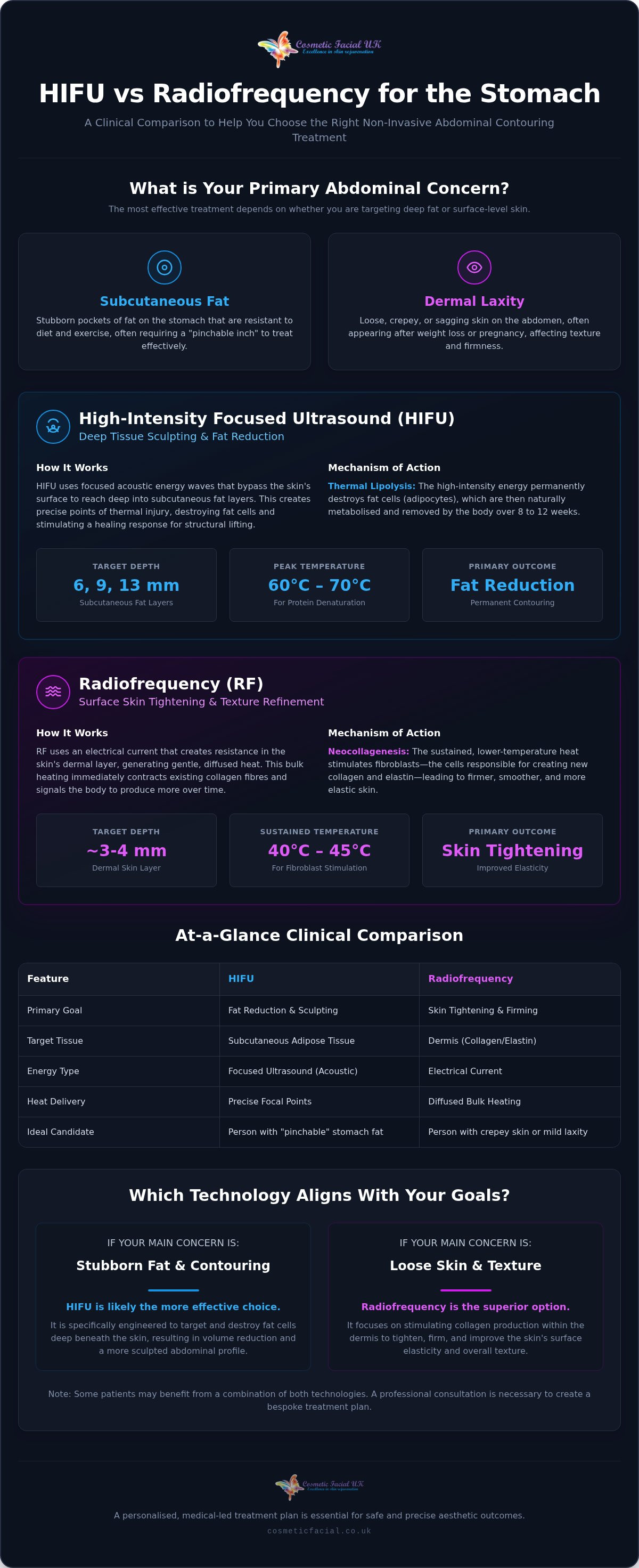
Both modalities are non-invasive, yet they operate on distinct physical principles. High-Intensity Focused Ultrasound (HIFU) utilises acoustic energy to target specific depths within the tissue, whereas Radiofrequency (RF) employs electrical currents to generate heat through resistance in the skin layers. When evaluating hifu vs radiofrequency for stomach applications, the primary distinction lies in the depth of energy delivery and the peak temperatures achieved. HIFU focuses energy into a precise focal point, creating thermal coagulation zones. RF provides a more diffused, bulk-heating effect.
The thermal profiles of these treatments vary significantly. HIFU generates temperatures between 60°C and 70°C at a precise focal point, which is sufficient to cause protein denaturation and immediate tissue contraction. In contrast, Radiofrequency maintains a more controlled dermal temperature of approximately 40°C to 45°C. This lower, sustained heat is ideal for stimulating fibroblast activity without damaging the surrounding tissue. Understanding these thermal thresholds is vital when comparing hifu vs radiofrequency for stomach rejuvenation, as the higher temperatures of HIFU are required for adipose tissue disruption, whilst the lower temperatures of RF are optimal for dermal thickening.
The Mechanism of High-Intensity Focused Ultrasound
HIFU technology is unique in its ability to bypass the epidermis entirely, delivering concentrated ultrasound waves to the subcutaneous fat layers and the Superficial Muscular Aponeurotic System (SMAS). For HIFU Body treatments, we utilise specific transducers that reach depths of 6mm, 9mm, or 13mm. These depths are necessary to penetrate the thicker adipose tissue found on the stomach. By creating micro-injuries at these levels, the body initiates a healing response that leads to the destruction of fat cells and a structural lift of the abdominal wall. This architectural approach is why HIFU is often preferred for volume reduction and deep tissue tightening.
The Science of Radiofrequency Skin Tightening
Radiofrequency operates by passing an electrical current through the skin, where the natural resistance of the tissue converts this energy into heat. This process, known as bulk heating, targets the dermis rather than the deeper fat layers. The immediate effect is the contraction of existing collagen fibres, which provides an initial tightening sensation. Over the following weeks, the thermal stimulation triggers neocollagenesis, the production of new collagen and elastin. This makes RF an excellent choice for treating crepey skin texture and mild laxity. It refines the surface appearance and improves the overall elasticity of the abdominal skin without affecting the underlying fat volume.
HIFU for Stomach: Deep Tissue Sculpting and Fat Reduction
High-Intensity Focused Ultrasound (HIFU) represents a significant advancement in non-surgical body contouring. While facial applications focus on the SMAS layer, body-specific protocols are engineered to target the adipose tissue found in the abdominal region. When considering hifu vs radiofrequency for stomach treatments, it's essential to recognise that HIFU provides a mechanism for thermal lipolysis. This process involves the destruction of fat cells through concentrated heat, which the body then metabolises over a period of 8 to 12 weeks. It's a permanent reduction in the number of fat cells in the treated area, offering a contoured profile that mimics the effects of more invasive procedures without the associated downtime.
Targeting Subcutaneous Fat Pockets
The efficacy of this treatment depends on the presence of a "pinchable inch" of fat. We utilise precise transducers to reach the subcutaneous layers where stubborn fat persists despite a healthy diet and regular exercise. It's important to distinguish this from general weight loss. HIFU is a sculpting tool, not a weight management solution. For busy professionals in London, the appeal lies in the lack of recovery time. You can return to your schedule immediately after a session. This makes HIFU Body Treatment a practical choice for those seeking non-invasive fat removal stomach uk options that fit into a demanding lifestyle.
Structural Lifting for Post-Pregnancy Laxity
Post-pregnancy changes often involve a combination of fat accumulation and structural sagging. HIFU is particularly effective for "heavy" abdominal skin where the underlying support has weakened. By targeting the deeper structural layers, the treatment provides a lifting effect that surface-level therapies cannot achieve. This deep-tissue intervention is a primary factor in the hifu vs radiofrequency for stomach debate; HIFU addresses the architecture of the abdomen, while RF focuses on the skin's surface. If you're unsure which technology suits your specific anatomy, a medical-led assessment at our Marylebone clinic can provide clarity.
The results of HIFU are not instantaneous. The biological process of adipose tissue clearance and collagen remodelling takes time. Most patients observe the final contouring effects approximately three months after their initial treatment. This gradual improvement ensures a natural transition to a flatter, firmer abdominal profile. Because the fat cells are destroyed rather than shrunk, the results are enduring, provided a stable weight is maintained.
Radiofrequency for Stomach: Skin Tightening and Texture Refinement
The clinical profile of Radiofrequency (RF) Treatment is distinct from focused ultrasound. It prioritises the rejuvenation of the skin's surface and the dermal matrix. Whilst HIFU targets the deeper architectural layers, Radiofrequency is the clinical gold standard for addressing dermal laxity and improving the "snap-back" of abdominal skin. This technology is particularly effective amongst clients who present with thin, loose skin or visible cellulite rather than significant subcutaneous fat volume. When comparing hifu vs radiofrequency for stomach protocols, patients often find the experience of RF more tolerable. It is typically described as a warm, comfortable sensation, which contrasts with the deeper prickling or heat associated with HIFU.
Addressing Skin Laxity and Crepey Texture
Radiofrequency energy induces dermal remodelling by heating the collagen-rich layers of the skin to approximately 40 to 45 degrees Celsius. This temperature is sufficient to trigger the immediate contraction of existing collagen fibres, followed by a sustained period of neocollagenesis. This process thickens the dermis over the stomach, making it an ideal intervention for superficial wrinkles or skin that appears "stretched out" due to age or weight fluctuations. For those seeking a comprehensive approach to skin quality, our T-Shape Cellulite Treatment London guide provides further insight into how RF refines the skin's surface and mitigates the appearance of irregularities.
The Role of Lymphatic Drainage in Abdominal Contouring
At our practice, we utilise T-Shape 2 technology, which advances standard RF by integrating vacuum massage and Cold Laser. The vacuum component is essential for abdominal contouring as it assists in reducing fluid retention and enhancing lymphatic drainage. This mechanical action works in synergy with the RF heating to mobilise metabolic waste and improve local circulation. The result is a smoother, more defined stomach profile that addresses both skin quality and mild puffiness. This integrated approach is a hallmark of the clinical environment at our Marylebone skin clinic, where we prioritise multi-modal strategies for body sculpting.
The choice in the hifu vs radiofrequency for stomach debate often comes down to the quality of the skin versus the volume of the fat. Radiofrequency provides a refining tool for those whose primary concern is the "crepey" texture of the abdomen. It offers a non-invasive solution that requires no downtime and delivers progressive improvements in skin elasticity over a series of treatments. By focusing on the health of the dermis, RF ensures that the skin remains resilient and firm, providing a necessary complement to any body contouring regimen.
The Comparison: Choosing Between HIFU and RF for Abdominal Rejuvenation
Deciding between hifu vs radiofrequency for stomach treatments depends on your unique clinical presentation. It isn't a matter of one being superior; it's a question of which modality addresses your specific tissue concerns. We evaluate the ratio of subcutaneous fat to dermal laxity before recommending a protocol. Whilst some patients require volume reduction, others simply need to improve the structural integrity of the skin. Our clinicians take a methodical approach to these assessments, ensuring that the chosen modality aligns with your physiological goals and lifestyle requirements.
HIFU vs Radiofrequency: At a Glance
This comparison table outlines the technical specifications of both treatments to assist in your decision-making process.
| Clinical Feature | HIFU Body Treatment | Radiofrequency (RF) |
|---|---|---|
| Target Depth | 4.5mm to 13mm (Subcutaneous) | 2mm to 4mm (Dermal) |
| Primary Goal | Fat removal and deep structural lift | Skin tightening and smoothing |
| Typical Sensation | Deep thermal prickling | Comfortable bulk heating |
| Recovery | Mild internal tenderness | Zero downtime |
Identifying the Ideal Candidate
Identifying your clinical needs often requires two simple assessments. The "Pinch Test" involves measuring the volume of subcutaneous fat. If you can grasp more than an inch of adipose tissue, HIFU is typically the primary recommendation due to its ability to induce thermal lipolysis. Conversely, the "Stretch Test" assesses dermal elasticity. If the skin on your abdomen stays folded when moved or appears crepey, Radiofrequency is likely the priority to stimulate neocollagenesis and thicken the dermal matrix. You may also find our comparison of Clinical Body Sculpting: CoolSculpting vs Lipofirm Pro useful for understanding alternative non-surgical options.
For complex cases, such as the "mummy tummy" or laxity following significant weight loss, a single technology may not suffice. We often utilise hybrid protocols that combine both modalities to address volume and laxity simultaneously. It's vital to maintain realistic expectations regarding non-surgical outcomes. Whilst these treatments offer substantial improvements in contour and texture, they don't replicate the results of surgical procedures like an abdominoplasty. They are best suited for patients who desire a flatter, tighter profile without the associated risks or recovery of surgery. Results are progressive, and the biological response varies amongst individuals based on age and skin health.
Clinical Body Sculpting at Cosmetic Facial: A Personalised Approach
Body sculpting is not merely an aesthetic choice but a clinical intervention that requires a thorough understanding of tissue biology. At Cosmetic Facial, we believe that a successful outcome in the hifu vs radiofrequency for stomach debate begins with a comprehensive medical assessment. Unlike high-street salons, our practice is led by Dr Faramarz Didar, a GMC-registered GP (5200505) who holds an MSc in Dermatology with Commendation from the University of Hertfordshire. This clinical background ensures that every patient undergoes a rigorous screening process to identify contraindications and establish realistic physiological goals before any energy-based device is applied. We utilise high-end technologies, including T-Shape 2 and HIFU LAB DUAL, to deliver precise energy to the target layers with clinical accuracy.
The Value of a Medical Assessment
A medical consultation is essential to differentiate between simple adipose accumulation and more complex conditions such as diastasis recti or systemic fluid retention. During your assessment, we evaluate the health of your skin and the depth of the subcutaneous layers to determine whether HIFU, Radiofrequency, or a combination of both is appropriate for your anatomy. Our expertise in facial rejuvenation provides a foundational understanding of collagen synthesis and tissue remodelling, which we apply with the same precision to body contouring. This thoroughness allows us to organise bespoke treatment plans that prioritise safety and long-term efficacy over standardised packages. We also consider your general health history and lifestyle factors to ensure your chosen treatment is safe for your specific profile.
Booking Your Consultation in Marylebone
Our clinic is situated in the heart of Marylebone, providing convenient access for clients travelling from Central London locations such as Fitzrovia, Mayfair, and the wider West End. We maintain a professional, calm, and reassuring environment where patients can discuss their concerns with a medical expert without the pressure of a high-conversion sales environment. Following your initial treatment, we implement a structured follow-up protocol to monitor your progress and adjust the treatment parameters as your results develop over the typical 12-week biological cycle. This methodical monitoring is vital for evaluating the body's response to thermal lipolysis or dermal heating, allowing for a truly personalised experience that respects the limits of current evidence in aesthetic medicine.
If you are ready to explore a treatment plan backed by medical expertise, we invite you to arrange a clinical body sculpting consultation at our practice. We operate by appointment only and do not offer Sunday sessions, ensuring that each patient receives our undivided professional attention in a focused clinical setting. Our goal is to provide a reference-quality service where you can understand your options fully before committing to a procedure.
Achieving Precision in Abdominal Contouring
Determining the optimal path for abdominal rejuvenation requires a clear distinction between the need for adipose tissue reduction and the requirement for dermal tightening. We've examined how High-Intensity Focused Ultrasound addresses deep structural volume whilst Radiofrequency refines the skin's surface and texture. Your decision in the hifu vs radiofrequency for stomach debate should be guided by a clinical assessment of your specific tissue quality and fat distribution. This ensures the chosen technology aligns with your biological needs rather than a generic protocol.
At our Marylebone practice, Dr Faramarz Didar utilises his MSc in Dermatology with Commendation to ensure every treatment plan is physiologically sound. By employing advanced technologies such as T-Shape 2 and HIFU LAB DUAL, we provide a medical-led environment that prioritises safety and measurable results. This personalised approach ensures that your body sculpting journey is both effective and clinically responsible. Our central London location offers a discreet, professional setting for those seeking expert aesthetic care.
We look forward to helping you achieve a firmer, more contoured profile through evidence-based care and clinical expertise.
Frequently Asked Questions
Is HIFU or Radiofrequency better for stomach fat?
HIFU is superior for fat reduction because it induces thermal lipolysis to destroy fat cells at depths up to 13mm. Radiofrequency primarily targets the dermis for skin tightening rather than volume loss. When evaluating hifu vs radiofrequency for stomach fat, HIFU is the architectural tool for adipose reduction, whereas RF is a surface-level refinement tool. The choice depends on whether you have pinchable fat or just loose skin.
How many sessions of HIFU are needed for the stomach?
Most patients require between one and three sessions to achieve visible abdominal contouring. The specific number depends on the volume of adipose tissue and the body's metabolic response. Because the process of clearing destroyed fat cells and remodelling collagen takes time, sessions are typically spaced eight to twelve weeks apart. We assess your progress during follow-up appointments to determine if additional treatments are clinically necessary for your goals.
Does radiofrequency skin tightening on the stomach hurt?
Radiofrequency is generally a comfortable procedure described as a warm, deep heating sensation similar to a hot stone massage. It does not involve the sharp prickling or intense heat focal points associated with ultrasound treatments. Most clients find the bulk-heating effect of the electrical current tolerable and even relaxing. There is no requirement for topical anaesthesia, and you can resume normal activities immediately following the session without any lingering discomfort.
Can I combine HIFU and Radiofrequency for better results?
Combining these technologies often provides a more comprehensive outcome for the abdominal area. This hybrid approach allows us to address subcutaneous fat pockets with HIFU whilst simultaneously refining skin elasticity with Radiofrequency. When considering hifu vs radiofrequency for stomach rejuvenation, using both modalities in a structured plan targets multiple anatomical layers. This is particularly beneficial for post-pregnancy laxity where both volume reduction and skin tightening are required for a flatter profile.
How long do the results of non-invasive stomach tightening last?
The results of fat reduction through HIFU are considered permanent because the destroyed fat cells are metabolised and removed from the body. However, skin tightening results from Radiofrequency are subject to the natural ageing process. To maintain the improved dermal thickness and elasticity, we recommend maintenance sessions every six to twelve months. A stable weight and healthy lifestyle are essential to preserving the contoured profile achieved through these clinical interventions.
Is there any downtime after a HIFU body treatment?
There is no clinical downtime required following a HIFU body treatment. You may experience mild redness or a slight swelling immediately after the procedure, but these effects typically subside within a few hours. Some patients report a sensation of internal tenderness or "muscle soreness" for several days, which is a normal response to the thermal coagulation in the deeper tissue layers. You can return to work and exercise on the same day.
What is the difference between HIFU and T-Shape 2 for the stomach?
HIFU uses focused ultrasound to create precise thermal injuries in deep fat layers for volume reduction. In contrast, T-Shape 2 is a multi-polar Radiofrequency system that integrates vacuum massage and cold laser. Whilst HIFU focuses on structural lifting and fat destruction, T-Shape 2 excels at improving lymphatic drainage, reducing fluid retention, and refining the skin's surface texture. We often recommend T-Shape 2 for treating cellulite and superficial skin laxity on the abdomen.
Am I a good candidate for non-invasive fat removal after pregnancy?
You may be an ideal candidate if you have reached a stable weight but struggle with localised fat pockets or loose abdominal skin. We typically advise waiting at least six months postpartum to allow the body to recover naturally. A clinical assessment is necessary to ensure there is no significant diastasis recti, which requires a different management approach. Our medical-led team evaluates your tissue health to determine the most effective protocol for your recovery.
Disclaimer
All content on cosmetic Facial website, including blogs, graphics, logos, images, and software, is the property of CosmeticFacial UK or its content suppliers and is protected by applicable copyright laws. Unauthorized use, reproduction, distribution, or modification of any content without prior written permission is strictly prohibited.


