


The most adjustable device isn’t automatically the right choice for every skin concern. In a dermapen vs dermaroller professional comparison, the key difference is how the needles move and how the practitioner controls the device. The device alone doesn’t determine suitability, comfort or recovery.
It’s understandable to want clear answers about skin sensitivity and downtime, particularly when device marketing can make one approach sound universally better. This article explains the practical differences between professional pens and rollers, and why your skin needs and a clinical assessment matter alongside device design. Cosmetic Facial in Marylebone offers professional micro-needling with a Dermaroller. Understanding the comparison can help you discuss whether this approach is suitable for you. We’ll also cover useful questions to raise during a consultation, so your decision is guided by your concerns and a practitioner’s assessment rather than brand claims.
Key Takeaways
- Understand how a pen-style device differs from a roller, and why technique is only one part of treatment planning.
- Compare treatment area, practitioner control, hygiene and your individual skin needs when considering professional microneedling devices.
- Discuss suitability with a practitioner rather than assuming a pen is automatically the better option.
- Prepare for your consultation by noting your goals, skin history, current concerns, medicines and previous procedures.
- Learn what to discuss when considering professional Dermaroller micro-needling at Cosmetic Facial in Marylebone.
Professional Dermapen vs Dermaroller: What is being compared?
Professional microneedling is a planned procedure in which a device with fine needles is used on the skin. The term doesn’t specify the device, technique or treatment area, and it isn’t a promise of a particular change in appearance. Comparing Dermapen and Dermaroller therefore means comparing two device formats, not ranking guaranteed results.
In brief: a Dermapen is a pen-style microneedling device, whilst a Dermaroller has a rotating, needle-covered head. The format describes how the device moves, not whether treatment is suitable for an individual. The procedure is also known as collagen induction therapy (microneedling), although names and protocols can vary between clinical settings.
How does a microneedling pen differ from a dermaroller?
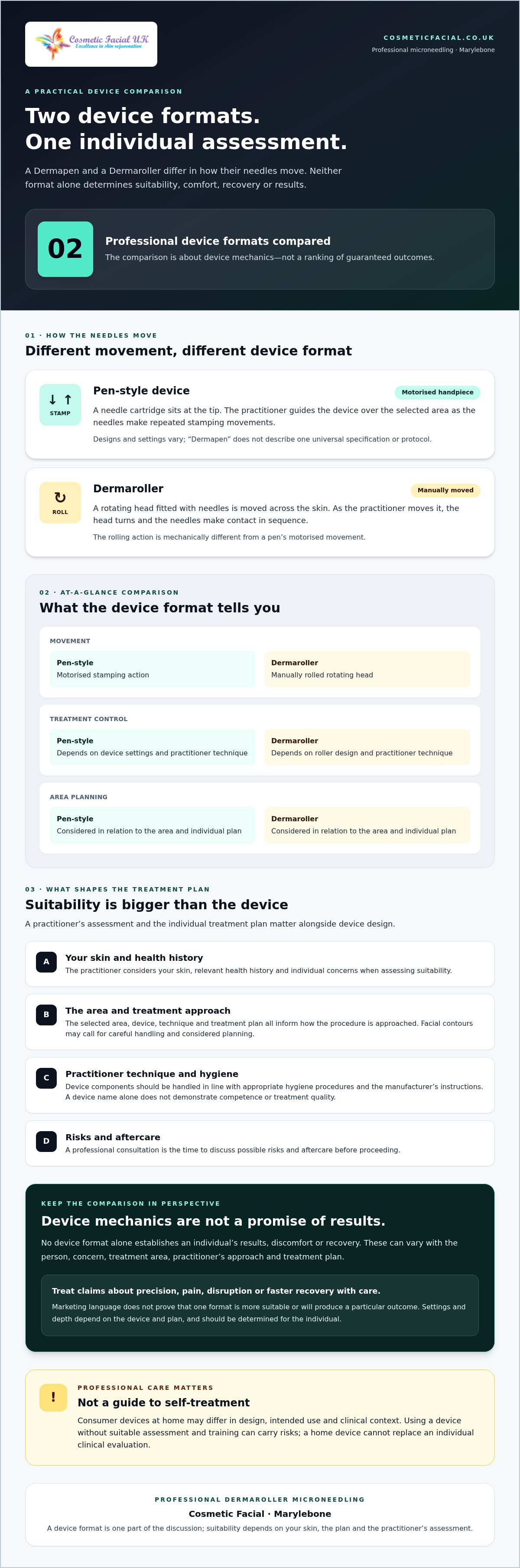
A pen uses a motorised handpiece with a needle cartridge at its tip. The practitioner guides it over the selected area as the needles operate through the cartridge. Device designs and settings vary, so “Dermapen” doesn’t describe one universal specification or treatment protocol.
A Dermaroller has a rotating head fitted with needles. As the practitioner moves it across the skin, the head turns and the needles make contact in sequence. This rolling action differs from the pen’s motorised movement. Neither description establishes which format is more appropriate for a particular person or concern.
What does professional microneedling mean?
In a professional setting, treatment involves more than selecting a device. A practitioner considers the skin and relevant health history, discusses the person’s concerns, and assesses whether treatment is suitable and how it should be approached. The consultation is also the time to discuss possible risks and aftercare before proceeding.
Hygienic clinical practice is part of the treatment context. The device and its components should be handled in line with appropriate hygiene procedures and the manufacturer’s instructions. A pen or roller alone doesn’t demonstrate practitioner competence, careful assessment or treatment quality.
Professional treatment is different from using a consumer microneedling device at home. Similar-looking tools don’t necessarily have the same design, intended use or clinical context. This comparison isn’t a guide to self-treatment: using a device without suitable assessment and training can carry risks, and a home device can’t replace an individual clinical evaluation.
In the dermapen vs dermaroller professional comparison, keep the distinction clear: device format explains how the tool moves, while suitability depends on your skin, the treatment plan and the practitioner’s assessment. Consider those factors alongside the treatment area and your priorities, rather than treating a device name as a guarantee of quality or outcome.
How Dermapen and dermaroller techniques differ in professional practice
The main practical difference is how the needle head moves across the skin. A pen-style device is motorised and makes repeated stamping movements as the practitioner guides it over an area. A Dermaroller is moved manually, with its cylindrical head rotating as it travels. These are differences in mechanics, not guarantees of different results.
Device movement may inform how a practitioner approaches different facial areas. For example, the contours around the nose or jawline can call for careful handling and a considered plan. A device’s design can be part of that discussion, but it doesn’t prove that one format is easier to use on a particular area or will produce a specific outcome.
Movement, control and treatment areas
Pen devices may have adjustable settings, depending on the model, whilst roller devices use a rolling head. The level of control depends on the device, the practitioner’s technique and the treatment plan. Treat claims that one device is inherently more precise with care: marketing language doesn’t establish that it is more suitable for you or produces better results.
| Consideration | Pen-style device | Dermaroller |
|---|---|---|
| Movement | Motorised stamping action | Manually rolled rotating head |
| Treatment control | Depends on device settings and practitioner technique | Depends on the roller design and practitioner technique |
| Area planning | Assessed in relation to the area and individual plan | Assessed in relation to the area and individual plan |
Device choice is one factor in microneedling. Suitability, practitioner technique and the individual treatment plan also matter. The benefits of microneedling are often discussed in general terms, but general information about the procedure doesn’t prove that a specific device will deliver a particular outcome.
Does the device determine results, discomfort or recovery?
No device format can establish what results, discomfort or recovery an individual will experience. These can vary with the person, the concern and area being treated, the practitioner’s approach and the treatment plan. Claims that a pen is less painful, causes less disruption or leads to faster recovery than a roller need reliable comparative evidence relevant to the devices and protocol in question.
Depth and other settings depend on the device and plan. The practitioner should determine what is appropriate for the individual, rather than relying on a general setting or an advertised capability. Treat claims about needle depth, tissue effects, comfort and recovery as specific to the treatment being discussed, not as universal differences between device types.
In a dermapen vs dermaroller professional discussion, ask how the proposed method relates to your skin concern, the treatment area and your expectations. If you’re considering professional Dermaroller micro-needling in Marylebone, find out more about Cosmetic Facial and discuss whether treatment is suitable for you.
Dermapen vs professional dermaroller: which considerations matter most?
A pen isn’t automatically the right choice for every patient. Device format is one part of a clinical decision, alongside the skin concern, treatment area, practitioner technique, hygiene and individual suitability. Comparing Dermapen and professional Dermaroller treatments is most useful when it helps clarify these factors, rather than turning the decision into a contest between devices.
Skin texture, acne scarring and fine lines may be worth discussing during an assessment, but having one of these concerns doesn’t mean microneedling is necessarily appropriate. Scars and pigmentation concerns can have different causes and characteristics, and the same procedure won’t suit every skin concern. For example, acne scar treatment considerations should be discussed in light of the type of scarring and the clinically appropriate options.
What should be assessed before recommending a method?
A practitioner should consider your current skin condition, what you hope to address and the area you’d like assessed. Relevant medical history and previous procedures also inform the discussion. If a concern is active, changing or complex, it may need clinical review before cosmetic treatment is considered. The aim is to establish suitability, not to choose a device based only on its advertised features.
Hygiene and the practitioner’s technique matter too. A device name can’t demonstrate that appropriate clinical practice is followed or that a particular approach suits your skin. Ask for a clear explanation of the proposed plan, why it is being considered, and the risks and aftercare expectations relevant to you.
| Consideration | What it means for the comparison | Evidence limitation |
|---|---|---|
| Skin concern | Texture, acne scarring or fine lines can be discussed individually. | A concern alone does not establish suitability or predict an outcome. |
| Treatment area | The area and its contours form part of treatment planning. | Device format alone does not prove one method is preferable for that area. |
| Technique and hygiene | Practitioner approach and hygienic practice matter alongside the device. | Marketing claims about precision do not establish clinical quality. |
| Personal circumstances | Skin condition, health history and previous procedures inform assessment. | General device comparisons cannot replace an individual review. |
In a dermapen vs dermaroller professional discussion, ask how the proposed method relates to your concern and circumstances, rather than which device is described as more advanced. Expected outcomes also need to be discussed individually; a device comparison can’t promise a result.
For a considered discussion of facial rejuvenation treatment options, a consultation can help clarify your goals, relevant history and whether professional Dermaroller micro-needling is suitable. Cosmetic Facial offers this treatment in Marylebone, London, with suitability assessed individually.
How to prepare for a professional microneedling consultation
A useful consultation gives the practitioner a clear picture of your skin, health history and expectations before a treatment plan is discussed. You don’t need to decide in advance whether you prefer a pen or roller. Assessment should come before device selection, because the appropriate approach depends on your skin and individual circumstances.
What information should you bring to an assessment?
Be ready to describe the concern you want to discuss, where it appears and what you hope to address. Share relevant medical history, medicines, allergies, previous procedures and current skin concerns, including recent changes. The practitioner can then decide whether further clinical assessment is appropriate before considering cosmetic treatment.
This checklist can help you organise the discussion:
- Describe your concern. Be specific about the area and whether you’re concerned about texture, acne scarring, fine lines or another feature.
- Explain your goals. Say what you hope to address, while recognising that treatment outcomes can’t be guaranteed.
- Share relevant health information. Disclose medical conditions, allergies and all medicines you use, including prescribed and non-prescribed products. Don’t stop or alter medication for a treatment without advice from the appropriate healthcare professional.
- List previous procedures. Mention past skin treatments and when they took place, as well as any current or recent cosmetic procedures.
- Raise current skin changes. Tell the practitioner about active irritation, breakouts, infection or other changes. They can advise whether these need assessment before a cosmetic procedure is considered.
- Ask about the proposed plan. Find out why a particular approach is being considered, what alternatives may be relevant and what factors could affect suitability.
What should you understand about recovery and risks?
Before deciding, ask the practitioner to explain possible reactions, the aftercare relevant to the proposed treatment and when to seek clinical advice. Recovery varies between individuals and treatment plans, so a fixed downtime estimate or universal aftercare rule may not apply to you. Risk and aftercare information should be relevant to the procedure being discussed.
Ask the practitioner to distinguish expected short-term effects from symptoms that need follow-up, and to explain how to access advice if you have concerns after treatment. Make sure you understand the plan before proceeding. If something is unclear, ask for it to be explained in plain terms rather than relying on general online advice or assumptions based on a device’s brand.
Bring notes if that helps you cover your questions. A considered discussion is more useful than arriving with a device already chosen, since the consultation should establish whether professional Dermaroller micro-needling is suitable for your needs.
Professional Dermaroller treatment in Marylebone: the next step
For anyone considering professional microneedling in London, Cosmetic Facial offers micro-needling with a Dermaroller at its Marylebone clinic. A consultation is an opportunity to discuss your skin concerns and whether this treatment may be suitable for you. Suitability is assessed individually, and treatment cannot guarantee a particular result.
What can you expect when discussing Dermaroller treatment?
The discussion can cover the area you’d like assessed, why you’re considering microneedling and any relevant health or skin history. Share previous procedures, current concerns and what you hope to address. These details help inform the assessment, but don’t determine the outcome in advance.
If treatment is considered appropriate, the practitioner can explain the proposed approach and relevant aftercare, and address your questions before you decide how to proceed. Ask how the plan relates to your skin and what limitations may apply. You don’t need to arrive having chosen a device based on advertising: the purpose of the discussion is to consider your needs in context.
That distinction matters in a dermapen vs dermaroller professional comparison. Understanding how each device is designed can help you discuss the options, but a general comparison can’t establish which method suits you. A clinical discussion connects the treatment being considered with your concerns, circumstances and expectations, without assuming one device is right for everyone.
Why does practitioner background matter?
Dr Faramarz Didar holds an MSc in Dermatology Skills and Treatment with Commendation from the University of Hertfordshire. He also has documented postgraduate training in non-surgical facial aesthetics and a General Practice qualification certified by PMETB. This is relevant professional background, but it shouldn’t be interpreted as certification for a particular microneedling device or a guarantee of treatment outcomes.
For a useful consultation, consider whether the discussion gives you a clear understanding of:
- How your skin concerns and relevant history inform the suitability assessment.
- Why Dermaroller micro-needling is being considered for your individual needs.
- What the proposed approach involves and what aftercare is relevant.
- What questions or concerns should be addressed before you decide.
Cosmetic Facial’s Marylebone clinic provides a London setting for a considered discussion about professional Dermaroller micro-needling. The focus is on understanding your concerns and assessing suitability, rather than making assumptions based on device names or marketing claims. Take time to understand the proposed plan and raise anything that remains unclear before deciding whether to proceed.
Take the next step at your own pace
The useful outcome of a dermapen vs dermaroller professional comparison isn’t choosing a device before discussing your skin. It’s knowing what to explore in a clinical conversation: whether microneedling suits your concern, what the proposed approach involves, and what limitations or alternatives to consider. An assessment may also indicate that waiting or considering another option is more appropriate.
Before deciding, reflect on whether the explanation addressed your priorities and whether you understand the proposed plan. You should feel able to ask about suitability, risks and aftercare, and to make a decision without pressure. A considered choice starts with clear information that relates to your circumstances, not a device claim or a promise of a particular outcome.
With the right questions and a measured discussion, you can decide whether to take the next step. To discuss professional Dermaroller micro-needling in Marylebone, explore treatment options with Cosmetic Facial.
Frequently Asked Questions
Is Dermapen better than a professional dermaroller?
Neither device is universally better for every patient. A pen and a roller work differently, but the appropriate option also depends on your skin concern, treatment area, technique and individual assessment. In a dermapen vs dermaroller professional discussion, ask why a particular approach is being considered for you. A device’s name or advertised features can’t guarantee better results or establish that treatment is suitable.
Can a professional dermaroller help with acne scars?
Microneedling may be discussed for some acne-scar concerns, but it isn’t suitable for every scar or every person. The appearance and extent of scarring can affect which options are appropriate. A practitioner should assess your skin and explain potential benefits, limitations and risks without promising improvement. If acne is still active, or you’re unsure what is causing a skin change, seek clinical advice before pursuing a cosmetic procedure.
Does professional microneedling hurt?
Sensation varies between individuals and may depend on the treatment area, technique and personal sensitivity. No device can be assumed to provide a pain-free experience, and comfort can’t be guaranteed. Ask what sensations you might notice and how comfort will be managed during the proposed treatment. If you have a history of skin sensitivity or are concerned about discomfort, include this in your assessment.
How many professional microneedling sessions will I need?
There isn’t a session number that applies to everyone. The plan depends on the concern being considered, your skin’s response and the practitioner’s assessment. Ask how progress would be reviewed and what factors might lead to a change in plan. Be cautious of a fixed course or guaranteed timeline offered without reference to your circumstances. You should understand the proposed schedule and its limitations before deciding whether to proceed.
Can microneedling be performed on sensitive or reactive skin?
Sensitive or reactive skin doesn’t automatically determine whether microneedling is suitable. The cause and current state of the reaction matter. Tell the practitioner about irritation, diagnosed skin conditions, allergies and any current treatment, including relevant skincare products. If your skin is inflamed or the concern is unexplained, seek appropriate clinical advice before considering a cosmetic procedure. The practitioner can assess whether further review is needed before discussing treatment.
Is professional microneedling different from using a device at home?
Yes. Professional microneedling is considered in a clinical context, with assessment of your skin and discussion of the method, suitability and aftercare. Consumer devices have different purposes and shouldn’t be treated as interchangeable with professional treatment. This comparison isn’t a guide to using a device on yourself. If you’re considering treatment, discuss your concern with a qualified practitioner rather than attempting skin-needling based on online instructions or device marketing.
When can I return to my usual skincare after microneedling?
The timing depends on the treatment, your skin’s response and the practitioner’s instructions, so there’s no universal schedule. Before leaving the clinic, ask which products or activities are relevant to your aftercare and when to resume your usual routine. If your skin response concerns you, ask what signs should prompt you to seek clinical advice. Don’t apply general online recommendations to your recovery without discussing them with your practitioner.
Disclaimer
All content on cosmetic Facial website, including blogs, graphics, logos, images, and software, is the property of CosmeticFacial UK or its content suppliers and is protected by applicable copyright laws. Unauthorized use, reproduction, distribution, or modification of any content without prior written permission is strictly prohibited.


