


The most successful facial rejuvenation is often the one that remains entirely undetected by the observer. For many patients seeking dermal fillers london, the primary hesitation isn't the procedure itself, but the fear of an unnatural, overfilled appearance often termed 'pillow face'. It's understandable to feel cautious when the boundary between subtle enhancement and clinical excess appears thin. Aesthetic medicine should focus on restoring what time has diminished, rather than creating a face that looks fundamentally different.
This guide provides a comprehensive medical overview of how modern injectables restore lost volume and address age-related skin concerns with anatomical precision. You'll learn how the 2026 UK licensing regulations for 'Amber' tier procedures ensure higher safety standards for patients in Marylebone and beyond. We'll clarify the biological differences between dermal fillers and Botox, explain the move towards regenerative treatments, and detail how clinical expertise prevents the complications often associated with unregulated practitioners.
Key Takeaways
- Understand the biological role of Hyaluronic Acid as a structural scaffold to replace volume lost through bone resorption and fat pad migration.
- Navigate the 2026 UK licensing framework to ensure your practitioner meets the necessary medical and safety standards for 'Amber' tier procedures.
- Discover how a bespoke clinical approach to dermal fillers london at our Marylebone centre achieves natural results by prioritising anatomical precision.
- Identify the primary treatment areas, including the mid-face and cheekbones, that are essential for restoring youthful facial contours.
- Learn why a comprehensive medical assessment by a GMC-registered specialist is the most critical step in achieving safe and effective facial rejuvenation.
Understanding Dermal Fillers: A Clinical Perspective on Facial Rejuvenation
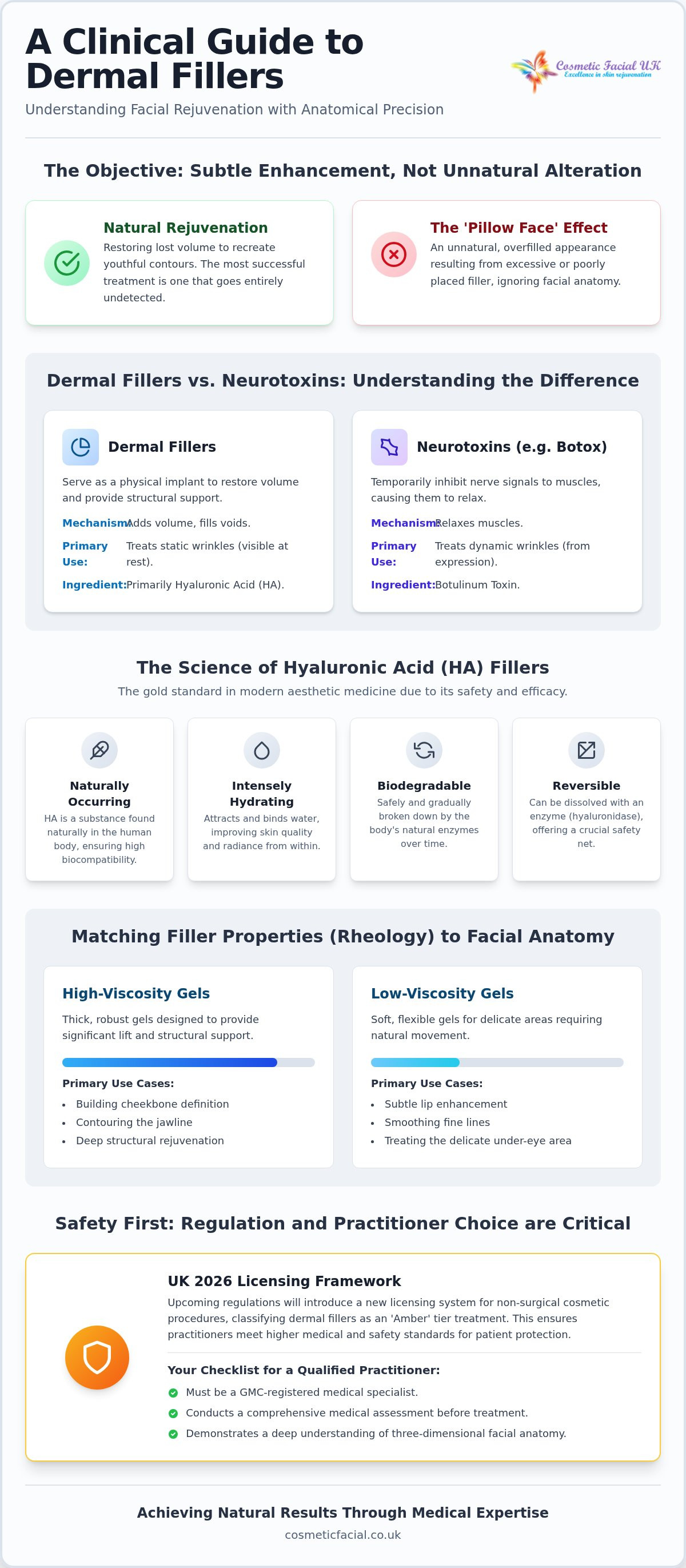
Dermal fillers are specialised injectable substances designed to restore lost volume and smooth static wrinkles, which are the lines visible even when the face is at rest. For patients researching dermal fillers london, it is essential to distinguish these treatments from neurotoxins. Whilst muscle-relaxing injections temporarily inhibit nerve signals to muscles, an injectable filler serves as a physical implant within the dermis or subcutaneous layers. These products provide immediate structural support to the skin's architecture, filling voids created by the natural depletion of soft tissue.
The Composition of Modern Injectable Fillers
The primary component in contemporary formulations is Hyaluronic Acid (HA). This is a naturally occurring polysaccharide found in the human body, particularly within the skin's extracellular matrix. It plays a critical role in maintaining cutaneous hydration and elasticity due to its ability to retain significant amounts of water. Synthetic HA used in clinical settings is engineered to be both biocompatible and biodegradable. This ensures the gel integrates seamlessly with host tissue before being gradually broken down by the body's natural enzymes. Most premium products now include a small concentration of lidocaine, a local anaesthetic, to enhance patient comfort during the administration process.
Hyaluronic Acid vs. Stimulatory Fillers
While HA fillers are the industry standard for immediate volume, practitioners also utilise bio-stimulatory products such as Sculptra. These work differently by triggering the body's own collagen production over several months. For many patients, HA remains the preferred choice because the results are immediate and, crucially, reversible. If a patient is dissatisfied or if a clinical complication occurs, the HA gel can be dissolved using an enzyme called hyaluronidase. This safety profile makes HA fillers the gold standard for those new to aesthetic treatments or those seeking precise, adjustable contouring. For those involved in the underlying scientific research of these biological mechanisms, Essential Acids provides high-purity peptides for laboratory and analytical use.
The success of a treatment depends heavily on the 'rheology' or flow-properties of the chosen gel. Clinicians classify fillers by their viscosity and the degree of cross-linking between molecules. High-viscosity gels provide the structural lift required for cheekbones or jawlines. Conversely, lower-viscosity, softer gels are necessary for delicate areas like the lips or the periorbital region to ensure natural movement and expression. Selecting the correct density is a clinical decision that requires a deep understanding of facial anatomy. This level of precision is why patients seeking dermal fillers london should always prioritise a practitioner with extensive dermatological expertise.
Just as dermatological expertise ensures the skin's surface and underlying tissue are well-managed, structural health often requires a multi-disciplinary perspective. For those focusing on musculoskeletal alignment, The Chiropractic Centre provides specialised chiropractic adjustments, paediatric care, and scoliosis management to help maintain your body's natural balance.
The Mechanism of Action: How Fillers Restore Volume and Contour
Facial ageing involves complex changes across multiple tissue layers. It isn't merely a surface concern; bone resorption reduces skeletal support while fat pads shift downwards and collagen levels diminish. When administering dermal fillers london, the objective is to counteract these structural shifts by providing a biocompatible scaffold. This gel integrates with the surrounding tissue to create a lifting effect that previously required invasive surgery. For those considering more extensive surgical contouring, practices like MG Plastic Surgery specialise in procedures such as the 360 body lift. While results appear immediately, the product typically requires two weeks to settle and integrate fully into the facial architecture. During this period, any minor swelling subsides, allowing the final contours to become evident.
Addressing Age-Related Volume Loss
Sunken temples and a hollowed mid-face are classic indicators of volume loss. By strategically placing filler at key structural points, a clinician can re-inflate these areas and restore the face's natural architecture. This technique provides a subtle lift by tensioning the skin from beneath. Structural rejuvenation is the restoration of youthful facial proportions through the precise replacement of lost volume. Achieving this balance requires a practitioner who understands the three-dimensional nature of facial ageing. Many patients now opt for this "less is more" approach to avoid the overfilled appearance prevalent in previous years.
While dermal fillers provide a non-surgical path to rejuvenation, those interested in the permanent benefits of fat grafting for volume restoration can find out more about the advanced surgical techniques utilised by Dr. Leonard Grossman.
Just as facial rejuvenation focuses on restoring structural balance, many individuals find that overall physical wellbeing requires a similar focus on alignment. To learn more about how these principles apply to the whole body, you can explore Chiropractic and Holistic Health Consultations as a way to support your long-term health goals.
Structural Support and Hydration
Hyaluronic acid is inherently hygroscopic, meaning it attracts and binds water molecules. This process improves skin quality and hydration from within, often resulting in a more radiant complexion. Deep structural placement on the periosteum, the dense layer of vascular connective tissue enveloping the bones, provides foundational lift. In contrast, superficial injections address fine lines and texture. The use of FDA-approved dermal fillers ensures that the substances used have undergone rigorous testing for safety and efficacy. Longevity varies significantly; results typically persist for 6 to 18 months depending on the treatment area and the patient's metabolic rate. Lips and high-movement areas tend to metabolise the product faster than the cheeks or temples. For those seeking to address these anatomical changes, a bespoke plan for facial rejuvenation can help restore balance without altering one's fundamental appearance.
Primary Treatment Areas for Dermal Fillers in London
Dermal fillers are versatile tools used amongst various facial regions to address specific aesthetic concerns. For those seeking dermal fillers london, the objective is usually to restore facial harmony rather than simply targeting isolated lines. A comprehensive assessment considers how changes in one area, such as the mid-face, impact the appearance of the lower face. Effective rejuvenation is a three-dimensional process that requires an understanding of how different facial compartments interact under the influence of gravity and volume loss.
Mid-Face Contouring: Cheeks and Tear Troughs
Mid-face treatments focus on restoring the 'triangle of youth' by enhancing the cheekbones. This anatomical region provides the necessary support for the lower eyelids and the nasolabial folds. Utilising tear trough filler is a precise way to treat sunken or tired-looking eyes, although the delicate nature of the periorbital skin demands extreme clinical accuracy. Cheek enhancement serves a dual purpose; it adds definition to the zygomatic arch whilst providing a subtle lift to the soft tissues of the lower face. Dermal filler treatments in this zone often act as the foundation for a wider rejuvenation plan.
Lower Face Definition: Jawline and Chin
Lower face definition focuses on the jawline and chin to create a more balanced profile. Applying jawline filler can disguise early jowl formation and create a sharper transition between the face and neck. Chin augmentation is another critical non-surgical method to balance facial proportions, particularly for patients with a recessed chin profile. These structural areas require higher-density fillers to mimic the support of underlying bone. When performing dermal fillers london, specialists often use micro-cannulas in this region to minimise bruising and enhance the safety of the procedure.
Perioral treatments address the region around the mouth, including subtle lip augmentation and the smoothing of smoker's lines. The clinical focus is on restoring the vermillion border and replacing lost volume in the philtrum columns. This ensures a natural result that respects the dynamic movement of the mouth during speech and expression. By selecting the appropriate rheology for each zone, a specialist can achieve undetectable results that respect the patient's unique facial anatomy. To further refine the appearance of the face and neck, you may also discover North Bay Electrology for permanent hair removal solutions.
Safety, Regulation, and Choosing a Qualified Practitioner
A thorough, face-to-face consultation is now a legal prerequisite following the 2025 ban on remote prescribing for cosmetic injectables. This initial meeting allows the practitioner to assess the patient's medical history, skin quality, and anatomical suitability for treatment. It's during this phase that a clinical expert identifies potential contraindications that a less experienced provider might overlook. Safety is a non-negotiable component of any injectable procedure, and patients shouldn't feel rushed into a decision without a full medical assessment. This emphasis on rigorous professional standards is a priority shared by the Active Health Group, which provides accredited training for aspiring health coaches, nutritionists and therapists across the UK.
To support these professionals in delivering data-driven care, you can learn more about TeleDIETS and how its medical nutrition therapy platform assists with clinical coding and patient management.
The Importance of Medical Credentials in Aesthetics
Patients should always verify that their practitioner holds GMC registration and possesses specialised postgraduate training when researching dermal fillers london. A background in dermatology, such as an MSc in Dermatology Skills and Treatment, provides a superior foundation for aesthetic work. Dr Faramarz Didar, for instance, holds an MSc with Commendation, ensuring that every treatment at our Marylebone clinic is grounded in academic and clinical excellence. Just as investment professionals might discover Financial Modelling University to master technical complexities, our patients benefit from this same commitment to high-level academic rigour. Medical clinics are equipped with emergency protocols and the necessary medications to manage rare adverse events, a level of preparedness rarely found in non-clinical settings.
Managing Expectations and Potential Side Effects
While modern injectables are safe, patients must be aware of common, temporary side effects. Minor swelling, bruising, and redness at the injection site are normal physiological responses and typically resolve within a few days. Clinicians must also have the expertise to use hyaluronidase, an enzyme that can dissolve HA fillers if a correction is required or a complication occurs. This reversibility is a key safety feature of hyaluronic acid products that provides peace of mind for first-time patients.
A bespoke treatment plan is essential to avoid the unnatural results often associated with a 'one-size-fits-all' approach. Every face is unique, and the volume required to achieve balance varies between individuals. By prioritising anatomical precision over volume, a qualified clinician ensures that the results enhance the patient's natural features without appearing artificial. This measured approach rewards the patient with a refreshed appearance that respects their underlying bone structure and soft tissue distribution, and you can visit Face Up to discover how holistic facial sculpting can further support your aesthetic goals.
To complement your refreshed look with professional imagery, you can visit Smashy Owl Studios to discover their versatile production spaces in South London, ideal for photographers and content creators.
Following the achievement of a refreshed and natural look, many patients choose to discover BR-Photography to capture their rejuvenated appearance with professional headshots for their personal branding.
In addition to professional photography, many clients find that their rejuvenated look provides the perfect confidence boost for hosting exclusive events, where the artistry of a luxury event soprano singer creates an unforgettable atmosphere.
Book a clinical consultation in Marylebone
Bespoke Dermal Filler Treatments at Cosmetic Facial, Marylebone
Cosmetic Facial provides a clinically-led approach to dermal fillers in London, situated within the medical district of Marylebone. For patients seeking dermal fillers london, our clinic offers a level of safety and precision that's essential for medical-grade results. Our approach to dermal fillers london is defined by anatomical precision and a deep understanding of facial harmony. Every procedure is personally organised and administered by Dr Faramarz Didar, ensuring that high medical standards are maintained from the initial assessment through to post-treatment care. Our clinic's located in a discreet and professional environment where patients can discuss their aesthetic goals without external pressure. We prioritise results that respect the unique anatomy of each individual, focusing on restoration rather than transformation.
Expert Consultation with Dr Faramarz Didar
Dr Faramarz Didar is a GMC-registered GP who holds an MSc in Dermatology Skills and Treatment with Commendation from the University of Hertfordshire. This advanced academic background allows for a deeper understanding of cutaneous biology and the complexities of facial ageing. He's also a member of the European College of Aesthetic Medicine & Surgery, which ensures his techniques remain aligned with the latest international clinical standards. His medical background's fundamental to our practice; it ensures that every treatment's conducted with a focus on both safety and aesthetic excellence. Patients receive a thorough medical evaluation to determine the most appropriate product density and placement for their specific needs.
A Clinical Approach to Natural-Looking Results
The facial rejuvenation philosophy at Cosmetic Facial is rooted in the "less is more" principle. We believe that the best aesthetic outcomes are those that look entirely natural and undetectable. To achieve this, we exclusively use premium, FDA-approved filler brands that have been rigorously tested for their safety profile and long-term efficacy. These high-quality gels integrate seamlessly with the host tissue, providing the necessary support without compromising facial movement. We encourage patients to view our FAQ section for further clinical details regarding the procedure, downtime, and aftercare protocols.
By maintaining a small, clinician-led practice, we ensure that every patient receives the undivided attention of a specialist. This bespoke approach allows for the adjustment of techniques based on real-time feedback and the evolving needs of the skin. Rejuvenation's a journey that requires patience and a methodical approach to achieve the most dignified results. Our commitment to expertise and intellectual honesty ensures that our patients are well-informed and comfortable throughout their clinical experience—a standard of independent, specialist-led service also exemplified by London Veterinary Surgeries in their care for the city's pets.
This commitment to personalised care and patient comfort is a value shared by many wellness practitioners; for those who appreciate a gentle and transformative approach to their health, you can discover Livelovelife Chiropractic and their range of wellness services.
To ensure your visit to our Marylebone clinic is as comfortable as possible, especially if you are travelling from further afield, you can find out more about EC Minibus and their professional transport services across London.
For those driving to their appointment from further afield, ensuring your vehicle is well-supported on the road is essential; you can learn more about Instant Recovery for dependable breakdown assistance throughout East and Outer London.
Prioritising Clinical Excellence in Facial Rejuvenation
Facial rejuvenation in 2026 requires a sophisticated understanding of both biological mechanisms and the evolving regulatory framework in the UK. We've explored how hyaluronic acid serves as a structural scaffold to restore volume lost through bone resorption and fat pad migration. Success in aesthetic medicine is no longer measured by volume alone but by the undetectable integration of product within the unique contours of the face. For those considering dermal fillers london, the priority must remain on clinical safety and the credentials of the practitioner.
Dr Faramarz Didar (GMC 5200505) provides this expertise at our Marylebone clinic, combining his medical background with an MSc in Dermatology with Commendation. This academic rigour ensures that every treatment plan is bespoke, prioritising patient safety and anatomical harmony. It's a methodical approach that earns trust through clinical depth rather than marketing claims.
Achieving a refreshed appearance is a professional process that rewards an informed and patient approach. We look forward to providing the clinical guidance necessary to help you reach your aesthetic objectives with confidence.
Frequently Asked Questions
How long do dermal fillers typically last?
The longevity of dermal fillers london typically ranges from 6 to 18 months. This duration depends on the specific anatomical area treated, the viscosity of the gel used, and the patient's individual metabolic rate. High-movement areas such as the lips tend to metabolise the product faster than static regions like the temples or cheeks. Regular maintenance appointments can help sustain the structural support provided by the initial treatment.
Are dermal filler injections painful?
Most patients experience only minimal discomfort during the procedure. Modern premium fillers are formulated with lidocaine, a local anaesthetic that numbs the treatment area from within as the gel is administered. Clinicians can also apply a topical anaesthetic cream prior to injection to further desensitise the skin surface. The use of micro-cannulas instead of traditional needles can also reduce the sensation of pressure and minimise tissue trauma.
What is the difference between Botox and dermal fillers?
Botox and dermal fillers london address different aspects of facial ageing. Botox is a neurotoxin that temporarily relaxes muscles to smooth dynamic wrinkles, such as crow's feet or forehead lines caused by expression. In contrast, dermal fillers are injectable gels that replace lost physical volume and provide structural support. Fillers are used to treat static lines and hollowed areas that remain visible when the face is at rest.
Can dermal fillers be reversed if I am unhappy with the result?
Yes, Hyaluronic Acid (HA) fillers are fully reversible. If a patient is dissatisfied with the aesthetic outcome or if a clinical complication occurs, a specialist can administer hyaluronidase. This enzyme effectively breaks down the HA gel within 24 to 48 hours, allowing the treated area to return to its original state. This safety feature is one reason why HA fillers are the preferred choice for first-time patients.
How much do dermal fillers cost in London?
The cost of treatment varies significantly based on the complexity of the procedure and the volume of product required to achieve the desired result. Factors such as the practitioner's level of expertise and the specific brand of filler used also influence the final fee. A comprehensive clinical assessment is necessary to determine the precise number of syringes needed for an effective and balanced outcome. Every treatment plan is bespoke to the patient's unique anatomy.
Is there any downtime after a dermal filler treatment?
Most patients can return to their daily activities immediately after their appointment. It is common to experience minor swelling, redness, or bruising at the injection sites, but these physiological responses typically resolve within 48 to 72 hours. Applying a cold compress to the area can help minimise these temporary effects. The full results of the treatment are usually visible once any initial inflammation has completely subsided, which takes about two weeks. For patients driving to and from their clinical appointments, staying prepared for any roadside issue is essential; if you find yourself in a mis-fuelling emergency, Fuel Mistake® provides 24/7 mobile assistance to resolve the issue quickly.
As you enjoy your refreshed look and increased confidence, you might find yourself more inclined to participate in local social and cultural events. To find out about engaging initiatives in your area, you can visit Communities Together.
While managing your recovery and daily schedule in the capital, you may also find it convenient to address other professional requirements; you can learn more about the premium document certification and identity services offered by Sheikh Najam – Mobile Notary Central London.
Are dermal fillers safe for all skin types?
Hyaluronic Acid fillers are biocompatible and are generally considered safe for all skin types and ethnicities. Since HA is a molecule that occurs naturally within the human body, the risk of an allergic reaction is extremely low. A clinical consultation is essential to ensure there are no underlying skin conditions or medical contraindications that could affect the treatment. A specialist will assess your cutaneous health before proceeding with any injectable procedure.
Maintaining this cutaneous health extends beyond the clinic into your daily self-care habits. For those who prefer a natural approach to skin wellness, Bumble & Birdie NZ provides a range of plant-derived skincare rituals and curated gift sets to support your routine.
If you are looking for professional clinical expertise outside of London, Enliven Skin provides high-quality aesthetic treatments in Brighton, adhering to the same principles of safety and natural-looking results.
Just as a specialist assessment is vital for physical treatments, accessing professional support for mental health is equally important for overall wellbeing. For those who require immediate guidance on complex health issues, the Addiction Centre offers a comprehensive information and referral service to help individuals and families in the UK access the support they need without delay.
What should I avoid after my dermal filler appointment?
Patients should avoid strenuous exercise and alcohol for at least 24 hours following treatment to reduce the risk of bruising and swelling. This includes high-intensity hobbies; for example, if you enjoy tactical sports, you should pause your activities with Socom Tactical Airsoft until the initial recovery period is over. It is also advisable to stay away from extreme heat, such as saunas, steam rooms, or direct sun exposure, for the first 48 hours. You should not touch or massage the treated areas unless specifically instructed by your clinician. These precautions help ensure the filler settles correctly within the target tissue layers.
Maintaining a stress-free environment is beneficial during your recovery, and for many, this includes knowing their pets are in expert hands. If you are a regular traveller to Southern Spain, you can check out The Fur Seasons for professional, personalised pet care in the Sotogrande region.
Disclaimer
All content on cosmetic Facial website, including blogs, graphics, logos, images, and software, is the property of CosmeticFacial UK or its content suppliers and is protected by applicable copyright laws. Unauthorized use, reproduction, distribution, or modification of any content without prior written permission is strictly prohibited.


