


A growth that looks like a wart isn’t always one, and that distinction matters before treatment. If you’ve searched “cryotherapy for warts london”, first consider whether the lesion has been assessed and whether freezing is an appropriate option for it.
It’s understandable to want to know what cryotherapy involves, including possible discomfort, blistering and visible skin changes afterwards. Warts are generally harmless and may resolve without treatment, so the decision should reflect the diagnosis and your circumstances, not an assumption that freezing is always needed.
This guide explains how wart cryotherapy works, what may influence suitability and treatment planning, and how it compares with topical treatments. It also suggests questions to raise about possible effects and aftercare, without promising a particular result or number of sessions. Cosmetic Facial offers cryotherapy, wart and verruca removal, and dermatology consultations at its Marylebone clinic, where you can discuss a skin growth and possible next steps.
Key Takeaways
- Have a skin growth assessed before destructive treatment, particularly if its identity is uncertain or it is changing.
- Ask how freezing is applied, what skin responses may follow and whether review could be recommended.
- Compare cryotherapy with topical treatments by considering the setting, clinician involvement and your individual suitability.
- Use a consultation to clarify the diagnosis, likely process and aftercare before deciding whether treatment is right for you.
- Cosmetic Facial offers cryotherapy and wart and verruca removal at its Marylebone clinic in London.
Cryotherapy for warts in London: what the treatment is and why diagnosis matters
Cryotherapy uses cold to treat selected skin lesions. The technique can vary, so the clinician should explain the method being considered during assessment. It is not suitable for every skin growth: the first step is to identify what is being treated.
Warts are associated with human papillomavirus (HPV), which affects the skin. But not every bump or thickened patch is a wart. Searching for cryotherapy for warts london can help you find a treatment option, but general information cannot confirm the diagnosis of an individual lesion.
How a wart differs from other skin growths
Common warts can have a rough or thickened surface and may appear on the hands or feet, although appearance and location vary. The Wart overview describes different types and causes, but appearance alone may not establish what a particular growth is. Other skin lesions can look similar, so seek clinical assessment when you are unsure of the diagnosis.
This matters because cryotherapy deliberately treats tissue with cold. If a growth has not been confidently identified, treating it as a wart without assessment may be inappropriate. A clinician can consider its appearance and context, then discuss whether wart treatment is suitable or whether further assessment is needed.
Why London patients may seek clinic-based wart treatment
A clinic appointment gives you the opportunity to discuss the growth before choosing a treatment. Assessment can help clarify whether it appears consistent with a wart, whether cryotherapy is a reasonable option and what factors may affect the decision. You can also describe any changes or concerns and understand the next step without assuming that freezing is necessary.
Cosmetic Facial is located in Marylebone and offers cryotherapy, wart and verruca removal, and dermatology consultations. For people seeking a private dermatologist consultation in London, a consultation provides a setting to discuss diagnostic uncertainty before a procedure is considered.
Seek clinical assessment before destructive treatment if a lesion is changing, looks unusual to you or has not been identified. This is a cautious step, not a reason to assume that an ordinary skin change is serious. The aim is to base a treatment decision on the lesion itself, rather than a label inferred from appearance or an online description.
How wart cryotherapy works and what treatment may involve
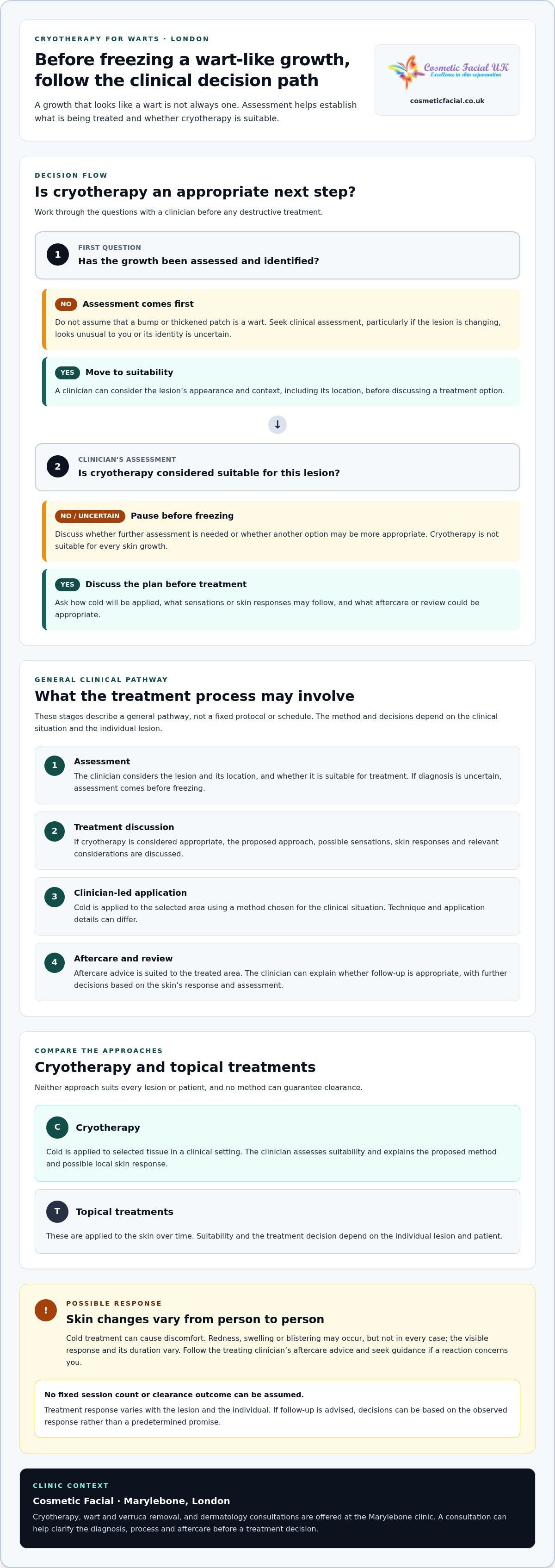
Cryotherapy applies cold to selected tissue. For wart treatment, the cold is intended to damage the targeted tissue and prompt a local skin response. Methods can vary between clinical settings, so the approach used at Cosmetic Facial should be explained as part of the treatment discussion rather than assumed from the term “cryotherapy”.
The stages below describe a general clinical pathway, not a fixed protocol or schedule. For background on freezing for common warts and possible side effects, see Mayo Clinic on Cryotherapy for Warts.
- Assessment: The clinician considers the lesion and its location, and discusses whether it is suitable for treatment. If the diagnosis is uncertain, assessment comes before freezing.
- Treatment discussion: If cryotherapy is considered appropriate, the clinician explains the proposed approach and discusses possible sensations, skin responses and relevant considerations.
- Clinician-led application: Cold is applied to the selected area using the method chosen for the clinical situation. Application details can differ, so don’t assume one technique or duration applies to every case.
- Aftercare and review: The clinician gives advice suited to the treated area and explains whether follow-up is appropriate. Further decisions depend on the skin’s response and clinical assessment.
What happens during a cryotherapy appointment
The appointment begins with an assessment and discussion of whether treatment is suitable. If treatment proceeds, the clinician explains the planned approach before applying cold to the selected lesion. Equipment, application method, appointment length and treatment schedule are not universal. They depend on the clinical approach and the individual lesion, so a general description cannot predict every appointment.
Possible sensations and short-term skin changes
Cold treatment can cause discomfort, and the treated skin may show a local reaction afterwards. Redness, swelling or blistering are possible, but they do not happen in every case. The visible response and its duration vary. Follow the treating clinician’s aftercare advice, and seek guidance if a reaction concerns you rather than relying on a generic online schedule.
Treatment response is not guaranteed. A lesion may respond differently depending on its characteristics and the individual. Don’t assume a fixed number of treatments or a particular clearance outcome. If follow-up is advised, decisions can be based on the observed response rather than a predetermined promise.
If you are considering cryotherapy for warts london, a discussion at Cosmetic Facial’s London clinic can help you understand the option in relation to your lesion and its clinical assessment.
Cryotherapy versus other wart treatments in London: how to compare options
Choosing a wart treatment involves more than comparing speed or convenience. Cryotherapy applies cold to selected tissue in a clinical setting, while topical treatments are applied to the skin over time. Neither approach suits every lesion or patient, and no method can guarantee clearance. NICE guidance identifies topical salicylic acid as a first-line option for warts. A clinician can discuss whether that or a procedure is appropriate in an individual case.
| Factor | Topical treatment | Cryotherapy |
|---|---|---|
| Setting | Usually applied by the patient, following product or clinician instructions. | Delivered in a clinical setting by a clinician. |
| Clinician involvement | May be recommended after assessment, with guidance on appropriate use. | Requires assessment of the lesion and clinician-led treatment. |
| Convenience | Can involve repeated applications as directed, which requires consistency. | Involves attending a clinic; further review may be advised. |
| Suitability | Depends on the lesion, the person and whether the treatment can be used as directed. | Depends on the diagnosis, lesion characteristics and individual clinical factors. |
When treatment choice depends on the wart and the patient
Location, size, duration and confidence in the diagnosis can all inform treatment choice. A lesion in a sensitive or awkward area may call for a different discussion from one elsewhere. A longstanding or persistent growth may also affect the options considered. Age and relevant health factors can influence a clinician’s recommendation. These are considerations for individual assessment, not a checklist that determines suitability on its own.
If you are comparing cryotherapy for warts london, focus on whether the lesion has been assessed, what treatment involves and how its likely burdens fit your circumstances. Freezing may be uncomfortable, and the treated skin can react. Weigh those possibilities alongside the convenience and commitment of topical treatment, rather than dismissing them or treating them as inevitable.
Why one appointment may not settle the decision
A clinician may recommend a review if the response is unclear or the lesion remains, then consider whether to continue, change approach or reassess the diagnosis. There is no fixed session count that applies to everyone. Treatment response and recurrence are also different issues: an initial response does not establish whether a lesion will return, and choosing one method over another cannot rule out recurrence.
A useful comparison is individual, not a promise about which treatment will work best. Discuss the expected process, possible discomfort, follow-up and alternatives before deciding. This allows the plan to reflect both the lesion and your preferences, without assuming that cryotherapy or topical treatment is universally superior.
Choosing wart cryotherapy in London: questions to consider before treatment
A considered decision starts with assessment, not a treatment preference. Before choosing cryotherapy, make sure you understand what the lesion may be, why freezing is being considered and what the next steps could involve. Use the questions below to make a consultation more focused and avoid assuming that every wart-like growth should be treated in the same way.
Questions to discuss during a clinical assessment
Describe how long you have noticed the lesion, where it is, whether it has changed and what treatment, if any, you have already tried. Mention relevant health information and raise concerns about discomfort or visible skin changes. These details provide context, but the clinician’s assessment determines whether cryotherapy is appropriate.
- Diagnosis: What features support the view that this is a wart, and is any further assessment needed before treatment?
- Suitability: How do the lesion’s location and characteristics affect the options being considered?
- Expected response: What local skin reactions or discomfort may occur, and how will the response be assessed?
- Aftercare: What advice applies to this treated area, and which changes should prompt a review?
- Next steps: If the lesion does not respond as expected, what options or reassessment might be considered?
You don’t need to arrive with a preferred procedure. These questions are intended to clarify the reasoning, possible responses and follow-up, not to predict a result or treatment schedule.
When a wart-like lesion needs medical assessment first
If you are uncertain what a growth is, or it is changing, bleeding or causing unusual symptoms, seek medical assessment before any destructive treatment. Don’t try to freeze an undiagnosed lesion at home: treating the wrong type of growth can delay appropriate assessment. Cosmetic Facial offers dermatology consultations alongside cryotherapy and wart and verruca removal, providing a clinical setting to discuss diagnostic uncertainty.
For cryotherapy for warts london, practical planning can also make an appointment easier to manage. Cosmetic Facial is in Marylebone. Before attending, consider your route, allow time for your journey and note any relevant history or previous treatments to discuss. Travel arrangements depend on your starting point, so plan accordingly.
Use the checklist to decide what you need clarified before proceeding. A suitable plan should reflect the assessment, the lesion and your circumstances, with clear advice about aftercare and any recommended review. If uncertainty remains, address it before treatment rather than treating visual resemblance as a confirmed diagnosis.
Wart cryotherapy at Cosmetic Facial in Marylebone: your London next step
Cosmetic Facial offers cryotherapy and wart and verruca removal at its clinic in Marylebone, London. These services provide a local option for people considering treatment, but a wart-like appearance alone does not establish that freezing is appropriate. The decision should take account of the clinical findings and your circumstances, including the lesion’s location and history.
What the clinic information can help patients understand
Knowing that cryotherapy and wart and verruca removal are available helps you identify a relevant service to discuss, rather than assume that every skin growth should be treated in the same way. Suitability depends on what the lesion is and its particular features. If its identity is uncertain, clarify that before considering a procedure.
Dr Faramarz Didar was awarded an MSc in Dermatology Skills and Treatment with Commendation by the University of Hertfordshire on 14 July 2015. This qualification provides context for the clinic’s dermatology experience, but it does not promise a particular treatment outcome. Results cannot be guaranteed, and no fixed number of sessions should be assumed.
Before making an enquiry, it may help to note what you would like clarified. For example:
- Whether the growth needs assessment before treatment is considered.
- How its position or characteristics may affect the options discussed.
- What skin response and aftercare advice may be relevant in your case.
- Whether the clinician recommends review or another approach.
These points can help focus the discussion without requiring you to decide in advance that cryotherapy is right for you. If a lesion is changing, bleeding or otherwise uncertain, prioritise medical assessment rather than treating it as a confirmed wart.
How to take the next step in Marylebone
If you are exploring cryotherapy for warts london, you can review Cosmetic Facial’s clinic information and make an enquiry through its website. Consider your journey to Marylebone and allow for your own travel arrangements. An enquiry gives you a way to discuss the service and the questions you want addressed, without committing to a particular treatment outcome or schedule.
A measured next step is to explain what prompted you to seek treatment and ask what assessment and options are relevant. The clinical discussion can then be guided by the lesion and your circumstances, rather than an assumed diagnosis or a guarantee of clearance.
Make your next step an informed one
Choosing cryotherapy for warts london is not simply a decision about freezing a skin growth. It is an opportunity to clarify what the lesion may be, whether treatment is appropriate and what the process could involve. A thoughtful discussion can help you weigh the available options against your priorities, without assuming a particular result.
Before making an enquiry, note any details you want to discuss, such as changes you have observed, previous treatment or concerns about aftercare. If you remain unsure about the diagnosis, make that the focus of your first conversation. Take time to understand the recommendation and decide what feels appropriate for you.
A clear, considered next step can make the decision feel more manageable. Take the time you need to make it with confidence.
Frequently Asked Questions
Is cryotherapy suitable for every type of wart?
No. Cryotherapy isn’t automatically suitable for every wart-like lesion or every patient. A clinician considers the diagnosis, the lesion’s site and relevant health factors before recommending treatment. For example, a growth on a sensitive area may call for a different discussion from one elsewhere. If you’re unsure what a skin growth is, make diagnosis the first point of your appointment rather than treating its appearance as confirmation.
Can wart cryotherapy be completed in one appointment?
Not necessarily. Whether further treatment or review is appropriate depends on the lesion and its response, so one appointment cannot be assumed to settle every case. Before treatment, ask what signs will be used to assess progress and how you’ll know if review is advised. If the growth changes or the diagnosis becomes uncertain, seek reassessment rather than arranging repeat treatment on the assumption that it remains a wart.
Does cryotherapy for warts hurt?
Temporary discomfort can occur, but people experience cold treatment differently. Sensation may depend on the treatment and the area involved, and any local skin response can vary too. If you’re concerned, tell the clinician before treatment so they can explain what may be relevant to your situation. Follow the aftercare advice you’re given, and seek guidance if your skin’s response causes concern.
Can I use an at-home freezing kit on a wart?
An at-home freezing product isn’t a substitute for confirming that a skin growth is a wart. Products intended for home use and clinical cryotherapy may differ, and self-treatment may be inappropriate for some lesions or sites. Don’t freeze a growth if you’re uncertain what it is, if it’s changing or if its symptoms concern you. Seek clinical assessment first so the decision is based on the lesion, not guesswork.
What happens if a wart bleeds, changes or does not respond to cryotherapy?
Arrange medical assessment rather than repeatedly treating a lesion that bleeds, changes or persists. These features don’t establish a diagnosis by themselves, but they warrant professional evaluation, particularly if the growth no longer looks or feels as it did before. A clinician can assess whether the original diagnosis remains likely and discuss an appropriate next step. Don’t assume that a wart-like appearance rules out another cause.
How much does cryotherapy for warts cost in London?
There isn’t one fee that applies to every clinic or case. Cosmetic Facial charges per visit for medically oriented treatments, including cryotherapy, with fees listed individually by treatment type. Cost is only one part of the decision: assessment and clinical suitability matter too. Avoid relying on an outdated price or assuming cost predicts treatment choice.
Are warts contagious after cryotherapy?
Cryotherapy doesn’t mean you can assume that any risk of transmission ends immediately. Warts are associated with human papillomavirus, and the effect of treatment on transmission cannot be reduced to a universal time period. Follow the aftercare guidance for your treated area and ask the clinician which precautions are relevant to your circumstances. Don’t infer that treatment guarantees either immediate non-contagiousness or a particular period of risk.
Disclaimer
All content on cosmetic Facial website, including blogs, graphics, logos, images, and software, is the property of CosmeticFacial UK or its content suppliers and is protected by applicable copyright laws. Unauthorized use, reproduction, distribution, or modification of any content without prior written permission is strictly prohibited.


