


The visible legacy of historic UV exposure often manifests as stubborn dyspigmentation and telangiectasia that standard topical serums fail to resolve. Many patients find that even the most sophisticated cosmetic concealers can't fully mask these persistent solar lentigines, which often contribute to an appearance of premature ageing. Seeking IPL for sun damage on face uk providers is a necessary step for those who prioritise clinical precision over superficial beauty interventions. At our Marylebone clinic, we treat solar damage as a complex dermatological condition that requires the calibrated energy of medical-grade light therapy rather than a generic aesthetic approach.
This clinical guide details the mechanism of Intense Pulsed Light and its role in modern photorejuvenation. You will gain a clear understanding of how targeted wavelengths fragment excess melanin and address facial redness under the supervision of a GMC-registered professional. We provide a thorough preview of the treatment process, from the initial diagnostic skin analysis to the final restorative results. By exploring the science of dermal repair and the safety standards required for amber-tier procedures, this article ensures you are fully informed before embarking on a professional rejuvenation plan in London.
Key Takeaways
- Understand how medical-grade Intense Pulsed Light employs selective photothermolysis to fragment dermal pigmentation and address visible solar damage.
- Compare the efficacy and recovery requirements of IPL against chemical peels and resurfacing lasers to identify the most appropriate rejuvenation strategy for your skin.
- Recognise the clinical necessity of a preliminary patch test to ensure skin compatibility and treatment safety at least 24 hours before your procedure.
- Learn why choosing IPL for sun damage on face uk within a medical setting ensures your treatment is overseen by a GMC-registered practitioner.
- Discover how bespoke rejuvenation plans are structured to target both vascular redness and pigmented lesions to achieve an even and restored skin tone.
Understanding Facial Sun Damage and the Role of IPL in the UK
Photo-ageing represents the clinical manifestation of chronic ultraviolet (UV) radiation exposure, a cumulative biological process that differs fundamentally from chronological ageing. Whilst natural ageing involves the gradual thinning of the skin, solar damage involves the profound structural alteration of the dermal matrix. UV radiation triggers the production of reactive oxygen species, which subsequently degrade collagen and elastin fibres. This degradation results in the characteristic appearance of leathery texture, deep rhytids (wrinkles), and dyspigmentation.
The temperate climate of the United Kingdom often creates a false sense of security regarding UV safety. Solar damage is prevalent across the British population because UVA radiation remains constant throughout the year and penetrates cloud cover with ease. Consequently, many patients in London develop significant photo-ageing through incidental exposure rather than intentional tanning. For those seeking IPL for sun damage on face uk, the objective is typically to address these long-term biological changes that topical creams cannot reach.
To better understand the clinical distinction between light-based therapies, watch this explanation by Dr Davin Lim:
Correcting deep-seated pigmentation requires a technology capable of bypassing the superficial epidermis to reach the chromophores (targets) within the dermis. Intense Pulsed Light (IPL) serves as a non-invasive corrective standard because it delivers broad-spectrum light across various wavelengths. This versatility allows the practitioner to target different depths and types of damage simultaneously, providing a comprehensive approach to skin restoration that standard skincare cannot replicate.
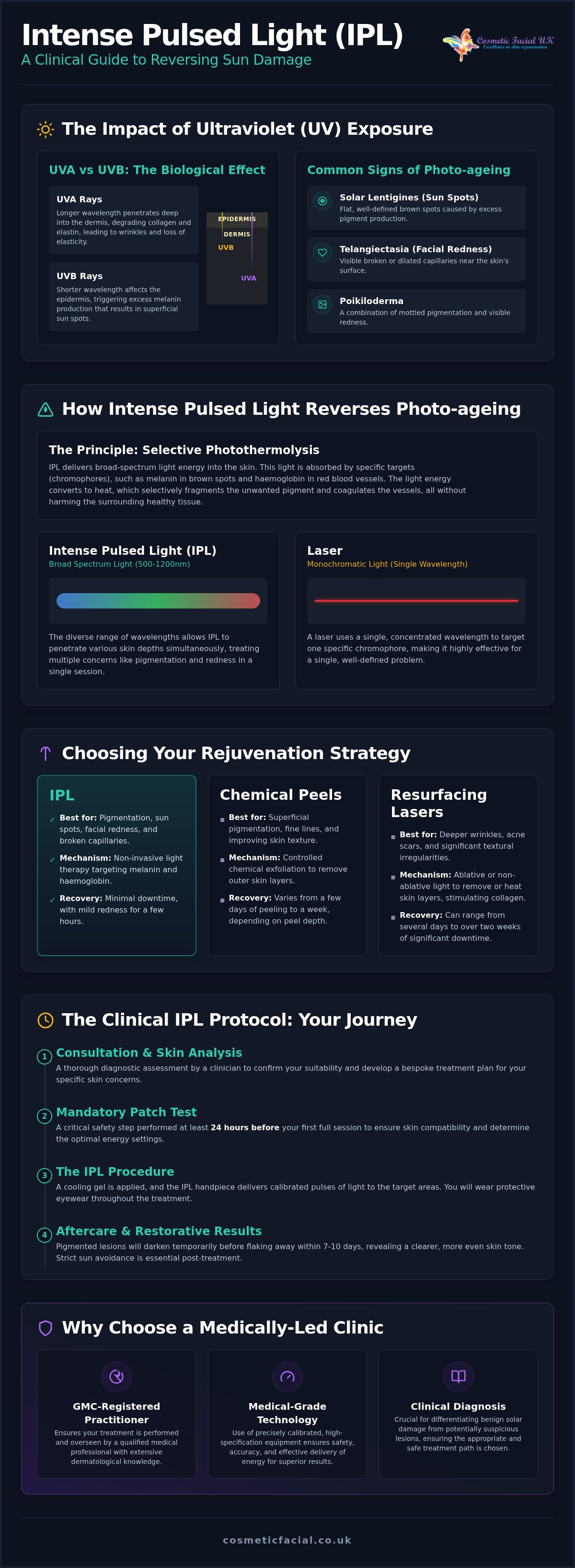
UVA vs UVB: The Biological Impact on British Skin
UVA rays possess a longer wavelength, allowing them to penetrate deep into the dermis where they cause significant damage to the skin's supportive scaffolding. This process, known as solar elastosis, leads to the loss of elasticity and the formation of fine lines. In contrast, UVB rays have a shorter wavelength and primarily affect the epidermis, triggering the melanocytes to produce excess pigment. This biological response results in superficial solar lentigines, commonly known as sun spots. London-based individuals often accumulate damage through incidental exposure whilst walking between buildings or sitting near windows, making year-round protection and corrective therapy essential.
Identifying Solar Lentigines, Redness, and Poikiloderma
Clinical identification is the first step in any rejuvenation plan. Solar lentigines appear as flat, well-defined brown spots, whilst poikiloderma of Civatte presents as a combination of mottled pigmentation and visible telangiectasia (broken capillaries), often on the neck and chest. It's vital to differentiate these benign lesions from suspicious moles or actinic keratoses. A professional private dermatology consultation is required to ensure that the chosen light therapy is safe and appropriate for the specific lesion type. IPL for sun damage on face uk is particularly effective because the light energy is absorbed by both the melanin in brown spots and the haemoglobin in red vessels, allowing for the simultaneous treatment of multiple signs of photo-ageing.
How Intense Pulsed Light Reverses Photo-ageing
The efficacy of Intense Pulsed Light (IPL) in treating solar damage resides in its ability to deliver a broad spectrum of wavelengths, typically ranging from 500nm to 1200nm. Unlike monochromatic laser therapy, which emits a single, concentrated beam of light, IPL uses a diverse range of light energies. This characteristic is clinically significant because it allows the light to penetrate various depths of the skin simultaneously. Different skin concerns, such as superficial sun spots and deeper vascular redness, exist at varying dermal levels. By utilising multiple wavelengths, the practitioner can address these distinct issues in a single session, making an IPL photofacial for photoaging a highly versatile corrective tool.
The fundamental process involves the conversion of light energy into thermal energy. When the light pulses are emitted, they are absorbed by specific targets in the skin known as chromophores. In the context of sun damage, these targets are primarily melanin (pigment) and haemoglobin (blood). The absorbed light energy creates a rapid rise in temperature within the target, causing controlled thermal damage. This process is highly precise; the surrounding healthy tissue remains unaffected because it does not absorb the light at the same intensity as the darker or redder lesions.
Selective Photothermolysis: Targeting Melanin and Haemoglobin
The IPL device is engineered to recognise the contrast between damaged pigment and natural skin tone. Selective photothermolysis is the foundation of modern photo-rejuvenation, utilising specific light pulses to thermally damage targeted tissue whilst preserving the integrity of adjacent structures. When treating solar lentigines, the light energy shatters the concentrated melanin clusters into microscopic particles. These fragments are then naturally processed and eliminated by the body's lymphatic system over the following weeks. For vascular issues, the heat causes the vessel walls to collapse and eventually be reabsorbed, resulting in a clearer, more uniform complexion.
Stimulating Neocollagenesis for Improved Skin Texture
Beyond the removal of visible spots, IPL provides a secondary biological benefit known as neocollagenesis. The gentle heating of the deeper dermal layers stimulates fibroblasts, the cells responsible for producing collagen and elastin. Patients seeking IPL for sun damage on face uk often report improvements in skin "crepiness" and a reduction in enlarged pore size as a direct result of this thermal stimulation. Over a course of treatments, the skin's structural scaffolding is reinforced, leading to enhanced radiance and a smoother surface texture. A detailed clinical assessment at our Marylebone clinic ensures that the device settings are precisely calibrated for your specific skin type and degree of solar damage.
IPL vs. Chemical Peels and Fractional Lasers: Which is Best?
Selecting the appropriate modality for solar damage requires an understanding of how different energies interact with the skin's architecture. Whilst ablative lasers remove the entire surface layer, Intense Pulsed Light (IPL) Therapy works beneath the epidermis to target specific chromophores without compromising the skin's surface. This makes it an exceptionally cost-effective option for broad-area rejuvenation, such as the full face, neck, or décolletage, where treating large surface areas with a laser might be prohibitively expensive or result in excessive recovery times. When considering IPL for sun damage on face uk, we evaluate your Fitzpatrick skin type to ensure safety; IPL is generally most effective on types I through IV. For patients with darker skin tones, the higher concentration of melanin in the surrounding tissue necessitates more conservative settings or alternative treatments to prevent adverse effects.
When to Choose IPL Over a Chemical Peel
The choice between light therapy and chemical peels often depends on whether the primary concern is pigment depth or surface texture. Peels excel at exfoliating the stratum corneum to improve fine lines and superficial dullness. However, they may not reach the deeper dermal melanin clusters that cause persistent brown spots. IPL is the preferred choice for busy London professionals because it offers a "no-downtime" solution. Unlike deep peels that require several days of visible peeling, IPL allows patients to return to their routine immediately. Long-term, repeated IPL sessions can also encourage dermal thickening through collagen stimulation, whereas frequent heavy peels might temporarily thin the skin barrier if not managed correctly.
Laser Resurfacing vs. Photo-rejuvenation: A Clinical View
Laser resurfacing and photo-rejuvenation serve distinct clinical purposes. A Fractional CO2 laser is typically required when the patient presents with deep solar elastosis, significant rhytids, or structural scarring that requires physical tissue displacement. These lasers create microscopic columns of thermal injury to force deep tissue remodelling and skin tightening. Conversely, IPL remains the "gold standard" for addressing vascular redness and rosacea, symptoms that CO2 lasers are not designed to treat effectively. The safety profile of IPL is also superior for sensitive facial areas, such as the skin around the eyes and nose, where the precision of broad-spectrum light can be tightly controlled to avoid collateral damage.
For many patients seeking IPL for sun damage on face uk, a combination approach yields the most natural results. By pairing IPL with other non-surgical interventions, we can address both the pigmentary and structural legacies of UV exposure. This methodical strategy ensures that each layer of damage is treated with the most effective technology available, resulting in a comprehensive restoration of skin health. For those considering complementary treatments such as Botox for a refreshed appearance, you can check out Monday Aesthetics & Consulting, PLLC to see how they achieve subtle, natural rejuvenation.
A successful clinical outcome depends on strict adherence to a structured protocol. In accordance with UK safety standards for light-based therapies, a patch test is mandatory at least 24 to 48 hours before the full procedure. This ensures the skin's biological response to the calibrated light energy is within expected clinical parameters. By testing a small area, the practitioner can verify that the energy levels are appropriate for your specific skin type and that there are no adverse reactions before treating the entire face.
Pre-Treatment Requirements for British Skin
Adherence to pre-treatment requirements is essential for safety. Patients must avoid both natural UV exposure and artificial tanning products for four weeks prior to treatment. This is critical because the IPL device can't distinguish between solar-damaged melanin and a superficial tan, which increases the risk of thermal injury. Retinoids and photosensitising medications should be discontinued seven days before the session. On the day of the procedure, the face must be thoroughly cleansed and free from all topical products, including serums and moisturisers.
During the treatment, the practitioner applies a chilled gel to the skin to facilitate light conduction and protect the epidermis. You'll experience a sensation often described as the rapid flick of an elastic band against the skin as the handpiece moves across the treatment area. Whilst some mild erythema, or redness, is expected immediately after the session, it's usually resolved within a few hours.
Managing the 'Coffee Ground' Effect: Post-Treatment Care
A unique aspect of IPL for sun damage on face uk is the "coffee ground" effect. Within 24 to 72 hours, targeted pigmented lesions will darken significantly. This micro-crusting occurs as the shattered melanin rises to the surface of the epidermis. It's a clear clinical sign that the treatment has successfully reached the intended chromophores. These dark specks may look prominent, but they indicate that the body is preparing to shed the damaged pigment.
It's vital that patients don't pick or exfoliate these areas. Natural sloughing must occur to reveal the restored skin beneath. This process usually completes within seven to ten days for facial treatments. Forcing the exfoliation can lead to scarring or post-inflammatory hyperpigmentation, which compromises the final result.
Post-treatment care requires absolute sun avoidance to protect the newly vulnerable skin. We mandate the use of a broad-spectrum SPF 50 daily, even in overcast London conditions. Mineral makeup and soothing, non-active moisturisers may be applied 24 hours after the procedure to manage any residual sensitivity. If you're concerned about the healing process, our clinical team is available to provide professional reassurance throughout your recovery.
Specialist IPL Treatment at Cosmetic Facial, Marylebone
Seeking IPL for sun damage on face uk often leads patients to a choice between high-street salons and clinical facilities. At Cosmetic Facial, we operate as a dedicated medical practice in the heart of Marylebone, providing a level of dermatological oversight that exceeds standard aesthetic expectations. Our proximity to Fitzrovia and the prestigious medical district ensures that patients receive care in a controlled, clinical environment. This setting is vital for the administration of high-energy light therapies, where precision is the primary factor in both safety and the successful reversal of solar damage.
We don't view light therapy as a standalone procedure. Instead, it's integrated into comprehensive full face rejuvenation plans tailored to each patient's unique dermal profile. By combining medical-grade IPL with bespoke skincare protocols, we ensure that the results achieved in the clinic are maintained and protected against future UV-induced degradation. This holistic approach focuses on long-term skin health rather than temporary cosmetic improvement.
Expert Oversight by Dr Faramarz Didar
The clinic is led by Dr Faramarz Didar, whose GMC registration (5200505) and MSc in Dermatology Skills and Treatment provide the foundation for our clinical protocols. This advanced academic background allows for a more nuanced approach to device settings. We don't rely on factory presets; we calibrate the IPL device based on a sophisticated understanding of skin physics and biological responses. For complex cases involving mottled pigmentation or vascular irregularities, this expert oversight is essential for avoiding complications such as thermal injury or suboptimal pigment clearance. We're committed to evidence-based medicine, ensuring every treatment is backed by established dermatological research and clinical excellence.
Booking Your Consultation in Central London
Your journey begins with a private skin analysis. During this initial assessment, we utilise diagnostic tools to map the extent of your solar damage and verify your suitability for light-based therapy. We understand that our Marylebone residents and London professionals require efficiency. Therefore, we offer streamlined online booking options to facilitate easy access to our specialist services. Preparing for your consultation involves a review of your current skincare regime and any previous light-based treatments to ensure the safest possible intervention.
Restoring Dermal Health through Clinical Photorejuvenation
Reversing the cumulative legacy of solar exposure requires a transition from superficial skincare to medical-grade light therapy. By employing selective photothermolysis, Intense Pulsed Light effectively fragments deep-seated melanin and collapses the visible vascular lesions that contribute to an aged appearance. This clinical approach ensures that IPL for sun damage on face uk is delivered with the precision necessary to achieve a uniform skin tone whilst preserving dermal integrity. The secondary benefit of neocollagenesis further assists in restoring the skin's structural resilience over time.
At our Marylebone clinic, every procedure is overseen by Dr Faramarz Didar, who leverages an MSc in Dermatology to ensure optimal energy settings and patient safety. We prioritise a methodical treatment journey, from the initial diagnostic analysis to the final restorative results. This commitment to clinical excellence, maintained within CQC-compliant standards, provides the reassurance that your skin health is managed by experts in the heart of London's medical district. Choosing a GMC-registered practitioner ensures that your rejuvenation plan is grounded in evidence-based medicine and professional accountability.
We look forward to assisting you in achieving a clearer and more resilient complexion through our specialised clinical protocols.
Frequently Asked Questions
Is IPL for sun damage painful during the procedure?
Most patients describe the sensation as a series of rapid, hot flicks, similar to the snap of an elastic band against the skin. While the procedure involves high-intensity light pulses, the application of a chilled conduction gel and the device's integrated cooling systems manage thermal discomfort effectively. It's generally well-tolerated without the need for topical anaesthesia. The sensation is momentary and subsides immediately after the handpiece moves to the next area.
How many IPL sessions will I need to see clear results?
A standard course typically consists of three to six sessions, spaced approximately four weeks apart, to achieve optimal pigment clearance. While initial improvements in skin radiance are often visible after a single treatment, cumulative sessions are required to address deeper dermal damage and stimulate neocollagenesis. The exact number depends on the severity of the solar damage and the patient's biological response. We determine a specific schedule during your initial clinical skin analysis in Marylebone.
Can IPL be used on all skin types for pigmentation?
IPL is most effective and safest for individuals with Fitzpatrick skin types I to IV. Patients with darker skin tones (types V and VI) have a higher concentration of epidermal melanin, which can absorb the light energy indiscriminately. This increases the risk of thermal injury or post-inflammatory hyperpigmentation. For these cases, we often recommend alternative interventions like chemical peels or specialised laser therapies that offer greater pigment selectivity for darker dermal profiles.
What happens if I have IPL and then go in the sun?
Unprotected UV exposure following IPL for sun damage on face uk significantly increases the risk of complications, including blistering and permanent pigmentary changes. The treatment leaves the skin temporarily vulnerable as it undergoes the repair process. We mandate the use of broad-spectrum SPF 50 and physical sun avoidance for at least two to four weeks post-procedure. Failure to adhere to these aftercare protocols can compromise the results and trigger new solar damage.
How long do the results of a photo-rejuvenation treatment last?
The longevity of results depends largely on subsequent UV protection and the patient's lifestyle. While IPL effectively removes existing solar lentigines and vascular redness, it doesn't prevent the formation of new damage if the skin is exposed to the sun without protection. Most patients maintain their clearer complexion for twelve to eighteen months. We recommend annual maintenance sessions and a medical-grade skincare regime to sustain the structural and pigmentary improvements achieved at our London clinic.
Are there any side effects of IPL for sun damage on the face?
Common side effects include transient erythema (redness) and mild oedema (swelling), which typically resolve within twenty-four hours. As discussed in previous sections, the "coffee ground" effect is an expected clinical response where pigmented spots darken before sloughing off. Rare complications can include crusting or temporary bruising if the energy settings are high. Choosing a GMC-registered practitioner ensures that these risks are minimised through precise device calibration and thorough pre-treatment screening.
Can I wear makeup immediately after my IPL session?
We advise patients to wait at least twenty-four hours before applying traditional cosmetic products to the treated area. This allows the skin's barrier to stabilise and prevents potential irritation from fragrances or preservatives. If coverage is essential, mineral-based makeup is generally acceptable as it's non-comedogenic and lacks harsh chemicals. It's vital to apply and remove any products gently to avoid disrupting the micro-crusting pigment as it begins the natural exfoliation process.
Is IPL better than laser for removing brown age spots?
IPL is often considered the superior choice for broad-area facial rejuvenation because its multi-wavelength light can target both melanin and haemoglobin simultaneously. While lasers use a single wavelength for deep, targeted lesions, IPL's versatility allows it to treat various types of solar damage across a larger surface area in one session. This makes it a more efficient and cost-effective standard for patients presenting with a combination of sun spots, redness, and general photo-ageing.
Disclaimer
All content on cosmetic Facial website, including blogs, graphics, logos, images, and software, is the property of CosmeticFacial UK or its content suppliers and is protected by applicable copyright laws. Unauthorized use, reproduction, distribution, or modification of any content without prior written permission is strictly prohibited.


