


A non-surgical facelift is not one treatment, and it cannot reproduce the results of surgery. The best non-surgical facelift in London is an approach matched to the cause of facial ageing, whether that is volume loss, reduced skin firmness or a change in facial contour. Treatments can improve skin quality or create a visible lift, but the degree of change depends on the method and the features being treated.
It’s understandable to want a refreshed appearance without looking noticeably different. A liquid facelift uses injectable treatments to restore volume and support facial contours. Skin-tightening treatments work differently, targeting firmness rather than replacing lost volume. Combining approaches may be appropriate, but more filler is not always the answer and can contribute to an overfilled appearance.
This article explains what non-surgical facelifts can and cannot achieve, how liquid facelifts and skin-tightening treatments work, and what influences a natural-looking result. It also covers questions to consider before choosing an approach, so you can weigh the options and their limitations before making a decision.
Key Takeaways
- Non-surgical treatments can improve facial contours or skin firmness, but they work in different ways and do not reproduce surgical results.
- A liquid facelift uses injectable treatments to address concerns such as lost volume, jawline definition and wrinkles.
- A measured treatment plan can help maintain natural-looking proportions and reduce the risk of an overfilled appearance.
- Bruising, temporary bumps and redness may occur after treatment; the type of procedure affects what to expect during recovery.
- Understanding the difference between facial lifting and skin tightening can help you identify which approach best matches your concern.
Do non-surgical facelifts really work?
Yes, non-surgical treatments can improve facial contour, soften lines or tighten skin, depending on the concern. The best option depends on whether you want to address volume loss, movement-related wrinkles or skin laxity.
Facial areas treated
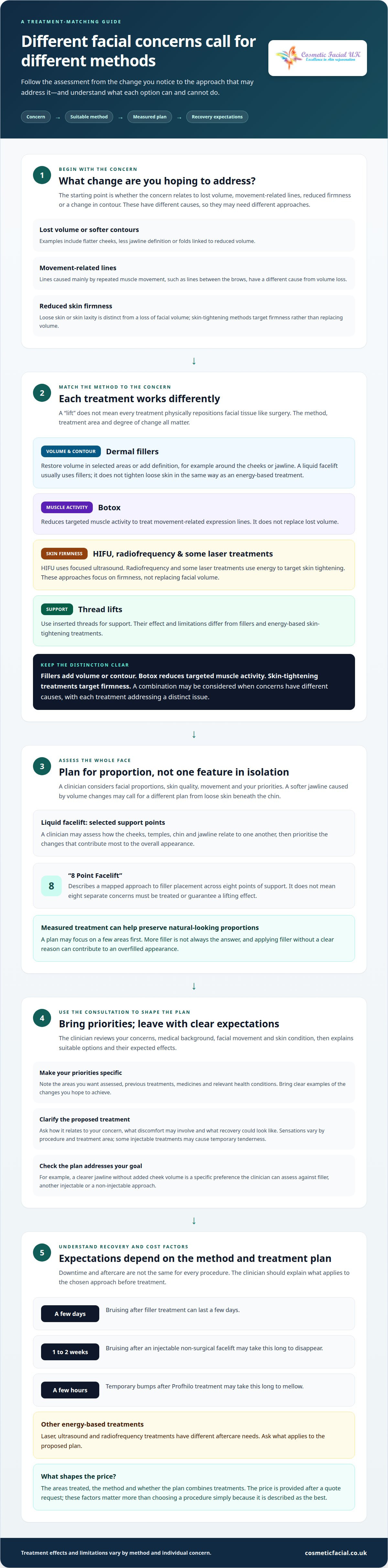
Different treatments address different concerns, so start by identifying the change you want to improve. Dermal fillers may add definition around the cheeks or jawline, while Botox targets movement-related lines, such as those between the brows. Skin-tightening treatments focus on firmness rather than replacing facial volume.
During a consultation, the clinician assesses facial proportions and skin quality alongside your priorities. A softer jawline caused by volume changes, for example, calls for a different plan from loose skin beneath the chin. A suitable treatment plan considers surrounding features, not just the area you notice first.
Comparing lifting treatments
HIFU uses focused ultrasound, while radiofrequency and some laser treatments use energy to target skin tightening. Thread lifts use inserted threads for support; fillers restore volume and can define contours. Botox relaxes targeted muscle activity, so it treats expression lines rather than replacing lost volume.
The best non-surgical facelift treatments in London depend on your concern, the treatment area and the degree of change you want. A combination may address more than one concern, but each method has different effects and limitations. The word “lift” does not mean that every treatment physically repositions facial tissue like surgery.
Personalised planning begins with a consultation. The clinician reviews your concerns, medical background, facial movement and skin condition, then explains suitable options and their expected effects. To prepare, note the areas you want assessed, previous treatments, medicines and relevant health conditions. Bring clear examples of the changes you hope to achieve.
Ask how each proposed treatment relates to your concern, what discomfort may involve and what recovery could look like. Sensations vary by procedure and treatment area; some injectable treatments may cause temporary tenderness. Bruising after filler treatment can last a few days, while bruising after an injectable non-surgical facelift may take 1 to 2 weeks to disappear.
Downtime depends on the method. Profhilo treatment can leave temporary bumps, which may take a few hours to mellow. Laser, ultrasound and radiofrequency treatments have different aftercare needs, so the clinician should explain what applies to your chosen plan before treatment.
Prices depend on the areas treated, the method and whether the plan combines treatments; the price is provided after a quote request. These factors matter more than choosing a procedure because it is described as the best. A clear consultation helps match treatment to your priorities and avoid paying for procedures that do not address them.
Non-surgical facial lifting describes an approach tailored to the areas and changes being assessed, rather than a single treatment suitable for everyone.
What's a liquid facelift?
A liquid facelift uses injectable treatments, usually dermal fillers, to restore volume in selected areas and refine contours. It is not a surgical facelift, and it does not tighten loose skin in the same way as an energy-based treatment. The aim is to address visible changes such as flatter cheeks, softer jawline definition or lines associated with volume loss.
Filler placement depends on facial structure and the concern being treated. Carefully placed filler may add definition along the jawline or support the cheeks, while treatment around the mouth may soften folds linked to reduced volume. Lines caused mainly by repeated muscle movement have a different cause, so Botox may be considered instead of adding filler.
Full-face rejuvenation does not mean treating every area. A clinician assesses how the cheeks, temples, chin and jawline relate to one another, then identifies which changes contribute most to your overall appearance. Treating one area can affect facial balance elsewhere, so a plan may prioritise structural support before addressing smaller lines or contour changes.
An “8 Point Facelift” describes a mapped approach to facial filler placement across eight points of support. The aim is to use those points as part of an overall assessment, rather than treating eight separate concerns automatically. The exact placement and amount depend on the individual face; the name alone does not specify a suitable plan or guarantee a lifting effect.
For a liquid facelift, dermal fillers may be placed at selected points to improve support, restore volume or define contours. The clinician considers tissue movement, facial proportions and your preferred degree of change. A measured plan can focus on a few areas first, rather than applying filler across the face without a clear reason.
Fillers and Botox serve different purposes. Fillers add volume or contour, while Botox reduces targeted muscle activity. Combining them may be considered when both volume loss and movement-related lines are concerns, but each treatment should address a distinct issue. A well-explained plan makes clear which feature each injection is intended to change and why the combination is appropriate.
During a consultation, describe the changes you notice and the result you want, such as a clearer jawline without added cheek volume. The clinician can assess whether filler, another injectable or a non-injectable approach best fits that goal. This keeps facial rejuvenation focused on proportion and the areas that need attention.
Explore facial rejuvenation options to consider how dermal fillers may fit into a personalised treatment plan.
Natural-looking results and avoiding overfilling
Natural-looking results depend on proportion, treatment choice and the degree of change planned. Dermal fillers can restore volume, but adding more product does not automatically create a better lift.
Natural-looking results
A balanced plan starts with the feature being treated, not a target amount of filler. For example, a clinician may assess cheek support before considering definition around the lower face. This helps keep changes in proportion to surrounding features. A staged approach can also make the effect easier to assess before considering further treatment.
Overfilling can make facial contours look heavier or less consistent with your natural features. When planning treatment, agree which areas matter most and what degree of change feels appropriate. The aim is not to remove every line or restore all lost volume, but to address specific concerns without losing facial character.
Before-and-after results
Before-and-after photographs can help illustrate changes in facial contour, volume or lines. Compare images taken from similar angles and with similar expressions, as a different pose or lighting can alter how a jawline or cheek appears. Look at the treated area and the overall facial balance, rather than judging change by one feature alone.
Use photographs as a discussion aid during consultation, not as a promise that your result will match someone else’s. Facial anatomy, starting volume and treatment choices differ. Agreeing which features should change, and which should remain unchanged, gives the clinician a clearer reference for planning.
Longevity varies with the injectable used and the area treated. Injectable results last 4-6 weeks, while Profhilo results can last up to six months in most cases. These are different treatments, so their durations should not be treated as interchangeable or as a single maintenance schedule.
Maintenance should follow the visible effect and original treatment plan, not an automatic calendar. At review, assess whether the initial concern has returned, whether facial balance remains suitable and whether further treatment is appropriate. This supports measured decisions instead of adding filler simply because time has passed.
A non-surgical approach avoids surgery, but “non-invasive” does not mean there are no recovery considerations. Bruising after filler treatment can last a few days, and downtime varies by treatment and individual response. Allow for this when planning an event, and follow the aftercare instructions for your procedure.
To keep results proportionate, discuss your preferred outcome before treatment, then reassess the effect before considering additional volume. This makes it easier to distinguish a genuine remaining concern from an expectation of further change.
How is it possible to lift the face non-surgically?
Non-surgical treatments change facial appearance through different mechanisms, including restoring volume or supporting collagen. Recovery also varies: injectable treatments can cause bruising or bumps, while energy-based procedures have their own aftercare needs.
A consultation may suit people seeking a measured change in contour or skin firmness. Anyone expecting the degree of tissue repositioning achieved through surgery should understand that non-surgical treatments do not provide that result. A clinician considers health history, skin condition and the treatment target before planning.
Recovery depends on the method and treatment area. Bruising after filler treatment can last a few days. Bruising after an injectable non-surgical facelift may take 1 to 2 weeks to disappear, so plan around events where visible marks would be unwelcome.
Profhilo can leave small bumps at injection points; allow a few hours for them to mellow down. After Morpheus8 treatment, avoid makeup so the skin can breathe. These examples show why aftercare instructions should match the specific procedure, rather than being assumed to apply to every treatment.
Preparation can reduce avoidable bruising. Avoid alcohol for 48 hours before treatment, as it could increase bruising. After treatment, avoid alcohol and exercise for a couple of days. Follow the instructions provided for your procedure, since recovery advice varies between injectables and energy-based treatments.
Redness, tenderness or temporary swelling can occur after facial procedures, but the expected pattern depends on the technique and area treated. A treatment plan should explain which reactions are expected, how to care for the area and what changes call for prompt clinical advice. This makes recovery expectations specific rather than generic.
Minimal downtime does not mean every treatment produces an immediate lift. Injectable results depend on placement and the concern addressed; treatments intended to stimulate collagen work differently. The visible effect and its timing vary by method, so the clinician should explain what to expect before treatment.
For example, someone addressing mild skin laxity has a different goal from someone seeking restored cheek volume. Matching the method to that goal helps set realistic expectations about appearance, recovery and degree of change. A clear treatment plan also explains whether a combination is appropriate or one approach is sufficient.
Non-surgical facial lifting and skin tightening
Facial lifting and skin tightening address related but different changes. Fillers restore volume in selected areas, while energy-based approaches target skin firmness. Start by identifying the change you want, such as a softer jawline, better cheek support or firmer-looking skin.
HIFU uses focused ultrasound, radiofrequency applies controlled energy, and laser treatments use light-based technology. These approaches are not interchangeable: each targets different concerns and tissues. Someone concerned about skin laxity, for example, may discuss a tightening treatment, while someone noticing flatter cheeks may need an assessment of facial volume.
That distinction matters because lifting is not a single treatment effect. A procedure that enhances contour through volume does not necessarily tighten skin, and a skin-focused treatment does not replace lost volume. The practitioner should explain how the proposed method relates to the specific area and appearance you want to refresh.
Combination treatment may be considered when concerns have more than one cause. For instance, reduced cheek volume and laxity along the lower face may call for separate approaches. Planning should remain selective: treating every visible change can add unnecessary complexity without improving the feature that matters most to you.
Ask the practitioner to explain the treatment target, the expected type of change and how progress will be assessed. A clear plan distinguishes between contour, skin texture and firmness. It should also specify which areas will be treated and why, so you can understand how each step contributes to the overall result.
Before proceeding, discuss previous procedures, relevant health information and any concerns about recovery. The method affects aftercare: instructions following an injectable procedure differ from those for laser or radiofrequency. Understanding the steps in advance helps you plan around work, social commitments and any temporary visible effects.
In aesthetics, “non-surgical lift” describes a range of approaches, not one standard outcome. The change achievable depends on the treatment selected and the feature being addressed. Non-surgical methods do not reproduce a surgical facelift, so keep this distinction clear when setting facial rejuvenation goals.
A practical decision is to match the treatment to your primary concern first. Discuss volume-focused options for contour changes, or skin-tightening options for firmness. If both matter, ask how the practitioner would prioritise them and assess the result before adding further treatment.
Explore facial rejuvenation treatment options
Cosmetic Facial
Cosmetic Facial can help you consider which non-surgical approach best matches your facial concern and desired degree of change. A discussion of your priorities can distinguish movement-related lines, which may suit Botox Treatment, from concerns that call for a different approach. This is a useful next step if you understand the options but are unsure which addresses your main concern.
Bring specific points to discuss, such as which lines or areas affect your appearance and how subtle you want the result to be. This helps focus the conversation on treatment suitability, expected effects and relevant aftercare, rather than choosing a procedure by name alone.
Choose a next step that fits your priorities
Use your main concern to guide the next conversation: decide whether you want to address facial movement, skin laxity or contour. The best non-surgical facelift in London is not one treatment, but an approach matched to your features and preferred degree of change.
Cosmetic Facial offers Botox Treatment and HIFU Face Lift among its services, as well as IPL Hair Removal Treatment. A discussion can help clarify which treatment relates to your facial concern and what to consider before proceeding. If you’re weighing up options, identify the outcome that matters most to you.
A considered decision starts with a clear goal and a treatment plan that reflects it.
Frequently Asked Questions
Are treatments painful?
Discomfort varies with the procedure and the area treated. Injectable treatments involve needles, while energy-based procedures may cause sensations of heat or pressure. For Profhilo, numbing cream can be used. Tell the practitioner about previous reactions or concerns before treatment, and discuss what to expect during the appointment. This helps you plan calmly and understand which comfort measures are relevant to your procedure.
How do I know which treatment is right for me?
The right treatment addresses your main concern, rather than simply matching a popular procedure name. At consultation, describe the feature you want to change, such as expression lines when smiling or reduced jawline definition. The practitioner can assess facial movement, skin quality and volume, then explain which approach fits and what outcome it is designed to produce.
How long do results last?
Duration differs by treatment and product. Profhilo results can last up to six months in most cases, while injectable results last 4-6 weeks. These figures refer to different treatments and should not be used as a universal timetable. At a review, consider whether the original concern has returned and whether the visible result still suits your preferences before deciding on maintenance.
Is there any downtime?
Some people return to normal activities promptly, but temporary marks can affect plans. Filler-related bruising may last a few days, and bruising after an injectable non-surgical facelift may take 1 to 2 weeks to disappear. Profhilo can leave small bumps that mellow down over a few hours. Consider work or social events when choosing an appointment time, and follow the procedure-specific aftercare.
Are results immediate?
Some visible changes can appear immediately after treatment, but the result depends on the method. Cosmetic Facial describes its non-surgical cosmetic treatments as providing immediate visible results. This does not mean every treatment produces the same change at once. Injectable volume changes and skin-focused treatments work differently, so ask which effects may be visible immediately and which may develop later.
Are there any precautions I should take beforehand or afterwards?
Avoid alcohol for 48 hours before treatment because it could increase bruising. After treatment, avoid alcohol and exercise for a couple of days. After Morpheus8, avoid makeup to allow the skin to breathe. These precautions are specific examples, not a universal aftercare plan. Follow the instructions for your procedure and raise medicines, health conditions or previous treatment reactions during consultation.
Can I combine treatments for better results?
Yes, a treatment plan can combine approaches when they address separate concerns. For example, Botox targets movement-related lines, while dermal fillers address volume or contour. Combining them is not automatically better; each treatment should have a clear, complementary purpose. Ask the practitioner to explain what each procedure is intended to change and how the plan will maintain facial balance.
What results can you expect from each non-surgical facelift treatment, and how long do they last?
Botox targets movement-related lines, fillers add volume or definition, and HIFU, radiofrequency and laser treatments focus on skin tightening. Thread lifts provide support through inserted threads. Results and duration differ by method, treated area and individual facial features. Profhilo results can last up to six months in most cases; injectable results last 4-6 weeks. These durations do not apply equally to every treatment.
Disclaimer
All content on cosmetic Facial website, including blogs, graphics, logos, images, and software, is the property of CosmeticFacial UK or its content suppliers and is protected by applicable copyright laws. Unauthorized use, reproduction, distribution, or modification of any content without prior written permission is strictly prohibited.


