


The option that reaches deeper isn't automatically the better choice. For HIFU vs radiofrequency skin tightening, HIFU is generally associated with deeper lifting and contouring, while radiofrequency (RF) is used to support skin firmness, smoothness and texture. HIFU results may last 12-18 months; RF is more commonly delivered as a course, with maintenance treatments often spaced 3-6 months apart.
Both treatments can involve little downtime when used without microneedling, but RF microneedling has a different recovery profile because it punctures the skin. The right comparison depends on your main concern, the degree of skin laxity, your preferred treatment schedule and how much recovery time you can accommodate.
This article explains how HIFU and RF work, what to expect from results and recovery, and how to decide which approach may better suit your aims. It also distinguishes standard RF from RF microneedling, so you can compare like with like before considering a treatment.
Key Takeaways
- HIFU is generally associated with deeper lifting and contouring, while radiofrequency is often chosen to support firmness, smoothness and skin texture.
- Compare the treatment schedule as well as the goal: HIFU is commonly spaced further apart, whereas radiofrequency is often delivered as a course.
- HIFU results develop gradually over the following months and may last 12-18 months, although outcomes vary between individuals.
- Standard HIFU and radiofrequency usually involve minimal downtime; RF microneedling can cause redness and pinpoint marks for several days.
- Distinguish standard radiofrequency from RF microneedling when weighing your options, as the latter delivers energy below the skin surface using microneedles.
HIFU vs RF Skin Tightening: Which Is Better?
Neither treatment is universally better: the choice depends on whether lifting or skin quality is your priority. HIFU is associated with deeper lifting and contouring, while radiofrequency (RF) commonly supports firmness, smoothness and texture. For fine lines or acne scars, RF microneedling is another option, delivering energy below the skin surface through microneedles.
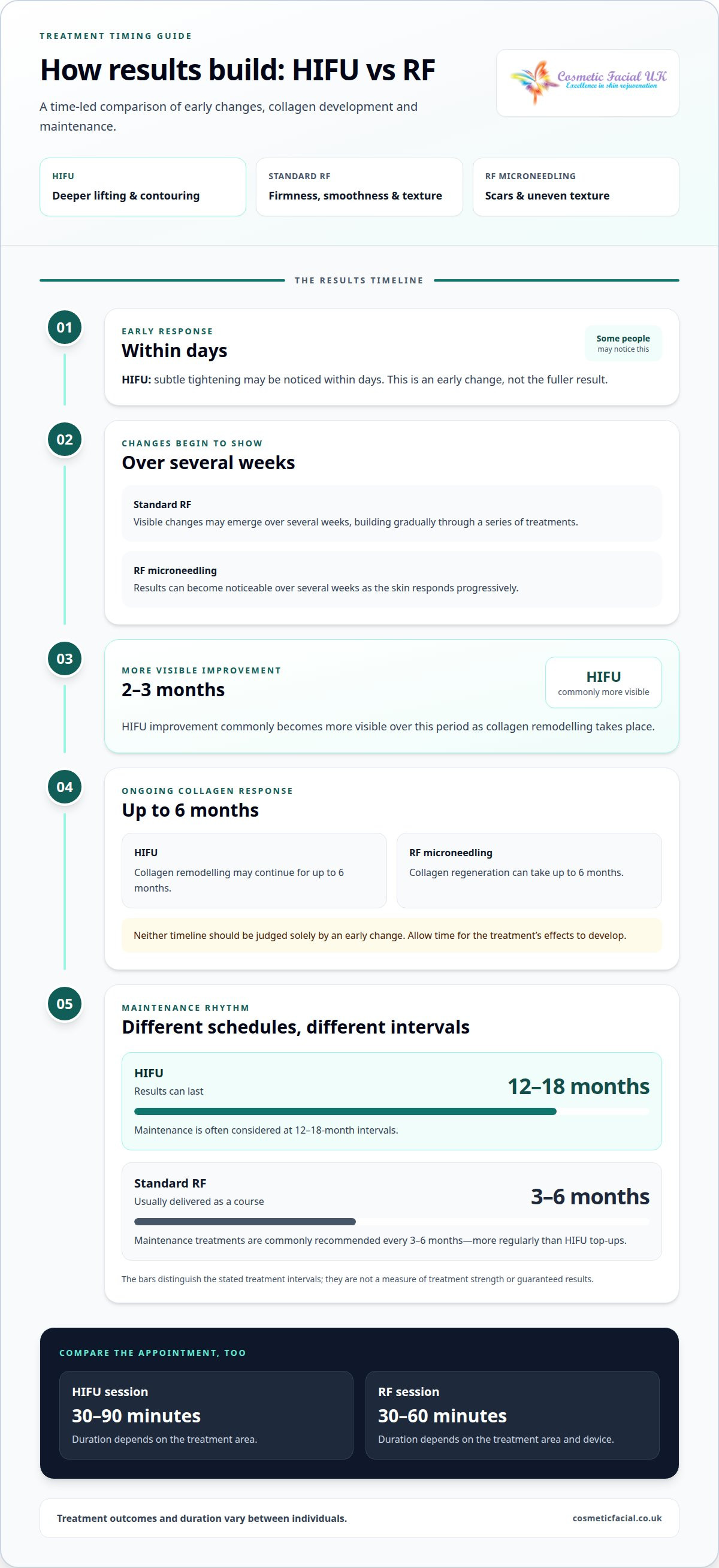
A HIFU or radiofrequency appointment begins with a consultation about your concerns, treatment area and skin condition. A session commonly lasts 30 to 90 minutes for HIFU, or 30 to 60 minutes for RF, depending on the area and device.
Clinic systems and home devices are not interchangeable. Professional HIFU and home HIFU differ in energy delivery, treatment protocols and intended use. Home devices are designed for controlled, repeatable use, not to replicate clinic treatment. Follow the device schedule and avoid unnecessarily layering energy treatments over the same area.
| Option | Typical focus | Schedule and recovery |
|---|---|---|
| Clinic HIFU | Deeper lifting and contouring | Often one session; minimal downtime is common |
| Clinic standard RF | Firmness, smoothness and texture | Often a course; usually minimal downtime |
| RF microneedling | Fine lines, acne scars and uneven texture | Redness may last a few days |
| Home energy device | Controlled, repeatable use | Follow the device schedule |
Safety planning matters as much as the device, and qualified practitioners rely on structured training to deliver treatments responsibly. While educational standards across the wider beauty and personal care sector are upheld through platforms such as EZceus, clinical consultations must always focus on individual suitability. A practitioner should explain the treatment method, intended target and relevant risks during consultation. HIFU may not suit skin with open wounds, severe acne or an active infection in the treatment area. RF skin tightening may be avoided during pregnancy as a precaution.
Ask how the practitioner assesses suitability and selects the device settings for your treatment area. HIFU cartridges can target depths of 1.5 mm, 3 mm or 4.5 mm; these settings should reflect the planned treatment, not a home-device assumption. Standard RF warms the skin, whereas HIFU delivers focused ultrasound energy. HIFU can cause temporary tenderness or puffiness; standard RF and HIFU generally involve minimal downtime. Follow the practitioner’s aftercare instructions for your specific treatment.
Choose HIFU when deeper lifting is the main aim, standard RF for gradual firmness and texture support, or RF microneedling when concerns include scars or uneven texture.
How long do HIFU vs RF results last?
HIFU and radiofrequency can address different concerns: HIFU is used for lifting on the face and neck, while RF supports firmness, fine lines and texture. RF microneedling can also treat scars or stretch marks on the face, neck, décolletage and body.
HIFU results and maintenance
HIFU results develop gradually as collagen remodelling takes place. More visible improvement commonly appears over 2 to 3 months, although some people notice subtle tightening within days. Collagen remodelling may continue for up to 6 months, and results can last 12-18 months. Skin quality, age and lifestyle influence duration, so maintenance is often considered at 12-18-month intervals.
This longer interval distinguishes HIFU from radiofrequency, which is usually delivered as a course and maintained more frequently. HIFU is generally chosen when lifting and facial contour are central concerns, rather than texture alone. Its effect is not immediate: allow time for collagen changes to develop before assessing the fuller result.
Radiofrequency results and maintenance
Standard RF treatments are commonly delivered in a series, building firmer-looking skin, smoother texture and improvement in the appearance of fine lines gradually. Visible changes may emerge over several weeks. Maintenance treatments are commonly recommended every 3-6 months, making the schedule more regular than HIFU’s typical top-up interval.
RF microneedling has a different timeline: collagen regeneration can take up to 6 months, with results becoming noticeable over several weeks. The treatment type and concern being addressed matter. Standard RF focuses on skin quality, while RF microneedling may address uneven texture, acne scars and mild to moderate laxity.
Lifting and skin-texture results
HIFU is associated with a more noticeable lifting effect because it targets deeper structural levels. It is commonly used for sagging and facial contour concerns, including the face and neck. Radiofrequency generally produces less lifting, but can support smoother texture, elasticity and firmness, particularly where looseness is mild.
Both methods stimulate collagen, but their results follow different patterns. HIFU’s gradual collagen remodelling can continue across several months; RF skin-tightening results typically build over a series of sessions. RF microneedling also works progressively, with fuller effects developing over weeks and months. Neither timeline should be judged solely by an early change.
For a useful comparison, identify the main outcome you want: contour and lift, or smoother, firmer-looking skin. Then consider whether a less frequent HIFU schedule or regular RF maintenance better fits your priorities. Treatment area also matters, since RF microneedling can be used beyond the face, including on the décolletage and body.
To consider the options alongside your specific skin concerns, review available treatment options before deciding on a suitable approach.
Downtime and recovery
Standard HIFU and radiofrequency (RF) skin tightening usually involve minimal downtime. Recovery differs if RF microneedling is used, because its needles puncture the skin. The treatment method therefore matters when planning work, social events or travel around an appointment. A non-surgical treatment is not a surgical facelift, and its recovery should not be confused with surgical recovery.
After HIFU, focused ultrasound energy may leave the treated area temporarily red, tingling or tender. These effects generally settle within a few hours to a couple of days. Some people experience mild puffiness or tenderness, even when there is little visible redness. This short-term response can occur as the deeper treatment area responds to energy.
Standard RF commonly produces a warm sensation during treatment and is generally described as gentler than deeper energy delivery. Temporary redness, slight swelling, sensitivity or tenderness can also occur. Mild bruising or numbness is possible but uncommon. With either standard treatment, the skin may feel different briefly, so follow the specific aftercare instructions provided for the treated area.
RF microneedling has a more noticeable recovery profile than standard RF. Redness commonly lasts a few days, while tiny pinpoint marks may be visible during the first day or two. Those marks usually settle over several days. Depending on treatment depth and intensity, downtime can range from a few hours to a few days.
Before choosing, clarify whether the proposed treatment is standard RF or RF microneedling. Standard RF delivers energy through the skin surface; microneedling places RF energy below it. That difference affects the skin response and practical recovery. For example, someone arranging an appointment before an important event should account for possible redness and pinpoint marks after microneedling.
After treatment, follow the practitioner’s aftercare instructions rather than applying a routine intended for another procedure. Avoid rubbing or irritating the treated area while it feels tender or sensitive. If redness, swelling, tingling or tenderness occurs, note how it changes and follow the clinic’s advice about care. Expected recovery varies with the method, treatment depth and intensity.
Recovery expectations should also shape the decision between lifting and skin-quality goals. HIFU may cause temporary tenderness or puffiness despite minimal downtime, while standard RF often feels warm during treatment. RF microneedling can leave visible marks for several days. Discuss the method, likely skin response and timing before booking, particularly if an event or travel is approaching.
How HIFU and radiofrequency work
HIFU and radiofrequency use different forms of energy and reach different skin layers. Their mechanisms help explain how each may address laxity, firmness and skin quality without surgery.
HIFU treatment mechanism
High-intensity focused ultrasound (HIFU) directs concentrated ultrasound energy beneath the skin surface. It can target deeper layers, including the superficial muscular aponeurotic system (SMAS) and deeper fascial layers. Unlike standard radiofrequency, HIFU is associated with deeper structural targeting rather than heating the dermis through the surface.
Focused energy creates thermal coagulation zones in the treatment area, stimulating collagen production. HIFU cartridges can target tissue at depths of 1.5 mm, 3 mm or 4.5 mm. The selected depth relates to the area being treated and the intended target. These different depths help explain why HIFU is used for lifting and contouring, rather than only surface-level firmness.
HIFU does not break the skin surface. Energy is focused beneath it, so the treatment works on deeper tissue without the microneedle pathway used by RF microneedling. This distinction matters when comparing the intended treatment layer: HIFU targets deeper structural levels, while microneedling-based radiofrequency delivers energy through needles into deeper skin layers.
Radiofrequency treatment mechanisms
Radiofrequency (RF) uses controlled thermal energy to warm the dermal layers. Standard RF delivers energy through the skin surface without breaking it. The heat supports collagen stimulation in the dermis, making this mechanism distinct from HIFU’s focused ultrasound delivery to deeper structures.
RF microneedling combines microneedling with radiofrequency energy. Microneedles pass through the surface, allowing RF energy to reach deeper skin layers. Unlike standard RF, this method does break the skin surface. It is therefore important to distinguish the two when discussing treatment depth, the skin’s response and the approach to skin quality.
A radiofrequency protocol heated the dermis to 41 to 43°C. This illustrates controlled thermal delivery within the dermal layer; it does not describe every RF device or protocol. HIFU instead concentrates ultrasound energy at selected depths, creating thermal coagulation zones beneath the surface. Both mechanisms stimulate collagen, but they differ in energy type, treatment depth and whether the skin surface is penetrated.
In practical terms, the treatment choice depends on the target. For deeper structural laxity and lifting, HIFU’s focused ultrasound reaches beneath the dermis. For dermal firmness, standard RF applies controlled heat through the surface. For energy delivery below the surface using needles, RF microneedling combines thermal energy with microneedling. These are distinct techniques, not interchangeable names for one procedure.
How radiofrequency skin tightening differs from HIFU
The key difference is where each device delivers energy and the effect it is designed to produce. Radiofrequency (RF) warms the dermal layers, supporting firmness, texture and fine lines. HIFU uses focused ultrasound to target deeper structures, so it is more associated with lifting and facial contouring. The choice depends on your concern, not simply on which treatment sounds more intensive.
Standard RF delivers energy through the skin surface without breaking it. Sessions usually take 30-60 minutes, depending on the area and device, and are commonly arranged as a course of 4-8 treatments spaced a few weeks apart. This schedule suits gradual skin-quality support, where results build across repeat sessions rather than relying on one treatment.
HIFU focuses ultrasound energy beneath the surface, targeting deeper tissue. A session usually lasts 30 to 90 minutes, depending on the treatment area. HIFU is often performed as one session, with treatments generally spaced further apart than RF. Results may last 12-18 months, while radiofrequency maintenance is commonly recommended every 3-6 months.
That difference in target helps explain the distinction in visible effect. HIFU is commonly used for skin tightening and lifting on the face and neck, particularly when mild to moderate laxity affects contour. Standard RF may suit early ageing or very mild looseness, where smoother texture, elasticity and firmer-looking skin are the main goals. Its lifting effect is usually less noticeable.
RF microneedling is a separate method, not another name for standard RF. It combines microneedling with radiofrequency delivered below the skin surface. This can address fine lines, wrinkles, acne scars and uneven texture, as well as mild to moderate laxity. The microneedles puncture the skin, unlike standard RF and HIFU, which leave the surface intact.
At-home devices also differ from professional clinic systems. Home HIFU devices have different energy delivery, protocols and intended use; they are not designed to replicate clinic treatment. Follow each device’s schedule and avoid unnecessarily layering energy treatments over the same area. A practitioner should plan clinic protocols combining HIFU and RF.
In practical terms, match the device to your main concern. Choose HIFU for deeper lifting and contouring, standard RF for gradual firmness and texture support, or RF microneedling when scars or uneven texture are prominent. Treatment area, desired effect, recovery tolerance and willingness to attend a course all shape that decision.
For a facial concern, consider whether lifting or skin quality is the priority before selecting a treatment. A consultation can clarify the target area, treatment method and schedule. This distinction is central to comparing HIFU and RF: they use different energy pathways, and their effects are not interchangeable.
Cosmetic Facial: Radiofrequency (RF) Treatment
Cosmetic Facial’s Radiofrequency (RF) Treatment may suit you if your priority is gradual support for skin firmness, smoothness or texture rather than a more pronounced lifting effect. The comparison above can help clarify whether radiofrequency aligns with your concerns and preferred treatment approach.
If deeper lifting is your main aim, HIFU Face Lift is another option to discuss. The appropriate choice depends on the treatment area, degree of laxity and outcome you want to address. A consultation can help you consider these factors and understand how RF fits your treatment plan.
Contact Cosmetic Facial in London to discuss Radiofrequency (RF) Treatment and whether it may suit your skin concerns.
Make your next step a considered one
Before deciding, identify the change that matters most to you and how it fits your wider treatment priorities. The choice between HIFU and radiofrequency skin tightening becomes clearer when you distinguish a preference for facial definition from a focus on overall skin quality. A consultation can help translate that priority into a treatment plan, including what to address first and how to judge progress over time.
Individual responses vary, so neither approach can guarantee a particular result. You can still make a considered decision by weighing the expected type of change alongside your comfort, schedule and personal aims, rather than choosing solely by treatment name.
To discuss which option may suit your concerns, contact Cosmetic Facial in London.
With a clear priority and an informed plan, you can take the next step with greater confidence.
Frequently Asked Questions
Can HIFU and RF be combined?
Yes, a practitioner can plan a protocol combining HIFU and radiofrequency when both approaches suit the treatment aims. The sequence, treatment areas and spacing should be planned together, rather than applying both energies independently to the same area. If you use home devices, follow each device’s schedule and avoid unnecessarily layering treatments. A consultation helps establish whether combining treatments is appropriate for your skin concerns.
What Is HIFU and How Does It Work?
HIFU means high-intensity focused ultrasound, a non-surgical treatment used to tighten and lift skin. The device directs ultrasound energy to selected tissue beneath the skin, triggering collagen production. In practice, treatment planning considers the area and desired effect, such as addressing laxity around the lower face or neck. It differs from radiofrequency because it uses focused ultrasound rather than controlled radiofrequency heat.
Are HIFU and Radiofrequency Safe?
Both treatments require a suitability assessment, because neither is appropriate for every person or treatment area. HIFU may not suit an area with open wounds, severe acne or an active skin infection. Radiofrequency skin tightening may be avoided during pregnancy as a precaution. A consultation should cover your skin condition, relevant health factors and proposed treatment area before a procedure is planned.
Does HIFU hurt?
HIFU can cause discomfort during treatment, and the sensation may vary across the treated area. Some people experience tenderness or tingling afterwards, while radiofrequency commonly feels warm during the session. Tell the practitioner if a sensation becomes difficult to tolerate so they can respond appropriately during treatment. The device, treatment area and energy delivery all influence the experience; there is no single sensation that applies to everyone.
How many sessions of HIFU or RF will I need?
HIFU commonly involves one session, while radiofrequency skin tightening is often delivered as a course of 4-8 sessions. The schedule depends on the treatment area, skin concern and device being used. RF microneedling is a distinct procedure from standard RF, so its plan may differ. A treatment plan should specify the method and intended course, rather than treating all radiofrequency procedures as interchangeable.
How does HIFU skin tightening work compared with radiofrequency?
HIFU uses focused ultrasound to target deeper tissue, whereas standard radiofrequency delivers controlled heat through the skin surface to warm the dermis. This difference helps determine the treatment focus: HIFU is commonly associated with lifting and contouring, while radiofrequency supports firmness and skin texture. RF microneedling is another distinct method, delivering radiofrequency below the surface through microneedles.
How effective are HIFU and radiofrequency skin tightening, and how long do results last?
HIFU is generally selected for lifting and contouring, with visible improvement developing gradually over 2 to 3 months. Results may last 12-18 months, depending on factors including skin quality, age and lifestyle. Radiofrequency is more commonly used to support firmness and texture through a treatment course, with maintenance treatments often spaced 3-6 months apart. The suitable approach depends on the change you want to address.
How many HIFU or radiofrequency treatments are usually needed, and at what intervals?
HIFU often involves one session, with any repeat treatment generally considered after months. Radiofrequency skin tightening is commonly offered as 4-8 sessions spaced a few weeks apart, followed by maintenance every 3-6 months. These are typical schedules, not a prescription for every concern. A London consultation can establish whether HIFU or radiofrequency better matches your treatment area and preferred appointment pattern.
Disclaimer
All content on cosmetic Facial website, including blogs, graphics, logos, images, and software, is the property of CosmeticFacial UK or its content suppliers and is protected by applicable copyright laws. Unauthorized use, reproduction, distribution, or modification of any content without prior written permission is strictly prohibited.


