


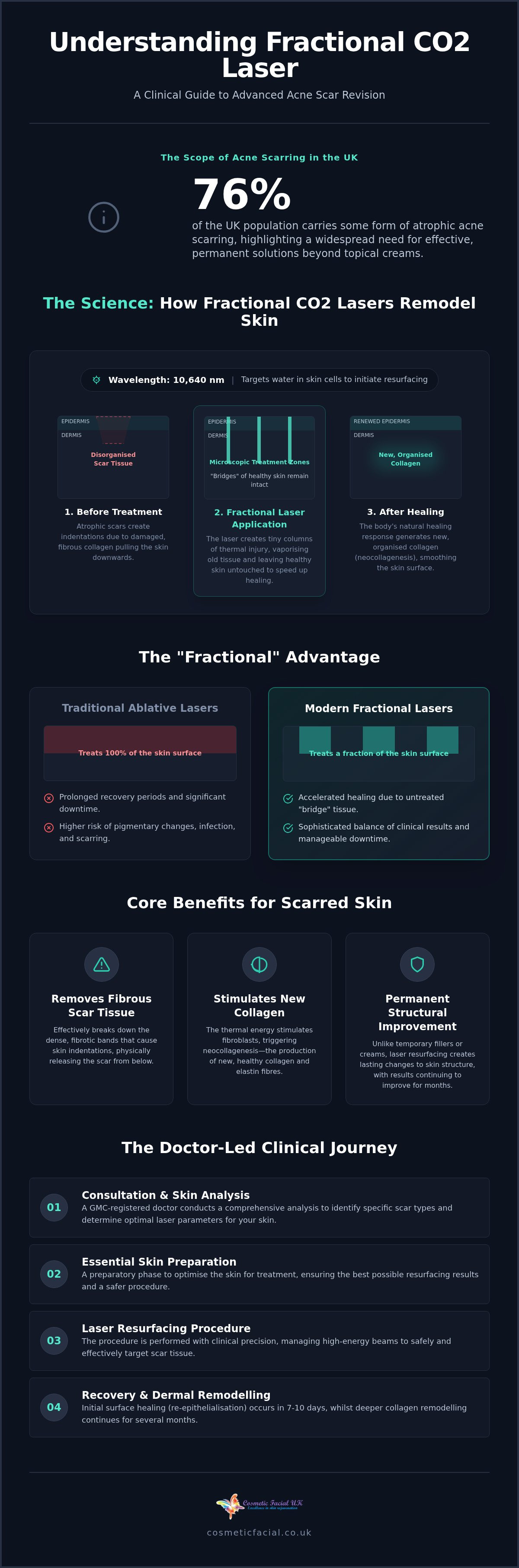
Approximately 76% of the UK population carries some form of atrophic acne scarring, a statistic that highlights how common persistent skin texture issues truly are. If you've spent years experimenting with over-the-counter creams or mild peels only to find your confidence still hampered by deep indentations, your frustration is entirely valid. Seeking a fractional CO2 laser for acne scars London based treatment is often the point where patients move from temporary skincare to permanent medical intervention.
This clinical guide explains how advanced fractional CO2 technology resurfaces the skin by stimulating the body's own regenerative mechanisms under expert medical supervision. You'll discover the precise biological processes involved in collagen production, the reality of clinical downtime, and why a doctor-led approach in Marylebone is essential for safety. We'll clarify the differences between various laser modalities to help you understand why this specific wavelength is considered the gold standard for significant scar revision. By the end of this guide, you'll have a thorough understanding of the journey toward smoother, more resilient skin.
Key Takeaways
- Understand how the 10,640 nm wavelength targets water in skin cells to trigger neocollagenesis and remodel deep, fibrous scar tissue.
- Learn why seeking a fractional co2 laser for acne scars london based treatment under a GMC-registered doctor ensures clinical precision and safety.
- Discover how a comprehensive skin analysis identifies specific scar shapes to determine the most effective laser parameters for your skin type.
- Explore the clinical journey from the initial Marylebone consultation through the essential skin preparation phase to optimise resurfacing results.
- Recognise the importance of specialist dermatological training in managing high-energy laser beams to achieve permanent improvements in skin quality.
What is Fractional CO2 Laser for Acne Scars?
Fractional CO2 laser technology represents the clinical gold standard for skin resurfacing, particularly in the management of complex acne scarring. This system utilises a carbon dioxide laser with a specific wavelength of 10,640 nm, which possesses a high affinity for the water molecules found within skin cells. When the laser energy is absorbed, it causes the targeted tissue to vaporise in a controlled manner, facilitating the removal of damaged superficial layers whilst simultaneously delivering thermal energy to the deeper dermis.
Historically, traditional ablative lasers treated the entire surface of the skin, which often resulted in prolonged recovery periods and a higher risk of pigmentary changes. Modern fractional technology has transformed this approach by delivering the laser energy in a pixelated pattern. This advancement is particularly favoured in London clinical settings because it offers a sophisticated balance between significant clinical results and manageable social downtime.
To observe the clinical application of this technology, watch this introductory video:
The "Fractional" Difference Explained
The term "fractional" refers to the method by which the laser beam is divided into thousands of microscopic treatment zones (MTZs). Each MTZ is a tiny column of thermal injury that penetrates deep into the skin, but these columns are separated by areas of untreated "bridge" tissue. This healthy, unaffected skin acts as a biological reservoir, providing the necessary cells and nutrients to accelerate the healing process from the inside out. By leaving these bridges intact, clinicians can reduce the risk of complications such as scarring or infection, which were more prevalent with older, non-fractional systems.
Core Benefits for Scarred Skin
A primary advantage of selecting a fractional co2 laser for acne scars london treatment is the dual-action mechanism of tissue remodelling. The procedure effectively removes fibrous scar bands that pull the skin downward, creating the characteristic indentations of atrophic scars. Concurrently, the thermal energy stimulates neocollagenesis, the production of new collagen and elastin fibres. This biological response improves the skin's "bounce" and overall elasticity. Unlike temporary topical solutions, the structural changes achieved through CO2 laser resurfacing are permanent, with improvements in skin texture and volume often continuing to develop for several months after the initial procedure.
The Science of Skin Resurfacing: How CO2 Lasers Remodel Tissue
The biological response to a fractional co2 laser for acne scars london treatment is a sophisticated cascade of cellular repair. Unlike superficial treatments that merely exfoliate the epidermis, the CO2 laser penetrates the deeper dermal layers where permanent scar tissue resides. This process involves the creation of controlled micro-injuries that trigger the body's natural wound-healing response without the risks associated with traditional full-surface ablation.
The thermal energy from the laser disrupts the cross-linked arrangement of old, fibrotic scar tissue, creating a wound-healing response that prioritises the synthesis of organised Type I collagen. This remodelling doesn't happen instantly. Whilst the initial re-epithelialisation, which is the regrowth of the skin's surface, typically occurs within seven to ten days, the deeper structural changes continue for several months. This timeline reflects the natural pace of dermal regeneration, moving from acute inflammation to the gradual replacement of scar tissue with healthy, functional skin cells.
Dermal Remodelling and Collagen Induction
At the heart of this process are fibroblasts, the specialised cells responsible for producing the extracellular matrix. When stimulated by the laser's heat, these fibroblasts accelerate the production of collagen and elastin. The heat itself is a critical component; it causes an immediate contraction of existing collagen fibres, leading to a visible tightening effect in the skin surrounding the scars. However, the most significant improvements are structural. Patients often observe a gradual smoothing of the skin's surface as the new dermal matrix fills in atrophic indentations. These structural gains typically peak around the six-month mark after the procedure.
Precision Targeting of Scar Depth
Achieving optimal results requires a meticulous approach to energy delivery. Different types of acne scars, such as deep "ice pick" scars or wider "boxcar" scars, require varying levels of laser intensity and penetration depth. In a clinical setting, the specialist adjusts the "dwell time", the duration the laser beam remains on a single point, to ensure sufficient thermal impact without causing excessive heat spread to surrounding tissue. Customising these parameters is a hallmark of professional clinical care, ensuring that a fractional co2 laser for acne scars london session is both safe and effective for the patient's unique skin anatomy. For those considering this advanced procedure, a comprehensive skin analysis is the essential first step in determining the precise energy parameters required for your specific scar profile.
Identifying Your Scar Type: Is Fractional Laser Right for You?
A clinical consultation at our Marylebone centre is the prerequisite for any fractional co2 laser for acne scars london procedure. This assessment allows for the precise identification of scar morphology, which is the primary predictor of treatment success. Not all scars are created equal. Whilst the laser is exceptionally versatile, its effectiveness varies depending on whether the scarring is atrophic, hypertrophic, or characterised by specific textural indentations. A doctor-led analysis ensures we don't apply a generic solution to a complex dermatological issue.
We must ensure the skin is clear of active, inflammatory acne before proceeding with resurfacing. The presence of pustules or cysts increases the risk of spreading bacteria and can lead to post-treatment complications. For patients experiencing significant volume loss alongside surface irregularities, we often integrate a multi-step plan. This might include dermal fillers to provide underlying structural support before or after the laser resurfacing phase to achieve a more harmonious facial contour.
Mapping Ice Pick, Boxcar, and Rolling Scars
Different scar shapes respond uniquely to laser energy. Boxcar scars, which have defined, vertical edges, are ideal candidates for resurfacing because the laser can effectively level the sharp boundaries. Rolling scars create a wave-like appearance on the skin and are caused by fibrous bands tethering the epidermis to the deeper tissue. The thermal energy from the fractional laser helps to break these bands and stimulate new collagen to lift the depression. Conversely, ice pick scars are very narrow and deep. These often require a combined approach, such as TCA cross or punch excision, because the laser energy may not reach the full depth of the narrow tract in a single session. By categorising these types during your analysis, we can manage expectations and refine the clinical approach.
Suitability and Skin Tone Considerations
Safety is our paramount concern, particularly when treating diverse skin tones. We use the Fitzpatrick scale to assess the level of melanin in the skin and determine the risk of post-inflammatory hyperpigmentation (PIH). For patients with darker skin tones, specific pre-treatment protocols involving topical agents may be required to stabilise pigment-producing cells for several weeks prior to the procedure. A medical consultation with Dr Faramarz Didar is non-negotiable. His clinical background and GMC registration ensure that every fractional co2 laser for acne scars london treatment is conducted with the highest standards of dermatological safety. We prioritise long-term skin health over immediate, aggressive results.
The Treatment Journey: From Consultation to Recovery in London
The journey begins at our Marylebone centre with a comprehensive clinical assessment. This initial consultation serves to evaluate the current state of your skin health and to establish a personalised treatment protocol. For many patients, the preparation phase is critical. We may recommend specific medical-grade skincare routines to optimise the skin's barrier function and melanin stability before the application of laser energy.
Step-by-Step Procedure Day
On the day of your fractional co2 laser for acne scars london session, we prioritise patient comfort by applying a high-strength topical anaesthetic. This cream requires approximately 45 to 60 minutes to reach full efficacy. Once the skin is sufficiently numbed, the procedure begins. You'll experience a sensation of intense heat and a slight tingling or snapping feeling as the laser traverses the treatment area. A full-face session typically lasts between 30 and 60 minutes, depending on the complexity and depth of the scarring being addressed.
Navigating Recovery in the City
The immediate post-laser phase is often compared to the sensation of a severe sunburn. During the first 48 to 72 hours, redness and swelling are the primary clinical observations. For those navigating London, protecting the treated area is essential. We advise avoiding the London Underground during the initial 24 hours to minimise exposure to urban dust and airborne pollutants that could irritate the healing tissue. You should also strictly avoid direct UV exposure, as the new skin is exceptionally vulnerable to pigmentary changes. As the skin heals, tiny micro-crusts will form. It's imperative that you don't pick or exfoliate these crusts, as they act as a natural biological dressing whilst the underlying epidermis regenerates.
Long-term Aftercare and Results
Visible improvements in skin texture usually become apparent once the initial peeling process concludes, typically within seven to ten days. However, as the deeper dermal remodelling progresses, the most significant results emerge between three and six months post-procedure. Maintaining these gains requires a commitment to high-SPF protection, ideally SPF 50, to shield the delicate new tissue from environmental damage. For more detailed information on specific recovery timelines and post-procedural expectations, refer to our FAQ.
Clinical Excellence in Marylebone: Why Specialist Expertise Matters
Selecting a provider for a fractional co2 laser for acne scars london treatment involves more than comparing equipment or location. High-energy CO2 lasers are powerful medical instruments that require a deep understanding of cutaneous biology and laser physics to operate safely. At our Marylebone clinic, we believe that clinical outcomes are inextricably linked to the practitioner's medical qualifications and experience. Entrusting your skin to a GMC-registered doctor ensures that every parameter of the procedure is governed by medical evidence and safety protocols rather than commercial incentives.
Academic Rigour and Dermatological Training
Dr Faramarz Didar (GMC 5200505) brings a level of academic rigour to his practice that distinguishes it from high-street aesthetic centres. He holds an MSc in Dermatology Skills and Treatment with Commendation from the University of Hertfordshire, a qualification that informs his nuanced approach to complex scar tissue. His expertise is further bolstered by specialist training in advanced surgical dermatology in Italy and membership in the European College of Aesthetic Medicine & Surgery. This international perspective, including insights from institutions like the Instituto Javier de Benito, allows him to implement the safest laser protocols available in 2026. This extensive background is essential for identifying potential contraindications and managing the skin's response to high-intensity thermal energy.
Personalised Care Plans at Cosmetic Facial
Every patient who visits our Marylebone clinic undergoes a thorough medical assessment that considers their full skin history and aesthetic objectives. We don't believe in generic protocols. Instead, we develop bespoke care plans that may combine laser resurfacing with other medical-grade interventions. Because Dr Didar also provides comprehensive GP services and health checks, his assessment of your skin is holistic. He considers underlying health factors that might influence your healing capacity or inflammatory response. This medical-first philosophy is central to our approach to facial rejuvenation, where long-term skin health is prioritised alongside visible textural improvements. By choosing a doctor-led clinic, you're opting for a level of clinical oversight that protects your skin whilst working towards permanent, life-changing results.
Achieving Permanent Structural Change in Skin Quality
Achieving permanent structural improvements in skin texture requires a methodical combination of sophisticated laser technology and rigorous clinical expertise. By understanding the precise biological mechanism of fractional CO2 resurfacing, you've taken the essential first step toward addressing persistent acne scarring with a medical-grade solution. Professional oversight remains a fundamental requirement for successful resurfacing. This guide has detailed how the pixelated delivery of energy remodels fibrous tissue and stimulates organised Type I collagen production to fill indentations from the inside out.
Choosing a fractional co2 laser for acne scars london based treatment at our Marylebone centre ensures your care is supervised by Dr Faramarz Didar. As a GMC registered medical professional (5200505) with an MSc in Dermatology (Commendation), Dr Didar prioritises clinical safety and the development of bespoke protocols tailored to your unique skin history. We focus on delivering outcomes that respect the long-term integrity of your skin whilst providing a clear pathway to improved confidence.
We look forward to supporting your journey toward healthier, smoother skin through evidence-based dermatological care.
Frequently Asked Questions
Is fractional CO2 laser treatment for acne scars painful?
Patients generally describe the sensation as manageable through the use of high-strength topical anaesthesia applied prior to the procedure. Whilst the laser energy creates a feeling of intense heat and sharp tingling, the numbing agent significantly mitigates discomfort. Most individuals report that the sensation subsides quickly after the session is complete, leaving a feeling similar to a moderate sunburn for the remainder of the day.
How many sessions of CO2 laser will I need for deep scarring?
The number of sessions required depends on the depth and morphology of the acne scarring. Whilst some patients see significant improvement after a single session, deep boxcar or rolling scars often require two to three treatments spaced several months apart. A clinical assessment at our Marylebone centre is necessary to determine the specific protocol required for your unique dermal remodelling goals.
How long is the downtime after a fractional CO2 laser treatment in London?
Social downtime following a fractional co2 laser for acne scars london treatment typically lasts between seven and ten days. During the first three days, patients experience redness and swelling, followed by a period of micro-crusting and peeling. It's essential to follow post-procedural instructions regarding urban pollution and UV protection to ensure the underlying epidermis regenerates without complication or unwanted pigmentary changes.
Can fractional CO2 laser be used on all skin types and tones?
Fractional CO2 laser can be used on various skin tones, but patients with higher melanin levels require specialised pre-treatment protocols. These protocols often involve topical agents used for several weeks to stabilise pigment-producing cells. A medical consultation with a GMC-registered doctor is vital to assess individual risk factors and to adjust the laser's energy parameters to prevent post-inflammatory hyperpigmentation.
What is the difference between fractional CO2 laser and microneedling?
Unlike microneedling, which creates mechanical channels in the skin, the fractional CO2 laser delivers thermal energy that vaporises columns of tissue. This heat is essential for breaking down deep, fibrous scar bands and triggering more robust neocollagenesis. Whilst microneedling is effective for superficial texture issues, the laser is considered the gold standard for significant structural scar revision and dermal tightening.
Are the results of CO2 laser resurfacing for acne scars permanent?
The structural changes achieved through CO2 laser resurfacing are permanent. Once the laser has successfully remodelled the fibrotic tissue and stimulated new collagen production to fill indentations, those specific scars do not return. However, the skin will continue to undergo the natural biological aging process, so maintaining a medical-grade clinical skincare regime is recommended to preserve overall skin health and quality.
What are the risks of CO2 laser if not performed by a specialist?
If performed by an unqualified practitioner, high-energy laser treatments carry risks of permanent scarring, infection, or chronic hyperpigmentation. Specialist expertise is required to balance the energy intensity with the skin's individual healing capacity. Choosing a GMC-registered doctor ensures that the procedure is conducted using calibrated medical-grade equipment and that any adverse reactions are managed with clinical precision.
How much does fractional CO2 laser resurfacing cost in London?
Costs for a fractional co2 laser for acne scars london reflect the high operational standards and specialist expertise required in a central London clinical setting. Pricing is typically determined by the size of the treatment area and the complexity of the scar tissue being addressed. A comprehensive skin analysis is provided during the initial consultation to outline the expected investment for a complete treatment course.
Disclaimer
All content on cosmetic Facial website, including blogs, graphics, logos, images, and software, is the property of CosmeticFacial UK or its content suppliers and is protected by applicable copyright laws. Unauthorized use, reproduction, distribution, or modification of any content without prior written permission is strictly prohibited.


