


The persistent belief that topical serums alone can resolve deep-seated dermal discolouration is often a costly misconception for those seeking clear skin. Whilst many high-street products claim to brighten the complexion, they frequently fail to reach the basal layer where melanocyte activity originates. Professional microneedling for pigmentation london offers a mechanical solution that bypasses the skin's natural barrier to deliver corrective results through controlled micro-conduits.
It's understandable to feel frustrated when expensive treatments yield negligible changes, or worse, trigger post-inflammatory hyperpigmentation due to incorrect application. You're right to seek a more rigorous, evidence-based approach to your skin health. This guide details how clinical microneedling, performed under the supervision of Dr Faramarz Didar, an MSc-qualified specialist in Dermatology, can achieve up to a 70.21% reduction in melasma severity scores by facilitating deeper penetration of depigmenting agents.
We'll examine the specific biological mechanisms of collagen induction, the importance of precise needle depth for different skin types, and how medical-grade protocols in our Marylebone clinic ensure both safety and luminosity. You'll also learn why this cold, mechanical therapy is often preferred over heat-based lasers for maintaining the integrity of darker skin tones.
Key Takeaways
- Understand why mechanical disruption of melanosome clusters is more effective for deep-seated pigment than standard topical brighteners that cannot penetrate the dermal layers.
- Discover why microneedling is a preferred "cold" therapy for Fitzpatrick skin types IV-VI, offering a lower risk of reactive melanogenesis compared to heat-based laser treatments.
- Learn about the clinical protocols for microneedling for pigmentation london at our Marylebone practice, where medical-grade micro-conduits facilitate superior cellular turnover.
- Explore how the creation of microscopic channels enhances the transdermal delivery of specialised depigmenting agents by over 80 per cent compared to surface application.
- Identify the importance of a professional medical diagnosis to distinguish between epidermal and dermal hyperpigmentation before commencing any clinical intervention.
Understanding Hyperpigmentation: Why Surface Solutions Often Fail
Hyperpigmentation is a complex physiological response where melanocytes produce excessive melanin. Whilst many patients attempt to manage this with over-the-counter serums, these formulations often fail to penetrate the stratum corneum effectively. In a metropolitan environment, the causes of hyperpigmentation are frequently multifaceted, involving both internal biological triggers and external stressors.
Those seeking microneedling for pigmentation london must understand that surface-level brightening is limited by the skin's architecture. Melanin is produced deep within the epidermis, meaning that topical agents often dissipate before reaching the target cells. A clinical approach is necessary to ensure active ingredients or mechanical interventions address the root of the discolouration rather than just the surface symptoms.
To better understand the biological mechanisms behind these treatments, watch this clinical overview:
The Biology of Melanin and Pigment Formation
Melanocytes reside in the basal layer of the epidermis, which is the deepest part of the outer skin layer. These cells produce melanosomes, which are small granules of pigment subsequently transferred to keratinocytes. When this process is overstimulated, visible dark spots appear on the surface. It's vital to distinguish between epidermal pigmentation, which is relatively superficial, and dermal pigmentation, which sits deeper and requires more intensive clinical intervention to resolve.
Common Triggers: From UV Exposure to London Pollution
London's climate presents unique challenges for skin health. UVA and UVB rays penetrate cloud cover even on overcast days, stimulating melanogenesis without the presence of direct heat. Additionally, high levels of particulate matter in urban pollution create oxidative stress. This triggers a cascade of inflammatory responses that worsen existing discolouration. Post-Inflammatory Hyperpigmentation (PIH) is another common concern, often resulting from poorly managed acne or aggressive treatments that cause trauma to the skin.
Distinguishing between melasma, solar lentigines, and PIH is vital for treatment success. A professional assessment at our clinic ensures that we don't treat dermal melasma with protocols designed for superficial sun damage. This precision is why medical-led microneedling for pigmentation london remains a gold standard for restoring an even tone through comprehensive facial rejuvenation.
The Clinical Mechanism: How Microneedling Targets Pigment
Microneedling, or collagen induction therapy, operates through the creation of thousands of microscopic channels in the skin. Whilst frequently discussed in the context of anti-ageing, its application in microneedling for pigmentation london focuses on the physical breakdown of excess melanin within the epidermal and dermal layers. According to the American Academy of Dermatology guide on microneedling, these controlled micro-injuries safely stimulate the skin's natural repair mechanisms without the thermal risks often associated with certain laser therapies.
Mechanical Disruption of Melanosome Clusters
When the surgical-grade needles penetrate the skin at precise depths, they physically fragment melanosome clusters. These clusters are the dense deposits of pigment that manifest as dark spots, solar lentigines, or melasma. Once fragmented, the body initiates a biological process known as phagocytosis, where specialised cells engulf and clear away the cellular debris and pigment particles. Controlled micro-injury acts as the primary catalyst for this accelerated cellular turnover, ensuring that stagnant pigment is brought to the surface and shed.
This "fractional" approach to healing is essential for safe pigment correction. By treating only a portion of the skin's surface with micro-punctures, the surrounding healthy tissue remains unaffected. This promotes a rapid regenerative response where pigmented cells are systematically replaced by new, healthy tissue with a more balanced melanin distribution. This method reduces the likelihood of the rebound hyperpigmentation that can occur with more aggressive, non-fractional treatments.
Transdermal Delivery: Enhancing Serum Efficacy
The microscopic channels created during the procedure serve a secondary, equally vital purpose: they act as micro-conduits for transdermal delivery. These channels allow active depigmenting agents to bypass the stratum corneum, the skin's primary barrier, which normally blocks the majority of topical formulations. Research indicates that mechanical microneedling can increase transdermal permeability by over 80 per cent compared to topical application alone.
At a clinical level, we utilise specialised serums containing high concentrations of Vitamin C, Kojic acid, or Tranexamic acid. These medical-grade formulations are significantly more potent than over-the-counter alternatives, as their molecular structure and stability are optimised for deep dermal absorption. This targeted delivery ensures that melanogenesis inhibitors reach the melanocytes directly, slowing the production of new pigment whilst the existing discolouration is cleared.
Understanding these biological pathways is the first step toward effective correction. For those considering microneedling for pigmentation london, a bespoke clinical plan ensures these mechanisms are leveraged safely for your specific skin type. Patients can discuss their suitability for this mechanical approach during a detailed assessment at our Marylebone practice.
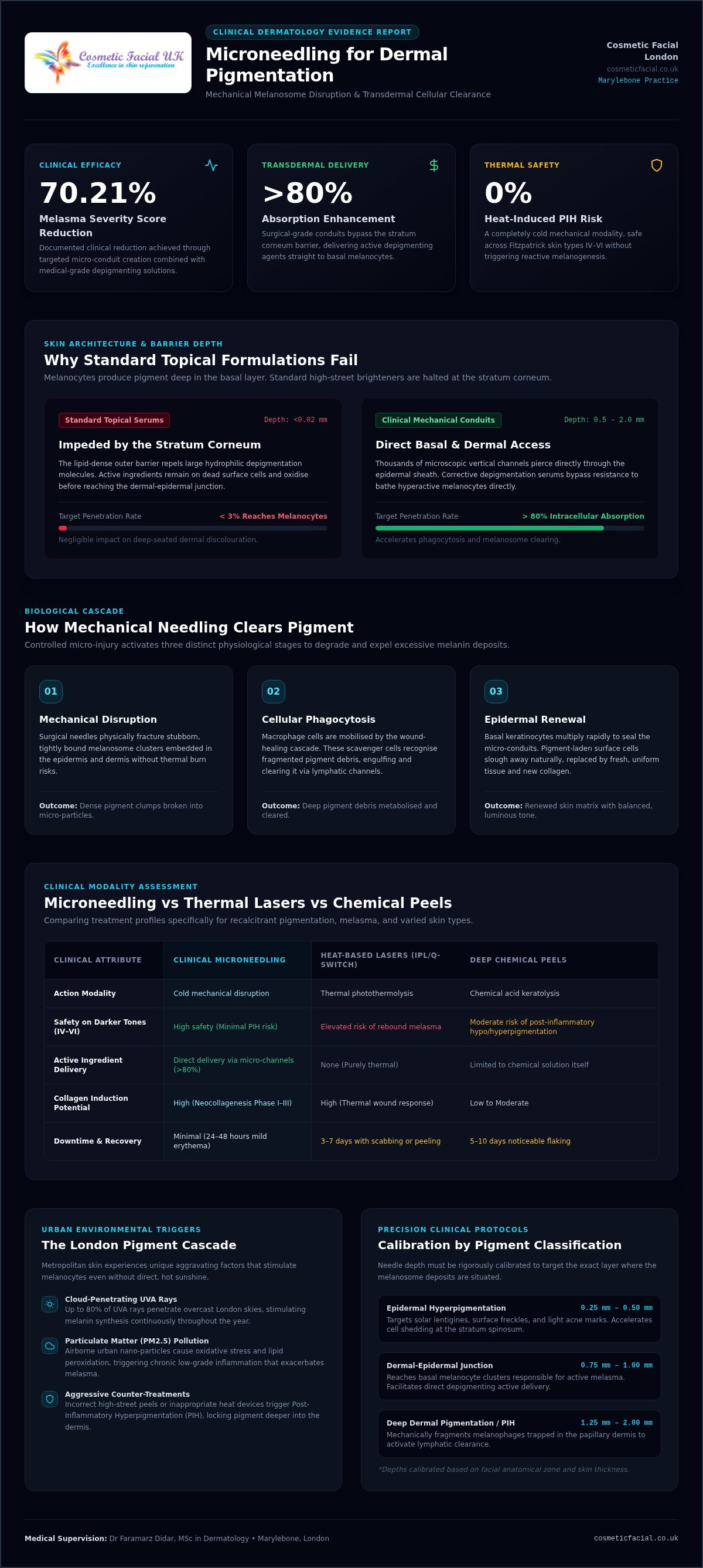
Microneedling vs Chemical Peels and Lasers for Pigment
Choosing the correct modality for pigment correction requires a detailed understanding of how different energies interact with the skin. Whilst lasers are often positioned as a rapid solution for discolouration, they rely on selective photothermolysis, a process that uses heat to target melanin. In contrast, microneedling for pigmentation london is a mechanical, or "cold", treatment. This distinction is fundamental when treating patients who are susceptible to heat-induced skin reactions.
Safety Profiles for Diverse Skin Tones
For patients with darker skin tones, specifically those categorized as Fitzpatrick IV to VI, the risk of thermal damage from certain lasers is significant. Excessive heat can trigger reactive melanogenesis, leading to rebound pigmentation or worsening of the original condition. Because microneedling is a mechanical procedure, it doesn't rely on light absorption or heat. This makes it a safer clinical choice for those prone to Post-Inflammatory Hyperpigmentation (PIH). It's essential to follow established FDA microneedling safety guidance, which emphasises the use of medical-grade devices to maintain skin integrity. While microneedling is excellent for pigment, patients with deep, tethered acne scarring might find more comprehensive results by exploring a Fractional CO2 Laser, provided their skin type is suitable for thermal intervention.
Combining Microneedling with Professional Peels
Clinical outcomes are often enhanced when multiple modalities are used in a structured treatment programme. Professional chemical peels for hyperpigmentation complement microneedling by accelerating epidermal shedding and inhibiting pigment production at the surface. Whilst microneedling targets the deeper dermal-epidermal junction, a peel addresses superficial clusters.
In our Marylebone practice, we often employ a "sandwich" technique. This involves alternating microneedling sessions with specialised chemical peels over several months. This approach ensures that pigment is addressed at every cellular level. It's vital to maintain appropriate intervals, typically four to six weeks, between different clinical procedures. This recovery period allows the skin to complete its inflammatory repair cycle and produce new, unpigmented tissue. A bespoke framework for choosing between these treatments is established during your initial consultation, where we assess pigment depth and your tolerance for clinical downtime. This methodical approach ensures that microneedling for pigmentation london provides long-term stability rather than a temporary surface change.
The Treatment Journey: Your Marylebone Clinical Experience
Embarking on a course of microneedling for pigmentation london requires more than a simple booking; it begins with a rigorous medical evaluation to ensure the treatment aligns with your specific pathology. The clinical journey at our Marylebone practice prioritises safety and diagnostic accuracy, moving beyond the surface-level approach of standard aesthetic salons. We focus on creating a stable environment for skin regeneration whilst managing the factors that lead to discolouration.
The Importance of a Specialist Clinical Consultation
A medical assessment is the foundation of successful pigment correction. We use detailed skin analysis to determine if the melanin is concentrated in the epidermis or the deeper dermis. This distinction is critical as it dictates the required needle depth and the concentration of transdermal serums used. Your medical history, including any hormonal changes or previous reactions to light-based therapies, is reviewed to mitigate the risk of complications. For complex cases involving persistent melasma or multi-layered pigment, a private dermatologist consultation ensures your treatment plan is medically sound.
Procedure Steps and Pain Management
Patient comfort is a priority throughout the procedure. Once your suitability is confirmed, the treatment area is thoroughly cleansed and a high-strength topical anaesthetic is applied. This numbing process takes approximately 30 minutes to ensure the microneedling is well-tolerated. During the actual treatment, the device creates controlled micro-channels across the target areas. You can expect pinpoint redness, technically known as erythema, which signifies the initiation of the wound-healing response. We conclude the session with the application of a medical-grade soothing mask designed to reduce inflammation and provide immediate hydration to the newly created channels.
Recovery and Protecting Your Results
Recovery is generally efficient, making it suitable for the busy London professional. Most patients experience a sensation similar to mild sunburn for 24 to 48 hours. During this window, you must avoid intense heat, steam rooms, and heavy exercise. The most critical factor in preventing rebound pigmentation is the consistent application of broad-spectrum SPF 50+. Even in London's often overcast climate, UV radiation remains high enough to trigger melanocytes during the vulnerable healing phase. We recommend avoiding makeup for at least 24 hours to allow the micro-channels to close naturally without the risk of irritation or infection.
Corrective results for deep-seated pigmentation are cumulative. Whilst skin luminosity improves after a single session, a course of three to six treatments, spaced four to six weeks apart, is typically required to achieve significant clearance. This timeline allows the skin to complete its inflammatory repair cycle and replace pigmented clusters with new, healthy tissue.
Why Choose Cosmetic Facial for Pigmentation Treatment?
Selecting a clinical environment for microneedling for pigmentation london is a decision that directly impacts both the safety of the procedure and the longevity of the results. Our Marylebone practice operates under rigorous medical standards, ensuring that every intervention is delivered within a sterile, professional setting. We don't view skin health as a transactional service; instead, we approach pigment correction as a clinical discipline that requires diagnostic precision and expert oversight.
Dr Faramarz Didar: MSc-Qualified Dermatology Expertise
The clinic is led by Dr Faramarz Didar, whose extensive academic credentials provide a level of expertise often absent in high-street aesthetic salons. Dr Didar holds an MSc in Dermatology Skills and Treatment with Commendation from the University of Hertfordshire, a qualification that underpins his deep understanding of both pathological and cosmetic skin conditions. As a GMC registered specialist (5200505) and a member of the European College of Aesthetic Medicine & Surgery, he ensures that every treatment protocol is rooted in current medical evidence.
This academic background is particularly vital when managing complex pigmentary disorders. An incorrect assessment of pigment depth or the use of inappropriate needle parameters can exacerbate conditions like melasma. Dr Didar’s unhurried, methodical approach ensures that every patient receives a thorough evaluation before any mechanical intervention begins. This intellectual honesty gives our patients the reassurance that they are in the hands of a knowledgeable authority who prioritises clinical integrity over showmanship.
Bespoke Plans for Long-Term Skin Health
Every patient presents with a unique skin profile influenced by genetics, hormonal fluctuations, and urban environmental exposure. We reject the generic models of care common in non-medical settings. Instead, we develop bespoke strategies for facial rejuvenation that address your specific pigment type, whether it is superficial sun damage or deeper dermal discolouration. Our commitment is to achieve natural-looking, refreshed results that respect the biological integrity of your skin.
Our Marylebone practice provides a discreet and professional environment for those who take their skin health seriously. By combining advanced mechanical technology with medical-grade topical agents, we provide a pathway to a balanced skin tone that is both safe and sustainable. We believe in building trust through the depth of our information and the consistency of our outcomes, ensuring that our patients are fully informed at every stage of their treatment journey.
Advancing Your Path to Balanced Skin Tone
Successful management of hyperpigmentation requires a transition from superficial treatments toward evidence-based clinical protocols. By leveraging mechanical disruption and enhanced transdermal delivery, patients can address the root causes of discolouration whilst maintaining the structural integrity of the skin. This approach is particularly effective for those seeking microneedling for pigmentation london, as it avoids the thermal risks often associated with heat-based lasers, especially in darker skin types.
Under the specialist guidance of Dr Faramarz Didar at our Marylebone practice, each treatment plan is tailored to the individual's specific pigment depth and skin pathology. Dr Didar's MSc in Dermatology with Commendation and GMC registration (5200505) ensure that every procedure adheres to the highest standards of medical safety. Establishing a clear diagnostic baseline is the essential first step toward restoring a luminous and resilient complexion.
We look forward to providing the expert medical oversight necessary to help you achieve your skin health goals with confidence.
Frequently Asked Questions
Is microneedling painful for treating pigmentation?
Microneedling is generally well-tolerated because we apply a high-strength topical anaesthetic for 30 minutes prior to the procedure. Most patients describe the sensation as a light vibration or mild prickling rather than acute pain. This numbing process ensures that the specialist can reach the necessary dermal depths to disrupt pigment clusters without causing significant discomfort. Any residual sensitivity typically dissipates within a few hours of leaving our Marylebone clinic.
How many sessions of microneedling will I need for dark spots?
Most patients require a course of three to six sessions to achieve a significant reduction in dark spots. These appointments are usually spaced four to six weeks apart to allow for a full cellular turnover cycle. Whilst superficial epidermal pigment may respond sooner, deep-seated dermal discolouration often requires the full course to achieve stable, long-term results. We assess your progress after each session to adjust the protocol accordingly.
Can microneedling make melasma worse?
Microneedling is a mechanical therapy that carries a lower risk of worsening melasma compared to heat-based lasers. However, incorrect needle depth or aggressive application can trigger inflammation, which may lead to rebound pigmentation. This is why a medical assessment by a specialist like Dr Faramarz Didar is essential. By using cold mechanical disruption, we can safely target melanosomes without the thermal energy that often exacerbates hormonal pigment conditions.
What is the downtime for microneedling in London?
The typical downtime for microneedling for pigmentation london is between 24 and 48 hours. You'll likely experience erythema, which is a clinical term for redness, similar to a mild sunburn. Most London professionals find they can return to their usual schedule the following day. It's vital to avoid intense heat, heavy exercise, and the direct particulate matter of urban pollution during this initial healing window to protect the micro-channels.
Is microneedling safe for dark or Asian skin tones?
Clinical evidence confirms that microneedling is exceptionally safe for dark or Asian skin tones, specifically Fitzpatrick types IV to VI. Unlike certain lasers that target melanin as a chromophore, microneedling is a mechanical process that avoids thermal damage to the surrounding tissue. This significantly reduces the risk of Post-Inflammatory Hyperpigmentation (PIH). It remains a gold standard for Asian skin concerns where heat-induced reactive melanogenesis is a major clinical anxiety.
When will I see results from my microneedling treatment?
Initial improvements in skin luminosity are often visible within two weeks, but corrective pigment clearance takes longer. You'll typically see a more significant reduction in dark spots after your second or third treatment. The biological process of phagocytosis, where the body clears fragmented melanin, reaches its peak clinical effect between 12 and 24 weeks. Patience is required as the skin systematically replaces pigmented cells with healthy, unblemished tissue.
Can I wear makeup immediately after a microneedling session?
No, you should avoid wearing makeup for at least 24 hours following your clinical session. The procedure creates thousands of micro-channels that remain open for several hours, making the skin vulnerable to irritation or infection from cosmetic ingredients. Once this initial healing window has passed and the redness has subsided, you may resume your usual routine. We recommend using a high-factor, broad-spectrum SPF as your primary post-procedure priority to prevent UV-induced pigment rebound.
What is the difference between home dermarollers and professional microneedling?
Professional microneedling for pigmentation london differs significantly from home dermarollers in terms of depth, safety, and results. Home devices are generally limited to 0.25mm, which only aids the absorption of topical serums. In a clinical setting, we use medical-grade devices that reach depths of up to 1.5mm to physically fragment deep melanin clusters. Clinical environments ensure sterile conditions and expert oversight, which are essential for preventing scarring or infection.
Disclaimer
All content on cosmetic Facial website, including blogs, graphics, logos, images, and software, is the property of CosmeticFacial UK or its content suppliers and is protected by applicable copyright laws. Unauthorized use, reproduction, distribution, or modification of any content without prior written permission is strictly prohibited.


