


In the competitive landscape of central London aesthetics, the lowest price for a skin resurfacing procedure often correlates with the highest risk of long term dermal complications. You've likely found that researching chemical peel cost london options creates more confusion than clarity, especially when attempting to balance visible improvements with the fear of potential downtime. It's common to feel hesitant after using over the counter treatments that failed to resolve persistent hyperpigmentation, leaving you seeking a professional, medical grade solution that prioritises safety and clinical expertise.
This clinical guide provides a methodical breakdown of the factors that define a successful resurfacing outcome. We'll explore how the specific chemistry of the peel, the depth of penetration, and the medical expertise of the practitioner dictate the final investment. By understanding the distinction between superficial exfoliation and deep tissue regeneration, you can make an informed decision based on anatomical requirements rather than marketing claims. We will examine the clinical standards expected in a Marylebone practice, the necessity of GMC oversight, and the biological processes that ensure transformative, predictable results for your skin.
Key Takeaways
- Understand the biological mechanisms of Alpha Hydroxy Acids and Beta Hydroxy Acids in facilitating controlled clinical exfoliation.
- Identify the appropriate resurfacing depth, ranging from superficial to deep, required to address specific dermatological concerns such as texture or hyperpigmentation.
- Evaluate the clinical variables affecting chemical peel cost london, including formulation complexity and the professional standards maintained in Marylebone practices.
- Learn the necessity of clinical skin priming and post-treatment protocols to ensure even acid penetration and safe inflammatory management.
- Recognise the safety advantages of a medical-led environment where treatments are overseen by a GMC-registered doctor with specialist dermatology qualifications.
Understanding Chemical Peels: A Clinical Overview
A chemical peel is a controlled clinical exfoliation process designed to remove specific layers of the epidermis or dermis using specialised acid solutions. Unlike mechanical exfoliation, which relies on physical abrasion, chemical resurfacing employs biochemical agents to induce a precise injury to the skin, stimulating a restorative wound healing response. This comprehensive clinical overview highlights how the procedure addresses various dermatological concerns, including post-inflammatory hyperpigmentation, atrophic acne scarring, and solar lentigos. Professional grade peels are formulated to penetrate significantly deeper than over the counter alternatives, ensuring that the active ingredients reach the precise target depth necessary for structural change.
To better understand this concept, watch this helpful video:
The Mechanism of Chemical Resurfacing
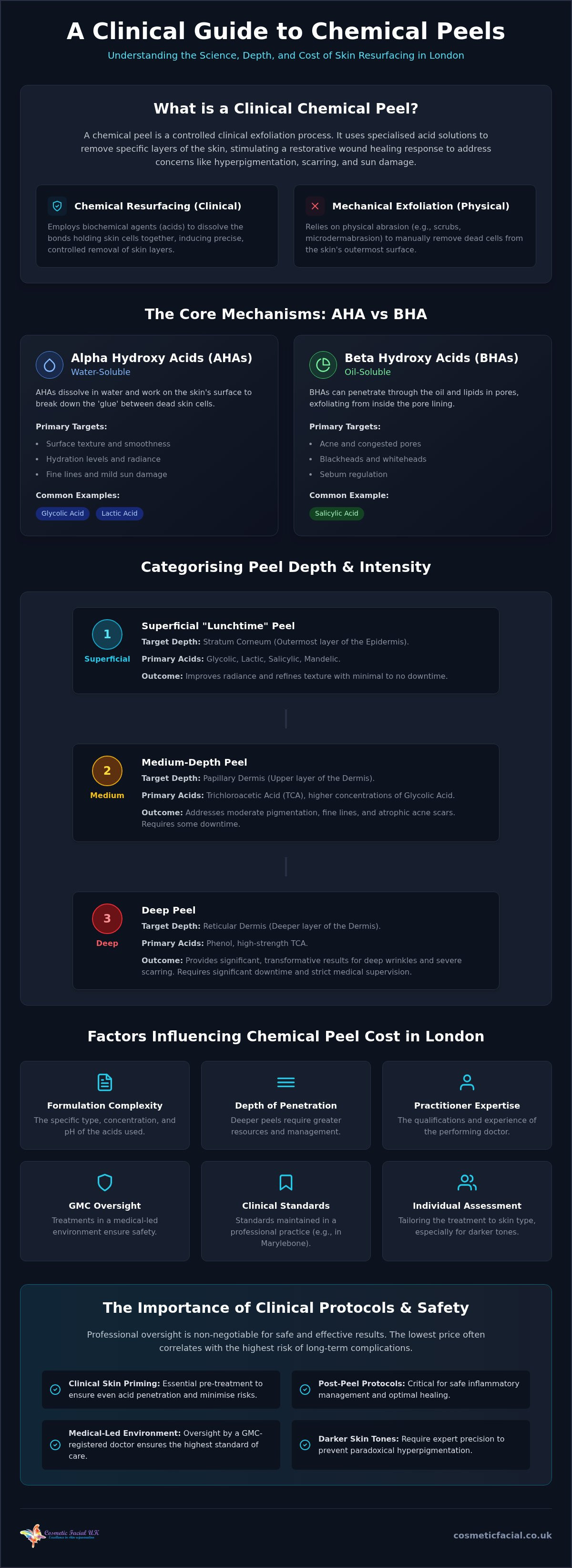
The efficacy of a chemical peel depends on its ability to break down intercellular desmosomes, which are the protein structures that hold skin cells together. Once these bonds are dissolved, the outer layers of dead skin shed, triggering rapid cell turnover. The biological roles of Alpha Hydroxy Acids (AHAs) and Beta Hydroxy Acids (BHAs) are distinct in this process. AHAs, such as glycolic or lactic acid, are water soluble and primarily target surface texture and hydration. BHAs, specifically salicylic acid, are oil soluble, allowing them to penetrate the lipid barriers of the pores to treat acne and congestion. This stimulation of the extracellular matrix signals dermal fibroblasts to increase the production of collagen and elastin. During deeper treatments, a practitioner might observe "frosting", a white coating caused by protein denaturation in the skin, which serves as a critical clinical indicator of acid depth.
Medical vs. Cosmetic Skin Peels
The primary distinction between medical and cosmetic peels lies in the pH levels and the concentration of the acids used. Clinical formulations often have a lower pH, making them more acidic and capable of penetrating the deeper layers of the dermis for more significant results. When assessing the chemical peel cost london clinics present, the price reflects the complexity of these medical variables and the expertise required to manage them. Medical assessments remain vital for patients with darker skin tones on the Fitzpatrick scale, as high concentration acids can trigger paradoxical hyperpigmentation if not administered with precision. For patients requiring a more tailored approach, seeking a private dermatologist consultation london ensures that the peel depth and formulation are safely matched to their unique biological profile. Understanding these clinical nuances helps clarify why professional interventions offer superior outcomes for complex conditions compared to standardised home kits.
Categorising Skin Peels: From Superficial to Deep Resurfacing
Clinical skin peels are categorised by the depth of tissue penetration they achieve. The selection of a specific depth is a clinical decision based on the patient's dermatological objectives and their tolerance for recovery. Generally, a direct correlation exists between the intensity of the acid formulation and the efficacy of the final result. However, deeper peels necessitate significant downtime and stringent medical supervision. When evaluating chemical peel cost london, patients must consider that deeper resurfacing requires greater clinical resources and practitioner expertise.
Superficial and Lunchtime Peels
Superficial peels utilise Alpha Hydroxy Acids like Glycolic or Mandelic acid, or Beta Hydroxy Acids such as Salicylic acid, to exfoliate the stratum corneum. These treatments are often termed "lunchtime peels" because they cause minimal disruption to the skin barrier. Patients can expect improved radiance and refined texture without visible shedding. These formulations are ideal for those seeking facial rejuvenation who cannot accommodate social downtime. While effective for maintenance, they typically require a series of sessions to achieve cumulative results.
Medium-Depth and TCA Peels
Medium-depth peels typically employ Trichloroacetic Acid (TCA) at concentrations between 20% and 35% to reach the papillary dermis. This depth is necessary for treating solar lentigos, deeper dyschromia, and moderate fine lines. Unlike superficial treatments, TCA peels induce a significant inflammatory response. The recovery phase involves distinct shedding where the treated layers peel away over five to seven days. This clinical complexity is a primary driver of the chemical peel cost london clinics apply to medium-depth treatments. Strict adherence to Pre-treatment and post-peel recovery protocols is essential to prevent complications such as post-inflammatory hyperpigmentation.
Deep Peels and Phenol Solutions
Deep peels use Phenol (carbolic acid) to penetrate the reticular dermis, providing intensive resurfacing for severe solar damage and deep-set rhytids. These procedures are less common in modern aesthetic practice as Fractional CO2 lasers often offer similar outcomes with lower systemic risks. Phenol is cardiotoxic if absorbed too rapidly, necessitating cardiac monitoring and a specialist medical environment. Because of these safety requirements and the prolonged healing period, deep peels represent a significant clinical undertaking. For those considering intensive resurfacing, a consultation with a GMC registered doctor at Cosmetic Facial can help determine the safest therapeutic path for your skin profile.
Factors Influencing Chemical Peel Cost in London
Determining the chemical peel cost london patients encounter involves evaluating several clinical and operational variables. While entry-level pricing exists in high street settings, medical-led clinics in Marylebone and Harley Street reflect a premium that accounts for rigorous safety standards. This isn't merely a reflection of location; it represents the clinical oversight recommended by the British College of Aesthetic Medicine. Patients must distinguish between a standard aesthetic application and a medically supervised procedure where acid concentrations are adjusted based on real-time epidermal response.
Practitioner Qualifications and Safety
Professional fees are significantly influenced by the practitioner’s level of medical expertise. Being treated by a GMC-registered doctor who holds a Master’s in Dermatology ensures that your skin health is managed with academic precision and clinical depth. Clinical overheads in CQC-standard facilities, alongside the necessity of comprehensive medical insurance, contribute to the final fee structure. There's a significant hidden cost associated with seeking treatment from unqualified practitioners: the risk of chemical burns or scarring. These complications often require expensive corrective dermatology, which far exceeds the initial saving of a cheaper, non-medical peel.
Bespoke Formulations vs. Standard Peels
The complexity of the chemical formulation also dictates the investment required. A standard glycolic peel is less resource-intensive than a bespoke acid blend designed to treat recalcitrant melasma or deep-seated solar damage. These advanced protocols often include clinical skin priming kits within the total price to prepare the tissue for even acid penetration. For those investigating chemical peels for hyperpigmentation, the inclusion of medical-grade home care is vital for achieving a safe, uniform outcome without triggering paradoxical darkening.
Financial considerations also extend to the frequency of treatment. Patients often find that purchasing a course of three to six sessions is more cost-efficient than booking single appointments. Because many dermatological conditions require cumulative treatment to achieve structural change, clinics package these sessions to encourage consistency. This approach ensures that the treatment plan remains uninterrupted, leading to more predictable and sustainable skin resurfacing results. By prioritising clinical expertise over the lowest available price, patients secure both their safety and the long-term health of their dermal layers.
Pre-Treatment Protocols and Post-Peel Recovery
Clinical chemical resurfacing is a physiological process requiring meticulous preparation. The chemical peel cost london patients encounter often includes the clinical oversight required to manage these complex preparation protocols. The objective of pre-treatment priming is to stabilise melanocyte activity and thin the stratum corneum, ensuring the acid solution penetrates uniformly across the treatment area. This reduces the risk of focal "hot spots" where the acid might otherwise penetrate too deeply, potentially causing irregular results.
Preparing Your Skin for Success
Patients must discontinue the use of high-strength retinoids, Alpha Hydroxy Acids, and Beta Hydroxy Acids at least 14 days before their clinical appointment. This pause allows the skin's natural barrier to stabilise. For patients with higher Fitzpatrick skin types or those prone to post-inflammatory hyperpigmentation (PIH), the use of tyrosinase inhibitors is often recommended during the priming phase. These agents suppress melanin production, significantly lowering the risk of rebound pigmentation following the procedure. A comprehensive skin analysis and consultation is the mandatory first step in this process. It allows the practitioner to evaluate the skin's baseline health and prescribe the appropriate priming agents for your specific dermal profile.
The Recovery Timeline: What to Expect
- Days 1-3: Immediately following the procedure, the skin often exhibits erythema (redness) and a sensation of tightness. This is the initial inflammatory response. Desquamation, or the shedding of the epidermis, typically begins around the mouth and nose.
- Days 4-7: This is the active peeling phase. It's critical that patients don't manually remove or "pick" at the shedding skin. Doing so risks premature exposure of the underlying tissue, which can lead to permanent scarring or PIH.
- Day 10 onwards: The inflammatory response subsides, and re-epithelialisation is largely complete. Patients will observe the emergence of refreshed, more luminous skin texture.
Post-peel care focuses on barrier repair. Using products rich in ceramides, fatty acids, and hyaluronic acid supports the healing epidermis whilst preventing trans-epidermal water loss. A broad-spectrum SPF 50+ is non-negotiable to protect the newly exposed skin from UV damage. When calculating the chemical peel cost london clinics quote, patients should account for these essential recovery products. They are fundamental to the safety and longevity of the results. Consistency in post-procedural maintenance ensures that the skin heals without complication and maintains its improved texture for a longer duration.
Why Choose Cosmetic Facial for Your Professional Skin Peel?
Selecting a practitioner for skin resurfacing involves more than just a comparison of chemical peel cost london clinics provide. At Cosmetic Facial, the procedure is treated as a clinical intervention rather than a standard beauty service. Led by Dr. Faramarz Didar, the practice adopts a medical-first approach to aesthetic dermatology in Marylebone. Dr. Didar holds an MSc in Dermatology Skills and Treatment with Commendation from the University of Hertfordshire, ensuring that every peel formulation is selected based on a deep academic understanding of dermal pathology. This level of expertise is critical for achieving structural skin changes whilst maintaining the highest safety margins.
Clinical Excellence in Marylebone
Dr. Didar’s clinical technique is informed by extensive international training across centres of excellence in Barcelona, Vienna, and Italy. This global perspective on aesthetic medicine, combined with a strict adherence to UK regulatory and GMC safety standards (GMC registration 5200505), ensures a superior level of care. Instead of offering a generic "buffet" of treatments, the clinic focuses on personalised protocols that address the root cause of skin concerns, such as chronic solar damage or hormonal dyschromia. Every patient undergoes a thorough medical assessment where Fitzpatrick skin typing and clinical history are used to mitigate risks and optimise the chemical peel cost london investment through predictable, high-quality outcomes.
Combining Peels with Advanced Aesthetics
Clinical peels often serve as the foundational layer of a full face rejuvenation plan. By refining the skin's surface texture and addressing pigmentation, peels create a healthier canvas for subsequent interventions. There's a clear synergy when combining chemical resurfacing with Botox treatments; the peel addresses static texture whilst the injectable targets dynamic lines. Additionally, professional peels are frequently used to prepare the skin for deeper thermal treatments like HIFU or fractional laser therapies. This integrated approach ensures that results aren't just visible, but are biologically sustainable and naturally refreshed. The clinic's commitment to precision ensures that the skin’s integrity is never compromised for short-term gain.
Achieving transformative results requires a partnership between the patient and a qualified medical professional. By choosing a GMC-registered doctor with specialist dermatology qualifications, you're prioritising the long-term health and resilience of your skin. Book your clinical skin analysis to begin your bespoke resurfacing journey.
Prioritising Clinical Expertise for Optimal Resurfacing Results
Successful skin resurfacing requires a balance between precise acid concentration and controlled biological recovery. The chemical peel cost london patients evaluate should be viewed as an investment in medical safety and academic precision. Choosing a treatment pathway led by a GMC Registered Specialist ensures that your skin's unique physiological needs are met with a bespoke formulation rather than a standardised application.
Dr. Faramarz Didar, who holds an MSc in Dermatology with Commendation, provides the clinical oversight necessary for complex non-surgical facial rejuvenation. By adhering to strict pre-treatment protocols and post-peel maintenance, you'll ensure the longevity of your results whilst minimising the risk of dermal complications. This methodical approach prioritises your long-term skin health above all else.
Professional skin health is a journey that rewards patience and medical diligence. Taking this first step toward clinical resurfacing can restore your confidence through a clearer, more refined complexion.
Frequently Asked Questions
How much does a chemical peel cost in London on average?
The chemical peel cost london patients encounter varies significantly based on the formulation depth and the clinic's location. Central London practices, particularly in Marylebone, often reflect a premium for medical expertise and clinical overheads. Generally, superficial peels are the most accessible, whilst medium and deep resurfacing procedures require a higher investment due to the increased complexity and recovery monitoring involved. Bundled courses of three to six sessions frequently offer better value than individual appointments.
Is a chemical peel painful, and what does it feel like?
Most patients describe a sensation of heat or tingling rather than acute pain. During a superficial peel, you might experience a mild prickling feeling as the acid interacts with the epidermis. Medium-depth treatments often produce a more intense warming sensation, which practitioners manage using cooling techniques. Once the acid is neutralised, any discomfort typically subsides, leaving the skin feeling tight or slightly sensitive, similar to a mild sunburn.
How many sessions will I need to see a significant difference?
The number of sessions depends entirely on the specific dermatological concern and the depth of the peel used. Superficial peels typically require a course of four to six treatments, spaced two to four weeks apart, to achieve cumulative improvements in texture and tone. When considering chemical peel cost london packages, a single medium-depth TCA peel can produce substantial results for deeper pigmentation. A bespoke clinical assessment is necessary to determine the optimal frequency for your skin profile.
Can chemical peels be used on darker skin tones safely?
Yes, chemical peels are safe for darker skin tones when administered by a medical professional with expertise in the Fitzpatrick scale. Dr. Didar uses specific protocols to prevent post-inflammatory hyperpigmentation, which is a higher risk for patients with more melanin. This often involves lower acid concentrations and longer skin priming periods with tyrosinase inhibitors. A medical-led approach ensures that the resurfacing process remains controlled and doesn't trigger paradoxical darkening of the tissue.
What is the difference between a chemical peel and microdermabrasion?
Chemical peels use acid solutions to induce a biochemical exfoliation, whilst microdermabrasion is a mechanical process using fine crystals or a diamond tip. Peels can penetrate deeper into the dermis to stimulate collagen production and treat pigmentation at a cellular level. Microdermabrasion primarily removes the outermost layer of dead skin cells for immediate surface smoothing. Because they work through different mechanisms, chemical resurfacing is generally more effective for addressing structural skin concerns and deeper scarring, though for surgical marks that require colour correction, specialised paramedical tattooing from Illusions By Ink Studio offers a complementary camouflage approach.
The longevity of results varies from several months to years, depending on the peel's depth and your post-treatment maintenance. Superficial results are maintained through regular sessions and medical-grade skincare. The effects of medium and deep peels are more enduring as they involve significant dermal remodelling. Consistent use of broad-spectrum SPF 50+ and avoiding excessive solar exposure are fundamental to preserving the clarity and texture achieved through the resurfacing process.
Are there any side effects or risks associated with deep peels?
Deep peels carry higher clinical risks, including prolonged erythema, temporary swelling, and potential changes in skin pigmentation. Because phenol solutions can affect cardiac rhythm, these procedures require a specialist medical environment with heart monitoring. There's also a risk of infection or scarring if post-procedural care isn't strictly followed. Choosing a GMC-registered doctor ensures these risks are managed through rigorous safety protocols and appropriate patient selection based on clinical history.
Can I go back to work immediately after a superficial peel?
Most patients can return to their professional activities immediately following a superficial or "lunchtime" peel. You might observe mild redness or a slight "glow", but there is typically no significant downtime or visible shedding in the first 48 hours. It's important to apply a high-factor sunscreen and avoid direct heat, such as saunas or intensive exercise, for the remainder of the day. Any minor dryness that occurs can be managed with a clinical moisturiser.
Disclaimer
All content on cosmetic Facial website, including blogs, graphics, logos, images, and software, is the property of CosmeticFacial UK or its content suppliers and is protected by applicable copyright laws. Unauthorized use, reproduction, distribution, or modification of any content without prior written permission is strictly prohibited.


