


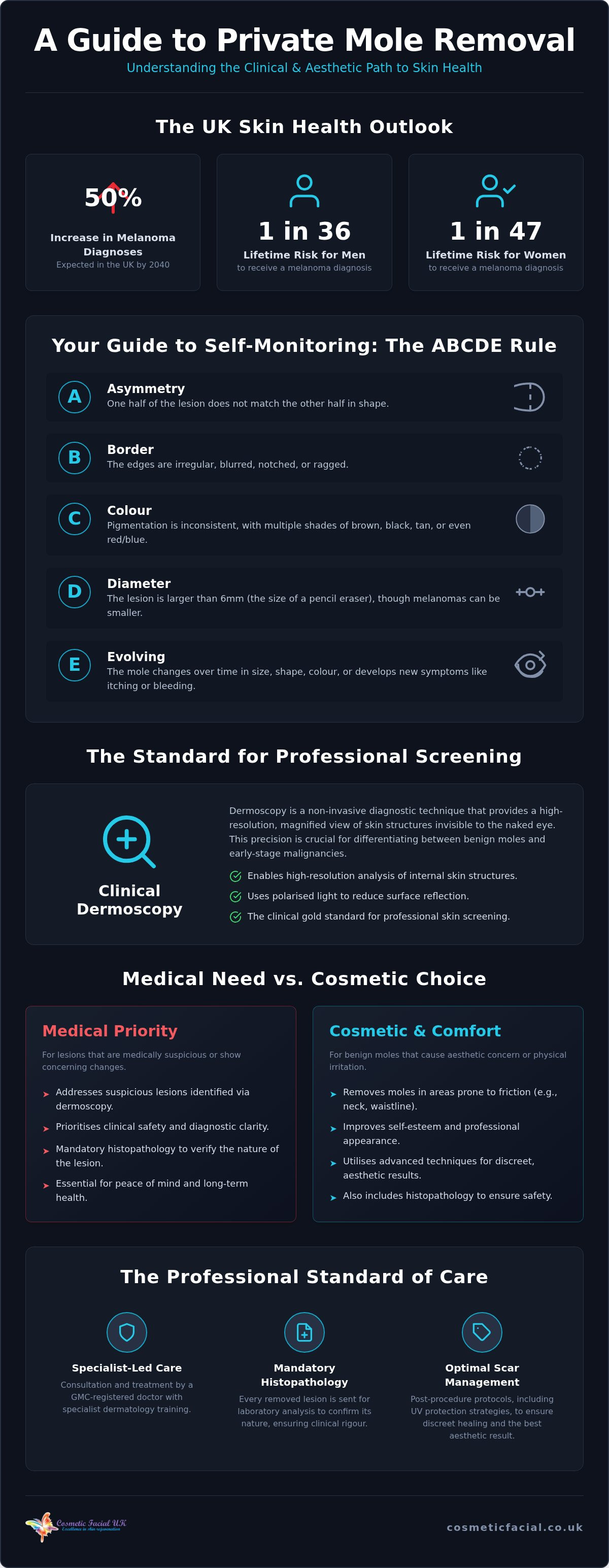
With melanoma diagnoses in the UK expected to increase by 50% by 2040, the decision to monitor skin lesions has moved from a cosmetic preference to a clinical priority. Current estimates suggest that 1 in 36 men and 1 in 47 women in the UK will receive a melanoma diagnosis during their lifetime. For many individuals, the challenge lies in accessing timely, expert assessment without the protracted waiting periods often associated with public dermatology services. Seeking private mole removal London offers a direct route to both diagnostic clarity and aesthetic precision, ensuring that concerning growths are addressed with professional rigour.
It's understandable to feel anxious when you notice a changing mole or a new lesion on the face or neck, particularly when you're concerned about the potential for visible scarring. This article explains why professional dermoscopy and specialist-led removal are essential for your long-term skin health. You'll discover the clinical standards maintained by a GMC-registered doctor in the heart of Marylebone, the importance of histopathology for peace of mind, and the advanced techniques used to achieve discreet results that prioritise both safety and appearance.
Key Takeaways
- Differentiate between benign pigmented naevi and medically suspicious lesions to determine the most appropriate clinical or aesthetic course of action.
- Understand how clinical dermoscopy enables a GP with specialist dermatology training to perform a non-invasive, high-resolution analysis of the skin's internal structures.
- Explore the various surgical techniques used for private mole removal london and the mandatory role of histopathology in verifying the nature of every removed lesion.
- Identify the essential post-procedure protocols and UV protection strategies required to ensure discreet healing and optimal scar management.
- Discover the benefits of receiving bespoke care in a boutique Marylebone clinic that prioritises clinical rigour alongside refined aesthetic outcomes.
Understanding Private Mole Removal in London: Medical vs Cosmetic Needs
A melanocytic naevus, commonly referred to as a mole, is a benign cluster of melanocytes; these are the cells responsible for skin pigmentation. These lesions can appear anywhere on the body and vary in size, shape, and colour. To gain a foundational understanding of these skin growths, one might ask: What is a mole? In most cases, these are harmless developments. However, distinguishing between a medically suspicious lesion and an aesthetically bothersome one requires clinical expertise. For many seeking private mole removal london, the motivation is often a combination of clinical caution and personal comfort.
Moles that are raised or positioned in areas prone to friction, such as the neck or waistline, often become irritated by clothing or jewellery. London patients, particularly busy professionals in Marylebone, often prioritise efficiency and clinical safety when dealing with lesions that interfere with their daily routine or professional appearance. While these growths may not be cancerous, they can cause persistent discomfort or affect a patient's self-esteem. A professional mole check serves as the essential first step before any intervention; this ensures that the removal method is tailored to the specific characteristics of the naevus.
To better understand the clinical process of identifying and treating these lesions, watch this helpful video:
When to Seek a Professional Mole Check
Regular screening is vital for individuals with a history of high UV exposure or a family history of skin cancer. A private dermatologist consultation london provides a comprehensive baseline for skin health, allowing for the early detection of subtle changes. Patients with fair skin, often classified as Fitzpatrick types I or II, should consider annual checks. Conversely, those with a high density of moles may require more frequent surveillance to manage their specific risk profile. Choosing a boutique clinic in Marylebone offers a more personalised alternative to large screening centres, ensuring your skin health is monitored by the same specialist over time.
The ABCDE Rule: A Guide for Home Monitoring
Self-monitoring is a proactive way to track skin health amidst a busy London lifestyle. The ABCDE rule provides a structured framework for assessment:
- Asymmetry: One half of the mole doesn't match the other.
- Border: Edges are irregular, blurred, or notched.
- Colour: Pigmentation is inconsistent, with shades of black, brown, or tan.
- Diameter: The lesion is larger than 6mm, though smaller melanomas do occur.
- Evolving: The mole changes in size, shape, or symptoms like itching or bleeding.
Whilst these signs are useful for home checks, they can't replace the precision of clinical magnification. Using a smartphone to photograph and track changes amongst existing moles is a helpful practice for private mole removal london candidates, but any evolution necessitates a formal review using dermoscopy. Only a clinical examination can confirm if a lesion requires surgical intervention or continued observation.
Clinical Dermoscopy: The Standard for Professional Skin Screening
Clinical excellence in dermatology relies on the ability to differentiate between benign pigmentations and early-stage malignancies with absolute precision. In our Marylebone clinic, this is achieved through dermoscopy, a non-invasive diagnostic technique that has become the clinical standard for private mole removal london. By using high-resolution magnification and polarised light, a specialist can visualise skin structures that are invisible to the naked eye. This precision is vital. It significantly reduces the incidence of unnecessary surgical excisions whilst ensuring that suspicious lesions are identified at the earliest possible stage.
What Happens During Your Consultation?
The process begins with a comprehensive medical history intake. Dr Didar reviews your history of cumulative sun exposure, previous skin treatments, and family health patterns to establish a personalized risk profile. Patients can opt for a focused single-lesion assessment or a "top-to-toe" full-body skin analysis. Conducted within our discreet Central London practice, these checks provide a methodical review of all pigmented areas, ensuring no lesion is overlooked. This thorough approach is particularly reassuring for those who've experienced long NHS waiting lists for non-urgent dermatology reviews. You can arrange a dermatology consultation to discuss your specific concerns in a professional, unhurried environment.
The Science of Dermoscopy
Dermoscopy is a non-invasive diagnostic tool that uses polarised light and magnification to reveal the internal architecture of a mole. By examining the distribution of pigment and the vascular patterns beneath the skin's surface, a doctor with specialist dermatology training can identify signs of melanoma before they become clinically obvious. Structural patterns, such as the pigment network or the presence of specific globules, help in categorising the naevus with a high degree of accuracy.
Documentation is a key component of this process. High-quality dermoscopic images allow for long-term monitoring and comparison amongst existing moles. If a mole is deemed safe but requires observation, these baseline images are essential for detecting minute changes over time. For those considering private mole removal london, this diagnostic stage ensures that any surgical intervention is both necessary and clinically justified. It's this level of rigour that provides patients with the clinical peace of mind they require before proceeding with any treatment.
Private Mole Removal Techniques: Choosing the Right Approach
The selection of a surgical technique for private mole removal london is determined by the lesion's morphology, its anatomical location, and the results of the initial dermoscopic screening. Every procedure is performed within a sterile clinical environment in Marylebone by a GMC-registered doctor; this ensures the highest standards of infection control and surgical precision. Whilst the primary objective is the safe removal of the naevus, we place significant emphasis on achieving a discreet aesthetic result. This is particularly crucial for moles located on the face or neck, where the skin's healing characteristics require specialised handling to minimise visible scarring. Local anaesthetic is used in all cases to ensure the process is entirely comfortable for the patient.
Shave Excision vs Elliptical Excision
Shave excision is typically reserved for raised, benign moles that protrude from the skin surface. During this procedure, the doctor uses a fine surgical blade to remove the lesion flush with the surrounding tissue. It's an efficient method that often doesn't require stitches; the resulting wound heals similarly to a small graze. In contrast, elliptical excision is necessary for flat moles or those showing suspicious clinical features. This method involves removing the entire thickness of the mole along with a small margin of healthy tissue to ensure complete clearance. The wound is then meticulously closed with sutures, often using deep dissolving stitches and fine surface stitches to reduce tension and improve the final scar appearance.
Healing timelines vary between these two approaches. A shave excision site typically forms a scab and heals within 7 to 10 days, leaving a flat mark that fades over several months. Elliptical excisions require more careful management; sutures are generally removed after 5 to 7 days for facial sites or up to 14 days for the body. The deeper nature of this excision means the scar will mature over a longer period, eventually becoming a fine, linear mark. Patients are provided with detailed aftercare instructions to support this maturation process.
Histopathology: Why We Test Every Mole
Clinical safety is non-negotiable. Every lesion removed at our practice is sent for histopathology; this is the microscopic examination of tissue by a consultant pathologist. This process is the gold standard for confirming that a mole is benign and hasn't undergone any malignant transformation. Even when a naevus appears entirely normal during dermoscopy, laboratory verification provides absolute clinical peace of mind. It ensures that the diagnosis is based on cellular analysis rather than visual assessment alone.
In a private London setting, histopathology results are typically available within 3 to 7 working days. This rapid turnaround is a significant advantage of private mole removal london, as it eliminates the prolonged anxiety often associated with waiting for diagnostic results through other channels. Once the report is received, your doctor will discuss the findings with you, ensuring you have a complete understanding of your skin health status. This final step completes the clinical pathway from initial screening to confirmed resolution.
Recovery and Scar Management: Achieving an Aesthetic Result
Clinical excellence in private mole removal london extends beyond the procedure room into the months of recovery that follow. We understand that for many patients, the anxiety over potential scarring on the face or neck is a primary concern. Our surgical approach prioritises the placement of incisions along relaxed skin tension lines; this technique significantly reduces the visibility of the final scar. It's a standard of care that makes our Marylebone practice a preferred choice for those integrating removal into a full face rejuvenation plan london, ensuring that the skin's overall harmony is maintained.
The First 48 Hours: Immediate Aftercare
Immediate post-procedure care is critical for preventing infection and ensuring the wound edges remain stable. During the first 48 hours, patients should follow a structured routine to support the initial healing phase:
- Keep the surgical dressing dry and intact for the first 24 to 48 hours as advised.
- Avoid strenuous physical activity that could cause tension or stretching at the wound site.
- Clean the area gently with sterile saline only when instructed, applying a thin layer of prescribed ointment to maintain a moist environment.
Mild redness or slight swelling around the incision is a normal physiological response and typically subsides within three days. If stitches were used during an elliptical excision at our Marylebone clinic, they're usually removed between 5 and 14 days later. The exact timing depends on the anatomical location of the mole and the rate of individual tissue repair.
Long-Term Scar Management
Once the initial wound has closed, the focus shifts to scar maturation. A scar's appearance evolves significantly over several months as collagen remodels and the blood supply to the area normalises. UV protection is non-negotiable during this essential phase of private mole removal london; direct sun exposure can lead to permanent hyperpigmentation of the healing tissue. We recommend a high-factor SPF applied daily, even in overcast conditions, whilst the scar matures.
To further refine the result, patients can use silicone-based gels and gentle massage techniques to soften and flatten the scar tissue. This process helps the scar blend with the surrounding skin more effectively. For those looking to achieve a truly seamless finish, subsequent treatments such as chemical peels can later assist in blending skin texture and tone once the site has fully matured, typically after six months.
Why Choose Cosmetic Facial in Marylebone for Mole Removal?
Selecting a provider for private mole removal london involves more than just a surgical procedure; it requires a practitioner who understands the delicate balance between clinical necessity and aesthetic confidence. Cosmetic Facial operates as a boutique alternative to high-volume screening centres, offering a medical-aesthetic hybrid approach that prioritises both the safety of the lesion and the patient's desire for a discreet final result. For those interested in how surgical precision translates to other areas of facial aesthetics, you can check out Emre Üregen M.D., a specialist in advanced skin rejuvenation. This specialised focus is particularly advantageous for busy professionals in Marylebone and Central London who require expert care delivered with efficiency and clinical rigour. By bridging the gap between medical dermatology and advanced aesthetic skin health, we ensure that every patient receives a comprehensive management plan tailored to their unique skin profile.
The practice is led by Dr Faramarz Didar (GMC 5200505), a GP with an MSc in Dermatology Skills and Treatment, awarded with Commendation from the University of Hertfordshire. His clinical background is supplemented by extensive training in leading medical centres across Europe and membership in the European College of Aesthetic Medicine & Surgery. This depth of education allows for a highly methodical approach to skin analysis, where dermoscopy is used to its full potential to avoid unnecessary excisions. Dr Didar’s commitment to academic excellence ensures that the latest clinical evidence is integrated into every treatment plan, providing a level of expertise that earns trust through depth of information rather than marketing claims.
A Discreet Marylebone Clinic Experience
Our Marylebone clinic offers a discreet and professional atmosphere where the patient experience is defined by calm, unhurried care. We focus on managing expectations through clear, technical communication, ensuring that you are fully informed about the nature of your skin lesions and the specifics of the removal process. This unhurried pace is essential for a thorough clinical experience, allowing enough time for a detailed medical history and a precise surgical plan. We believe that professional reassurance is built through intellectual honesty and a shared understanding of the clinical pathway. We invite you to book a specialist mole check or consultation at our Central London practice to discuss your skin concerns with a knowledgeable expert who prioritises your health and aesthetic outcomes equally.
Prioritising Clinical Rigour and Aesthetic Outcomes
Accessing private mole removal london ensures that concerning lesions are assessed with the highest diagnostic standards. By utilising advanced dermoscopy and mandatory histopathology, we provide a clear clinical pathway that prioritises your long-term health. Our Marylebone practice combines this medical precision with refined surgical techniques to achieve discreet results, particularly for sensitive areas like the face and neck.
Led by Dr Faramarz Didar (GMC 5200505), a GP who holds an MSc in Dermatology with Commendation, the clinic offers a professional and unhurried environment. This expertise is essential for distinguishing between benign naevi and suspicious growths, giving you the clinical peace of mind you deserve. It's a vital investment in your future wellbeing to take a proactive approach to skin health.
We're ready to provide the specialist care and professional reassurance you require. Your skin health is our primary focus, and we look forward to welcoming you to our Marylebone practice.
Frequently Asked Questions
Is a private mole check in London worth the cost compared to the NHS?
A private check is often considered essential for those seeking immediate access to a specialist. The NHS typically only removes moles that meet specific clinical criteria for suspected malignancy. If your concern is aesthetic or if a benign mole is causing physical irritation, public services won't usually provide treatment. Choosing private mole removal london allows for a comprehensive assessment by a doctor with specialist dermatology training in an unhurried, professional environment.
How long does a full body mole check appointment take?
A comprehensive "top-to-toe" skin analysis generally requires between 30 and 45 minutes to complete. This duration allows for a thorough review of your medical history followed by a detailed examination of individual lesions using a dermatoscope. The exact time depends on the total number of naevi present on your skin. Dr Didar ensures that every suspicious or irregular growth is meticulously documented and analysed during this clinical consultation in Marylebone.
Can a dermatologist tell if a mole is cancerous just by looking at it?
Whilst a specialist can identify suspicious clinical features with the naked eye, a definitive diagnosis cannot be made by visual inspection alone. Clinical dermoscopy is the standard tool used to visualise deeper structures within the skin. If a lesion shows irregular patterns under magnification, surgical removal and histopathology are required. Laboratory analysis remains the only "gold standard" method to confirm whether a mole is benign or contains malignant cells.
Will I have a scar after my mole is removed?
Any procedure that breaks the skin's surface will result in a permanent mark, though its visibility varies significantly. Shave excisions often leave a flat, pale mark that blends well with the surrounding tissue. Elliptical excisions result in a fine, linear scar. Dr Didar utilises advanced surgical techniques and precise suture placement to ensure the most discreet aesthetic outcome possible, which is particularly important for lesions located on the face or neck.
Is the mole removal procedure painful?
The procedure is not painful as it's performed under local anaesthesia. You'll feel a brief stinging sensation during the initial injection, but the area becomes completely numb within seconds. Once the anaesthetic has taken effect, you won't feel any sharp pain or discomfort whilst the mole is being removed. Most patients find the experience very tolerable and are able to return to their normal daily activities immediately after leaving the clinic.
What happens if a mole is found to be suspicious during my check?
If a lesion displays irregular dermoscopic features, Dr Didar will recommend a formal excision. The mole is removed in its entirety, including a small margin of healthy tissue, and is immediately sent to a consultant pathologist for microscopic analysis. This histopathology report confirms the exact nature of the cells. We'll then arrange a follow-up appointment to discuss these laboratory findings and determine if any further clinical intervention is necessary for your health.
Do I need a GP referral to book a mole check in Marylebone?
You don't require a referral from your NHS General Practitioner to book a consultation at our practice. Private patients can contact us directly to arrange a specialist skin analysis or a focused check of a specific lesion. This direct access is a significant advantage of private mole removal london, as it bypasses the lengthy administrative wait times often found in the public sector, allowing you to address your skin concerns with clinical efficiency.
How quickly can I get my histopathology results?
In a private clinical setting, histopathology results are typically processed and returned within 3 to 7 working days. This rapid turnaround time is vital for reducing patient anxiety and ensuring that any necessary follow-up care is initiated promptly. Once the consultant pathologist has completed the microscopic examination of the tissue, Dr Didar will personally review the report with you to provide absolute clinical peace of mind regarding the nature of the lesion.
Disclaimer
All content on cosmetic Facial website, including blogs, graphics, logos, images, and software, is the property of CosmeticFacial UK or its content suppliers and is protected by applicable copyright laws. Unauthorized use, reproduction, distribution, or modification of any content without prior written permission is strictly prohibited.


