


Deciding to explore Botox in London is rarely a snap decision. Most people spend weeks researching, second-guessing, and wondering whether the results will look natural, whether the procedure is genuinely safe, and how on earth they're supposed to identify a qualified practitioner amongst the sheer volume of clinics operating across the city. Those concerns are entirely reasonable, and they deserve straightforward answers.
The demand for Botox treatments has grown considerably in recent years, yet the volume of available information hasn't always made the decision-making process easier. If anything, conflicting advice online can leave prospective patients feeling less certain than when they started. This guide is designed to change that. Whether you're considering treatment for the first time or looking to better understand what a responsible clinical experience should involve, what follows covers the Botox process from initial consultation through to aftercare, what to look for when selecting a clinic, and how to approach the decision with confidence. The aim is straightforward: to give you the clinical clarity you need to make an informed choice.
Key Takeaways
- Botox is a clinically established treatment derived from botulinum toxin that works by temporarily relaxing targeted facial muscles - understanding its mechanism helps set realistic expectations before you commit to a procedure.
- Navigating botox london clinics requires more than a quick search; verifying a practitioner's qualifications, regulatory standing, and clinical experience are essential steps that this guide walks you through in detail.
- A responsible Botox appointment follows a structured process, from pre-treatment assessment through to the procedure itself - knowing what to anticipate at each stage allows you to attend with confidence rather than uncertainty.
- Botox and dermal fillers are frequently confused, yet they work through fundamentally different mechanisms and are suited to distinct aesthetic concerns - this article clarifies the key differences so you can identify which approach may be appropriate for your needs.
- Making an informed decision about any cosmetic procedure requires professional consultation; this guide equips you with the right questions to ask and the clinical context to evaluate the answers you receive.
What is Botox and How Does It Work?
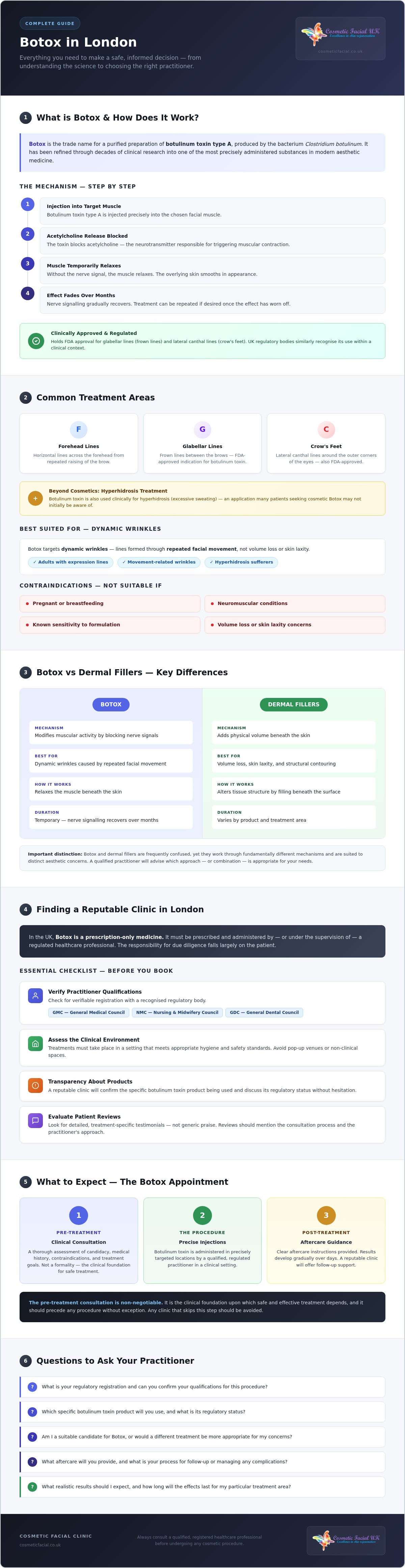
Botox is the widely recognised trade name for a purified preparation of botulinum toxin type A, a neurotoxic protein produced by the bacterium Clostridium botulinum. Despite its origins as a bacterial toxin, it has been refined through decades of clinical research into one of the most precisely administered substances in modern aesthetic medicine. Its use in cosmetic treatments is now well established, and its safety record, when administered by qualified practitioners, is extensively documented.
The mechanism is specific and localised. When injected into a target muscle, botulinum toxin type A blocks the release of acetylcholine, the neurotransmitter responsible for triggering muscular contraction. Without that signal, the muscle temporarily relaxes. The overlying skin, no longer being pulled by repeated contractions, smooths in appearance. The effect is temporary; nerve signalling gradually recovers over a period of months, at which point treatment can be repeated if desired.
The Science Behind Botox
Clinical evidence supporting botulinum toxin type A for cosmetic use is substantial. The treatment holds approval from the United States Food and Drug Administration for several cosmetic indications, including glabellar lines (the frown lines between the brows) and lateral canthal lines (commonly referred to as crow's feet). Regulatory bodies in the United Kingdom similarly recognise its use within a clinical context. Unlike dermal fillers, which add volume beneath the skin, Botox works by modifying muscular activity rather than altering tissue structure. This distinction is clinically significant and determines which approach is appropriate for a given concern.
Who Should Consider Botox?
Botox is most appropriate for adults who are bothered by dynamic wrinkles, those formed through repeated facial movement rather than by volume loss or skin laxity. Common treatment areas include the forehead, the glabellar region, and the periorbital area around the eyes. Beyond cosmetic applications, botulinum toxin is also used clinically for hyperhidrosis (excessive sweating), a condition that a number of patients seeking botox london treatments may not initially realise can be addressed through the same mechanism.
Certain individuals are not suitable candidates. Pregnancy, breastfeeding, specific neuromuscular conditions, and known sensitivity to any component of the formulation are all contraindications that a qualified practitioner will assess during a pre-treatment consultation. For those who are currently prioritising their reproductive health or planning a family, you can check out Ombright Wellness Fertility Acupuncture for specialised holistic support. That consultation is not a formality; it's the clinical foundation upon which safe and effective treatment depends, and it should precede any procedure without exception.
For those exploring botox london options, understanding both the science and the appropriate candidacy criteria is the starting point for a well-informed decision.
Finding a Reputable Botox Clinic in London
London has no shortage of clinics offering botulinum toxin treatments. The challenge isn't finding options; it's distinguishing between them. Regulatory oversight of cosmetic procedures in the United Kingdom has tightened in recent years, yet the market remains varied in quality, and the responsibility for due diligence falls largely on the patient. Knowing what to look for before you book makes that process considerably more manageable.
Several factors carry particular weight when assessing a clinic's suitability. These include:
- Practitioner qualifications: In the UK, Botox is a prescription-only medicine. It must be prescribed and administered by, or under the supervision of, a regulated healthcare professional. Look for practitioners with verifiable registration through bodies such as the General Medical Council (GMC), the Nursing and Midwifery Council (NMC), or the General Dental Council (GDC).
- Clinical environment: Treatments should take place in a setting that meets appropriate hygiene and safety standards, not a pop-up venue or non-clinical space.
- Transparency about products: A reputable clinic will be able to confirm the specific botulinum toxin product being used and discuss its regulatory status without hesitation.
- Patient reviews: Look for detailed, treatment-specific testimonials rather than generic praise. Reviews that mention the consultation process, the practitioner's approach to assessment, and the clinical outcome are more informative than brief star ratings.
Top Botox Clinics in London
For those seeking botox london treatments in a clinical setting with qualified practitioners, Cosmetic Facial in Marylebone is a well-established option. The clinic offers a range of aesthetic treatments alongside Botox, including dermal fillers, skin peels, and mesotherapy, which allows for a more comprehensive assessment of a patient's concerns within a single practice. Marylebone itself is home to a number of reputable aesthetic clinics, reflecting the area's concentration of medical professionals and private healthcare facilities. When researching options online, prioritise clinic websites that provide clear information about practitioner credentials, the consultation process, and the specific treatments offered, rather than those that lead primarily with pricing or promotional offers.
What to Ask During Your Consultation
A pre-treatment consultation is the appropriate moment to ask direct questions. Don't treat it as a formality. Useful lines of enquiry include:
- What is your clinical background, and are you registered with a UK regulatory body?
- How many Botox treatments have you personally administered?
- Which product will be used, and what is the dosage being proposed for my treatment areas?
- What are the potential risks and side effects, and how would complications be managed?
- What aftercare guidance will I receive, and is there a point of contact if I have concerns post-treatment?
A practitioner who responds to these questions with clarity and without defensiveness is demonstrating the kind of clinical professionalism that responsible botox london treatment requires. If any question is deflected or met with vague reassurance, treat that as a meaningful signal.
What to Expect During Your Botox Appointment
For many patients, the uncertainty surrounding a first botox london appointment is less about the procedure itself and more about not knowing what the experience will actually involve. Understanding the sequence of events, from the moment you arrive through to the days that follow, removes much of that uncertainty and allows you to attend the appointment in a more informed and settled frame of mind.
Most appointments begin with a brief review of the consultation notes already taken, confirming the treatment areas, the dosage agreed upon, and any contraindications that were identified. If this is your first appointment at a particular clinic, the practitioner may conduct a short facial assessment, observing your muscle movement and skin quality in the areas to be treated. Photographs are sometimes taken at this stage as a clinical baseline for comparison at follow-up.
Preparation prior to the appointment is straightforward. Patients are generally advised to avoid alcohol for at least twenty-four hours beforehand and to refrain from blood-thinning medications or supplements, such as aspirin or high-dose fish oil, unless these have been prescribed by a doctor. Arriving with clean skin, free of makeup or topical products, is also standard practice.
The Injection Process Explained
The procedure itself is brief. Most treatment sessions, covering one or two areas such as the forehead and glabellar region, are completed within ten to fifteen minutes. The practitioner will use a fine-gauge needle to deliver small, precise volumes of botulinum toxin into the targeted musculature. The number of injection points varies depending on the treatment area and the clinical approach being taken. Topical anaesthetic is not routinely required, though it can be applied if a patient prefers it. Most people describe the sensation as a mild, transient sting at the injection site, which resolves almost immediately.
Visible results don't appear immediately. The neuromuscular effect typically becomes noticeable within three to five days, with the full outcome evident at around two weeks post-treatment. This timeline is clinically consistent and worth bearing in mind if you have a specific event or occasion in mind when booking.
Aftercare Instructions
Post-treatment care is not complicated, but it does require some attention in the first twenty-four to forty-eight hours. The following guidance reflects standard clinical recommendations:
- Avoid touching or massaging the treated areas for at least four hours following the procedure, to minimise the risk of product migration to unintended muscle groups.
- Remain upright for a minimum of four hours post-treatment; lying flat during this window is not advised.
- Avoid strenuous exercise, saunas, and excessive heat exposure for twenty-four hours, as elevated body temperature may affect how the product settles.
- Refrain from applying pressure to the face, including through facials or facial massage, until the practitioner confirms it's appropriate to resume.
Minor bruising, localised redness, or mild swelling at the injection sites are common and typically resolve within a few days. These are expected responses to the procedure rather than signs of complication. Symptoms that warrant prompt contact with the treating practitioner include asymmetry that persists beyond two weeks, drooping of the eyelid (ptosis), or any unusual visual disturbance.
A follow-up appointment, usually scheduled at two weeks post-treatment, allows the practitioner to assess the outcome, address any concerns, and determine whether a small corrective dose is needed. This review is a standard part of responsible botox london practice and shouldn't be skipped, particularly after a first treatment when the individual response to dosage is still being established.
Comparing Botox with Other Cosmetic Treatments
Botox is one option within a considerably broader landscape of non-surgical aesthetic treatments. For patients researching their choices, the distinctions between available procedures are not always clearly explained, and conflating treatments that work through fundamentally different mechanisms can lead to misaligned expectations. Understanding how Botox compares to alternatives such as dermal fillers, high-intensity focused ultrasound (HIFU), and radiofrequency (RF) treatments allows for a more considered clinical decision.
Botox vs. Dermal Fillers
The confusion between Botox and dermal fillers is understandable; both are injectable treatments delivered in a clinical setting, and both address visible signs of ageing. The mechanisms, however, are entirely distinct. Botox works by temporarily inhibiting muscular contraction, making it appropriate for dynamic wrinkles formed through repeated facial movement. Dermal fillers, by contrast, are typically composed of hyaluronic acid, a substance that adds volume beneath the skin's surface to address structural concerns such as nasolabial folds, hollowing beneath the eyes, or loss of definition along the jawline.
In terms of longevity, dermal fillers generally persist for longer than botulinum toxin treatments. Depending on the product used and the area treated, filler results can remain visible for anywhere from six months to over a year. Botox typically requires repeat treatment every three to four months to maintain results. Cost structures reflect these differences; filler treatments are generally priced per syringe and tend to carry a higher per-session cost than Botox, though the longer duration between sessions can offset this over time. Neither treatment is universally superior. The appropriate choice depends on the specific concern being addressed, and in many cases a qualified practitioner will recommend a combination of both to achieve a balanced outcome.
Other Alternatives: HIFU and RF Treatments
HIFU and radiofrequency treatments represent a different category altogether. Rather than targeting muscular activity or replacing lost volume, these technologies work by delivering controlled energy into deeper tissue layers to stimulate collagen production and promote tissue tightening. HIFU uses focused ultrasound energy to reach the superficial musculoaponeurotic system (SMAS), the same layer addressed in surgical facelifts, making it particularly suited to patients experiencing skin laxity rather than dynamic wrinkling. RF treatments work at a shallower depth and are often used to improve overall skin quality and firmness across larger surface areas.
The results from HIFU and RF treatments develop gradually over several weeks as collagen remodelling progresses, which contrasts with the relatively rapid onset seen with Botox. Neither technology is appropriate as a direct substitute for botulinum toxin; they address different tissue concerns and suit different patient profiles. Candidates experiencing significant skin laxity, reduced tissue density, or early jowling may benefit more from HIFU or RF than from Botox alone.
For patients exploring botox london treatments alongside other aesthetic options, a thorough consultation remains the essential starting point. Identifying the correct treatment, or combination of treatments, for a specific concern requires clinical assessment rather than self-diagnosis. Book a consultation at Cosmetic Facial to discuss which approach is clinically appropriate for your individual needs.
Conclusion: Making Informed Choices About Botox in London
Reaching the end of this guide, a few things should be considerably clearer than they were at the outset. Botox is a clinically established treatment with a well-documented mechanism, a defined safety profile, and a specific range of appropriate applications. It is not a universal solution for every aesthetic concern, and it is not without risk when administered outside a properly regulated clinical environment. Both of those realities matter equally.
The most consistent thread running through every stage of this guide is the centrality of clinical expertise. The science behind botulinum toxin type A is well understood, but its safe and effective application depends on the judgement, training, and regulatory standing of the practitioner delivering it. A thorough pre-treatment consultation, transparent communication about products and dosage, and structured aftercare are not optional extras in responsible botox london practice. They are the standard against which every clinic should be measured.
Before proceeding with any treatment, it's worth returning to a few core principles:
- Verify credentials: Confirm that your practitioner holds registration with a recognised UK regulatory body such as the GMC, NMC, or GDC before agreeing to any procedure.
- Prioritise consultation: No reputable clinic will proceed without a clinical assessment. If a provider skips this step or treats it as a formality, that's a meaningful signal.
- Understand the treatment: Knowing what Botox can and cannot address, how it differs from dermal fillers and energy-based treatments, and what realistic outcomes look like allows you to evaluate the advice you receive rather than simply accepting it.
- Follow aftercare guidance: The two weeks following treatment are clinically significant. Adhering to aftercare instructions and attending a follow-up review are straightforward steps that protect both your results and your safety.
Choosing where to seek treatment in a city as large and varied as London requires deliberate research rather than convenience-led decisions. The volume of clinics operating across the capital is not itself a guarantee of quality, and promotional pricing should never be the primary consideration when assessing a provider.
For those ready to take the next step, Cosmetic Facial in Marylebone offers a considered starting point. With a qualified clinical team and a broad range of aesthetic treatments available alongside botox london services, the clinic provides the kind of comprehensive assessment that allows patients to make genuinely informed decisions. Book a consultation to discuss your specific concerns and determine which approach is clinically appropriate for your individual needs.
Take the Next Step Towards Informed Botox Treatment
Understanding the clinical foundations of botulinum toxin, knowing how to assess a practitioner's credentials, and recognising what a responsible appointment looks like are all meaningful steps towards a well-considered decision. The research you've done here matters.
What follows that research is equally important: a proper consultation with a qualified specialist who can assess your individual concerns, discuss appropriate treatment options, and provide personalised care rather than a one-size-fits-all approach. That's where general knowledge gives way to clinical judgement specific to you.
Beyond the clinical room, many find that a truly comprehensive approach to self-improvement involves nurturing the mind and spirit. If you are interested in a holistic path to wellness, Best Life-ing offers luxury retreats and customised healing experiences designed for personal transformation.
For those ready to move forward with botox london treatment, Cosmetic Facial in Marylebone offers access to experienced practitioners and a straightforward online booking system that makes arranging an appointment uncomplicated. The consultation process is the right starting point, not a formality to work around.
Book your consultation for Botox today at Cosmetic Facial and take the first step with the clinical clarity you need to proceed confidently.
Frequently Asked Questions About Botox in London
What is Botox and how long does it last?
Botox is a purified preparation of botulinum toxin type A that temporarily relaxes targeted facial muscles by blocking the neurotransmitter responsible for triggering muscular contraction. It's primarily used to reduce the appearance of dynamic wrinkles formed through repeated facial movement. Results typically become visible within three to five days of treatment and last between three and four months, after which the nerve signalling gradually recovers and treatment can be repeated if desired.
Are there any side effects associated with Botox injections?
Minor side effects are common and generally short-lived. These include localised redness, mild swelling, and bruising at the injection sites, all of which typically resolve within a few days. Less common but clinically significant effects include eyelid ptosis (drooping) or asymmetry that persists beyond two weeks. These outcomes are rare when treatment is administered by a qualified, registered practitioner but should prompt immediate contact with your treating clinician if they occur.
How much does Botox treatment cost in London?
Botox pricing in London varies depending on the number of treatment areas, the practitioner's level of experience, and the clinical setting. Costs are typically structured per area treated rather than per unit. Patients are advised to treat significantly low pricing with caution; it can indicate the use of unlicensed products or under-qualified practitioners. For accurate pricing specific to your treatment plan, a consultation with a qualified practitioner is the appropriate starting point rather than comparing headline figures online.
Can I combine Botox with other cosmetic procedures?
Combining botox london treatments with other procedures is clinically common and, in many cases, produces more balanced outcomes than a single treatment approach. Botox addresses dynamic wrinkling caused by muscular activity, whilst dermal fillers restore volume in areas affected by structural loss. Skin-quality treatments such as mesotherapy, skin peels, or microneedling can complement both. The appropriate combination depends on your individual concerns and should be determined through clinical assessment rather than self-selection.
How do I prepare for my Botox appointment?
Preparation is straightforward. Avoid alcohol for at least twenty-four hours before your appointment, and refrain from blood-thinning medications or supplements such as aspirin or high-dose fish oil unless these have been prescribed by a doctor. Arrive with clean skin, free of makeup or topical products. If you're attending for the first time, bring a list of any medications you're currently taking, as these are relevant to the pre-treatment assessment your practitioner will conduct.
What should I do if I experience complications after Botox?
Minor post-treatment responses such as bruising or localised swelling don't require intervention and typically resolve independently within a few days. Symptoms that warrant prompt clinical attention include persistent asymmetry beyond two weeks, eyelid drooping, difficulty swallowing, or any unusual visual disturbance. Contact your treating practitioner directly in the first instance; a reputable clinic will provide a clear point of contact for post-treatment concerns as part of their standard aftercare provision.
Is Botox suitable for everyone?
Botox isn't appropriate for all patients. Pregnancy, breastfeeding, certain neuromuscular conditions such as myasthenia gravis, and known sensitivity to any component of the botulinum toxin formulation are all contraindications. It's also most effective for dynamic wrinkles rather than those caused by volume loss or skin laxity, which may respond better to dermal fillers or energy-based treatments. A thorough pre-treatment consultation with a qualified practitioner is the only reliable way to establish whether Botox is clinically appropriate for your specific circumstances.
Disclaimer
All content on cosmetic Facial website, including blogs, graphics, logos, images, and software, is the property of CosmeticFacial UK or its content suppliers and is protected by applicable copyright laws. Unauthorized use, reproduction, distribution, or modification of any content without prior written permission is strictly prohibited.


