


Achieving a refreshed appearance in the peri-orbital area is less about the quantity of product used and more about a precise anatomical understanding of the tear trough. Many individuals find that even a full night of rest cannot resolve the persistent shadows or hollows beneath their eyes, leading to a look of perpetual exhaustion that concealer fails to mask. When searching for under eye filler London, patients often express valid concerns regarding complications such as puffiness or the blue-tinted Tyndall effect. These issues typically arise when the treatment is approached as a simple filling exercise rather than a complex dermatological procedure.
This clinical guide explores the nuances of tear trough rejuvenation and explains how specialist expertise ensures natural, refreshed results. You'll learn how a GMC-registered doctor manages the unique challenges of thin sub-orbital skin to restore lost volume safely. We will preview the importance of bespoke consultations and the use of licensed hyaluronic acid fillers, providing a clear path toward looking well-rested and revitalised. By prioritising clinical precision over temporary trends, it's possible to achieve a subtle restoration that respects your natural facial structure.
Key Takeaways
- Understand how the orbicularis retaining ligament dictates the depth of the tear trough and why precise anatomical mapping is essential for a natural result.
- Learn about the clinical significance of hyaluronic acid rheology, specifically why fillers with low G-prime are required to prevent the blue-tinted Tyndall effect.
- Discover how to evaluate whether volume restoration alone is sufficient or if technology-based solutions like a HIFU face lift are needed to address skin laxity.
- Find out why seeking treatment from a GMC-registered doctor for under eye filler London ensures your procedure is guided by advanced dermatological expertise.
- Explore the structured patient journey at our Marylebone clinic, focusing on the importance of a comprehensive clinical history and skin analysis.
What is Under Eye Filler? Defining Tear Trough Rejuvenation
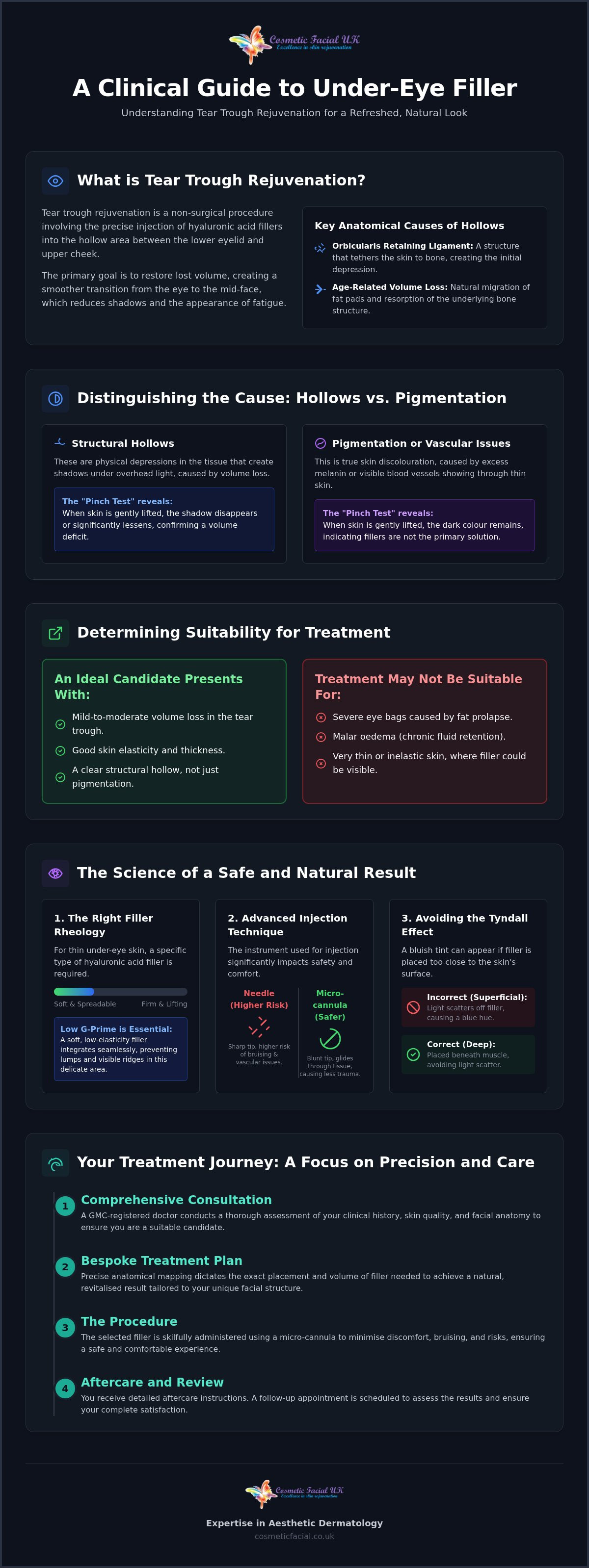
The application of under eye filler london involves the precise injection of hyaluronic acid dermal fillers into the depression situated between the lower eyelid and the upper cheek. This specific region is clinically termed the tear trough. A tear trough deformity is a three-dimensional anatomical hollow that creates a shadow. By restoring volume to this junction, clinicians can mitigate the appearance of fatigue and create a smoother transition between the eyelid and the mid-face.
The primary cause of this indentation is the orbicularis retaining ligament; this structure binds the skin and muscle to the underlying orbital rim. As we age, physiological changes such as age-related fat pad migration and bone resorption exacerbate the depth of the hollow. These structural shifts contribute significantly to cosmetic problems of the periorbita, as the loss of bony and fatty support allows the overlying skin to appear sunken or shadowed.
Hollows vs. Pigmentation: Identifying Your Concern
It's vital to distinguish between structural hollows and pigmentation before proceeding with treatment. Structural hollows are physical shadows caused by the recession of tissue. In contrast, vascular or pigmented dark circles result from blood vessels showing through thin skin or excess melanin production. To assess skin laxity and determine the origin of the shadow, clinicians often perform a "pinch test" in the peri-orbital region. By gently lifting the skin away from the bone, we can observe if the shadow disappears, which indicates a structural hollow, or remains, which suggests pigmentation. Light reflection plays a critical role here. When a hollow exists, overhead lighting creates a shadow that deepens the dark appearance; filling the area allows for more uniform light reflection and a brighter aesthetic.
Who is the Ideal Candidate for Under Eye Filler?
Success with under eye filler london depends heavily on rigorous patient selection. The ideal candidate possesses good skin elasticity and presents with mild-to-moderate volume loss. If the skin is too thin or inelastic, the filler may not integrate well and could remain visible. Conversely, filler is generally not recommended for patients with severe eye bags caused by fat prolapse or those suffering from malar oedema, which is chronic fluid retention. In these instances, adding volume could worsen the appearance of puffiness rather than resolving it. A comprehensive private dermatologist consultation london is necessary to evaluate these anatomical nuances and ensure the treatment plan is appropriate for your specific skin health.
The Clinical Science of Peri-Orbital Dermal Fillers
The clinical success of under eye filler london is largely determined by the rheology of the chosen hyaluronic acid. Rheology refers to how a substance flows and deforms under pressure. In the peri-orbital region, where the skin is exceptionally thin, it's necessary to select fillers with a low G-prime. G-prime is a measure of a gel's elasticity; a lower value indicates a softer, more spreadable product that integrates seamlessly with delicate tissues without creating palpable lumps or visible ridges.
Dr Didar’s MSc in Dermatology informs the precise selection of filler concentration and cross-linking density for each patient. A comprehensive clinical review of tear trough treatment confirms that using a product with excessive lifting capacity in this area can lead to unnatural projections. Precision is further enhanced through the use of micro-cannulas. Unlike traditional needles, these blunt-tipped instruments slide through the tissue layers, which significantly reduces the risk of vascular compromise and post-procedural bruising.
One frequent complication of poorly executed treatment is the Tyndall effect. This occurs when hyaluronic acid is placed too superficially, causing light to scatter and produce a persistent blue tint beneath the skin. Avoiding this requires deep placement and an expert understanding of light physics. Patients seeking professional aesthetic guidance in Marylebone benefit from a medical approach that prioritises these subtle clinical nuances to prevent such aesthetic setbacks.
Hyaluronic Acid and Tissue Integration
Modern hyaluronic acid formulations, such as those within the Restylane or Juvederm ranges, are engineered to mimic the body's natural polysaccharides. These gels are inherently hydrophilic, meaning they attract and bind water molecules to maintain volume. Managing this water retention is critical to avoid chronic post-treatment oedema or "morning puffiness." Specialist practitioners ensure the filler does not migrate during dynamic facial expressions by placing the product in the correct anatomical plane, which maintains a natural appearance during movement.
Anatomical Safety and Precision
The sub-orbital region contains vital structures, including the infraorbital foramen and various terminal vascular branches. Achieving optimal results involves sub-orbicularis placement, where the filler is deposited beneath the muscle layer to provide a natural camouflage. This depth is essential for safety, as it keeps the product away from the skin surface and ensures it remains undetectable. Given the proximity to the optic nerve and major blood vessels, clinical expertise is a non-negotiable requirement for any peri-orbital intervention.
Comparing Rejuvenation Options: Filler vs. Tech-Based Solutions
Whilst under eye filler london is a primary solution for treating structural hollows, clinical assessment often reveals that volume restoration alone is insufficient for comprehensive rejuvenation. If peri-orbital concerns involve skin laxity or surface irregularities rather than just a lack of volume, relying solely on dermal fillers london can lead to overfilling and an unnatural aesthetic. Clinicians must adhere to FDA guidance on dermal fillers, which emphasises using these devices only for their intended purposes, such as correcting specific anatomical deficiencies rather than attempting to resolve skin quality issues with gel alone.
For patients presenting with significant skin sagging or mild fat bulging, a HIFU face lift (High-Intensity Focused Ultrasound) provides a non-surgical alternative by targeting the deeper structural layers to induce collagen contraction. This approach is frequently integrated into a full face rejuvenation plan london to ensure that the under-eye area harmonises with the surrounding facial contours. Addressing the foundation of the face often reduces the amount of filler required in the tear trough itself.
Energy-Based Devices for Eye Bags
Non-invasive technologies like radiofrequency and HIFU are utilised to tighten the lower eyelid skin by delivering thermal energy to the dermis. This process stimulates fibroblasts without the need for surgical excision. For "crepey" skin texture, a Fractional CO2 laser is often the preferred modality, as it creates microscopic treatment zones that trigger a robust healing response and improve skin density. For international readers seeking advanced skin rejuvenation options abroad, you can visit RJ Clinic to learn more about their specialist services.
- Dermal Filler (Volume): Best for restoring the eyelid-cheek junction and filling deep hollows.
- Fractional CO2 Laser (Texture): Targets fine lines and superficial skin irregularities.
- HIFU (Tightness): Focuses on lifting and firming the peri-orbital skin through deep tissue heating.
Medical Skin Nutrition and Mesotherapy
Improving the biological health of the skin is a prerequisite for any injectable treatment. We often employ mesotherapy to deliver a concentrated cocktail of vitamins, minerals, and antioxidants directly into the mesoderm. This technique is particularly effective for vascular dark circles, where poor microcirculation causes a bluish hue. By enhancing the quality and thickness of the dermis before applying under eye filler london, we ensure a more stable foundation for volume correction. Healthy, well-nourished skin integrates with hyaluronic acid much more effectively, leading to longer-lasting and more natural results.
The Treatment Journey: Your Visit to Our Marylebone Clinic
The process at our Marylebone clinic begins with a comprehensive clinical history and dermatological skin analysis. This initial phase ensures that any underlying medical conditions or skin sensitivities are identified before proceeding. Dr Didar evaluates the specific topography of the peri-orbital area, looking for signs of volume loss and assessing the thickness of the dermis. Following the assessment, the anatomy is mapped with precision. Injection points are marked to guide the placement of the product, ensuring symmetry and anatomical accuracy.
During the procedure, patient comfort is prioritised. We apply a high-strength topical anaesthesia to the area, and the hyaluronic acid gels we utilise are typically infused with lidocaine, a local anaesthetic. This dual approach minimises discomfort during the administration of under eye filler london. The actual injection phase is methodical and unhurried, often taking approximately 30 minutes. Once the treatment is complete, we provide immediate aftercare instructions to support a "no-pressure" recovery period, where patients can return to most daily activities without significant disruption.
Preparation and Aftercare Protocols
Patients are advised to avoid blood-thinning agents, such as aspirin or ibuprofen, for at least one week prior to their appointment. This precaution reduces the risk of bruising at the injection sites. In the first 48 hours post-treatment, minor swelling is common as the hyaluronic acid integrates with the tissue. We recommend avoiding strenuous exercise and extreme heat during this window. Whilst individual results vary, under-eye fillers often last between 12 and 18 months due to the low mobility of the tear trough area.
Safety Standards and Complication Management
Our clinic operates under CQC-aligned protocols to maintain the highest standards of clinical hygiene and patient safety. We maintain an on-site supply of Hyaluronidase, an enzyme that can immediately dissolve hyaluronic acid fillers if required. This is a critical safety measure. Having a GMC-registered doctor perform the treatment ensures that any rare complications are managed with medical emergency preparedness. Dr Didar has held GMC registration since 2006, providing a level of clinical oversight that is essential for procedures near the optic nerve when administering under eye filler london.
Review our clinical safety frequently asked questions
Why Choose Cosmetic Facial for Under Eye Filler in London?
Selecting a clinic for under eye filler london requires a focus on medical accountability and anatomical expertise. At Cosmetic Facial, our approach is led by Dr Faramarz Didar, who graduated in 1991 and holds a Master of Science (MSc) in Dermatology with Commendation from the University of Hertfordshire. This advanced academic background provides a deep understanding of skin physiology and peri-orbital anatomy, ensuring that every treatment is grounded in clinical science. With over three decades of medical experience and GMC registration held since 2006 (GMC: 5200505), Dr Didar offers a level of expertise that prioritises patient safety and natural results.
Our clinic is situated in Marylebone, a district recognised globally as a centre for medical excellence. This central London location provides a discreet and professional environment where patients receive bespoke treatment plans designed to maintain facial harmony. We don't believe in a one-size-fits-all application. Instead, we assess each individual's unique bone structure and fat distribution to achieve a refreshed appearance that respects the natural contours of the face. Our commitment to clinical-grade rejuvenation means that every intervention is measured, precise, and tailored to the patient's long-term skin health.
Expertise Rooted in Dermatology
Advanced training in dermatology allows for superior filler placement, particularly in the delicate sub-orbital region. Dr Didar is a member of the European College of Aesthetic Medicine & Surgery, which reflects his commitment to global aesthetic standards and continuing medical education. By staying informed of the latest clinical developments and rheological advancements, we ensure that our patients benefit from the most effective and safe techniques available today. This academic rigour ensures that we don't just fill hollows; we manage the complex relationship between the dermis, muscle, and bone.
Organise Your Consultation
Booking an assessment is a straightforward process that can be completed through our online portal or via telephone. During your first visit to our Marylebone clinic, you'll undergo a thorough dermatological evaluation to determine if you're a suitable candidate for under eye filler london. We take the time to discuss your concerns, explain the technical aspects of the procedure, and set realistic expectations. Our goal is to provide a refreshed, well-rested look whilst ensuring your natural character remains entirely intact. Trusting your care to a medically qualified expert means your treatment is managed with precision, from the initial mapping to the final recovery phase.
Achieving Precise Peri-Orbital Restoration
Addressing tear trough hollows requires more than simple volume replacement; it necessitates a deep understanding of facial anatomy and the specific rheological properties of hyaluronic acid gels. Successful outcomes depend on placing the correct filler at the appropriate anatomical depth to avoid surface irregularities or the blue-tinted Tyndall effect. By prioritising clinical safety and dermatological expertise, you can effectively resolve persistent shadows and achieve a naturally refreshed aesthetic that looks well-rested rather than over-treated.
At our Marylebone clinic, under eye filler london is administered by Dr Faramarz Didar. His MSc in Dermatology with Commendation and GMC registration (5200505) provide the medical rigour required for such a delicate treatment area. This expertise ensures that every rejuvenation plan is bespoke, targeting the structural causes of tiredness whilst maintaining your unique facial character. We focus on long-term skin health and anatomical harmony to deliver results that are both safe and effective.
We look forward to helping you restore a brighter, more revitalised appearance through our specialist dermatological approach.
Frequently Asked Questions
How much does under eye filler cost in London for 2026?
Fees for under eye filler london vary based on the volume of product required and the complexity of the anatomical correction. In a clinical setting, pricing reflects the practitioner's expertise and the use of premium, licensed hyaluronic acid formulations. At our Marylebone clinic, we provide a transparent breakdown of costs during the initial dermatological consultation. This ensures that the treatment plan is tailored to your specific needs rather than a standardised price point.
Is under eye filler safe, and what are the risks?
Under eye filler is considered safe when performed by a GMC-registered doctor with specialist training in peri-orbital anatomy. Potential risks include temporary bruising, swelling, or minor asymmetry. More significant complications, such as vascular compromise or infection, are extremely rare in a clinical environment. Dr Didar's MSc in Dermatology and membership in the European College of Aesthetic Medicine & Surgery ensure that all procedures adhere to strict safety protocols and emergency preparedness.
How long do the results of tear trough filler typically last?
The results of tear trough rejuvenation typically persist for 12 to 18 months. This longevity is due to the low mobility of the under-eye area, which allows the hyaluronic acid to remain stable for longer than in dynamic regions like the lips. Factors such as individual metabolism, skin quality, and the specific concentration of the filler used will influence the duration. Regular maintenance assessments can help to preserve the refreshed appearance over time.
Will under eye filler get rid of my dark circles completely?
Filler is highly effective for dark circles caused by structural hollows that create shadows. However, it cannot resolve circles resulting from hyperpigmentation or thin skin that reveals underlying blood vessels. In these instances, we may recommend a combination of treatments, such as mesotherapy or skin peels, to improve dermal thickness and pigment. A thorough clinical skin analysis is essential to determine if volume restoration will achieve your desired outcome.
Does the procedure hurt, and is there any downtime?
Discomfort is minimal as we use high-strength topical anaesthesia and fillers containing lidocaine to numb the area during injection. Most patients experience a sensation of light pressure rather than pain during the administration of under eye filler london. Downtime is negligible; however, minor swelling or bruising may occur within the first 48 hours. We advise avoiding strenuous activity immediately following the procedure to ensure optimal integration of the product. Most individuals return to their social schedules within a day.
Can under eye filler cause lumps or the Tyndall effect?
Lumps or the blue-tinted Tyndall effect are usually the result of incorrect filler choice or superficial placement. Using a product with low G-prime and ensuring it is deposited in the sub-orbicularis plane prevents these aesthetic issues. Dr Didar's extensive training in dermatology and aesthetic science allows for precise placement that avoids the skin surface. If lumps do occur, they can be safely dissolved using hyaluronidase, which is always available on-site at our clinic.
What is the difference between tear trough filler and a blepharoplasty?
Tear trough filler is a non-surgical intervention that uses hyaluronic acid to restore volume to depressions. A blepharoplasty is a surgical procedure involving the excision of excess skin or the repositioning of fat pads to address more severe eye bags and laxity. Whilst filler is ideal for mild-to-moderate volume loss, surgery is often required for significant fat prolapse. We assess your anatomy to determine if a non-surgical approach will provide a satisfactory clinical result.
How do I know if I need filler or just a better skincare routine?
Skincare products can improve surface texture and minor pigmentation but cannot restore lost volume or correct deep structural hollows. If your dark circles remain visible regardless of hydration or topical treatments, they are likely caused by anatomical shadows. Our bespoke dermatology consultations in Marylebone include a detailed skin analysis to differentiate between surface-level concerns and the need for injectable volume. This ensures you receive the most effective intervention for your specific peri-orbital condition.
Disclaimer
All content on cosmetic Facial website, including blogs, graphics, logos, images, and software, is the property of CosmeticFacial UK or its content suppliers and is protected by applicable copyright laws. Unauthorized use, reproduction, distribution, or modification of any content without prior written permission is strictly prohibited.


