


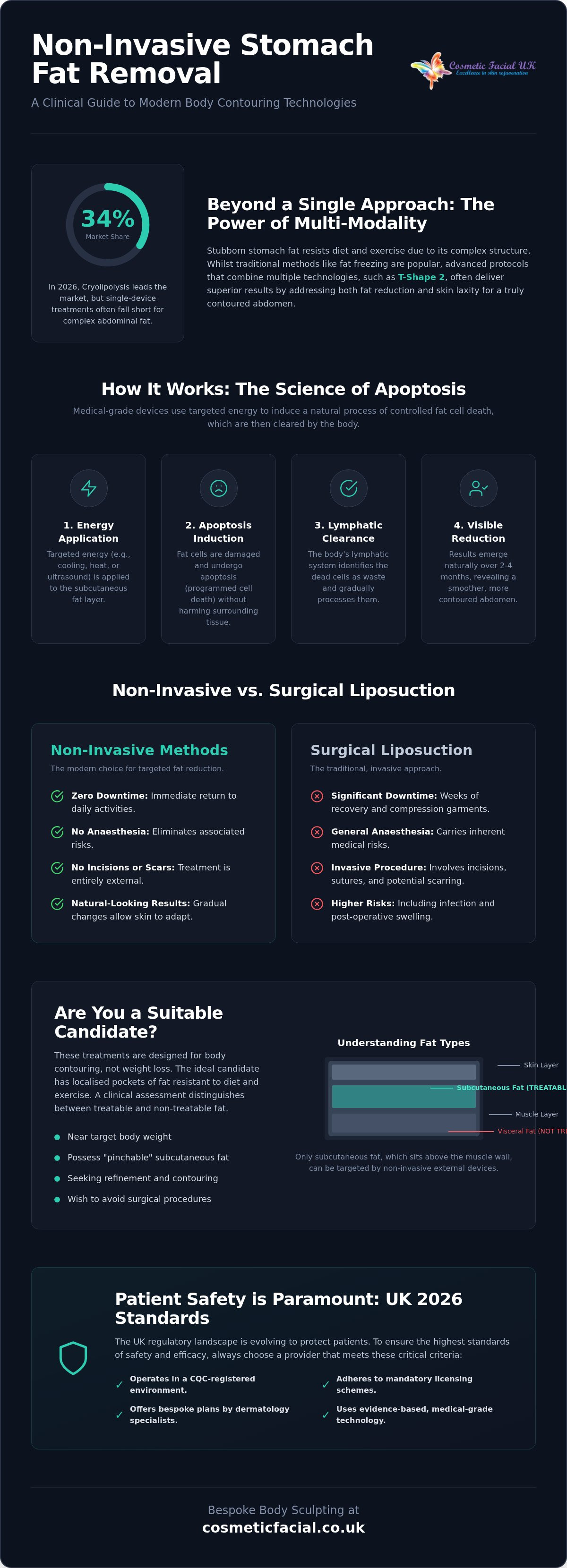
In 2026, cryolipolysis remains the leading non-invasive fat reduction technique with a 34% market share, yet many patients find that a single-device approach fails to address the structural complexities of abdominal adipose tissue. It's common to feel frustrated when targeted exercise and calorie deficits don't eliminate stubborn pockets of belly fat, especially when you're wary of the risks and downtime associated with surgical intervention. This guide provides a clinical overview of the most effective medical-grade technologies for non-invasive stomach fat removal in the UK, focusing on evidence-based outcomes within a CQC-registered environment.
You'll learn how multi-modality protocols, such as T-Shape 2 and high-intensity focused ultrasound (HIFU), work to induce apoptosis and tighten skin without a recovery period. We'll also examine the 2026 regulatory landscape, including the mandatory licensing schemes in England, to ensure your chosen treatment meets the highest safety standards. By understanding the biological mechanisms behind radiofrequency and ultrasound, you can move beyond the confusion of competing aesthetic claims and select a bespoke treatment plan that delivers a contoured, flatter abdomen.
Key Takeaways
- Understand the biological mechanisms of adipose reduction, where medical-grade technologies induce apoptosis to eliminate fat cells naturally via the lymphatic system.
- Discover why a multi-modality approach, such as T-Shape 2, is often more effective than single-device treatments for non-invasive fat removal stomach uk.
- Learn about the 2026 UK regulatory standards and the importance of receiving treatment in a CQC-registered clinical environment to ensure patient safety.
- Identify if you are a suitable candidate for stomach contouring through clinical assessments like the pinch test to distinguish between subcutaneous and visceral fat.
- Explore how bespoke treatment plans directed by a dermatology specialist can address both fat reduction and skin laxity for a comprehensive result.
Understanding Non-Invasive Fat Removal for the Stomach
Non-invasive fat removal refers to medical-grade procedures designed to eliminate adipose cells without the requirement for incisions, sutures, or general anaesthesia. In the context of non-invasive fat removal stomach uk, patients increasingly prioritise these methods to avoid the physiological stress and potential complications associated with theatre-based surgery. These treatments utilise specific energy sources, such as thermal, acoustic, or electromagnetic energy, to target fat deposits that remain resistant to traditional diet and exercise protocols. The objective is a refined physical contour achieved through precise clinical intervention rather than systemic weight reduction.
The biological mechanism behind these technologies relies on inducing controlled cell death, a process known as apoptosis. Once the integrity of the fat cells is disrupted, the body identifies them as cellular debris. Over the subsequent weeks, the lymphatic system processes and filters these lipids, eventually excreting them through natural metabolic pathways. This gradual transition allows the skin to adapt to the reduction in underlying volume, which often results in a more natural-looking contour than the rapid, aggressive removal seen in surgical alternatives. Because the process is biological, results emerge over two to four months as the body completes its clearance cycle.
Identifying the ideal candidate is a critical step in the clinical consultation. These procedures are not intended as primary treatments for obesity but as refining tools for individuals near their target weight who possess localised subcutaneous fat. The rise of non-surgical aesthetics amongst UK patients is largely driven by a professional demographic that demands effective body sculpting without an extended recovery period. It's a solution for those who've reached a plateau in their fitness journey and require a medical intervention to address specific anatomical concerns.
Non-Invasive vs. Surgical Liposuction
Surgical liposuction remains an invasive procedure that necessitates significant downtime and the use of restrictive compression garments for several weeks to manage post-operative swelling. Conversely, non-invasive protocols allow for an immediate return to daily activities and professional responsibilities. By avoiding general anaesthesia, patients eliminate the risks of pulmonary complications or surgical site infections. For targeted areas such as the lower abdomen or the flanks, non-surgical interventions offer a cost-effective alternative that aligns with a modern, fast-paced lifestyle while maintaining a high safety profile.
The Role of Adipose Tissue in Body Contouring
Effective treatment requires a clear clinical distinction between subcutaneous fat, which resides just beneath the skin, and visceral fat, which surrounds the internal organs. Only subcutaneous tissue is treatable via external energy devices. The stomach is a primary site for stubborn accumulation due to hormonal factors and genetic predispositions, making it the most requested area for clinical intervention. The Science of Cryolipolysis involves the thermal destruction of fat cells through controlled cooling, a method specifically designed to spare surrounding nerves and skin tissue. Understanding these tissue types ensures that patient expectations remain grounded in physiological reality.
The Science of Adipose Reduction: Key Technologies
Medical-grade technologies for non-invasive fat removal stomach uk have evolved into three distinct categories based on their thermal or mechanical interactions with adipose tissue. Whilst cryolipolysis remains a widely recognised method, the integration of radiofrequency and ultrasound has expanded the clinical ability to treat diverse patient profiles. These modalities don't just reduce volume; they are selected based on their specific interaction with the subcutaneous layers to ensure a smooth, contoured result.
Cryolipolysis, commonly referred to as fat freezing, utilises sub-zero temperatures to trigger apoptosis. Because fat cells are more sensitive to cold than surrounding tissues, they crystallise and undergo programmed cell death without damaging the dermis or nerves. This technology is particularly effective for distinct, "pinchable" pockets of fat on the abdomen. Over several weeks, the body naturally metabolises these destroyed cells, leading to a visible reduction in the fat layer thickness.
How Radiofrequency Tightens and Contours
Radiofrequency (RF) lipolysis employs controlled thermal energy to achieve a dual clinical objective. By heating the subcutaneous fat layer to approximately 42 to 45 degrees Celsius, the energy disrupts the integrity of the adipocytes, causing them to liquefy. Simultaneously, this thermal effect stimulates the production of new collagen and elastin fibres within the dermis. This mechanism is essential for preventing skin laxity that can occur when fat volume is reduced. For patients with post-pregnancy stomach concerns, RF is often the preferred choice because it addresses both residual adipose tissue and the stretching of the dermal matrix. Patients seeking a tailored clinical assessment may benefit from a consultation at Cosmetic Facial to determine which technology aligns with their tissue profile.
Ultrasound Technology for Deep Fat Targeting
High-Intensity Focused Ultrasound (HIFU) delivers concentrated acoustic energy to precise depths within the adipose layer, typically between 7mm and 13mm. This precision allows for the targeting of deeper fat deposits without affecting the skin surface or adjacent structures. The acoustic energy creates rapid pressure changes that disrupt fat cell membranes, a process often combined with other modalities to enhance overall metabolic clearance. As noted in the FDA guide to body contouring, these energy-based devices are regulated to ensure they deliver consistent results within safe thermal parameters. For non-invasive fat removal stomach uk, ultrasound is particularly useful for patients with higher fat density who require deep tissue disruption before secondary contouring treatments are applied.
The importance of skin tightening as a secondary benefit cannot be overstated. A successful stomach treatment must account for the structural integrity of the skin to avoid a "deflated" appearance. By selecting technologies that promote collagen synthesis alongside fat destruction, clinicians can ensure the resulting contour is both firm and proportionate to the patient's frame.
Comparing Leading Stomach Contouring Treatments in the UK
Selecting an appropriate modality for non-invasive fat removal stomach uk requires a clear understanding of how different proprietary systems interact with the subcutaneous environment. Whilst early technologies focused exclusively on cryolipolysis, modern clinical practice in 2026 often favours multi-layered approaches that address the skin and muscle layers alongside the fat. This comparative analysis examines the leading technologies available to patients seeking a refined abdominal profile without surgery.
Traditional fat-freezing methods like CoolSculpting remain a viable option for patients with high fat density and excellent skin elasticity. These systems rely on the specific vulnerability of adipocytes to cold, though they lack the skin-tightening or muscle-toning capabilities found in newer platforms. If a patient presents with significant skin laxity or "loose" tissue, a heat-based or multi-modality system is generally preferred to prevent a sagging post-treatment contour.
The T-Shape 2 Advantage for Abdominal Sculpting
Alongside these energy-based modalities, Nefretiti Laser Clinic & Aesthetics offers a variety of injectable treatments to refine the body and skin; you can explore Lemon Bottle Fat Dissolving and other advanced protocols within their clinical resources.
The T-Shape 2 system represents a significant advancement in body contouring by integrating three distinct technologies: Bipolar Radiofrequency (RF), Vacuum Massage, and Low-Level Laser Therapy (LLLT). Unlike single-modality devices, this 3-in-1 approach targets fat, cellulite, and skin laxity within the same session. The cold laser specifically increases the permeability of the fat cell membranes, allowing the liquefied lipids to escape into the interstitial space more efficiently. Bipolar RF then provides the thermal energy necessary to contract collagen fibres and stimulate new dermal growth. For optimal abdominal results, a course of six to eight sessions is typically recommended to ensure cumulative tissue remodelling. The Science of Adipose Reduction: Key Technologies provides further context on how these energy-based systems maintain safety whilst delivering clinical efficacy.
Lipofirm Pro and Muscle Toning
Lipofirm Pro distinguishes itself through the use of TriLipo technology, which combines Radiofrequency with Dynamic Muscle Activation (DMA). Whilst RF focuses on the reduction of fat volume and skin firming, the DMA component triggers internal muscle contractions. This is particularly beneficial for the abdominal region, where underlying muscle tone contributes significantly to a flat, contoured appearance. By stimulating the muscles, the treatment accelerates the drainage of released fat through the lymphatic system, effectively clearing the treated area faster than passive methods. You can explore our body sculpting results to see the clinical outcomes achieved through these combined metabolic pathways.
The choice of non-invasive fat removal stomach uk ultimately depends on a physical assessment of the adipose tissue's density and the structural integrity of the overlying dermis. Patients with a combination of stubborn fat and mild skin laxity often achieve the most harmonious results through these multi-modality protocols, as they address the abdomen as a complex anatomical unit rather than focusing on fat volume in isolation.
Determining Candidacy and Managing Clinical Expectations
The success of non-invasive fat removal stomach uk depends heavily on an accurate clinical assessment of the patient's tissue type. The "Pinch Test" is a primary diagnostic tool used during a consultation to distinguish between subcutaneous fat and visceral fat. Subcutaneous fat is the soft, graspable tissue located just beneath the dermis, which can be effectively targeted by cooling or thermal energy. Conversely, visceral fat is located deep within the abdominal cavity, surrounding the internal organs; because it resides behind the muscle wall, it cannot be treated by non-invasive external devices. If the abdominal area feels firm and cannot be easily pinched, the patient may not be a suitable candidate for these specific modalities.
Clinical eligibility is also determined by a review of medical contraindications. Procedures are not suitable for individuals who are pregnant or breastfeeding, nor for those with active malignancies or compromised lymphatic systems. Metal implants, such as pacemakers or surgical plates near the treatment site, may also preclude the use of radiofrequency or electromagnetic technologies. A dermatology specialist will evaluate these factors in a CQC-regulated environment to ensure the procedure is both safe and likely to yield the desired outcomes.
Managing the timeline for results is a critical aspect of patient education. Unlike surgical interventions, the effects of non-invasive treatments are gradual. The body requires time to metabolise the destroyed adipocytes and clear them through the lymphatic system. Whilst some patients notice subtle changes after four weeks, the peak clinical result typically manifests between twelve and sixteen weeks post-treatment. Patience is required as the biological process of cellular clearance follows its natural cycle.
What to Expect During Your Treatment Journey
The journey begins with a comprehensive skin analysis and medical history review. During the procedure, the physical sensation varies according to the technology selected. Cryolipolysis may cause an initial pulling sensation followed by intense cold and eventual numbness. Radiofrequency and ultrasound treatments typically produce a deep, building warmth that remains within comfortable parameters. Post-treatment care is focused on supporting the body's metabolic pathways. Maintaining high levels of hydration and engaging in light lymphatic drainage support, such as walking or gentle massage, can facilitate the efficient removal of lipids from the treated area.
Longevity of Results
The elimination of fat cells through apoptosis is permanent. Once these cells are destroyed and excreted, they do not regenerate. However, it's essential to understand that the remaining fat cells in the abdomen can still expand if the patient experiences significant weight gain. Maintaining a contoured stomach requires a commitment to a stable, healthy lifestyle. If you're uncertain which technology is best for your specific concerns, you can read more about HIFU vs Radiofrequency: Best Stomach Treatment? to understand the differences in tissue interaction.
Bespoke Body Sculpting at Cosmetic Facial Marylebone
Cosmetic Facial operates as a dedicated medical practice in Marylebone, London, prioritising clinical precision over standard aesthetic marketing. For patients seeking non-invasive fat removal stomach uk, the clinic provides a CQC-regulated environment where every protocol is grounded in dermatological science. This approach ensures that body sculpting is treated as a medical intervention requiring anatomical expertise and a thorough understanding of tissue behaviour. Every patient receives a bespoke assessment to ensure the selected modality aligns with their physiological profile and aesthetic objectives. We recognise that the abdominal area presents unique challenges, including varying depths of adipose tissue and differences in dermal elasticity, which must be addressed with calibrated energy levels.
The clinic utilises advanced platforms such as T-Shape 2 to deliver superior abdominal contouring. By integrating radiofrequency, vacuum massage, and low-level laser therapy, the practice addresses the complex nature of stomach fat, which often involves a combination of adipose volume and skin laxity. This commitment to state-of-the-art technology allows for the creation of natural-looking outcomes that respect the patient's existing proportions. Each treatment is administered with a focus on safety and precision, ensuring that the thermal or mechanical disruption of fat cells doesn't compromise the surrounding healthy tissue.
Why Choose a Dermatology Specialist?
When evaluating options for non-invasive fat removal stomach uk, the credentials of the practitioner are as significant as the technology itself. Selecting a practitioner with advanced medical training is essential for mitigating the risks associated with energy-based devices. Dr. Faramarz Didar (GMC 5200505) holds an MSc in Dermatology Skills and Treatment with Commendation, providing expertise that extends beyond basic device operation. His training allows for a nuanced analysis of the subcutaneous layers and dermal integrity. Personalised treatment plans are tailored to your unique anatomy, ensuring energy parameters are safe and effective for your specific fat density.
Book Your Consultation in Marylebone
The clinic is located in Marylebone, offering a professional setting for London-based patients who require expert-led care. Your journey toward a more contoured physique begins with an in-depth clinical consultation to determine the most appropriate technology for your goals. This assessment includes a physical examination of the abdominal tissue and a discussion of realistic clinical outcomes to ensure you're fully informed before proceeding with treatment.
Advancing Your Abdominal Contouring Journey in 2026
The evolution of aesthetic technology in 2026 has transitioned from single-device applications to sophisticated, multi-layered protocols that address the abdomen as a complex anatomical unit. Achieving optimal results with non-invasive fat removal stomach uk requires a clinical strategy that addresses both fat volume and skin laxity simultaneously. By prioritising clinical evidence over marketing claims, patients can achieve a refined physique without the risks or downtime inherent in surgical liposuction. This shift toward multi-modality systems like T-Shape 2 reflects a deeper medical understanding of adipose biology and dermal structural integrity.
Dr. Faramarz Didar, a GMC-registered specialist with an MSc in Dermatology with Commendation, provides the medical oversight necessary for these advanced procedures at our Marylebone clinic. Our commitment to clinical excellence ensures that every treatment plan is tailored to your unique tissue density and dermal elasticity. Achieving a contoured, flatter stomach is a gradual process that rewards those who choose expert-led care. We invite you to begin this professional journey in a safe, CQC-regulated environment.
Your path to a more confident physique is supported by our expertise in the latest body sculpting technologies. We look forward to helping you reach your aesthetic goals with precision and care.
Frequently Asked Questions
Is non-invasive fat removal on the stomach painful?
Most patients describe the sensation as tolerable rather than painful. Cryolipolysis involves an initial pulling sensation and intense cold, whilst radiofrequency treatments produce a deep, building warmth. These medical-grade procedures are performed without anaesthesia, allowing for immediate communication with the clinician. The objective is to maintain therapeutic temperatures that trigger fat reduction without causing epidermal damage or significant discomfort. Most individuals return to their daily London schedule immediately following the appointment.
How many sessions of non-surgical fat removal will I need for my stomach?
The number of sessions required depends on the specific technology used and the patient's anatomical starting point. For multi-modality platforms like T-Shape 2, a course of six to eight sessions is typically recommended to achieve optimal abdominal contouring. Results are cumulative, with the body requiring time between visits to process the disrupted fat cells. A bespoke treatment plan is established during your initial clinical consultation in Marylebone to ensure expectations align with biological timelines.
How much does non-invasive fat removal cost in the UK in 2026?
Fees for non-invasive fat removal stomach uk vary based on the complexity of the treatment plan and the number of sessions required. At our Marylebone practice, we charge per session for medical-grade body sculpting procedures. Because every patient's fat density and skin elasticity are unique, a precise cost can only be determined following a clinical assessment by a dermatology specialist. This ensures you receive a transparent breakdown of the investment required to reach your specific goals.
Can non-invasive fat removal help with a "mummy tummy" after pregnancy?
These treatments are highly effective for addressing post-pregnancy abdominal concerns, particularly when they integrate radiofrequency for skin tightening. Whilst traditional fat reduction focuses on volume, a "mummy tummy" often involves a combination of residual adipose tissue and dermal laxity. Technologies like T-Shape 2 or Lipofirm Pro are preferred in these instances as they stimulate collagen synthesis whilst simultaneously metabolising fat cells. This dual action helps restore a firmer, more contoured abdominal profile.
What is the difference between fat freezing and T-Shape 2?
Fat freezing, or cryolipolysis, is a single-modality treatment that uses sub-zero temperatures to destroy fat cells via apoptosis. T-Shape 2 is a more advanced 3-in-1 platform that combines bipolar radiofrequency, vacuum massage, and low-level laser therapy. Whilst fat freezing is effective for isolated pockets of fat, T-Shape 2 provides a more comprehensive solution by addressing fat reduction, skin firming, and lymphatic drainage within a single clinical session for superior results.
Are the results of non-surgical stomach contouring permanent?
The elimination of fat cells through apoptosis is permanent, as the body does not regenerate these specific cells once they are excreted via the lymphatic system. However, it's essential to understand that the remaining fat cells in the abdominal region retain the capacity to expand if a significant calorie surplus is maintained. To preserve the results of non-invasive fat removal stomach uk, patients are encouraged to maintain a stable weight through a balanced diet and regular physical activity.
Is there any downtime after non-invasive fat removal?
There is zero clinical downtime associated with these procedures. Patients can return to their professional and social obligations in London immediately after leaving the clinic. Unlike surgical liposuction, there is no requirement for compression garments, wound care, or recovery periods. Some patients may experience mild, transient redness or minor swelling in the treated area, but these effects typically resolve within a few hours and do not interfere with daily movement or physical exercise.
How do I know if I am a candidate for non-surgical stomach treatments?
Eligibility for non-surgical stomach treatments is determined through a clinical assessment, including the "pinch test." Ideal candidates possess localised subcutaneous fat that can be grasped, rather than firm visceral fat located behind the muscle wall. These procedures are most effective for individuals who are near their target weight but have stubborn areas resistant to exercise. A consultation with Dr. Didar will confirm if your tissue profile is suitable for energy-based fat reduction.
Disclaimer
All content on cosmetic Facial website, including blogs, graphics, logos, images, and software, is the property of CosmeticFacial UK or its content suppliers and is protected by applicable copyright laws. Unauthorized use, reproduction, distribution, or modification of any content without prior written permission is strictly prohibited.


