


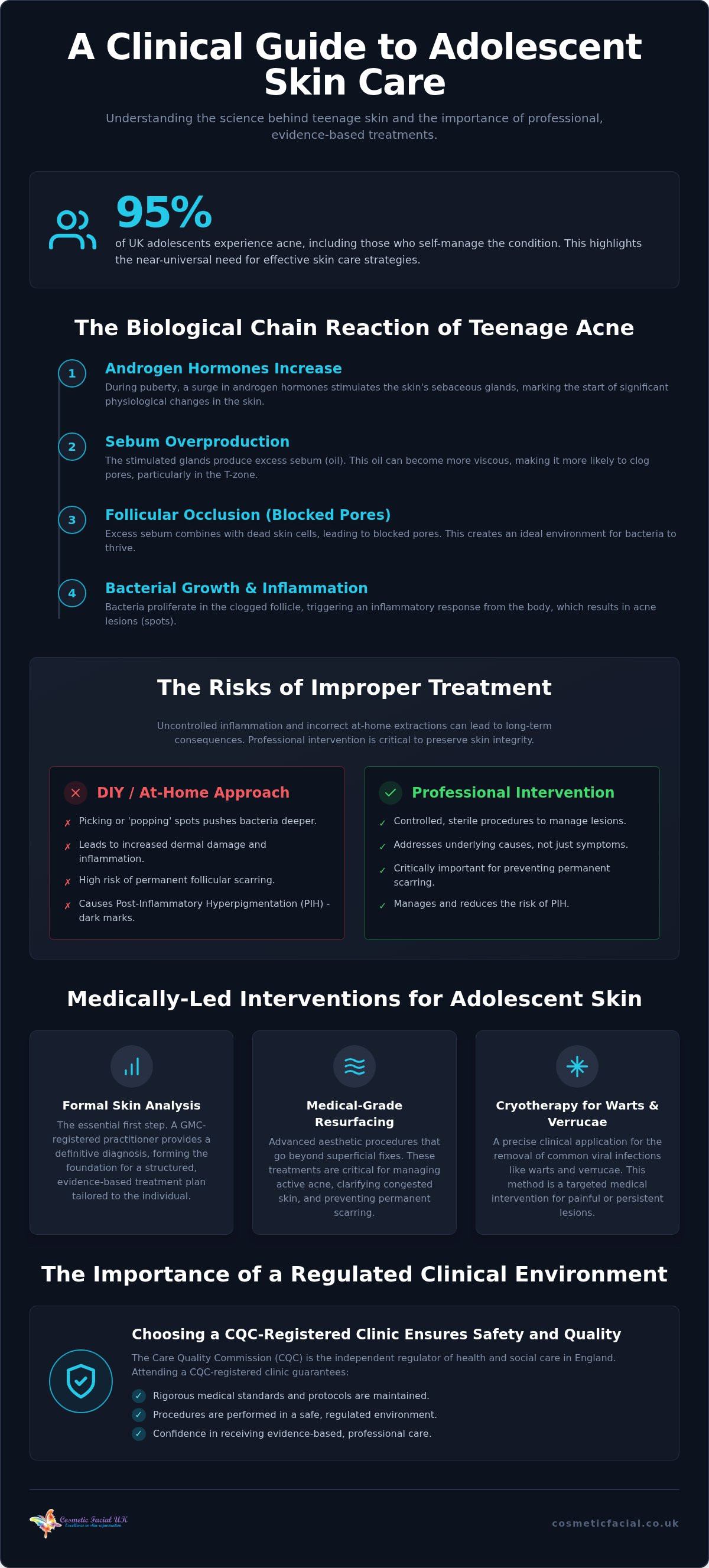
Recent data from the British Association of Dermatologists suggests that the true prevalence of acne amongst UK adolescents is approximately 95 per cent when accounting for those who self-manage the condition. This high frequency often leads to a reliance on over the counter products, yet professional teenager skin treatments remain the most effective route for preventing permanent scarring and addressing underlying hormonal triggers. It's understandable that parents and adolescents feel overwhelmed by the conflicting advice found on social media, particularly whilst managing the emotional impact of persistent breakouts or painful verrucae.
This clinical guide provides a comprehensive overview of medically-led interventions available in London, moving beyond superficial aesthetics to evidence-based dermatological care. You'll learn about the distinction between clinical acne management and advanced resurfacing techniques, alongside the importance of a formal diagnosis from a GMC registered practitioner to ensure long term skin health and improved confidence. The following sections detail how a structured medical approach can effectively resolve adolescent skin concerns through precise, regulated procedures.
Key Takeaways
- Understand the biological mechanisms of androgen-driven sebaceous activity and why they necessitate professional dermatological intervention.
- Explore the clinical application of cryotherapy for the precise removal of warts and verrucae amongst adolescents.
- Learn why professional teenager skin treatments involving medical-grade resurfacing are critical for preventing permanent follicular scarring.
- Identify the role of a formal skin analysis in establishing a structured, evidence-based plan for persistent adolescent acne.
- Recognise the safety benefits of attending a CQC-registered clinic that maintains rigorous medical standards in Marylebone.
Understanding Adolescent Skin: Why Teenager Skin Treatments Differ
Adolescence marks a period of significant physiological transition where the skin’s structure and function are fundamentally altered by hormonal shifts. Unlike adult skin, which typically faces issues related to moisture loss or collagen degradation, teenage skin is defined by hyperactive sebaceous glands. This biological reality means that teenager skin treatments must focus on regulation and clarification rather than simple hydration. With estimates suggesting that acne affects approximately 85 per cent of UK teenagers, the condition is a near-universal experience that nonetheless requires individualised clinical attention.
The primary drivers of these changes are androgen hormones, which increase in concentration during puberty. These hormones stimulate the sebaceous glands to produce higher volumes of sebum. When this excess oil combines with dead skin cells, it leads to follicular occlusion, or blocked pores. This environment is ideal for the proliferation of bacteria, resulting in inflammation. Whilst many young people experience occasional breakouts, a persistent condition is often diagnosed as Acne vulgaris, a chronic inflammatory disease that requires clinical management rather than high-street cosmetic fixes.
The impact of these conditions extends beyond physical discomfort. Adolescents often face considerable psychological pressure whilst in school, where visible skin issues can lead to social withdrawal or a decline in self-esteem. Professional teenager skin treatments address these concerns by providing a clear path to resolution, reducing the anxiety associated with unpredictable skin behaviour.
Hormones and Sebum: The Biological Drivers
During the teenage years, the composition of sebum itself changes, often becoming more viscous and prone to clogging pores. This oiliness is typically most evident in the 'T-zone', encompassing the forehead and nose, where sebaceous glands are most densely concentrated. Maintaining the skin's health requires protecting the acid mantle, which is the thin, slightly acidic film on the skin's surface that serves as a primary barrier against bacterial colonisation and environmental pathogens.
The Risk of Post-Inflammatory Hyperpigmentation (PIH)
Teenage skin is particularly susceptible to Post-Inflammatory Hyperpigmentation, which refers to the dark or red marks left behind after an inflammatory lesion heals. These marks occur because the skin's inflammatory response triggers an overproduction of melanin. Professional intervention is necessary to manage these risks, as DIY extractions or 'popping' spots at home significantly increase the likelihood of dermal damage and permanent scarring. A professional skin analysis allows for a controlled approach to extraction and resurfacing, ensuring the integrity of the skin remains intact whilst addressing the underlying congestion.
Medical Dermatology Treatments for Adolescent Concerns
Medical dermatology for adolescents focuses on resolving pathological conditions that don't respond to standard retail products. Whilst high-street solutions often manage minor congestion, persistent inflammatory conditions require teenager skin treatments that follow a more rigorous, evidence-based approach. Accessing a private dermatologist consultation london ensures that the patient receives a definitive diagnosis, which is the necessary foundation for any clinical intervention. Dr Faramarz Didar, with his MSc in Dermatology, oversees the assessment process to determine whether a topical, systemic, or procedural route is most appropriate for the individual's skin type and condition severity.
Understanding tween and teenage skin is essential for differentiating between transient puberty-related oiliness and chronic disorders. Beyond acne, teenagers frequently present with warts and verrucae, which are viral infections that can be both painful and socially embarrassing amongst peer groups. Clinical hyperhidrosis, or excessive sweating, also commonly emerges during these years, frequently affecting the axillae or palms. Our clinic provides targeted medical interventions that address these issues within a regulated, professional environment, moving beyond the limitations of general practice.
Specialised Acne and Rosacea Care
Moderate to severe acne often necessitates moving beyond topical retinoids or benzoyl peroxide. In a clinical setting, systemic treatments may be considered alongside prescription-strength topicals to reduce inflammation and prevent the scarring discussed in previous sections. Additionally, early-onset redness can be addressed through clinical rosacea treatment, which focuses on calming vascular reactivity and strengthening the skin barrier. These treatments are specifically formulated to manage the unique sensitivity of younger skin whilst providing results that standard cosmetics cannot achieve. Regular reviews with Dr Didar ensure that the treatment plan is adjusted as the skin evolves, maintaining efficacy whilst minimising potential side effects.
Cryotherapy and Lesion Removal
Cryotherapy is a highly effective method for removing benign skin lesions such as warts, verrucae, and skin tags. This procedure involves the controlled application of liquid nitrogen to freeze the targeted tissue, causing the lesion to eventually slough off. Safety protocols for younger patients are stringent; the procedure is quick and involves minimal discomfort. Recovery typically involves minor localised redness or a small blister, which resolves within a few days to a week. For those seeking professional resolution of these common concerns, teenager skin treatments at our Marylebone clinic offer a clinical alternative to ineffective home freezing kits, ensuring the procedure is performed with precision and care.
Advanced Aesthetic Procedures for Resurfacing and Clarity
When medical diagnosis has established a stable baseline, advanced aesthetic procedures can be employed to refine skin texture and address the aftermath of inflammatory conditions. These teenager skin treatments are designed to accelerate cellular turnover and clear deep-seated follicular debris that standard topical applications cannot reach. Unlike high-street facials which often provide temporary hydration, clinical resurfacing utilises medical-grade equipment and concentrated active ingredients to achieve structural improvements in the dermis and epidermis. Each procedure is selected based on its ability to manage the specific physiological requirements of adolescent skin whilst minimising downtime.
The selection of a specific procedure depends on the patient's skin phenotype and the nature of their concerns. For instance, micro-needling, often referred to as Dermaroller therapy, is an effective option for mature teenage skin. This process involves creating controlled micro-injuries to stimulate the body's natural collagen production, which helps to level uneven skin texture caused by previous breakouts. These treatments are always administered within our regulated clinical environment to ensure maximum safety and efficacy. This professional oversight is critical to avoid the complications often associated with unregulated aesthetic providers.
Clinical Skin Peels and Microdermabrasion
This emphasis on professional oversight is equally important for other skin-related procedures popular with teenagers, such as ear piercing. To understand how high standards of hygiene and precision are applied in a premium setting, you can learn more about Stellar SG, which specialises in elegant piercing services.
Medical-grade peels offer a sophisticated method for managing oil production and congestion. Salicylic acid peels are particularly effective for oily skin types because they are lipophilic, meaning they can penetrate the sebum to exfoliate inside the pore. In contrast, glycolic acid peels are often utilised to address surface dullness and refine overall skin tone. Diamond microdermabrasion provides a mechanical alternative to chemical exfoliation; it uses a diamond-tipped wand to precisely remove the stratum corneum. This differs significantly from high-street scrubs as it allows for uniform depth control and suction-assisted debris removal. For sustainable clarity, a series of four to six sessions spaced at monthly intervals is typically recommended.
Laser and Light Therapies
For established textural irregularities, the use of fractional co2 laser for acne scars is a gold-standard intervention for older teenagers. This technology creates microscopic columns of thermal damage that trigger intensive tissue remodelling, effectively smoothing depressed scars. Intense Pulsed Light (IPL) is another valuable tool, specifically for addressing the redness and pigmentation that often remains after acne has cleared. Safety is paramount when using light-based therapies on adolescent skin. Dr Didar meticulously assesses the patient's skin tone to calibrate the laser settings, reducing the risk of unintended pigmentary changes and ensuring the treatment remains appropriate for the young patient's developing skin structure.
The Clinical Consultation: Navigating Your First Appointment
The initial consultation is the most critical phase of adolescent dermatological care. It transitions the focus from general experimentation with retail products to a structured medical strategy. A professional skin analysis serves as the essential first step, allowing the practitioner to map the current state of the epidermis and identify specific triggers for inflammation or congestion. During this appointment, we discuss the patient's medical history and current skincare behaviours in detail. Understanding previous reactions to topical agents or systemic medications is vital for ensuring the safety and efficacy of future teenager skin treatments.
We prioritise creating a bespoke long-term plan rather than offering a superficial 'quick fix'. Adolescent skin is in a constant state of flux due to hormonal changes; therefore, the treatment must be adaptive and patient. Managing expectations is a core component of this clinical dialogue. Results typically follow the skin's natural 28-day regenerative cycle, meaning visible improvements often require several weeks of consistent adherence to the prescribed protocol. This methodical approach ensures that we address the root causes of skin concerns whilst maintaining the health of the dermal barrier.
What to Expect During the Assessment
Our assessment utilises advanced diagnostic tools to quantify sebum levels and identify latent sun damage that may not be visible to the naked eye. This data-driven approach ensures that every intervention is targeted and necessary. Dr Didar's MSc in Dermatology with Commendation informs the selection of specific modalities, whether that involves medical-grade peels or laser therapies. We maintain a professional, calm environment in our Marylebone clinic to ensure younger clients feel respected and informed throughout their journey. This clarity helps to reduce the anxiety often associated with clinical environments.
Bespoke Homecare Integration
Success in clinical dermatology relies on the synergy between in-clinic sessions and daily maintenance. We provide precise guidance on selecting medical-grade retail products that effectively manage oil without stripping the skin's essential moisture. We often advocate for a 'less is more' approach for teenage routines. Over-cleansing or using too many competing active ingredients can exacerbate inflammation and lead to sensitivity. Instead, we focus on a few high-quality, concentrated formulas that support the clinical teenager skin treatments performed on-site, ensuring the skin remains resilient between appointments.
Book your clinical skin assessment in Marylebone
Choosing a CQC-Registered Clinic in Marylebone, London
Selecting a clinical environment for adolescent care requires careful consideration of regulatory standards and practitioner credentials. In the UK, CQC (Care Quality Commission) registration serves as a vital benchmark for safety, ensuring that the facility adheres to rigorous clinical protocols and hygiene standards. For parents seeking teenager skin treatments in London, this registration provides the necessary assurance that the clinic operates under strict medical oversight. This is particularly important when managing conditions that involve medical-grade lasers or chemical resurfacing, where precision and safety are paramount for developing skin.
Accessing world-class medical expertise in the heart of London allows patients to benefit from the highest standards of dermatological care. Seeing a GMC-registered doctor, such as Dr Faramarz Didar, ensures that aesthetic procedures are governed by clinical ethics and a deep understanding of biological processes. Dr Didar's MSc in Dermatology with Commendation allows for a level of diagnostic accuracy that is rarely found in non-medical high-street settings. Marylebone, known as the medical heart of the capital, offers a discreet and professional setting that respects the privacy of younger clients whilst providing proximity to leading specialists.
Safety and Professional Standards
The clinical protocols required for medical registration include stringent infection control and the use of regulated, medical-grade equipment. Specialists in facial rejuvenation and adolescent dermatology must maintain a commitment to ongoing education to keep pace with international aesthetic standards. This academic rigour ensures that the teenager skin treatments offered are supported by the latest clinical evidence. Our clinic prioritises these standards to protect the long-term health of adolescent skin, ensuring that every procedure, from acne management to lesion removal, is performed with clinical excellence and care.
Booking and Accessibility
Organising an initial consultation is a straightforward process that can be completed online or via telephone. Our Marylebone clinic is centrally located, making it easily accessible for Central London residents and those travelling from further afield. It's important to note that the clinic is closed on Sundays; therefore, we recommend planning your visit during our standard operating hours to ensure you receive the dedicated time required for a thorough assessment. Whether you're seeking a formal diagnosis for persistent acne or professional cryotherapy for warts, our team is available to guide you through each stage of the clinical journey.
Prioritising Clinical Excellence for Adolescent Skin Health
Transitioning from experimental high-street products to a structured medical framework is essential for managing the complexities of adolescent skin. By focusing on the biological causes of congestion and inflammation, a clinical approach prevents the long-term dermal damage often associated with self-treatment. This guide has detailed how medically-led teenager skin treatments, ranging from cryotherapy to advanced laser resurfacing, provide a safer and more effective alternative to unregulated aesthetic services.
Our Marylebone clinic offers an integrated model of care led by Dr Faramarz Didar, who holds an MSc in Dermatology with Commendation. As a CQC registered facility, we maintain the highest clinical standards whilst providing a discreet environment for younger patients. This expertise in both medical and aesthetic dermatology ensures that every treatment plan is tailored to the individual's specific skin phenotype and developmental stage.
Achieving clarity and improved confidence is a gradual process that rewards patience and professional guidance. We look forward to supporting your journey toward healthier, more resilient skin.
Frequently Asked Questions
At what age can a teenager start professional skin treatments?
Teenagers can typically begin professional skin treatments from the age of 13 or 14; however, this always requires formal parental or guardian consent. The appropriate age depends on the specific condition being treated, such as early-onset inflammatory acne or viral verrucae. A clinical consultation with Dr Didar ensures that any intervention is physiologically appropriate for the patient's stage of development, prioritising the safety of the skin's barrier whilst addressing active concerns.
Is laser treatment safe for teenage skin?
Laser treatments are safe for adolescent skin when administered by a GMC registered doctor within a regulated clinical environment. These teenager skin treatments are specifically calibrated to manage the sensitivity of younger tissue, focusing on concerns like post-inflammatory redness or early acne scarring. Dr Didar meticulously assesses the patient's skin phenotype to ensure the laser settings are precise, which minimises the risk of pigmentary changes and ensures a controlled, effective clinical outcome.
How many sessions are typically needed to see an improvement in acne?
Most patients require a series of four to six sessions to observe a significant and sustainable improvement in clinical acne. Because skin follows a 28-day regenerative cycle, results are not immediate and require consistent adherence to the treatment protocol. During your initial assessment in Marylebone, a bespoke timeline is established based on the severity of the follicular occlusion and inflammation. Regular reviews allow us to adjust the concentration of active agents as the skin evolves.
Can a teenager have a chemical peel for blackheads?
Yes, medical-grade chemical peels are highly effective for resolving persistent blackheads and comedonal acne. Salicylic acid is frequently utilised because it is lipophilic, allowing it to penetrate deep into the sebaceous glands to dissolve the oil and debris causing the blockage. This clinical approach is far more precise than over the counter scrubs. These peels help to regulate sebum production and refine the skin's texture, preventing the transition from simple congestion to inflammatory lesions.
What is the difference between a high-street facial and a clinical skin treatment?
High-street facials typically focus on superficial hydration and relaxation, whereas clinical skin treatments are diagnostic and results-oriented interventions. Our Marylebone clinic utilises medical-grade equipment and concentrated active ingredients that are only available in a regulated setting. Unlike standard aesthetic services, these treatments are overseen by a specialist with an MSc in Dermatology. This ensures that the underlying biological causes of skin concerns, such as hormonal acne or viral infections, are addressed with medical precision.
Do I need a GP referral to see a dermatologist for teen acne?
You don't require a GP referral to book a consultation for teenager skin treatments at our private Marylebone practice. Whilst the NHS often has extensive waiting lists for dermatological concerns, private access allows for an immediate assessment and the swift implementation of a treatment plan. This direct access is particularly beneficial for managing active acne before it results in permanent scarring. Our clinic provides a comprehensive medical diagnosis and a structured path to resolution without the need for external paperwork.
Will these treatments help with old acne scars?
Clinical interventions such as micro-needling and fractional CO2 laser are specifically designed to address established acne scarring. These procedures work by stimulating the body's natural collagen production to remodel the skin's surface and improve overall texture. Whilst older scars may require multiple sessions for optimal results, these advanced aesthetic procedures can significantly reduce the depth of atrophic scarring. Dr Didar assesses the scar type during the consultation to determine which modality will provide the most effective structural improvement.
Are there any side effects to cryotherapy for verrucae?
Cryotherapy is a safe and common procedure, though it can cause minor localised side effects such as redness, swelling, or a small blister. These reactions are a normal part of the body's response to the freezing process and typically resolve within a few days. The treatment is quick and involves minimal discomfort for younger patients. Our clinical protocols ensure that the liquid nitrogen is applied with precision, targeting the viral lesion whilst protecting the surrounding healthy skin from unnecessary thermal damage.
Disclaimer
All content on cosmetic Facial website, including blogs, graphics, logos, images, and software, is the property of CosmeticFacial UK or its content suppliers and is protected by applicable copyright laws. Unauthorized use, reproduction, distribution, or modification of any content without prior written permission is strictly prohibited.


