


The most visible peeling doesn't always equate to the most profound structural change in the dermis. Many patients feel frustrated when high-street topical creams fail to yield results, leading to a common dilemma when choosing between microneedling vs chemical peel for skin texture. It's understandable to feel anxious regarding downtime or the safety of different treatment depths, especially amongst the various clinical options available in 2026. This guide provides a detailed clinical comparison to help you determine the most effective pathway for refining your skin.
You'll discover the precise biological differences between these two medical-grade procedures. Whilst microneedling focuses on mechanical collagen induction to rebuild the skin's foundation, chemical peels utilise controlled acid concentrations to polish the surface and promote cellular turnover. We'll preview the expected recovery phases, safety considerations under the evolving UK aesthetic regulatory framework, and the specific textural concerns that each modality is best equipped to address. By the end of this analysis, you'll have the evidence-based clarity required to make an informed decision for your long-term skin health.
Key Takeaways
- Understand the biological role of the stratum corneum and how cellular accumulation influences the physical smoothness and light reflection of the skin surface.
- Differentiate between the mechanical wound healing cascade triggered by microneedling and the intercellular dissolution achieved through acid-based chemical exfoliation.
- Compare the clinical efficacy of microneedling vs chemical peel for skin texture to determine which modality best addresses your specific dermatological concerns.
- Assess the varying recovery timelines and expected downtime associated with different resurfacing depths, ranging from superficial peels to deeper mechanical treatments.
- Identify the necessity of a medically-led skin analysis to develop a bespoke rejuvenation plan tailored to your skin's unique structural and physiological requirements.
Understanding Skin Texture: The Biological Basis for Resurfacing
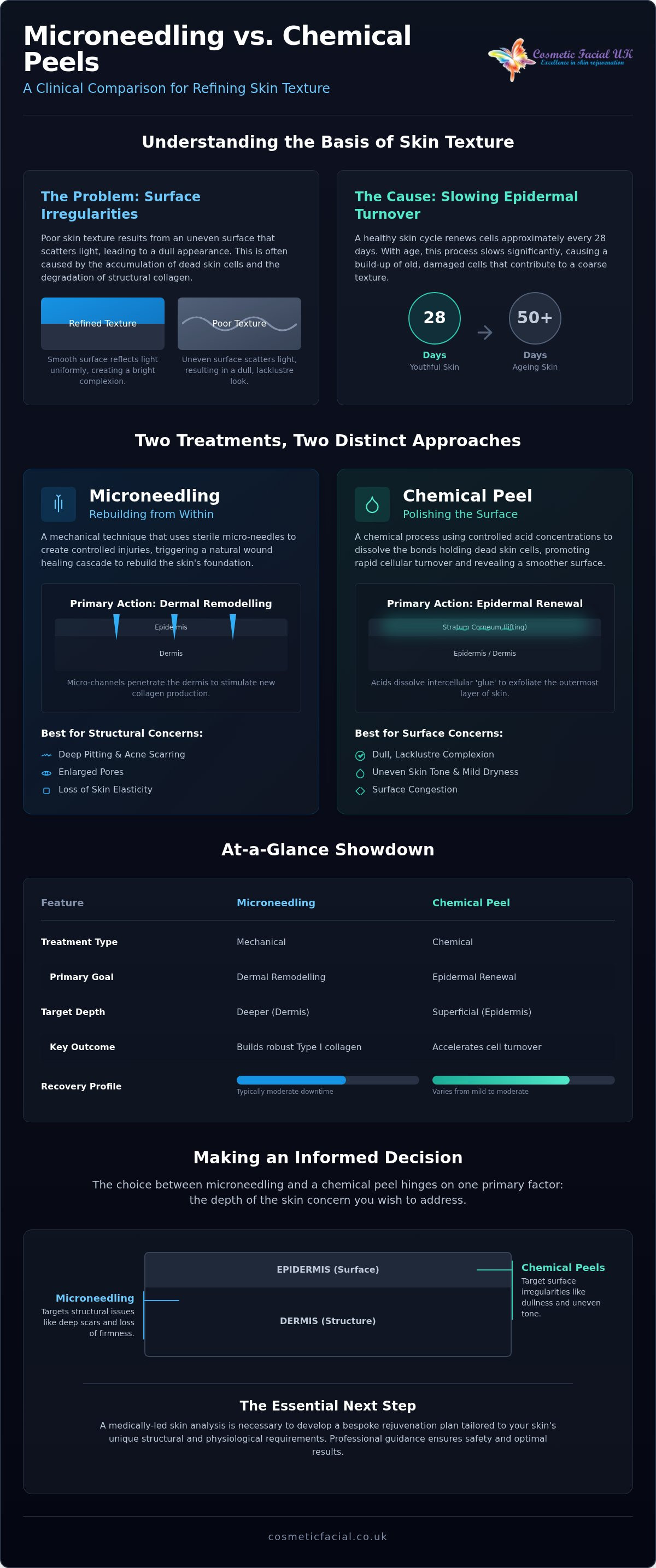
Skin texture refers to the physical condition of the skin's surface, characterised by its level of smoothness or roughness. In a clinical context, a refined texture is achieved when the epidermis is uniform and the underlying dermis provides robust support. The stratum corneum, which is the outermost layer of the skin, plays a critical role in this appearance. When dead skin cells, or corneocytes, accumulate excessively, they create an uneven surface that scatters light. This lack of uniform reflection results in a dull, lacklustre complexion. Amongst London clients, environmental factors such as high pollution levels and chronic UV exposure accelerate this process by damaging the skin's natural barrier and depleting essential structural proteins.
The loss of dermal collagen also significantly impacts texture. Collagen acts as the structural framework for the face. When these fibres degrade due to biological ageing or external stressors, the skin loses its elasticity. This often manifests as enlarged pores, which appear more prominent as the surrounding tissue sags, and the development of fine lines that break the skin's visual continuity. Understanding the interplay between these layers is vital when evaluating microneedling vs chemical peel for skin texture treatments.
The Role of Epidermal Turnover
A healthy skin cycle typically involves a 28-day turnover process where new cells migrate from the basal layer to the surface. As we age, this cycle becomes sluggish, often extending beyond 40 or 50 days. This delay leads to a buildup of older, damaged cells, giving the skin a leathery or coarse feel. Clinical interventions aim to disrupt this stagnation through the concept of controlled injury. By safely damaging specific layers of the skin, we stimulate a biological renewal process that forces the production of fresh, healthy cells. This mechanism is fundamental to Microneedling: Collagen Induction Therapy, which triggers a natural healing response to refine the skin's surface.
Structural vs Surface Irregularities
It's necessary to distinguish between surface-level concerns and deeper structural damage. Surface irregularities, such as congestion or mild dryness, are often effectively managed with targeted chemical peels. However, structural issues like deep pitting or acne scarring originate within the dermal layer and cannot be resolved by surface exfoliation alone. When deciding between microneedling vs chemical peel for skin texture, the depth of the irregularity must be the primary consideration. We define dermal remodelling as the physiological replacement of damaged tissue with new, organised collagen and elastin fibres. This process is the key to achieving a lasting, significant improvement in skin quality.
Microneedling: Collagen Induction Therapy for Structural Refinement
Professional microneedling is a precise mechanical resurfacing technique. It involves using sterile micro-needles to create thousands of microscopic punctures in the skin's surface. These controlled injuries don't cause permanent damage; they trigger a systematic wound healing cascade instead. This process begins with an inflammatory phase, moves into rapid cellular proliferation, and concludes with tissue remodelling. During this final stage, the body replaces immature Type III collagen with robust Type I collagen. This transition provides the skin with enhanced structural integrity. When evaluating microneedling vs chemical peel for skin texture, the mechanical nature of this treatment makes it particularly effective for deeper structural deficits.
It's vital to distinguish between professional microneedling and at-home rollers. Medical-grade devices allow for greater penetration depth and precision. This ensures safety whilst reaching the deeper dermal layers where true remodelling occurs. At-home devices often lack the necessary needle length to stimulate significant collagen production and carry a higher risk of infection or tissue tearing.
How Microneedling Rebuilds the Skin
The creation of micro-channels stimulates the release of essential growth factors, such as Transforming Growth Factor-beta (TGF-β) and Platelet-Derived Growth Factor (PDGF). These proteins signal the fibroblasts to synthesise new extracellular matrix components. For patients with pitted acne scars, this dermal thickening lifts the depressions from within. By strengthening the dermal architecture around the follicular openings, microneedling also reduces the appearance of enlarged pores. The choice between microneedling vs chemical peel for skin texture often depends on whether the patient requires surface smoothing or deeper collagen synthesis. Whilst the fundamentals of chemical peels focus on enzymatic or acid-driven exfoliation, microneedling provides the mechanical stimulus required for deep structural refinement.
What to Expect During Treatment
Patient comfort is prioritised through the application of a topical anaesthetic before the procedure begins. Most sessions last between 20 and 30 minutes. Post-treatment erythema, or redness, is a common and expected occurrence. It typically resembles a mild sunburn and subsides within 24 to 48 hours. To achieve the most significant structural changes, a standard course of three to six sessions is usually recommended. These are spaced four to six weeks apart to allow the skin sufficient time to complete each phase of the remodelling process. At our Marylebone centre, we ensure every treatment is performed in a sterile, medically-led environment. If you're considering how this technology fits into your routine, our specialists can provide a personalised skin analysis.
Chemical Peels: Acid-Based Exfoliation for Epidermal Smoothing
Chemical peels represent a cornerstone of dermatological resurfacing. Unlike mechanical methods, this approach utilises specific acid solutions to dissolve the intercellular adhesions, often described as "glue", that bind dead cells to the skin's surface. By inducing a controlled chemical injury, peels force the shedding of damaged outer layers. This reveal of fresh, underlying tissue is essential for correcting superficial irregularities and improving light reflection. When considering microneedling vs chemical peel for skin texture, peels are often the preferred choice for patients seeking immediate refinement of the epidermal surface. They don't require the same mechanical stimulus as needling, making them a distinct alternative for surface-level polishing.
Medical-grade peels are categorised by their depth of penetration. Superficial peels typically employ alpha-hydroxy acids (AHAs) or beta-hydroxy acids (BHAs) to target the stratum corneum. Medium-depth peels, often utilising trichloroacetic acid (TCA), reach the papillary dermis to address more significant damage. Deep peels, such as those using phenol, penetrate the reticular dermis; however, these require extensive recovery and are less common in modern clinical practice. For a comprehensive look at how these depths also address pigmentary issues, you may refer to our Chemical Peels for Hyperpigmentation guide. This differentiation in depth is why a professional analysis is required before treatment.
Mechanism of Chemical Resurfacing
The efficacy of a peel depends on the acid's ability to lower the skin's pH. This shift triggers keratolysis, causing protein structures to break down. During medium-depth treatments, clinicians often observe a "frosting" effect. This white appearance indicates protein coagulation, signalling the acid has reached the intended depth. As the old skin desquamates, the body produces fresh epidermal growth for a smoother "glass skin" finish.
Choosing the Right Acid for Your Texture
Acid selection is tailored to specific textural concerns. Glycolic acid is utilised for fine lines due to its small molecular size. Salicylic acid, being lipophilic, targets congested texture and enlarged pores by dissolving sebum. For pronounced sun damage, TCA provides a more intensive solution. Whilst microneedling vs chemical peel for skin texture remains a frequent debate, it's often the case that the choice rests on whether the patient requires enzymatic polishing or structural rebuilding.
The Comparison: Microneedling vs Chemical Peel for Skin Texture
A clinical evaluation of microneedling vs chemical peel for skin texture reveals two distinct pathways to dermal refinement. Microneedling operates through a mechanical mechanism, creating physical channels to trigger a healing response. Chemical peels rely on a chemical mechanism, using acid concentrations to dissolve cellular bonds. This fundamental difference dictates the recovery profile and the depth of the results. Microneedling typically involves a brief downtime of 24 to 48 hours, characterised by transient erythema. In contrast, a medium-depth chemical peel requires a social downtime of three to seven days as the epidermis undergoes visible desquamation, or peeling.
Patient phototype is a critical safety consideration in this comparison. Microneedling is often regarded as the safer modality for darker skin tones, specifically those classified as Fitzpatrick IV to VI. It carries a lower risk of post-inflammatory hyperpigmentation because it doesn't involve the heat or aggressive chemical triggers that can overstimulate melanocytes. Results also differ in their timeline. Peels offer a rapid improvement in surface smoothness and radiance. Microneedling results develop more slowly as collagen synthesis occurs, but they provide greater structural longevity by rebuilding the skin's internal framework.
Which Is Best for Your Specific Concern?
The choice of treatment depends heavily on the nature of the textural irregularity. For structural repair, such as indented acne scars or deep pitting, microneedling is the superior choice. The needles physically break up fibrous tissue and stimulate the dermal thickening required to lift these depressions. Sun-damaged texture and superficial pigment respond more effectively to chemical peels, which lift damaged cells to reveal a more uniform surface. Patients concerned with enlarged pores often find success with superficial peels or a combination of both treatments to maintain clear follicular openings and skin elasticity. For those interested in a comprehensive approach to skin health, you can learn more about Non-surgical aesthetic treatments and cosmetic injectables at specialised centres like Dr. Mehri Aesthetic Clinic.
The social downtime associated with visible peeling is a significant factor for many patients. Whilst microneedling allows for a quicker return to daily activities, a medium peel requires a period where the skin may look flaky or dry. Post-procedure skincare is vital for both treatments. The application of broad-spectrum SPF is non-negotiable amongst all patients to protect the vulnerable new tissue from UV damage. Understanding these recovery nuances is a key part of modern facial rejuvenation strategies.
The Clinical Consultation: Tailoring a Rejuvenation Plan in London
Successful dermatological outcomes depend on precise individualisation. A "one size fits all" approach is inappropriate in medical aesthetics because every patient presents with a unique skin phototype and history. When deciding between microneedling vs chemical peel for skin texture, a professional skin analysis at our London centre is the first step. This evaluation allows us to map irregularities at both the epidermal and dermal levels. We don't just look at the surface; we assess the underlying structural integrity to ensure the chosen modality aligns with your skin's biological capacity for repair.
Many patients benefit from combination therapy. This involves using both peels and microneedling in a staggered, multi-month plan. For example, a superficial peel can clear the stratum corneum of accumulated debris before a microneedling session targets deeper structural repair. This synergistic approach addresses surface dullness and deep-seated scarring simultaneously. By alternating these mechanisms, we can achieve a more comprehensive refinement of the skin's topography than with a single treatment type alone.
The Importance of Medical Expertise
Resurfacing procedures carry inherent risks if performed by non-medical staff. Deep chemical peels or high-intensity microneedling require a thorough understanding of skin anatomy to avoid complications such as scarring or post-inflammatory hyperpigmentation. Dr Faramarz Didar holds an MSc in Dermatology with Commendation from the University of Hertfordshire. This level of expertise ensures that treatments are performed within a safe, clinical environment. In 2026, whilst the UK aesthetics industry is transitioning toward new licensing under the Health and Care Act 2022, seeking a practitioner with over 30 years of medical experience remains the most reliable way to guarantee safety.
A medical consultation also identifies critical contraindications. If a patient is prone to cold sores, or herpes simplex, certain resurfacing treatments might trigger an outbreak. A medical professional can prescribe prophylactic antiviral medication to mitigate this risk. Such clinical diligence is essential for patient safety and ensures the recovery process remains uncomplicated. Your medical history directly influences the concentration of acids used in a peel or the needle depth selected for a microneedling session.
Your Journey at Cosmetic Facial Marylebone
Your journey begins with a bespoke treatment mapping session. We review your aesthetic goals and examine your skin's current condition to determine the ideal frequency of sessions. Our clinic is located in Marylebone, providing convenient access for those living or working in Fitzrovia and the West End. This central location allows patients to attend regular sessions whilst maintaining their professional schedules. We establish clear benchmarks for progress, adjusting the intensity of the resurfacing as your skin's texture improves over time.
Achieving Refined Skin Through Evidence-Based Resurfacing
Selecting between microneedling vs chemical peel for skin texture requires a thorough understanding of your specific dermatological needs. Whilst mechanical needling addresses the structural framework of the dermis to repair pitting and scarring, chemical exfoliation provides a precise solution for epidermal irregularities and dullness. A bespoke rejuvenation plan often combines these modalities to achieve a comprehensive result that respects the skin's biological limits. Professional guidance ensures that the depth and intensity of each treatment are calibrated to your unique phototype.
At Cosmetic Facial, every treatment is medically-led by Dr Faramarz Didar, who holds an MSc in Dermatology and brings over 30 years of medical experience to each consultation. Our expertise in both mechanical and chemical resurfacing ensures that your treatment journey is safe, effective, and tailored to your unique skin profile. We prioritise natural-looking outcomes through meticulous skin analysis and evidence-based protocols. This clinical approach allows for significant refinement without compromising the skin's health.
We look forward to helping you achieve a smoother, more refined complexion through our personalised clinical care. It's time to invest in a treatment pathway that delivers measurable, long-term improvements to your skin quality.
Frequently Asked Questions
Is microneedling or a chemical peel better for large pores?
Microneedling is generally more effective for addressing large pores when comparing microneedling vs chemical peel for skin texture. This is because needling targets the dermal structure surrounding the follicular opening. By stimulating collagen production, the treatment increases skin elasticity, which prevents the pore from sagging and appearing larger. Whilst chemical peels help by clearing sebum and debris from the pore, they don't provide the same structural support. A combination approach often yields the most refined results.
Can I have microneedling and a chemical peel in the same session?
We don't recommend performing microneedling and a chemical peel in the same session. Combining these two intensive resurfacing modalities simultaneously increases the risk of excessive inflammation and potential scarring. Instead, we advocate for a staggered treatment plan. This allows the skin sufficient time to complete its natural wound healing cascade between procedures. Typically, we space these treatments four to six weeks apart to ensure optimal safety and complete dermal recovery.
Which treatment is safer for darker skin tones (Fitzpatrick IV-VI)?
Microneedling is considered the safer option for patients with darker skin tones, specifically those in the Fitzpatrick IV to VI categories. Because the treatment involves a mechanical rather than a thermal or aggressive chemical trigger, it carries a significantly lower risk of post-inflammatory hyperpigmentation. Certain chemical peels can overstimulate melanocytes in darker phototypes, leading to uneven pigment. However, superficial peels with specific acids like mandelic can still be safely utilised under medical supervision.
How many sessions of microneedling are needed to see texture improvements?
Most patients require a course of three to six sessions to see significant textural improvements. Whilst some surface radiance may be visible shortly after the first session, true structural remodelling is a biological process that takes time. Collagen synthesis continues for several months following each procedure. We typically space sessions four to six weeks apart to align with the skin's natural 28-day turnover cycle and the subsequent dermal rebuilding phase.
What is the typical downtime for a medium-depth TCA peel?
The typical downtime for a medium-depth TCA (Trichloroacetic Acid) peel ranges from three to seven days. During the first 48 hours, the skin may appear red and feel tight. Visible desquamation, or peeling, usually begins on day three and continues for several days. It's essential to avoid picking at the shedding skin to prevent scarring or infection. Patients should plan for social downtime during this period when the peeling is most prominent.
Does microneedling help with deep "ice pick" acne scars?
Microneedling can improve the appearance of ice pick scars, but it's often more effective for rolling or boxcar scars. Ice pick scars are deep and narrow, frequently extending into the reticular dermis. Whilst microneedling stimulates collagen to lift the base of the scar, it may require combination therapy, such as TCA Cross, for optimal results. A clinical assessment is necessary to determine if needling alone will meet your expectations for deep pitting.
Will a chemical peel make my skin thinner over time?
There is a common misconception that regular chemical peels lead to skin thinning. In reality, professional peels stimulate the production of new epidermal cells and increase dermal thickness through collagen synthesis. Whilst the stratum corneum is temporarily thinned during the exfoliation process, the overall structural integrity of the skin is improved. When performed correctly under medical oversight, these treatments enhance the skin's density and resilience rather than compromising its natural protective barrier.
How should I prepare my skin for a resurfacing treatment?
Preparation is vital for ensuring a safe outcome when choosing between microneedling vs chemical peel for skin texture. Patients should discontinue the use of active retinoids and exfoliating acids at least five days before their session. It's also necessary to avoid direct sun exposure and tanning for two weeks prior to treatment. If you have a history of cold sores, we may prescribe antiviral medication to prevent a flare-up during the recovery phase.
Disclaimer
All content on cosmetic Facial website, including blogs, graphics, logos, images, and software, is the property of CosmeticFacial UK or its content suppliers and is protected by applicable copyright laws. Unauthorized use, reproduction, distribution, or modification of any content without prior written permission is strictly prohibited.


