


A microneedling facial isn’t a guaranteed shortcut to a specific result. It uses fine needles to create controlled micro-injuries in the skin, prompting a repair response. Whether it suits your concern depends on your skin, your aims and an individual clinical assessment.
If you’re considering microneedling for uneven texture, acne scarring or fine lines, it’s sensible to ask about potential benefits, discomfort, visible redness and recovery. Results and recommended treatment plans vary, so be wary of claims that promise a fixed outcome or schedule.
This guide explains how the treatment works, what it may address and how to prepare for a discussion with a practitioner. Cosmetic Facial offers micro-needling (Dermaroller) at its Marylebone clinic in London, with care tailored to the individual. Understanding the potential and limitations can help you decide whether to explore it for your skin.
Key Takeaways
- A microneedling facial uses controlled micro-injuries to prompt a skin-repair response, but cannot guarantee a particular result.
- Potential benefits depend on your skin concern, clinical assessment and the treatment approach selected.
- Discuss discomfort and possible temporary skin reactions when considering how treatment could fit around your routine.
- Share relevant skin history during your assessment and follow the practitioner’s preparation and aftercare instructions.
- Cosmetic Facial offers micro-needling (Dermaroller) in Marylebone, London, as part of an individual approach to skin treatment.
What Is a Microneedling Facial, and What Can It Address?
A microneedling facial uses fine needles to create controlled micro-injuries in the skin. It aims to support a change in the skin’s appearance. The concern being addressed, your assessment and the practitioner’s chosen approach all inform whether it may be suitable.
Microneedling is also known as collagen induction therapy. This name describes the treatment’s clinical rationale, not a guaranteed result. The Collagen Induction Therapy (Microneedling) overview discusses its use for concerns including scarring and acne. Whether it is relevant to your skin depends on your individual presentation and clinical judgement.
It’s helpful to distinguish an improvement in appearance from removal. A change in texture or the visibility of a mark, for example, does not necessarily mean the feature has disappeared. Set a specific, realistic aim for discussion rather than relying on a broad promise of rejuvenation.
Which skin concerns may lead someone to consider microneedling?
People may ask about microneedling because of uneven texture, fine lines or the appearance of scars, including marks left by acne. These concerns vary in depth, extent and cause, so the same approach won’t automatically suit each one. An assessment helps establish whether the treatment aim is realistic for your skin and what limitations may apply.
Describe the concern in practical terms. You might explain that an area feels uneven or that a scar is more noticeable in certain lighting. This gives the practitioner a clearer starting point for discussing what you hope to change and what an improvement could realistically mean in your case.
What a microneedling facial does not promise
Microneedling does not promise to make every scar, line or mark disappear. The aim is a possible change in the skin’s appearance over time, not guaranteed removal or an immediate, uniform result. A clinical rationale for controlled needle stimulation is not proof that a particular person will achieve a particular outcome.
Expectations should also reflect the type of concern. A practitioner may consider the area’s appearance, your skin history and the proposed approach before explaining potential benefits and limitations. Discuss what would count as a meaningful improvement, how uncertain the response may be and whether another approach should be considered. This keeps the decision grounded in your assessment rather than general claims about microneedling.
How Microneedling Works: The Skin’s Controlled Healing Response
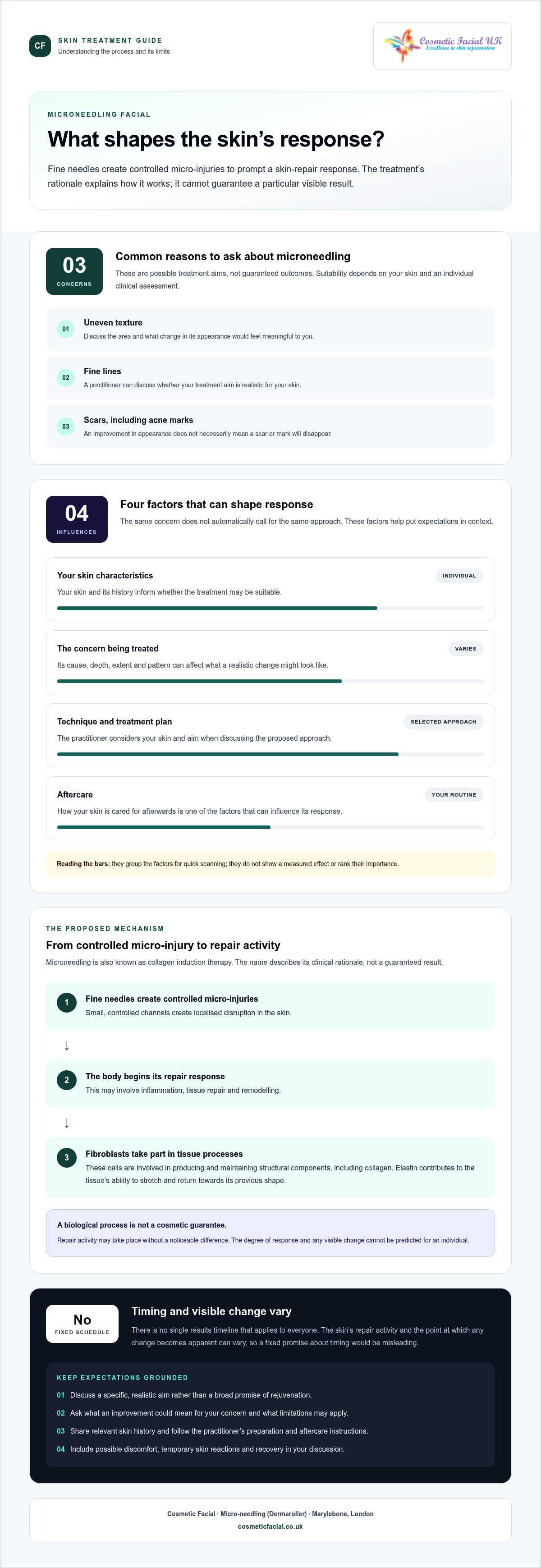
Fine needles create small, controlled channels in the skin. The body responds to this localised disruption through its usual wound-healing processes, which may involve inflammation, tissue repair and remodelling. The aim is to stimulate a repair response, not to dictate exactly how the skin will look afterwards.
In brief: microneedling creates controlled micro-injuries that activate the skin’s wound-healing response. This involves fibroblasts and the remodelling of collagen and elastin, but the degree of biological response and any visible change cannot be guaranteed.
Collagen is a structural protein that helps support skin tissue, while elastin contributes to its ability to stretch and return towards its previous shape. Fibroblasts are cells involved in producing and maintaining these components. Their role helps explain the treatment’s proposed mechanism, but it doesn’t mean every treated area will show a measurable or visible change. The skin’s response is biological, not a predictable cosmetic setting.
What happens during the skin’s repair response?
After controlled micro-injury, the body initiates repair activity in the affected tissue. Fibroblasts take part in this process, including the production and organisation of structural components such as collagen. Elastin also contributes to tissue properties, but these processes alone cannot establish how much change a person will see.
A repair response is not the same as guaranteed rejuvenation. Biological activity may take place without producing a noticeable difference, and visible changes may be more limited than hoped. The mechanism explains why microneedling is used, but it cannot predict an individual result.
Why individual results and timing vary
Response depends on several factors, including skin characteristics, the concern being treated, the technique and treatment plan, and how the skin is cared for afterwards. Two people with a similar concern may not respond in the same way. The depth and pattern of the concern can also affect what a realistic change might look like.
There is no single results timeline that applies to everyone. The skin’s repair activity and the point at which any change becomes apparent can vary, so a fixed promise about timing would be misleading. During an assessment, the practitioner can consider your skin and treatment aim, explain the proposed approach and discuss uncertainty before you decide.
At Cosmetic Facial, qualified specialists provide personalised micro-needling (Dermaroller) care. A personalised skin treatment discussion can put the procedure’s proposed mechanism in the context of your skin and expectations.
Microneedling Facial: Benefits, Limitations and Safety Considerations
Microneedling may improve the appearance of some skin concerns, but it cannot guarantee a specific result. Possible aims include changing the appearance of uneven texture, fine lines or scars. The degree of change, if any, depends on the person and the concern being treated. Improvement does not necessarily mean a mark or scar will disappear.
What benefits can be discussed realistically?
Focus the discussion on what you hope will look different, rather than on a promised outcome. For example, you may want to know whether a particular area of texture could appear more even. A practitioner can assess the concern, explain what change may be plausible and outline where expectations should remain cautious.
More than one appointment may be discussed if it is clinically appropriate for your skin and treatment aim. That does not mean everyone needs a course, or that repeating treatment will necessarily produce a better result. The number and spacing of appointments should follow individual assessment and the chosen approach, rather than a standard schedule assumed to suit everyone.
What discomfort and short-term reactions should readers understand?
Sensation during treatment varies. The NHS leaflet on microneedling in the context of scar treatment describes discomfort, so it would be misleading to assume the procedure is painless. Temporary visible reactions may also occur, but their nature and duration can differ between people and treatment plans. Personalised clinical advice is needed to understand potential risks and whether treatment is suitable for you.
Tell the practitioner about relevant skin history, current concerns and previous reactions to skin procedures. This helps inform the assessment and discussion of risks. Don’t decide suitability from a general online list. A feature that seems minor to one person may need a different clinical approach, and the practitioner must consider your circumstances as a whole.
More intensive treatment is not automatically more effective. Needle depth, coverage and other choices should be guided by the treatment aim and individual assessment. Increasing intensity may change how the skin responds, but cannot ensure a stronger cosmetic benefit and may affect the likelihood or extent of temporary reactions. The right approach balances the intended change with skin tolerance and safety, rather than simply choosing the most aggressive option.
Before proceeding, discuss the expected benefit, uncertainty, possible discomfort and visible reactions, as well as the reasons for the proposed approach. You should have the opportunity to understand these points and make a considered decision. A measured plan may involve adjusting the approach or deciding that microneedling is not appropriate for your concern at that time. Results are individual, and a careful discussion helps set realistic expectations.
Preparing for a Microneedling Facial and Managing Recovery
Preparation and aftercare should be guided by the practitioner, not copied from a general online routine. Your skin history, the area being treated and the selected approach can all affect the advice. A clear discussion beforehand helps you understand what to expect and what to do if your skin’s response concerns you.
What to discuss before your appointment
Tell the practitioner about your skin concerns, relevant medical history, current skincare products and medicines. Mention previous reactions to skin treatments if relevant. Don’t stop prescribed medicines or make significant changes to your skincare unless advised by an appropriate clinician. Use the assessment to discuss suitability, potential benefits and risks, and instructions tailored to you.
A clinician-led preparation and recovery sequence
Use this sequence to organise your discussion. The specific steps and timing should come from the clinic’s instructions for your treatment, rather than assumptions based on someone else’s experience.
- Before the appointment: Share relevant skin and health information, including current skincare and medicines. Discuss your treatment aim, possible reactions and any preparation instructions. If an instruction is unclear, ask the practitioner to explain it before treatment.
- On the day: Follow the clinic’s directions for preparing your skin and attending. The practitioner can explain the planned procedure and what you may feel. Sensation and treatment details vary, so raise any concerns before the procedure begins.
- After treatment: Follow the individual aftercare instructions you’re given. Ask which products or activities to avoid, when to resume your usual skincare and what changes should prompt you to seek advice. Don’t assume guidance for a different procedure or concern applies to you.
What recovery may involve after treatment
Some people experience temporary redness or sensitivity, while others may have a different response. These effects aren’t inevitable, and their intensity and duration can’t be predicted precisely for everyone. The approach used and your skin’s characteristics influence recovery advice, so avoid relying on a fixed timeline from someone else’s experience.
If a reaction concerns you, contact the clinic for advice and describe what you’re experiencing and when it began. Seek prompt medical assessment if symptoms are severe or worsening. Personalised aftercare is part of making an informed decision about a microneedling facial and should reflect both the procedure performed and your individual response.
Considering a Microneedling Facial in Marylebone, London
Understanding the procedure is one part of deciding whether it may suit your skin. An individual clinical assessment brings your concern, treatment aims and relevant skin history together. Cosmetic Facial offers micro-needling (Dermaroller) at its Marylebone clinic, with personalised care from qualified specialists. The assessment can help you decide whether to proceed without assuming the treatment suits everyone or will produce a particular result.
How an individual clinical assessment supports informed decisions
A useful assessment gives you the chance to explain what you hope to address and hear how the practitioner views the concern. Recommendations should reflect your skin and aims, not follow a standard plan regardless of individual differences. The discussion can cover suitability, possible benefits, risks, likely reactions and the limits of what treatment may achieve.
To make the conversation specific, consider describing:
- the area or feature that concerns you, and what you would consider a meaningful change;
- relevant skin or medical history, current skincare and medicines;
- questions about the procedure, discomfort, recovery or aftercare.
These points help focus the discussion, but they don’t replace clinical assessment. A practitioner may explain why a proposed approach does or does not fit your skin and treatment aim. You should feel able to weigh that advice against your expectations and decide whether to proceed.
Exploring microneedling at Cosmetic Facial
Cosmetic Facial’s micro-needling (Dermaroller) service is available to people considering a microneedling facial in London. The clinic is in Marylebone, and qualified specialists provide personalised care. Your treatment plan should be informed by your assessment. Don’t assume a device setting, course of appointments or visible outcome before that discussion.
Use the consultation to clarify what the treatment is intended to address in your case, what uncertainties remain and how preparation and recovery advice will be tailored. This keeps the decision centred on your skin and informed expectations, rather than broad claims about results.
Make Your Next Step an Informed One
Before choosing a microneedling facial, identify what you would like to change and what would make treatment worthwhile for you. Note practical concerns, such as fitting recovery into your routine, and write down any questions. This can help keep the discussion focused on your priorities rather than an idealised result.
You don’t need to decide immediately. A considered conversation can help you understand whether the treatment aligns with your aims and what uncertainties remain, so you can make an informed choice.
Whatever you decide, taking time to weigh your options is a positive step towards choosing care that feels right for you.
Frequently Asked Questions
Is a microneedling facial suitable for every skin type?
No. A particular skin type doesn’t automatically make treatment suitable or unsuitable. The practitioner needs to assess your skin, concern and relevant history. Mention current irritation or recent changes, along with previous reactions to skin procedures. If you’re unsure whether a feature needs medical attention before cosmetic treatment, raise it during the assessment so it can be considered before discussing a plan.
Does a microneedling facial hurt?
It can feel uncomfortable, although sensation differs between people and depends on the treatment approach. Descriptions such as “painless” can’t guarantee your experience. Before starting, discuss what you may feel and how to signal if you need a pause. If you’re particularly concerned about discomfort, mention it during your assessment rather than waiting until treatment is under way.
How long does redness last after microneedling?
There isn’t one reliable duration that applies to everyone. Redness may occur, but its intensity and how quickly it settles depend on your skin and the treatment performed. Follow the aftercare advice you’re given, and contact the clinic if redness is worsening, unusually uncomfortable or causing concern. A general online timeline can’t establish whether a reaction is expected in your circumstances.
Can I wear make-up after a microneedling facial?
Follow the practitioner’s instructions on when to resume make-up, rather than relying on a fixed online timetable. Advice may depend on your skin’s response and the approach used. If you have work or an event soon after treatment, mention this beforehand so you can discuss practical recovery expectations. Don’t apply products against your clinician’s guidance, even if they’re part of your usual routine.
When will I see results from a microneedling facial?
There’s no set point at which everyone will notice a change. Skin response and visible effects vary, and some people may see little change. Keep your expectations specific: for example, consider whether you’re hoping for a subtle difference in one area rather than a complete transformation. Your practitioner can discuss how progress might be assessed and when it would be reasonable to review your response.
How many microneedling sessions do I need?
The number of appointments can’t be decided from the treatment name alone. It depends on your concern, skin assessment, response and the practitioner’s plan. More than one session may be discussed, while others may be advised differently. Ask what any proposed appointments are intended to achieve and how the plan would be reviewed. Don’t assume a set course before your individual assessment.
Is at-home microneedling the same as a professional facial?
No. At-home devices and professional treatment aren’t interchangeable. The procedure, equipment and level of clinical assessment can differ. Using a device yourself doesn’t provide an assessment of whether microneedling suits your concern or guidance tailored to your skin. If you’re considering treatment, discuss your aims with a qualified practitioner before using a home device or combining it with other skin treatments.
Disclaimer
All content on cosmetic Facial website, including blogs, graphics, logos, images, and software, is the property of CosmeticFacial UK or its content suppliers and is protected by applicable copyright laws. Unauthorized use, reproduction, distribution, or modification of any content without prior written permission is strictly prohibited.


