


The clinical reality of neck rejuvenation has shifted away from superficial topical treatments toward procedures that address the underlying structural degradation of the dermis. It's understandable why many patients feel frustrated when standard skincare fails to address a softening jawline or the fine, crinkled texture that develops as skin loses its resilience. You've likely found that non-invasive options often lack the mechanical strength required for a visible lift, whilst invasive surgery carries risks and recovery periods that don't suit a busy professional schedule. This article explores how a pdo thread neck lift london provides a sophisticated, non-surgical alternative by combining immediate tissue repositioning with long-term biological rejuvenation. Discover how this advanced treatment, performed within our CQC-regulated clinic in Marylebone, targets both sagging and crepey texture through a precise dual-action mechanism. We'll examine the medical science behind polydioxanone threads, the necessity of dermatologist-led care, and the specific outcomes you can expect for a smoother, more defined neck profile in 2026.
Key Takeaways
- Understand the dual-action mechanism of polydioxanone (PDO) threads, which provides immediate mechanical lifting whilst stimulating long-term dermal collagen production.
- Learn why a pdo thread neck lift london is considered a clinical solution for crepey skin by significantly increasing the density of the thin neck dermis.
- Discover the procedural steps at our Marylebone centre, from the initial dermatological skin analysis to the application of local anaesthesia for patient comfort.
- Gain clarity on the recovery process and social downtime in 2026, including how to manage minor swelling as the threads integrate with your natural tissues.
- Recognise the importance of clinical oversight by a medically qualified dermatologist to ensure safety and natural-looking rejuvenation results.
Understanding the Mechanism: How PDO Threads Restore Neck Contours
Polydioxanone (PDO) is a medical-grade, biocompatible polymer that has been utilised in high-precision surgical fields, such as cardiothoracic surgery, for several decades. When applied to aesthetic medicine, specifically for a pdo thread neck lift london, it acts as both a mechanical support structure and a biological stimulant. The neck presents unique anatomical challenges, including a thinner dermis and a high degree of mobility. Consequently, successful rejuvenation requires a specific vector approach that differs from mid-face lifting, focusing on the redistribution of soft tissue along the jawline and submental area.
The Science of Polydioxanone
The efficacy of PDO lies in its predictable metabolic breakdown. The threads dissolve through a process known as hydrolysis, where the material is gradually absorbed by the body over approximately six months. During this interval, the thread induces a localised "foreign body response." Amongst clinical practitioners, this response is carefully managed to stimulate the induction of fibroblasts. These cells are responsible for the synthesis of new Type I and III collagen, which effectively increases dermal density and reverses the thinning associated with age. Whilst other materials like PLLA or PCL are available, PDO is frequently preferred for the neck due to its optimal balance of flexibility and tensile strength, which accommodates the constant movement of the cervical spine without causing visible irregularities.
Mechanical Lift vs. Biological Rejuvenation
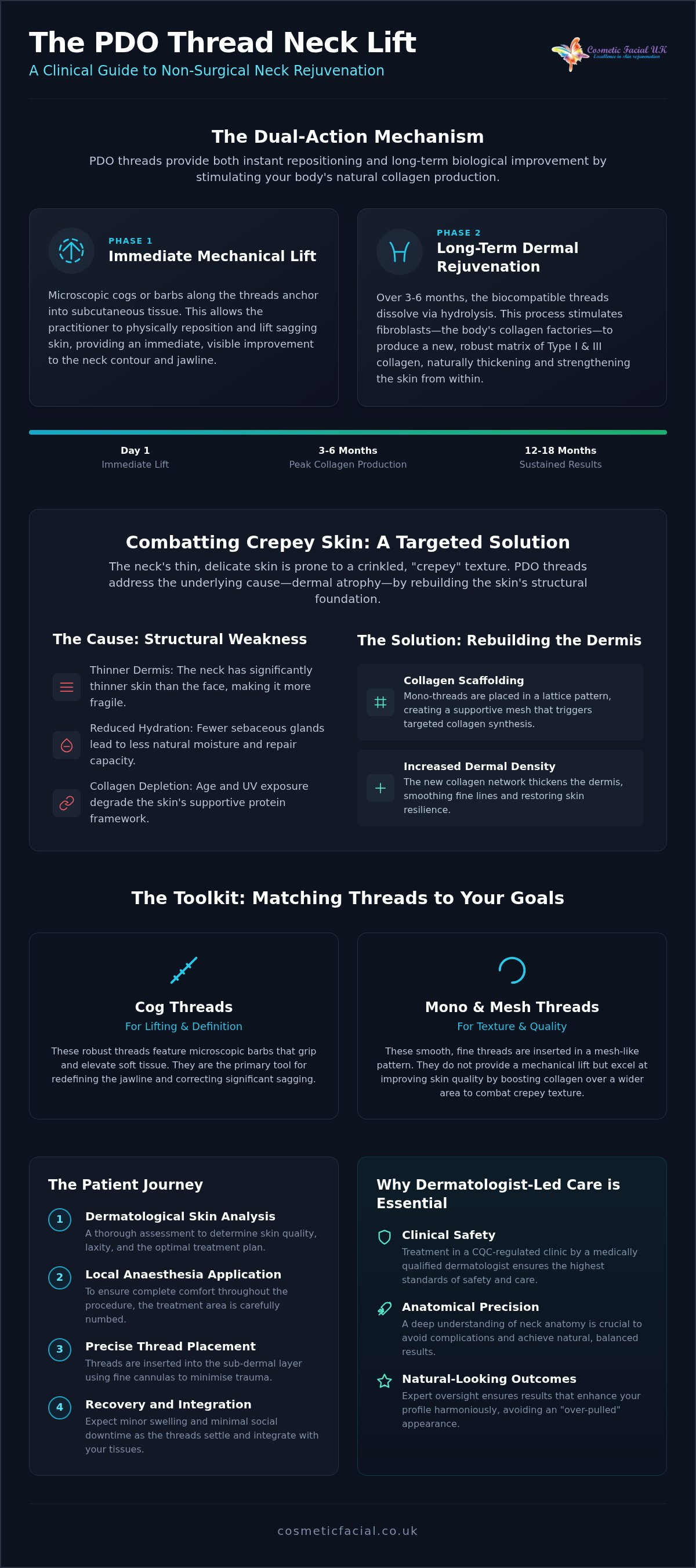
The clinical outcome of a PDO thread treatment is achieved through two distinct phases. The initial mechanical phase provides an immediate structural lift. It's made possible by "cogs" or microscopic barbs along the thread that anchor into the subcutaneous fat, allowing the practitioner to physically reposition sagging tissues. This methodology is a refined progression of early techniques, such as Contour threads, which established the use of barbed sutures for tissue suspension.
The secondary phase is biological and matures over three to four months. As the mechanical lift settles, the newly formed collagen matrix provides a natural scaffold that sustains the rejuvenated profile. Practitioners often employ a combination of thread types to achieve a comprehensive result:
- Cog Threads: Utilised for their lifting capacity and jawline definition.
- Mono or Mesh Threads: Inserted in a lattice pattern to address crepey skin texture by thickening the dermis.
This dual-action approach ensures that the patient receives both immediate gratification from the lift and long-term improvements in skin quality as the biological rejuvenation takes effect.
Combatting Crepey Skin: Why Threads are the Gold Standard for Neck Rejuvenation
The skin of the neck is uniquely vulnerable to the visible signs of ageing due to its distinct anatomical profile. Unlike the facial dermis, neck skin is significantly thinner and possesses fewer sebaceous glands, which results in a reduced capacity for self-hydration and repair. This structural fragility leads to dermal atrophy, manifesting as the fine, crinkled texture often described as "crepey" skin. For patients seeking a treatment for crepey skin on neck london, the objective must extend beyond surface-level hydration to address the loss of dermal density at its source.
A pdo thread neck lift london is particularly effective here because it targets the biological architecture of the skin. By inserting a series of mono-threads into the sub-dermal layer, we initiate a controlled healing response that replaces lost structural proteins. This process is essential for restoring the "snap-back" quality of healthy skin whilst providing a subtle, natural-looking improvement in skin tension.
Addressing Dermal Atrophy
Crepey skin is primarily a symptom of depleted collagen and chronic UV exposure, which degrades the elastin fibres. Mono-threads function as a supportive scaffolding. They don't provide the aggressive mechanical lift of cog threads but instead focus on skin quality. Over several months, the presence of the threads encourages the body to deposit new collagen in a lattice-like pattern. This thickening of the dermis smooths out fine lines and reduces the depth of horizontal "tech neck" creases. To further enhance these results, we often recommend adjunct therapies such as mesotherapy to provide the essential micronutrients and hyaluronic acid required for optimal fibroblast activity; additionally, you may wish to check out Lumière Apotheca for organic botanical products that nourish the skin naturally.
PDO Threads vs. Alternative Neck Treatments
When evaluating clinical options, it's vital to distinguish between lifting, tightening, and resurfacing. Whilst HIFU for the neck is an excellent modality for deep tissue tightening via ultrasound energy, threads offer a more precise mechanical repositioning of the skin. Similarly, chemical peels are effective for improving epidermal texture and pigmentation, yet they cannot address the underlying structural laxity that causes sagging.
For patients considering how to address surface-level skin quality alongside structural lifting, boutique wellness centres like Ammonite Laser Spa illustrate the value of incorporating advanced laser-based treatments to further refine skin texture and tone.
Dermal fillers, though useful in the face, are often unsuitable for the thin skin of the neck as they can lead to visible irregularities or a heavy appearance. Threads provide a more natural-looking rejuvenation by working with the body's own regenerative processes. Patients can explore these clinical options further by reviewing our comprehensive dermatology services in Marylebone, where we tailor each plan to the individual's skin health requirements.
The Procedure: What to Expect During Your London Neck Lift
The transition from clinical consultation to the actual procedure is a meticulous process that prioritises patient safety and anatomical precision. At our Marylebone centre, every pdo thread neck lift london begins with a comprehensive medical assessment and skin analysis. Operating within a CQC-compliant medical environment, we ensure that every stage of the treatment meets rigorous clinical standards. This initial analysis allows us to determine the precise degree of tissue laxity and dermal thinning, which informs the selection of threads and the mapping of insertion vectors.
Preparation and Vector Mapping
Successful results depend on accurate vector mapping, which is performed whilst the patient is in an upright position. It's essential to mark the skin while seated because gravity shifts the soft tissues of the neck and jawline differently than when a patient is supine. We identify the specific pathways where the threads will provide the most effective structural support. During this stage, the practitioner decides on the optimal combination of mono, screw, or cog threads. Cog threads are typically reserved for areas requiring significant mechanical lifting, whilst mono threads are mapped in a lattice pattern to address crepey texture. This bespoke mapping ensures that the submental area remains symmetrical and that the final result maintains natural contours without an over-tightened appearance.
The Insertion Process
We initiate the procedure by administering a local anaesthetic to ensure the patient remains comfortable throughout. Once the area is appropriately numbed, we utilise blunt-ended cannulas for the insertion of the threads. The use of cannulas is a vital safety protocol for a non-surgical face lift london, as they glide through the subcutaneous layers with significantly less tissue trauma than traditional needles. This technique minimises the risk of bruising and swelling.
The threads are carefully guided along the pre-marked vectors and anchored to the fascia, the deep connective tissue layer. This anchoring provides the necessary tension for an immediate lift. The practitioner makes real-time adjustments to the thread tension, observing the patient's profile from multiple angles to ensure a balanced outcome. The entire process typically requires 45 to 60 minutes. Because the procedure is non-surgical, there is no need for general anaesthesia or hospital stays, allowing patients to return home shortly after the treatment is complete.
Recovery and Longevity: Sustaining Your Results in 2026
The post-procedural phase of a pdo thread neck lift london is defined by what we term "social downtime." Whilst patients can generally return to light activities immediately, it's common for the first 48 hours to be characterised by a mild inflammatory response. This is a necessary biological reaction to the insertion of the polydioxanone material. You may observe minor swelling, bruising, or a slight "puckering" of the skin where the threads have been anchored. These effects are transient; they typically resolve within five to seven days as the threads settle into their final position within the subcutaneous tissue.
Longevity is a primary consideration for patients in 2026. Clinical standards suggest that the results of a thread lift remain visible for 12 to 18 months. This duration is influenced by the time required for the threads to undergo hydrolysis, which is approximately six months, and the subsequent lifespan of the newly induced collagen matrix. Individual results don't follow a single timeline. Factors such as metabolic rate, baseline skin quality, and UV exposure play a significant role in the degradation of the collagen scaffold. Chronic sun damage is known to accelerate this process, potentially shortening the effective lifespan of the treatment.
Immediate Aftercare Essentials
Adherence to aftercare protocols is vital to prevent thread displacement and ensure optimal integration. During the first week, we advise patients to adopt specific behaviours to protect the structural work:
- Sleeping Position: Sleep on your back with the head slightly elevated to reduce nocturnal swelling and prevent pressure on the neck.
- Movement Restrictions: Avoid opening the mouth excessively wide, such as during dental appointments or when eating firm foods, for at least 14 days.
- Physical Activity: Refrain from high-impact exercise and heat-based environments, such as saunas or steam rooms, for two weeks.
- Manual Pressure: Do not undergo facial massages or apply significant pressure to the neck area whilst the threads are anchoring.
A follow-up review at our Marylebone clinic is usually scheduled for two weeks post-treatment. This allows the practitioner to assess the symmetry and the progress of the tissue integration within a clinical setting.
Maximising Collagen Production
To extend the results of a pdo thread neck lift london, we recommend a multi-modality approach to skin health. Medical-grade skincare, particularly products containing L-ascorbic acid and retinoids, can support the fibroblasts in collagen synthesis. Many patients find that repeat treatments every 12 to 15 months help maintain a "collagen bank," ensuring that the structural integrity of the neck remains consistent. Integrating threads with line and wrinkle treatments can further refine the aesthetic outcome by addressing dynamic creases alongside structural sagging.
Why Choose Cosmetic Facial Marylebone for Your PDO Treatment?
Selecting a practitioner for a pdo thread neck lift london requires careful consideration of clinical credentials and anatomical expertise. Our clinic, situated in the medical district of Marylebone, provides a professional environment where aesthetic outcomes are balanced with medical safety. We serve patients from across Central London, including Fitzrovia and the West End, who seek natural-looking rejuvenation rather than the exaggerated, over-pulled results often associated with non-medical providers.
Expertise of Dr Faramarz Didar
The clinical lead, Dr Faramarz Didar, brings a dual perspective to aesthetic medicine as both a General Practitioner and a specialist in dermatology. He holds an MSc in Dermatology Skills and Treatment from the University of Hertfordshire, which he achieved with Commendation. This academic foundation ensures that every thread lift is approached with a deep understanding of skin biology and wound healing.
Dr Didar's technical proficiency is supported by advanced international training and certification from the IF AAS Non-Surgical Face Lift Master Class. His commitment to continuing medical education has taken him to clinical centres in Barcelona and Vienna, allowing him to integrate global best practices into our Marylebone centre. For Dr Didar, skin health is the prerequisite for beauty; he prioritises the restoration of dermal integrity alongside mechanical lifting.
A Bespoke Clinical Environment
Choosing a doctor-led, CQC-compliant clinic offers a significantly higher safety margin for procedures like thread lifting. We don't subscribe to a "one size fits all" approach. Instead, each patient receives an individualised treatment plan that accounts for their unique facial symmetry and tissue quality. This bespoke methodology is critical for achieving a natural-looking neck profile that respects the patient's original features.
Our clinic provides access to a comprehensive range of dermatology services and medical skin analysis. This allows us to treat the neck holistically, combining threads with other clinical solutions when necessary to address complex concerns like hyperpigmentation or chronic dehydration. By operating in the heart of London’s clinical hub, we maintain the highest standards of professional care for every pdo thread neck lift london we perform.
Achieving Sustainable Neck Rejuvenation in Marylebone
Achieving a restored neck profile requires a clinical approach that addresses both structural laxity and dermal atrophy. A pdo thread neck lift london offers a sophisticated, non-surgical pathway to these results by utilising the body's natural regenerative processes. By combining the immediate mechanical support of cog threads with the long-term collagen induction of mono threads, patients can achieve a more defined jawline and smoother skin texture that typically lasts between 12 and 18 months.
The success of this procedure depends on the precision of the practitioner and the standard of the clinical environment. Under the guidance of Dr Faramarz Didar, who holds an MSc in Dermatology with Commendation and IF AAS Master Class certification, our CQC-registered clinic provides a safe and professional setting for your treatment. We prioritise natural-looking aesthetics and medical precision in the heart of Marylebone. Investing in your skin health through these advanced clinical solutions ensures sustainable results and a rejuvenated appearance throughout 2026. You deserve a treatment plan that is as unique as your anatomy.
We look forward to providing the professional reassurance and expert care required to help you achieve your aesthetic goals with confidence.
Frequently Asked Questions
Is a PDO thread neck lift painful?
The procedure is generally well-tolerated because we utilise a local anaesthetic to numb the entry points and the insertion tracks. Patients typically report a sensation of pressure or a slight tugging as the threads are positioned, but acute pain is rare. Most individuals find the discomfort manageable during the 45 to 60-minute treatment. After the anaesthetic wears off, some tenderness or a "tight" sensation is expected, which usually resolves within a few days.
How much does a PDO neck lift cost in London in 2026?
The investment for a pdo thread neck lift london depends on several clinical variables, including the specific type of threads selected and the total quantity required to achieve the desired lift. Factors such as the degree of skin laxity and whether the focus is on mechanical lifting or dermal thickening will influence the final cost. We provide a bespoke quote during your clinical consultation in Marylebone, where a tailored treatment plan is developed based on your anatomical requirements.
How long do the results of a neck thread lift last?
Clinical results typically remain visible for 12 to 18 months, depending on the patient's biological response and lifestyle factors. Whilst the polydioxanone threads themselves undergo hydrolysis and dissolve within approximately six months, the secondary collagen scaffold they induce provides sustained structural support. Factors such as metabolic rate, smoking status, and chronic UV exposure can influence how long the body maintains this new collagen matrix. Periodic maintenance treatments can help sustain the rejuvenated profile.
Can PDO threads fix a "double chin" or just sagging skin?
PDO threads are primarily designed to address skin laxity and provide a structural lift rather than to remove significant adipose tissue. If a "double chin" is caused by sagging skin, threads can effectively reposition the tissue for a more defined jawline. However, if the concern is caused by submental fat, we may recommend combining threads with fat-dissolving injections or HIFU body treatments. This multi-modality approach ensures that both the fat volume and the skin laxity are addressed.
Are there any risks or side effects associated with neck threads?
Common side effects include minor bruising, localised swelling, and transient skin puckering, all of which typically resolve within a week. Because the neck is a highly mobile area, patients might occasionally feel the threads when turning their head during the first few days. Rare risks, such as infection or thread migration, are significantly minimised by having the procedure performed by a medically qualified dermatologist in a CQC-registered clinic. We follow strict sterile protocols to ensure the highest safety standards.
How many threads are usually needed for a neck lift?
The number of threads is determined by the severity of the sagging and the specific goals of the treatment. For a standard pdo thread neck lift london, we often use two to four cog threads per side to provide mechanical elevation. If the patient also requires treatment for crepey skin texture, we may insert an additional 10 to 20 mono threads in a lattice pattern. This combination ensures both a visible lift and a significant improvement in dermal density.
Can I combine a neck thread lift with Botox or fillers?
Combining threads with other injectables is a common clinical practice for achieving a total neck refresh. Botox can be utilised to relax the platysmal bands, which often cause vertical "cords" in the neck, whilst threads address the horizontal sagging. Dermal fillers might be used sparingly in the jawline area to further enhance definition. We assess your suitability for these combined therapies during your initial skin analysis to ensure the results remain natural and balanced.
What is the difference between PDO threads and a surgical neck lift?
The primary difference lies in the invasiveness and the nature of the results. PDO threads offer a non-surgical alternative that requires only local anaesthesia and minimal "social downtime." Surgery involves incisions, general anaesthesia, and a recovery period of several weeks. Whilst a surgical lift provides more permanent and dramatic changes, threads offer a more subtle, natural-looking rejuvenation. Threads are an ideal clinical solution for patients who wish to avoid the risks and scarring associated with invasive theatre procedures.
Disclaimer
All content on cosmetic Facial website, including blogs, graphics, logos, images, and software, is the property of CosmeticFacial UK or its content suppliers and is protected by applicable copyright laws. Unauthorized use, reproduction, distribution, or modification of any content without prior written permission is strictly prohibited.


