


After HIFU, the first changes you notice may be temporary skin reactions rather than the lifting or firming you hope to see. Mild redness, warmth, tenderness or swelling can occur, while visible results usually develop more gradually. This distinction is central to understanding the HIFU treatment recovery and timeline.
It’s understandable to want to know whether you’ll feel comfortable returning to work, exercise and your usual routine, and how to distinguish a short-term reaction from a developing result. Recovery varies between individuals, so there is no single timetable that applies to everyone. This guide explains what you may notice immediately and during the first week, when changes may begin to appear over the following months, and how to follow aftercare guidance. It also outlines when symptoms warrant individual clinical advice, so you can plan with realistic expectations rather than judging the treatment by the first few days.
Key Takeaways
- Use this HIFU treatment recovery and timeline guide to plan for the difference between short-term reactions and gradual visible changes.
- A temporary reaction does not prove that treatment has worked. Learn which symptoms should prompt clinical advice.
- Plan work, exercise and skincare around your treating clinician’s individual aftercare instructions.
- Individual responses vary. A later review can help assess progress more usefully than day-to-day comparisons.
- A consultation at Cosmetic Facial’s Marylebone clinic can help you discuss suitability, treatment areas and personal recovery expectations for HIFU face-lift treatment.
HIFU treatment recovery and timeline: what happens after a session?
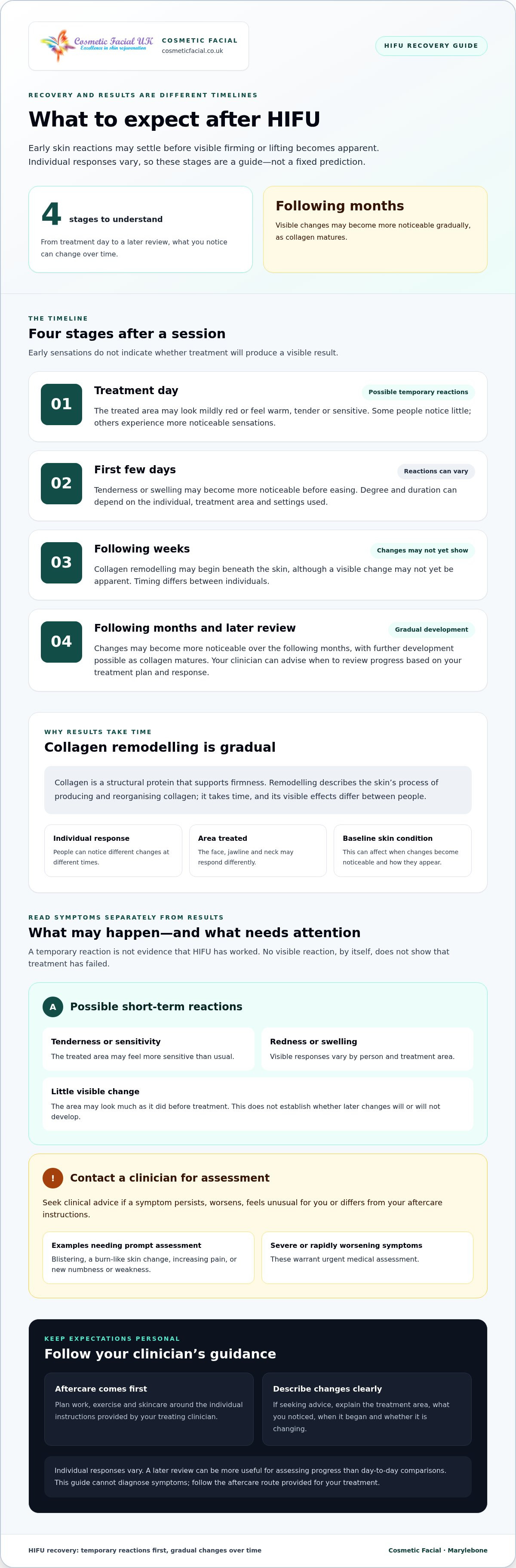
The immediate period after treatment and the wait for visible changes are separate parts of the experience. Temporary sensations may occur soon after a session, while visible firming or lifting can develop gradually. Recovery and results follow different timelines: early skin reactions may settle before treatment changes become apparent.
The stages below describe typical experiences, not a fixed prediction. Individual responses vary. The general overview of high-intensity focused ultrasound (HIFU) describes the technology and its different medical applications; recovery after aesthetic treatment should be considered in its specific clinical context.
- Treatment day: The treated area may look mildly red or feel warm, tender or sensitive. Some people notice little, while others experience more noticeable sensations. These early observations do not indicate whether treatment will produce a visible result.
- First few days: Tenderness or swelling may become more noticeable before easing. The degree and duration can depend on the individual, treatment area and settings used.
- Following weeks: Collagen remodelling may begin beneath the skin, although a visible change may not yet be apparent. Timing differs between individuals.
- Later review: Changes may become more noticeable over the following months, with further development possible as collagen matures. Your clinician can advise when to review progress based on your treatment plan and response.
What may happen on the day of HIFU treatment?
Redness, warmth, tenderness or sensitivity are possible temporary reactions, but their presence and intensity vary. The face, jawline and neck may respond differently, and treatment settings can also influence the experience. Some visible or sensory changes may be short-lived, while others take longer to settle. You may have no noticeable reaction, but this should not be assumed or promised. Follow the individual guidance provided after your treatment.
When might HIFU results become visible?
Visible changes may develop gradually rather than appearing as an immediate lift. Collagen remodelling describes the skin’s process of producing and reorganising collagen, a structural protein that supports firmness. This process takes time, and its visible effects differ between people. Individual response, the area treated and baseline skin condition can all affect when changes become noticeable and how they appear.
For HIFU face-lift treatment, a consultation helps establish which areas are being considered and set personal expectations for recovery and review. Cosmetic Facial provides HIFU face-lift treatment at its Marylebone clinic in London. You can also read about the clinic’s non-surgical face-lift treatment when considering an approach for your concerns.
HIFU recovery symptoms: what is expected and what needs attention?
A post-treatment reaction is a temporary response in the treated area. It is not evidence that HIFU has worked, and the absence of a visible reaction does not, by itself, show that treatment has failed. Symptoms should be considered separately from the gradual development of any cosmetic changes.
Temporary effects are generally mild and settle, while persistent, worsening or unusual symptoms should be assessed by a clinician. There is no single symptom pattern that applies to everyone. The area treated, individual sensitivity and treatment settings can all influence what you notice. Your treating clinician’s instructions take priority over general information.
Which short-term reactions may occur after HIFU?
Possible short-term effects include tenderness, sensitivity, redness or swelling. Some people notice little visible change immediately after treatment, while others experience one or more of these responses. You may feel a sensation without seeing an obvious change on the skin, so appearance alone may not describe the full experience. The degree and duration of a reaction vary. Do not assume that a particular symptom or intensity is inevitable.
- Tenderness or sensitivity: The treated area may feel more sensitive than usual. Note where the sensation occurs and whether it changes.
- Redness or swelling: These may be visible responses, but their presence and extent vary by person and treatment area.
- Little visible change: The area may look much as it did before treatment. This does not establish whether later changes will or will not develop.
Keep track of what you notice rather than judging treatment success from an early sensation. If you are unsure whether a reaction fits the guidance you were given, contact the clinic through the aftercare route provided for your treatment.
When should a patient contact the clinic?
Seek clinical advice if a symptom persists, worsens, feels unusual for you or differs from your aftercare instructions. Examples that need prompt assessment include blistering, a burn-like skin change, increasing pain, or new numbness or weakness. These signs cannot be assessed reliably through an article, and this guidance is not a diagnosis. Severe or rapidly worsening symptoms warrant urgent medical assessment.
When you get in touch, describe the treatment area, what you have noticed, when it began and whether it is changing. Follow the clinic’s instructions for sharing relevant details, but do not delay seeking assessment if symptoms are severe. Do not try to diagnose the cause or treat a significant skin change based solely on online advice. The treating clinician can assess your individual circumstances and advise on the appropriate next step.
The Cosmetic Facial clinic information explains the setting for HIFU care. For concerns about symptoms, use the aftercare contact route provided for your treatment.
HIFU recovery compared with results: addressing downtime and discomfort concerns
Limited visible downtime does not mean results appear immediately. You may feel comfortable returning to usual activities while visible changes are still developing. These are separate processes, so a quiet-looking recovery period should not be used to predict the eventual outcome.
When considering non-surgical face-lift treatment, think about three things: short-term recovery, gradual change and individual variation. The time ranges described are typical guidance, not guarantees.
| Aspect | What it may involve | How to interpret it |
|---|---|---|
| Short-term recovery | Temporary tenderness, sensitivity, redness or swelling may occur, though some people notice little. | Reactions can affect comfort and appearance without indicating whether treatment has succeeded. |
| Gradual change | Visible changes may emerge over weeks or months rather than straight after the session. | Early appearance is not a reliable measure of later results. Review progress when advised by your clinician. |
| Individual variation | Experience can differ with sensitivity, treatment area, settings and baseline skin condition. | Another person’s recovery or outcome is not a precise guide to yours. |
Does HIFU always involve no downtime?
No. Some people may resume usual routines soon after treatment, while temporary tenderness or visible changes may lead others to take things more carefully. Minimal disruption is not the same as an assurance of no reaction. If you have work, social plans or an important event, consider your own comfort and leave room for flexibility rather than relying on someone else’s experience.
Follow the individual aftercare instructions from your treating clinician, particularly about exercise and skincare. If an activity makes the treated area uncomfortable, pause and seek advice if you are unsure how to proceed. The appropriate return to your routine depends on how you feel and the guidance given for your treatment.
Why do visible HIFU results take longer than recovery?
Temporary reactions and cosmetic changes have different causes and timescales. Redness or tenderness may settle while the slower tissue response associated with treatment continues. Visible changes are often described as developing over the following months, but the timing and degree of change vary. Consider them in light of your treatment area and clinical plan.
The HIFU treatment recovery and timeline is not a single countdown. Feeling well enough for normal activities does not mean visible results have finished developing. Nor does a slower visible response, on its own, establish that treatment has failed. A planned review provides a more appropriate opportunity to discuss progress than repeated day-to-day comparisons, which can make subtle changes difficult to judge.
HIFU aftercare: how to plan the first days and weeks
Follow the instructions from your treating clinician, since advice can depend on the treatment area, settings and your individual response. General information can help you plan, but it should not replace the directions given for your session. Keep your routine flexible, follow the agreed guidance and seek advice if you are uncertain about a change.
The HIFU treatment recovery and timeline includes both the initial period after treatment and the longer wait for visible changes. Avoid using frequent mirror checks to judge progress. Subtle changes can be difficult to assess day to day, and an early appearance is not a reliable measure of the eventual result.
Returning to work, exercise and usual activities
There is no single return-to-activity schedule that suits every patient. Your clinician’s advice should reflect the treatment you received and how the treated area feels. Some people may be comfortable carrying on with usual plans; others may prefer to make adjustments if tenderness or sensitivity affects work, travel or social activities.
If possible, leave some flexibility in your plans rather than scheduling demanding activities immediately after treatment. Follow the specific guidance you were given about exercise and other activities. If movement or a task increases discomfort, pause and use the clinic’s aftercare contact route for advice instead of assuming one general recommendation applies to everyone.
- Work: Consider whether your role involves physical effort, prolonged travel or close contact with the treated area, and plan accordingly.
- Exercise: Follow your clinician’s instructions on when and how to resume your usual activity.
- Appointments: Keep any review arranged as part of your care, and raise concerns about symptoms or progress during follow-up.
Skincare and follow-up after HIFU
Use skincare according to your clinician’s instructions. Do not introduce new products or change your routine based on generic advice if you are unsure whether it is suitable for your treated skin. If you have a prescribed or recommended routine, follow that guidance and ask the clinic before making changes that could affect the area.
A brief, factual record can help you describe a concern clearly without repeatedly assessing the treatment area. Note when a symptom began, where it is, whether it is improving or worsening, and any relevant changes in your routine. If photographs are useful to your clinician, take them only as directed and in consistent conditions. Repeated close inspection can make small day-to-day differences seem more significant than they are.
Contact the clinic through the aftercare route provided if symptoms persist, change or concern you, or if you are unsure how to interpret progress. Keep your planned review, since gradual results are more useful to discuss over an appropriate interval than through daily comparisons. Individual advice is particularly helpful if your experience differs from the instructions you received.
A personalised consultation can help you discuss HIFU suitability, recovery expectations and aftercare questions before treatment.
Planning HIFU treatment in Marylebone: consultation, expectations and next steps
A consultation gives you and the clinician an opportunity to discuss whether HIFU face-lift treatment is suitable for your concerns, which areas may be considered and what recovery could involve for you. Cosmetic Facial offers HIFU face-lift treatment at its Marylebone clinic in London. The discussion should be individual, rather than based on a promise that one treatment plan or outcome applies to everyone.
Preparing a few questions can make the appointment more useful. Consider what you hope to address, how soon you need to return to particular activities, and what would help you feel informed before making a decision. A consultation can also clarify the proposed treatment area, aftercare instructions and when progress may be reviewed.
What to discuss before a HIFU appointment
Share your goals and relevant medical history, including medicines, health conditions, previous procedures and any concerns about the skin in the area being considered. Explain what downtime or sensations would be difficult to accommodate in your routine. This information helps the clinician assess individual suitability and discuss a realistic plan. An article cannot determine whether treatment is appropriate for you or predict an exact result.
How to set realistic expectations for HIFU
Short-term reactions and visible changes have separate timelines. Temporary redness or tenderness may occur soon after treatment, while any visible change may develop more gradually. The extent and timing of results vary between individuals, so another person’s experience is not a reliable forecast. Discuss what a review can assess and what would count as a meaningful change for your own goals.
It may also help to consider the broader context of facial rejuvenation. Cosmetic Facial’s facial rejuvenation information describes the clinic’s approach to this area, while its full face rejuvenation guide offers further context on non-surgical planning. These resources can support your preparation, but an individual clinical discussion remains important for advice specific to your circumstances.
The phrase “HIFU treatment recovery and timeline” covers more than the first few days. Planning also means understanding the likely review period, following aftercare instructions and having a clear route for raising concerns. Before proceeding, make sure you understand the treatment area being discussed, the limits of what can be predicted and how to seek advice if your recovery differs from expectations. A considered decision can include taking time to reflect after the consultation.
Make your next step an informed one
Use what you’ve learnt about the HIFU treatment recovery and timeline to frame the questions that matter most to you. Before deciding, consider what you hope to address, how treatment may fit around your routine and how you feel about waiting while results develop. A personalised clinical discussion can help you weigh these considerations and understand whether the proposed approach fits your needs.
At Cosmetic Facial, care is personalised and delivered by qualified specialists. A consultation is an opportunity to discuss your concerns openly, clarify the proposed treatment and recovery guidance, and take time to make a considered decision. General information alone cannot determine suitability or predict an outcome.
With clear individual advice and realistic expectations, you can decide on your next step with greater confidence.
Frequently Asked Questions
How long does HIFU recovery usually take?
HIFU recovery varies, so there is no fixed number of days that applies to everyone. Temporary reactions, such as tenderness or redness, are separate from gradual visible changes, which may take longer to develop. Your HIFU treatment recovery and timeline depends on factors including the treated area and your individual response. Follow your clinician’s aftercare guidance and discuss any questions about expected time ranges with them.
Can I go back to work after HIFU?
Some people may return to normal activities, but this cannot be guaranteed for every patient. Tenderness or sensitivity may affect your comfort, particularly if your work involves physical effort, travel or contact with the treated area. Follow your clinician’s specific instructions. If you have an important work commitment, plan flexibly and discuss any concerns during your consultation rather than assuming there will be no downtime.
Is HIFU painful, and will I feel anything afterwards?
Comfort during and after HIFU differs between individuals, and a pain-free procedure cannot be promised. Some people may notice sensations such as warmth or tingling, or temporary sensitivity afterwards. Your clinician can explain which sensations are relevant to your treatment. If you are concerned about discomfort, mention it at your consultation and ask how the proposed treatment area and settings may affect your experience.
Can I wear make-up after HIFU?
Make-up advice depends on your skin’s response and the clinic’s protocol, so there is no universal waiting time. Follow the aftercare instructions provided for your treatment, including any guidance on when to apply products to the treated area. If the skin looks unusually irritated or symptoms worsen, do not rely on general online advice. Contact the treating clinic for individual guidance.
When should I contact the clinic after HIFU?
Contact the treating clinic about symptoms that persist, worsen or seem unexpected, such as increasing pain, blistering, a burn-like change or new numbness. An online article cannot assess an individual reaction or establish its cause. Describe when the symptom began and how it has changed. If symptoms are severe or rapidly worsening, seek urgent medical care rather than waiting for a routine response from the clinic.
How long do HIFU results take to appear?
Visible changes do not necessarily appear immediately after a session. They may develop gradually over the following months; the timing and degree of change vary with the individual, treatment area and baseline skin condition. Some guidance describes changes emerging around two to three months, with further development possible over three to six months. Ask your clinician what to expect for your treatment area.
Can I have another HIFU treatment if I have not seen results yet?
Whether another session is suitable, and when to consider it, requires an individual clinical assessment. A lack of visible change soon after treatment does not automatically mean another session is needed, as results may develop gradually. Before deciding, discuss your progress, concerns and original treatment plan with your clinician. They can assess the treated area and advise whether further treatment is appropriate for your circumstances.
Disclaimer
All content on cosmetic Facial website, including blogs, graphics, logos, images, and software, is the property of CosmeticFacial UK or its content suppliers and is protected by applicable copyright laws. Unauthorized use, reproduction, distribution, or modification of any content without prior written permission is strictly prohibited.


