


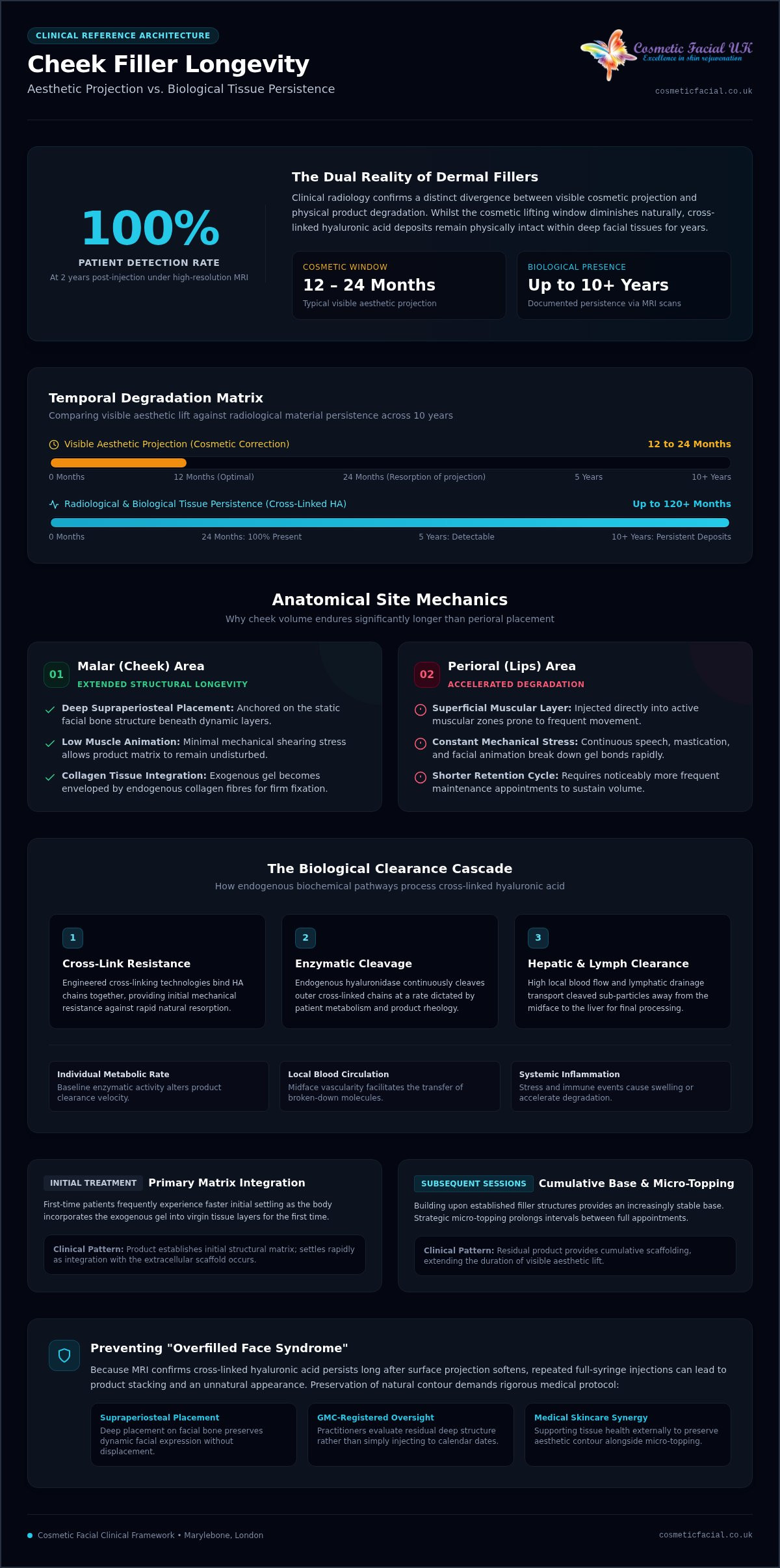
Recent high-resolution MRI evaluations have revealed that cross-linked hyaluronic acid remains physically detectable in 100% of patients at two years post-injection, with some deposits persisting for over a decade. This contrast between biological presence and visible aesthetic projection often leads to significant confusion. You might feel anxious about the conflicting claims regarding how long do cheek fillers last or worry that frequent maintenance could lead to an overfilled appearance. It's a valid concern for anyone seeking to balance cost-effectiveness with a natural, refined profile.
This 2026 clinical guide provides a definitive framework for understanding the 12 to 18 month typical window for cosmetic results. We'll explore how product rheology and individual metabolic pathways influence the degradation of dermal fillers. You'll also learn how precise supraperiosteal placement by a GMC-registered practitioner in Marylebone can maximise structural longevity. By the end of this article, you'll have the clinical knowledge required to make informed decisions about your midface rejuvenation journey.
Key Takeaways
- Understand that visible aesthetic projection typically persists for 12 to 24 months, whilst MRI studies confirm the product remains biologically present for considerably longer.
- Identify the clinical factors, including product rheology and individual metabolic rates, that determine how long do cheek fillers last for each patient.
- Learn how strategic "micro-topping" and medical-grade skincare can maintain facial volume and prolong the interval between full treatment sessions.
- Recognise the necessity of seeking treatment from a GMC-registered doctor to ensure precise anatomical placement and avoid the risks of overfilled face syndrome.
Defining Cheek Filler Longevity: What is the Standard Duration?
Clinical data suggests the standard duration for cheek fillers typically ranges from 12 to 24 months. This timeline represents the period of visible aesthetic correction, often referred to as the cosmetic window. It's essential to distinguish between these visible results and the physical persistence of the residual product within the facial layers. Recent radiological evidence demonstrates that injectable dermal fillers can remain in the tissue for several years, even after the initial volumising effect has diminished. Understanding this distinction helps practitioners avoid over-filling, as the goal is to maintain a natural contour rather than simply stacking product.
The mid-face is considered an ideal area for longevity because it possesses lower muscle mobility compared to the lower face. First-time patients often notice that their initial treatment seems to settle faster than subsequent sessions. This occurs because the body is integrating the exogenous gel into the dermal matrix for the first time. As you build a foundation of filler over multiple appointments, the cumulative structure provides a more stable base, which often extends the interval between maintenance visits. To better understand this concept, watch this helpful video:
The Role of Hyaluronic Acid in Modern Fillers
Hyaluronic Acid (HA) is a polysaccharide naturally found within the human extracellular matrix, valued for its ability to retain moisture and provide structural support. In aesthetic medicine, manufacturers use cross-linking technology to bind HA molecules together, creating a robust gel that resists immediate enzymatic breakdown. Premium, FDA-approved HA brands are engineered with specific rheological properties to ensure predictable degradation and biocompatibility. Using these high-quality formulations is fundamental to determining how long do cheek fillers last in a clinical setting, as they provide the necessary lift without migrating.
Cheeks vs. Lips: Why Location Matters
The rate at which the body metabolises filler is heavily influenced by local mechanical stress and facial animation. The perioral area, including the lips, is subject to constant movement from speech and mastication, which accelerates the mechanical breakdown of the gel. In contrast, the malar (cheek) bone area is relatively static, allowing the product to remain undisturbed deep on the supraperiosteal layer. Tissue integration refers to the process by which the filler gel becomes enveloped by the patient's own collagen fibres, anchoring the product within the anatomical compartment. This stability in the mid-face is why cheek treatments typically offer greater durability than more mobile facial regions, making them a cornerstone of facial rejuvenation plans.
The Biological Mechanism: How the Body Metabolises Dermal Fillers
The body's primary method for clearing hyaluronic acid (HA) is through the action of endogenous hyaluronidase, a naturally occurring enzyme that progressively cleaves the cross-linked chains of the gel. This process is continuous but occurs at a rate dictated by individual biochemistry. Whilst manufacturer data provides a baseline, individual metabolic rates significantly influence the speed of product clearance. High local blood flow and efficient lymphatic drainage in the mid-face also play roles, as they facilitate the transport of degraded particles to the liver for final processing. For detailed safety information, patients can consult the FDA guidance on soft tissue fillers, which outlines how these materials are resorbed over time.
Systemic inflammation can also alter the perceived longevity of results. During periods of high stress or acute illness, the body's immune response may cause transient swelling or, conversely, accelerate the breakdown of the filler's matrix. This variability is why clinical assessments are more reliable than simple calendar dates when determining how long do cheek fillers last for a specific patient.
Metabolic Variables and Lifestyle Factors
A common misconception is that intensive cardiovascular exercise "burns off" dermal filler in the same manner it metabolises calories. While high metabolic activity can slightly increase the rate of enzyme turnover, it rarely leads to a sudden reduction in how long do cheek fillers last. Other lifestyle factors play a more significant role in degradation:
- Hydration: Since HA is hydrophilic, it requires adequate water intake to maintain its structural volume and "loft".
- Oxidative Stress: Smoking and chronic UV exposure introduce free radicals that damage both natural collagen and filler integrity.
- Systemic Health: Chronic inflammation or autoimmune triggers can occasionally lead to faster metabolic clearance of the gel.
The Science of "Filler Creep" and Migration
Sometimes, a loss of cheek definition isn't due to the product disappearing, but rather the filler migrating to adjacent tissue planes. This "filler creep" often results from poor injection technique or placing high-volume product too superficially within the dermis. At Cosmetic Facial, we use deep-plane injection techniques, placing the bolus directly onto the supraperiosteal layer. This provides a stable foundation and prevents the gel from shifting under the weight of facial fat pads or muscle activity. Choosing a specialist dermal filler practitioner ensures that the product remains anchored, preserving the intended contour for the duration of its biological life.
Key Variables Affecting Longevity: Product Rheology and Patient Profile
The duration of visible results depends heavily on the rheology of the chosen product. Rheology refers to how a substance flows and deforms under stress. For mid-face augmentation, clinicians prioritise fillers with a high G-Prime, or elastic modulus. This property measures the gel's firmness and its capacity to provide structural lift against the weight of overlying tissue. High G-Prime products resist the compressive forces of facial muscles, ensuring the contour remains stable. When patients ask how long do cheek fillers last, the answer is often found in this technical specification: firmer gels typically take longer for the body to break down.
Filler Density and Structural Support
To effectively mimic the projection of a natural cheekbone, a high-density gel is required. These formulations contain a higher concentration of cross-linked hyaluronic acid, which creates a denser molecular matrix. This density not only provides superior lift but also slows the rate at which endogenous enzymes can penetrate and dissolve the product. According to FDA guidance on dermal fillers, these absorbable materials are designed for deep-tissue placement where they provide a scaffold for the skin. For those exploring Dermal Fillers London, selecting a practitioner who understands these technical nuances is vital for achieving durable results.
Patient age and baseline skin quality also dictate the lifespan of the treatment. Younger skin with robust collagen levels provides better intrinsic support, which helps maintain the filler's position. In contrast, skin with significant laxity may require a "layering" approach. Repeat patients often observe that their results endure longer over time. This is because subsequent treatments build upon a residual foundation of integrated filler, creating a cumulative volumising effect that requires less frequent maintenance.
Individual Anatomy and Volume Deficit
The perceived longevity of a treatment is frequently linked to the degree of initial volume loss. If a patient is under-filled, the natural metabolic reduction of even a small percentage of the gel will be immediately visible. Achieving "optimal correction" means using sufficient volume to restore the anatomical deficit fully. This ensures that the aesthetic improvement remains apparent for the full 12 to 18 month window. A staged approach, where volume is added gradually over two sessions, often allows for better tissue integration and a more predictable understanding of how long do cheek fillers last for that individual's unique anatomy.
Strategic Maintenance: How to Extend the Life of Your Cheek Enhancement
Maximising the lifespan of mid-face augmentation requires a proactive approach rather than a reactive one. Instead of waiting for the visible volume to vanish completely, clinical experts often recommend a "micro-topping" strategy. This involves administering smaller, strategic amounts of filler when the initial correction begins to soften. By maintaining a baseline level of product, you ensure the dermal matrix remains supported, which can effectively extend the interval between comprehensive treatments. Regular follow-up assessments are essential to this process, as they allow for precise adjustments based on real-time tissue changes rather than relying on a fixed calendar date.
Topical care acts as a vital synergy to injectable treatments. Using medical-grade skincare products strengthens the skin barrier and improves the health of the extracellular matrix. Specifically, daily application of broad-spectrum sun protection is non-negotiable. Ultraviolet (UV) radiation accelerates the degradation of natural collagen and elastin, which in turn weakens the structural scaffold that holds the filler in place. Protecting the skin from oxidative stress is a fundamental factor in determining how long do cheek fillers last for the long term.
The Importance of a Consistent Practitioner
Developing a long-term relationship with a single, highly qualified clinician like Dr Didar is clinically advantageous. A consistent practitioner maintains a detailed "facial map" and a historical record of injection sites, depths, and product volumes. This longitudinal tracking is the most effective way to avoid "filler stacking" or an over-filled appearance. It ensures that each subsequent treatment complements the existing residual product rather than overwhelming the natural anatomy. This methodical approach is a cornerstone of a successful Full Face Rejuvenation Plan.
Lifestyle Adjustments for Longevity
Specific lifestyle choices directly impact the biological environment of the filler. A diet rich in antioxidants helps neutralise free radicals that might otherwise accelerate enzymatic breakdown. Additionally, maintaining high levels of systemic hydration is crucial. Since hyaluronic acid is hydrophilic, it requires adequate water intake to retain its volumising "loft" and structural integrity.
Immediate post-treatment care is equally important for long-term stability. For the first 48 hours, you should avoid high-intensity exercise, extreme heat, and excessive facial manipulation. These golden rules allow the gel to set firmly in the intended anatomical compartment without displacement. It's helpful to view cheek filler as a continuous journey of maintenance and refinement, rather than a single, isolated event.
Book a clinical assessment in Marylebone
Clinical Excellence in Marylebone: Achieving Durable Results at Cosmetic Facial
Technical proficiency and a deep understanding of facial anatomy are the most critical factors in determining the success of mid-face treatments. Patients often inquire about how long do cheek fillers last without realising that the answer is inextricably linked to the precision of the injection technique. At Cosmetic Facial, our approach is centred on evidence-based medicine and anatomical accuracy. We prioritise natural facial harmony, ensuring that volume is restored in a way that respects the unique proportions of each individual's face. This philosophy prevents the "over-filled" look and ensures that the results remain aesthetically pleasing throughout the entire degradation cycle.
Dr Faramarz Didar, a GMC-registered doctor since 2006 (GMC 5200505), leads the clinic with a focus on clinical excellence. He holds an MSc in Dermatology Skills and Treatment with Commendation from the University of Hertfordshire, an academic achievement that reflects a commitment to the highest standards of skin health. This specialist training allows for a more nuanced understanding of how different dermal layers interact with various filler rheologies. By combining medical expertise with advanced surgical dermatology principles, we ensure that every treatment is both safe and effective.
Expertise You Can Trust
Choosing a practitioner with the correct medical credentials is vital for any injectable procedure. Dr Didar's postgraduate medical education and his membership in the European College of Aesthetic Medicine & Surgery provide a foundation of trust and reliability. Our Marylebone clinic operates as a centre of medical excellence, where we utilise only premium, clinically validated products. This level of oversight is essential when discussing how long do cheek fillers last, as the quality of the product and the skill of the injector are the primary variables in treatment longevity.
- GMC Registration: Continuous registration since 2006 ensures adherence to strict professional standards.
- Specialist Training: Advanced training in non-surgical facial rejuvenation and dermatology.
- Clinical Environment: A professional setting that prioritises patient safety and sterile protocols.
Book Your Consultation in London
The journey toward a refreshed and volumised profile begins with a comprehensive clinical assessment. During your initial consultation at our practice, which is conveniently situated near Marylebone and the Harley Street corridor, we'll perform a detailed facial analysis. This process allows us to create a personalised longevity projection based on your skin quality, metabolic rate, and the specific anatomical deficits present. We don't believe in a one-size-fits-all approach; instead, we tailor the volume and placement to meet your specific aesthetic goals whilst maintaining clinical safety.
Taking the next step is a matter of scheduling a formal review of your options. We'll discuss the various filler types available and explain how our specific techniques will work to maximise your results. Our goal is to provide you with the confidence that you're in capable, experienced hands for your mid-face rejuvenation.
Securing Your Aesthetic Future with Clinical Precision
Understanding how long do cheek fillers last involves recognising the complex interplay between high G-Prime product rheology and your unique metabolic clearance rate. Whilst the standard cosmetic window typically spans 12 to 24 months, radiological evidence confirms that the physical material remains integrated within the tissue for significantly longer. Achieving a durable yet natural result requires more than just high-quality hyaluronic acid; it necessitates the anatomical expertise of a specialist medical practitioner who understands the long-term behaviour of these biomaterials.
Cosmetic Facial provides a CQC-compliant clinical environment in Marylebone, led by Dr Faramarz Didar. With over 15 years of medical experience and an MSc in Dermatology Skills and Treatment with Commendation, Dr Didar prioritises clinical safety and facial harmony. By choosing an evidence-based approach to mid-face rejuvenation, you ensure your results are managed with the precision required for sustainable outcomes.
We look forward to supporting you in achieving a refined and refreshed appearance that stands the test of time.
Frequently Asked Questions
Do cheek fillers last longer than lip fillers?
Yes, cheek fillers typically demonstrate significantly greater longevity than lip fillers. This is primarily due to the lower rate of muscular animation in the mid-face compared to the perioral area. Whilst lips are subject to constant movement through speech and mastication, the cheek area remains relatively static. Additionally, the high-density gels required for structural cheek support are more resistant to enzymatic breakdown than the softer formulations used for lip augmentation.
Can I make my cheek fillers last longer with specific skincare?
Specific skincare protocols can support the dermal environment and indirectly influence how long do cheek fillers last. Medical-grade products containing antioxidants and retinoids help maintain the integrity of the extracellular matrix. Most importantly, daily application of broad-spectrum SPF prevents ultraviolet radiation from breaking down natural collagen and elastin. A healthy skin barrier ensures the filler remains well-supported within the tissue, preserving the visible volumising effect for the maximum possible duration.
How do I know when it is time for a cheek filler top-up?
Clinical indicators for a top-up include a visible loss of mid-face projection or the reappearance of shadows in the nasolabial folds. You might notice that the skin appears slightly more lax or that the lifted contour has softened. Rather than waiting for the product to deplete entirely, we recommend a clinical assessment when you perceive a 20% to 30% reduction in volume. This allows for a strategic maintenance approach that avoids the need for a full reinjection.
Will my face look worse when the cheek filler eventually wears off?
Your face will not look worse once the filler metabolises; rather, it will gradually return to its pre-treatment baseline. In many cases, the skin quality may actually appear improved due to the stimulatory effect that hyaluronic acid can have on natural collagen production. Regular treatments at our Marylebone clinic ensure that the transition is seamless. Provided the filler was placed correctly by a qualified doctor, the skin will not sag as the product dissipates.
Does exercise actually make cheek fillers disappear faster?
High-intensity cardiovascular exercise can marginally increase your systemic metabolic rate, but it rarely causes a sudden disappearance of dermal filler. The impact is typically negligible for most patients. However, elite athletes with exceptionally high metabolic turnover may find their results soften slightly sooner than sedentary individuals. The primary factors remain the product rheology and the depth of injection rather than physical activity levels. We advise avoiding strenuous exercise only during the initial 48-hour setting period.
Is it possible to dissolve cheek fillers if I do not want to wait for them to last?
Yes, hyaluronic acid fillers are fully reversible using a concentrated enzyme called hyaluronidase. This prescription-only medication is injected into the area to cleave the HA bonds, allowing the body to resorb the product within 24 to 48 hours. This is a precise medical procedure that requires clinical expertise to ensure the natural tissue is not affected. At Cosmetic Facial, we prioritise anatomical safety, but the option to dissolve remains a key benefit of non-permanent HA fillers.
Are there permanent cheek fillers available in the UK?
Permanent fillers are generally discouraged in the UK aesthetic market due to the high risk of long-term complications and the inability to adjust for natural facial ageing. Most reputable London clinics, including our practice in Marylebone, utilise temporary hyaluronic acid or biostimulatory agents. These products offer a safer profile because they are biocompatible and reversible. Using non-permanent options allows your clinician to refine your treatment plan as your facial structure evolves over the years.
What happens if I wait too long between cheek filler appointments?
Waiting too long between appointments simply means the visible aesthetic benefits will fade as the body clears the product. From a clinical perspective, you lose the layering advantage where residual filler provides a foundation for new injections. This may result in needing a higher volume of product at your next visit to achieve the same level of correction. Maintaining a consistent schedule prevents significant fluctuations in your appearance and often proves more cost-effective in the long term.
Disclaimer
All content on cosmetic Facial website, including blogs, graphics, logos, images, and software, is the property of CosmeticFacial UK or its content suppliers and is protected by applicable copyright laws. Unauthorized use, reproduction, distribution, or modification of any content without prior written permission is strictly prohibited.


