


A completely motionless forehead isn't a hallmark of successful aesthetic medicine; it's often a marker of clinical over-dosing. If you're anxious about ending up with an altered, rigid appearance, or if you've spent days wondering whether asymmetric brow heaviness is normal settling or a clinical mistake, that uncertainty is entirely understandable. Conflicting advice across non-medical cosmetic settings frequently obscures the vital signs of good vs bad botox, leaving patients without clear criteria for assessing their care.
This clinical guide will help you evaluate your treatment outcomes objectively, distinguish natural dynamic softening from practitioner error, and make informed choices about your facial health. We'll examine the precise visual benchmarks of balanced neurotoxin administration, outline the immediate red flags that warrant medical review, and clarify the anatomical principles that underpin safe, expert care in London.
Key Takeaways
- Distinguish the clinical signs of good vs bad botox by assessing dynamic expression retention against excessive dermal shine and complete muscular immobility.
- Understand the biomechanics of the upper face, specifically how frontalis over-treatment induces brow descent whilst compensatory muscle contraction triggers unnatural lateral elevation.
- Recognise adverse outcomes such as true eyelid ptosis and smile asymmetry, identifying which presentations require prompt clinical management rather than passive observation.
- Adhere to the essential fourteen-day assessment timeline to allow complete neuromuscular binding before considering any corrective review or secondary dosing.
- Evaluate medical injector credentials critically, ensuring your practitioner holds appropriate statutory registration and advanced postgraduate training in facial anatomy.
Defining Clinical Excellence: Hallmarks of Good Botox vs Poor Administration
Aesthetic medicine should refine facial dynamics rather than obliterate personal expression. When evaluating the signs of good vs bad botox, the primary criterion is whether muscular relaxation preserves dynamic balance across adjacent muscle groups. In medical practice, a detailed understanding of botulinum toxin pharmacology and safety profile ensures that targeted chemical denervation softens hyperdynamic rhytids without producing an unyielding, artificial mask. True clinical success respects individual anatomy, maintaining rested symmetry across the entire facial canvas.
Technical errors during injection often stem from formulaic injection patterns that overlook individual muscle vector strengths. To examine the clinical missteps that lead to suboptimal aesthetic outcomes, Dr Tim Pearce provides an anatomical breakdown in the video below:
The Hallmarks of Skilfully Administered Botulinum Toxin
Exemplary administration reflects a granular appreciation of facial kinetics. When assessing well-executed outcomes, clinicians look for specific functional benchmarks:
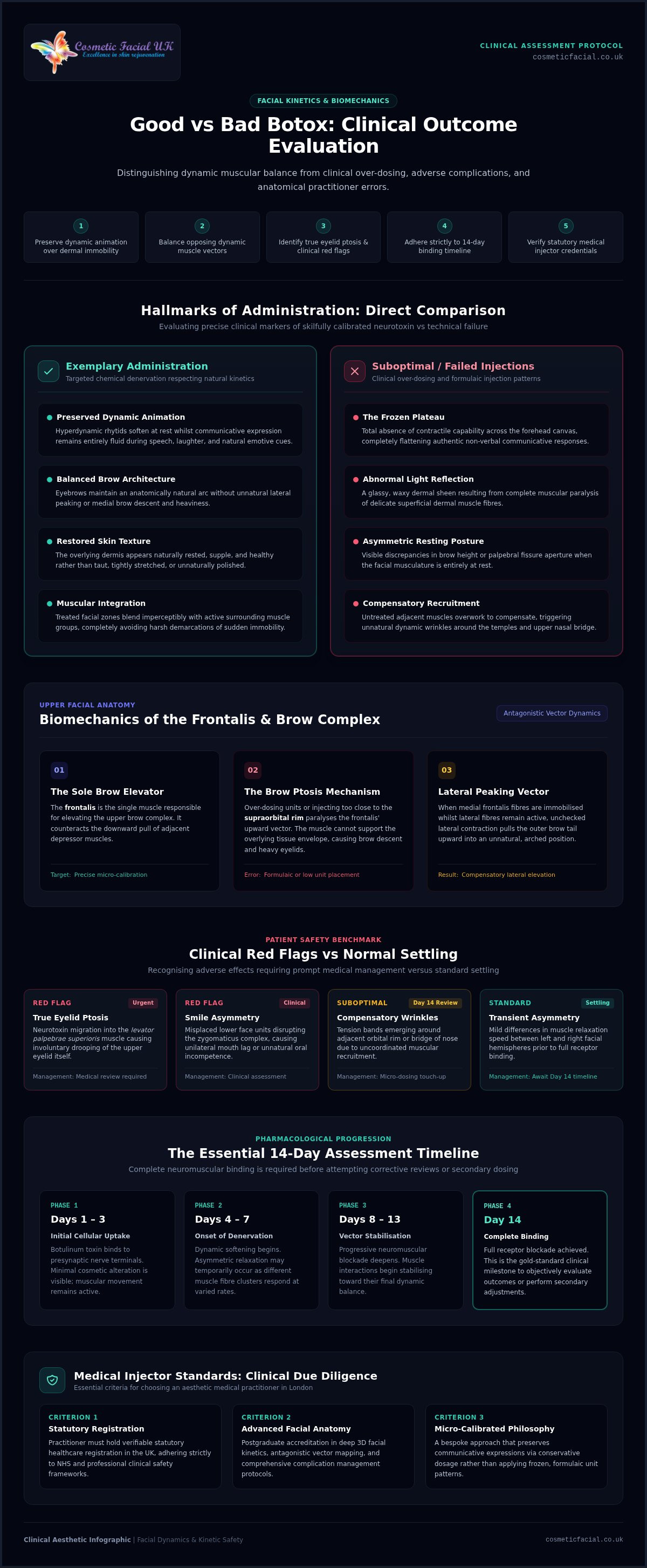
- Preserved dynamic animation: Expression lines soften at rest, yet communicative movement remains fluid during speech or laughter.
- Balanced brow architecture: Eyebrows maintain an anatomically natural arc without lateral peaking or medial depression.
- Restored skin texture: The overlying dermis appears rested rather than taut or artificially polished.
- Muscular integration: Treated zones blend imperceptibly with active surrounding muscles, avoiding harsh demarcations of immobility.
Immediate Visual Indicators of Suboptimal or Failed Injections
Distinguishing the signs of good vs bad botox becomes straightforward when inappropriate dosing or misplaced units compromise natural kinetics. Suboptimal technique produces distinct clinical markers:
- The frozen plateau: An immobile forehead exhibiting zero contractile capability, which flattens non-verbal communication.
- Abnormal light reflection: A waxy, glassy dermal appearance resulting from the complete paralysis of delicate superficial muscle fibres.
- Asymmetric resting posture: Obvious discrepancies in brow elevation or palpebral fissures when the face is at rest.
- Compensatory recruitment: Unnatural wrinkles emerging around the temples or upper bridge as untreated adjacent muscles strain to compensate.
Practitioners providing dedicated botox treatments recognise that conservative micro-calibration, rather than total immobilisation, remains the prerequisite for authentic, balanced outcomes.
Upper Facial Dynamics: Identifying Natural Movement vs the Frozen Forehead
Facial expression relies on an antagonistic balance between elevating and depressing muscle vectors. If these opposing forces aren't carefully managed, neuromuscular denervation quickly disrupts resting balance. Reviewing the anatomical signs of good vs bad botox across the upper third reveals why precision matters. Patients who follow NHS guidance on choosing a qualified cosmetic practitioner benefit from injectors who understand how improper dosing compromises facial balance.
Forehead Lines and the Frontalis Muscle: Balance vs Heaviness
The frontalis is the sole elevator of the brow complex. Precise micro-dosing softens horizontal rhytids without impeding its essential upward vector. When an injector over-doses or places units too close to the supraorbital rim, the frontalis can't support the overlying tissue envelope. The outcome is brow ptosis; patients experience a persistent heavy sensation across the eyelids and struggle to open their eyes fully. Skilled practitioners preserve baseline tone by placing micro-aliquots high on the forehead, leaving the lower fibres active to support the resting brow.
Glabellar Lines and Brow Positioning: Avoiding the Spock Effect
The glabellar complex, comprising the corrugator supercilii and procerus muscles, acts as the primary medial brow depressor. Modulating these targets softens vertical frown lines. However, clinical error frequently occurs when practitioners treat the glabella and central forehead while neglecting the lateral frontalis fibres. Unchecked by medial opposition, these lateral fibres overcompensate and contract forcefully. This dynamic imbalance produces the "Spock brow" or Mephisto sign, marked by unnaturally peaked lateral brow arches. Calibrated dosing coordinates medial relaxation with subtle lateral restraint to maintain natural curvature.
Periorbital Crow's Feet: Softening Without Compromising Cheek Elevation
Lateral canthal rhytids form through repeated contraction of the lateral orbicularis oculi during smiling. Skilful administration softens these dynamic creases while respecting the zygomaticus muscle group inferiorly. If injections are placed too deeply or too low, product diffusion can impair upper cheek elevation, creating a flat shelf or accentuating lower eyelid puffiness. Patients seeking subtle, anatomically sound line and wrinkle treatments should ensure their injector assesses dynamic movement at rest and during maximum contraction. Arranging a consultation at an established medical aesthetic clinic in Central London ensures every injection preserves natural periorbital vitality.
Clinical Red Flags: Recognising Bad Botox Complications and Adverse Effects
Adverse outcomes in aesthetic medicine rarely occur by chance. Injected neurotoxins bind strictly where they are deposited; therefore, significant functional deficits almost always indicate poor anatomical placement, inaccurate needle depth, or excessive volume diffusion. Recognising the objective signs of good vs bad botox requires distinguishing between harmless, transient post-procedure settling and genuine clinical complications that demand immediate medical oversight.
Blepharoptosis and Brow Ptosis: Causes, Mechanics, and Timelines
Eyelid drooping, or blepharoptosis, represents one of the most distressing adverse effects. This occurs when product diffuses through the orbital septum into the levator palpebrae superioris, the muscle responsible for elevating the upper eyelid. The patient struggles to open the affected eye fully, experiencing an involuntary partial closure. This differs mechanically from brow ptosis, where excessive denervation of the lower frontalis forces the entire brow downward onto the upper eyelid skin. Blepharoptosis typically manifests three to seven days following treatment. Unlike hyaluronic acid fillers, botulinum toxin cannot be dissolved enzymatically; however, medical practitioners can prescribe alpha-adrenergic agonist ophthalmic drops such as apraclonidine 0.5% to stimulate Müller's muscle and achieve temporary symptomatic elevation until the neuromodulator naturally degrades.
Lower Face Dysfunctions: Asymmetry, Mouth Droop, and Dysphagia
Treating the lower face introduces complex functional risks due to dense, overlapping muscle layers. Injections intended for the depressor anguli oris (DAO) to lift downturned mouth corners can easily diffuse into the risorius or depressor labii inferioris. The result is lower lip incompetence, dynamic smile asymmetry, or an inability to close the mouth cleanly. In masseter reductions, anterior product migration risks weakening the zygomaticus major or buccinator, causing difficulty with mastication and unnatural hollows. When treating platysmal neck bands, deep injections or excessive dosing can reach underlying pharyngeal muscles, creating rare but severe issues such as dysphagia (difficulty swallowing) or hoarseness. Review our frequently asked questions to understand the procedural boundaries that safeguard functional outcomes.
Compensatory Muscle Hyperactivity and Unintended Creasing
When an injector paralyses a targeted muscle group completely, the adjacent untreated musculature often contracts with increased recruitment to restore facial movement. Identifying the signs of good vs bad botox involves observing how surrounding tissues behave:
- Accentuated bunny lines: Hyperactive contraction of the transverse nasalis on the upper nasal bridge after complete glabellar immobilisation.
- Infraorbital pooling: Exaggerated horizontal creases under the eyes caused by unrestrained lower orbicularis fibres pulling upward against a relaxed lateral zone.
- Temple puckering: Unnatural dynamic wrinkling near the hair margins where untreated lateral frontalis fibres strain under excess load.
Preventing these distortions requires nuanced dosing that balances kinetic force rather than creating sudden muscular voids.
Assessment Timeline: What to Do If Results Look Wrong
Neuromuscular denervation is a progressive biochemical process rather than an immediate visual event. When evaluating the signs of good vs bad botox, premature judgement during the initial post-procedure window often leads to unwarranted distress. A transient pause in symmetry does not automatically indicate clinical failure; rather, it reflects variable uptake rates across bilateral muscle bellies. True assessment must align with the biological uptake curve of the neurotoxin.
The 14-Day Maturation Window: Distinguishing Uneven Onset from Errors
Initial chemical denervation begins within 24 to 48 hours, producing perceptible muscle relaxation between days 3 and 5. By day 7, approximately 70% to 90% of the relaxation effect takes hold. However, full neuromuscular blockade requires a complete 14-day cycle. Asymmetrical movement frequently appears during this interim period because dominant facial muscles metabolise and bind the protein at different rates. Administering corrective touch-ups before day 14 is clinically contraindicated. Intervening prematurely risks depositing secondary doses onto receptors that haven't completed their uptake, which compounds muscle heaviness and increases the likelihood of induced brow ptosis.
Clinical Remediation: Adjustments, Antidotes, and Waiting Out Diffusion
Once the two-week threshold arrives, an experienced practitioner can distinguish true clinical errors from dynamic variations. Certain suboptimal outcomes are readily correctable:
- Lateral brow hyper-elevation: A persistent Spock brow resolves swiftly with a precise, low-dose micro-aliquot delivered into the hyperactive lateral frontalis fibres.
- Residual dynamic rhytids: Isolated lines that retain contractility can receive conservative micro-doses without destabilising surrounding tissues.
- Symptomatic eyelid ptosis: Because botulinum toxin cannot be dissolved enzymatically, clinical management of blepharoptosis involves prescribing apraclonidine 0.5% ophthalmic drops. These stimulate Müller's sympathetic superior tarsal muscle to provide temporary lid elevation until the protein degrades through natural nerve terminal sprouting.
Questions to Ask at Your Post-Procedure Clinical Review
A structured day-14 review offers an opportunity to evaluate facial balance methodically. Arrive prepared to discuss the following points with your medical injector:
- Do remaining asymmetries stem from natural baseline dynamics or uneven product placement?
- What exact dosages and unit distributions were recorded across each anatomical zone?
- Could supplementary treatments, such as non-invasive facial rejuvenation, support tissue recovery and dermal quality?
- How will today's observations be documented to refine dosages for future procedures?
Choosing a Qualified Medical Injector in London to Guarantee Subtle Outcomes
Aesthetic medicine demands far more than basic technical dexterity. Administering botulinum toxin safely requires extensive clinical knowledge of complex facial anatomy, pharmacology, and tissue dynamics. In the UK, choosing a medical doctor registered with the General Medical Council (GMC) ensures strict professional accountability, rigorous clinical standards, and formal patient safeguarding. Understanding the signs of good vs bad botox ultimately highlights the critical distinction between transactional cosmetic treatments and comprehensive medical care.
Anatomical Mastery: Why Physician-Led Aesthetic Consultations Matter
Physicians evaluate structural facial morphology comprehensively before initiating any procedure. Rather than treating surface lines in isolation, a medical doctor assesses baseline skeletal symmetry, soft-tissue depth, and individual muscle vector tensions. At Cosmetic Facial in Marylebone, Dr Faramarz Didar brings over 30 years of medical experience, holding GMC registration (5200505), PMETB certification, an MSc in Dermatology Skills and Treatment with Commendation from the University of Hertfordshire, and postgraduate qualifications in non-surgical facial aesthetics from the University of Central Lancashire. This academic foundation ensures that pre-existing contraindications or previous procedural asymmetries are diagnosed accurately, protecting patients from preventable complications.
Personalised Dosing Versus Standardised 'One Size Fits All' Protocols
Every face presents unique contractile strengths that make standard injection templates clinically inappropriate. High-street or discount establishments frequently rely on rigid injection grids, which accounts for the high prevalence of suboptimal results. A doctor-led practice tailors micro-dosing to dynamic facial kinetics:
- Kinetic assessment: Dosing is calibrated precisely to active muscle mass rather than arbitrary regional units.
- Symmetry preservation: Natural baseline differences between the left and right sides of the face receive tailored micro-aliquots.
- Expression retention: Fractional dosing relaxes targeted rhytids while preserving natural emotive capacity across untreated zones.
What to Expect from a Clinical Facial Assessment in Marylebone
A private consultation at our Central London clinic begins with dynamic photography and high-resolution muscle tracking at rest and during maximum contraction. This methodical approach allows your physician to examine your kinetic vectors thoroughly and outline realistic aesthetic outcomes with total transparency. Clear signs of good vs bad botox demonstrate that refined outcomes rely on measured, conservative medicine rather than aggressive immobilisation. To receive unhurried, objective guidance regarding your facial health, Book a Consultation with Dr Didar at our Marylebone clinic.
Securing Natural Facial Balance Through Medical Expertise
Achieving refined aesthetic rejuvenation depends on understanding the critical signs of good vs bad botox. Exemplary outcomes preserve authentic facial expression while softening hyperdynamic lines, avoiding the rigid immobility and heavy brows caused by formulaic over-dosing. Remembering the biological 14-day binding window provides clarity during the settling phase, ensuring that true clinical complications are differentiated from normal neuromuscular uptake.
Your facial anatomy deserves meticulous care led by formal medical training. At Cosmetic Facial, situated in the prestigious medical district of Marylebone, consultations are conducted by Dr Faramarz Didar, MD. With GMC registration (5200505), over 30 years of medical experience, and an MSc in Dermatology Skills and Treatment with Commendation from the University of Hertfordshire, Dr Didar prioritises individual facial harmony over standardised templates.
You can approach your aesthetic decisions with confidence when your care is anchored in anatomical precision and medical integrity.
Frequently Asked Questions
How can I tell if my botox has gone wrong or is simply still settling?
You can confirm whether a result is a clinical error or normal settling by observing the 14-day binding timeline. Full chemical denervation requires two full weeks. Minor asymmetries or uneven brow elevation during days 3 to 10 frequently reflect different regional absorption rates rather than improper injection. If severe functional impairments such as true eyelid closure or speech impairment appear, consult your medical doctor immediately; otherwise, withhold clinical judgement until day fourteen.
What causes the "Spock brow" look and can it be corrected quickly?
The "Spock brow" occurs when medial brow depressors and central frontalis fibres are relaxed, but the lateral frontalis fibres remain active and untreated. This allows the unopposed lateral muscle to pull the brow tail upward into an unnatural peak. Fortunately, this is one of the easiest signs of bad botox to correct. A qualified doctor can administer a tiny micro-dose into the hyperactive lateral frontalis, restoring natural curvature within several days.
Can bad botox be dissolved immediately if I am unhappy with the result?
No, botulinum toxin cannot be dissolved or reversed with an enzyme. Unlike hyaluronic acid dermal fillers, which dissolve with hyaluronidase, neurotoxins bind irreversibly to presynaptic nerve terminals. Clinical remediation focuses on compensatory management; for example, apraclonidine drops can elevate a drooping eyelid, while minor asymmetries can be balanced with micro-dosing. Otherwise, resolution depends entirely on the body naturally regenerating new motor endplates over three to four months.
How long do the signs of a bad botox treatment typically last?
The aesthetic complications of a poorly administered treatment typically persist for ten to twelve weeks. Although primary muscular paralysis lasts between three and four months, dynamic muscle tone begins returning gradually after week eight as nerve terminal sprouting occurs. Consequently, obvious signs of good vs bad botox, such as heavy brow descent or asymmetric smiling, generally soften and become significantly less noticeable well before the drug fully leaves your system.
What is the physical difference between eyelid ptosis and brow ptosis?
Eyelid ptosis involves internal lid weakness, whereas brow ptosis involves descending external tissue. Eyelid ptosis occurs when neurotoxin diffuses into the levator palpebrae superioris, preventing the upper eyelid from opening fully. Brow ptosis happens when the frontalis muscle is over-dosed, causing the forehead skin and eyebrow complex to slide downward over the orbital rim. Both present as heaviness, but eyelid ptosis responds to prescription drops, while brow ptosis must metabolise naturally.
Why do some people develop an unnaturally shiny or waxy forehead after botox?
An unnatural, glassy forehead develops when high doses completely paralyse the superficial frontalis fibres, flattening microscopic skin texture. In healthy dynamic skin, fine dermal irregularities scatter light across multiple planes. When muscle contraction stops entirely and the dermis stretches taut, the skin surface reflects light like a polished mirror. Experienced medical injectors avoid this waxy finish by using micro-dosing techniques that preserve natural microscopic skin topography.
Can poor botox administration cause problems with smiling or chewing?
Yes, misplaced injections in the mid or lower face can impair dynamic oral functions. Injections into the masseter for jaw slimming can diffuse anteriorly into the risorius or zygomaticus muscles, causing asymmetrical smiling or bite fatigue. Similarly, incorrect placement near the chin can affect the depressor labii inferioris, resulting in lower lip incompetence. These complications demonstrate why London patients should choose an experienced medical doctor who maps individual muscle margins precisely.
Disclaimer
All content on cosmetic Facial website, including blogs, graphics, logos, images, and software, is the property of CosmeticFacial UK or its content suppliers and is protected by applicable copyright laws. Unauthorized use, reproduction, distribution, or modification of any content without prior written permission is strictly prohibited.


