


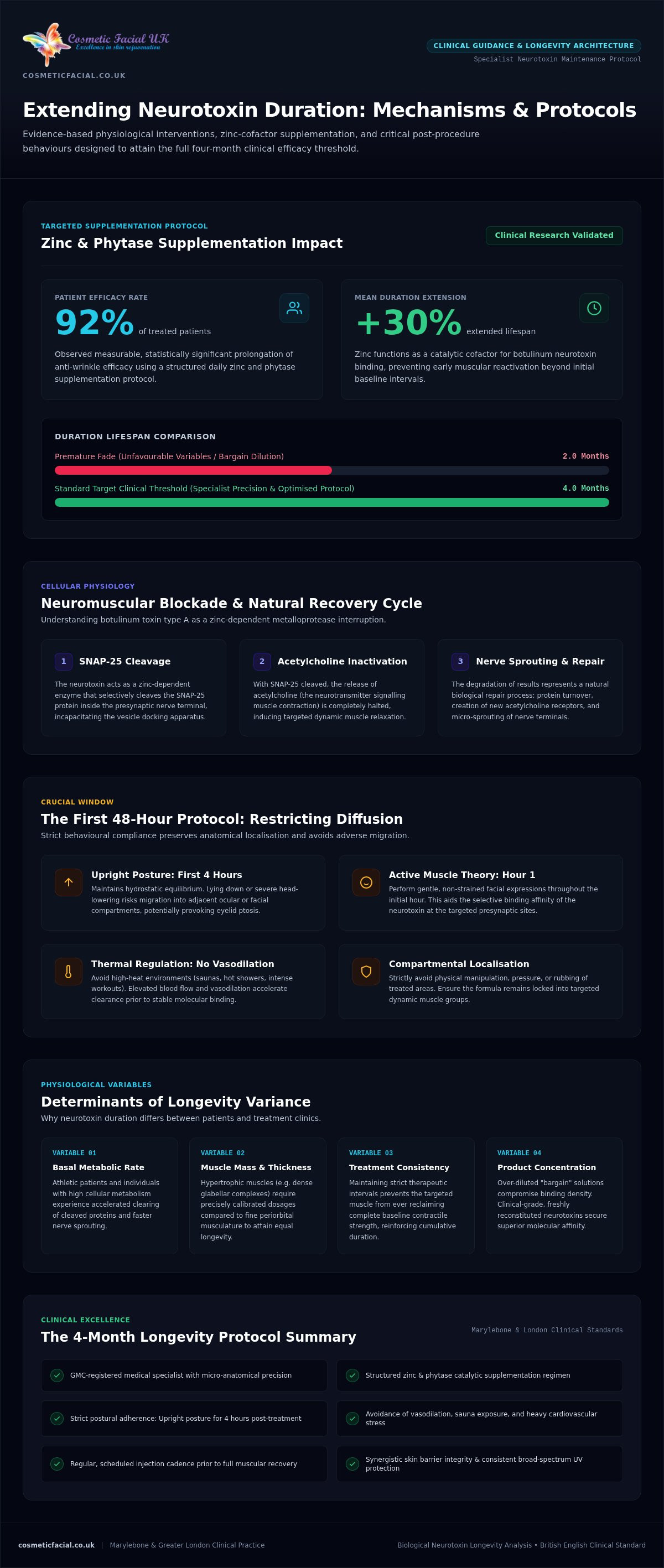
Clinical research demonstrates that 92% of patients who utilise a specific protocol of zinc and phytase supplementation see their neurotoxin duration extended by approximately 30%. It's a significant finding for anyone who feels their anti-wrinkle injections fade prematurely. You likely find it frustrating when movement returns after only two months, especially considering the financial investment and the desire for a consistent appearance. Understanding how to make botox results last longer requires a shift from viewing the treatment as a simple cosmetic fix to seeing it as a clinical partnership between practitioner technique and patient physiology.
This guide provides a comprehensive analysis of the lifestyle adjustments and clinical protocols required to reach the standard four-month efficacy threshold. We'll examine the biological mechanism of nerve regeneration and the role of zinc as a catalytic cofactor, whilst also considering the impact of metabolic rates. You'll also learn about the importance of precise muscle targeting by a qualified medical professional, which is a hallmark of reputable clinics in Marylebone and across London. By following these evidence-based steps, you can move away from inconsistent results and maintain a more stable, rejuvenated aesthetic.
Key Takeaways
- Understand the biological mechanism of neurotoxin degradation and how the regeneration of acetylcholine receptors determines the duration of your results.
- Master the essential first 48-hour protocols, focusing on postural awareness and activity restrictions to ensure the toxin remains in the targeted muscle groups.
- Discover evidence-based nutritional and lifestyle adjustments; this includes how to make botox results last longer through targeted zinc supplementation and consistent UV protection.
- Explore the benefits of a multi-modality approach where synergistic treatments reinforce the skin's structural integrity to complement muscle relaxation.
- Learn why clinical expertise and anatomical precision from a GMC-registered specialist are vital for achieving results that reach the full four-month efficacy mark.
Understanding the Mechanism of Botox Longevity
Botulinum Toxin Type A functions as a temporary neuromuscular blockade that specifically targets the SNAP-25 protein within the nerve terminal. By cleaving this protein, the toxin prevents the release of acetylcholine, which is the neurotransmitter responsible for muscle contraction. When this signal is interrupted, the muscle enters a state of relaxation, effectively softening the appearance of dynamic lines. To understand the mechanism of botulinum neurotoxin, one must view it as a precise biological interruption rather than a permanent structural change.
The body eventually initiates a natural repair process that involves the turnover of these proteins. It begins to develop new acetylcholine receptors and nerve sprouts to restore the communication pathway between the nerve and the muscle. This biological recovery is why the effects of line and wrinkle treatment are inherently temporary. Patients frequently ask how to make botox results last longer, and the strategy often involves managing these physiological variables through clinical precision and evidence-based lifestyle choices.
To better understand the biological process behind these treatments, watch this clinical explanation:
The Role of Molecular Binding
The longevity of the treatment depends heavily on the toxin’s ability to bind securely to the nerve terminal. As a zinc-dependent metalloprotease, the toxin requires specific cellular conditions to cleave proteins and inhibit muscle contraction effectively. High-potency, fresh product ensures a stronger binding affinity, which leads to more stable and predictable results. Conversely, seeking bargain injections often results in shorter-lived outcomes. This typically occurs because the product may be overly diluted or stored incorrectly, reducing its concentration and its ability to inhibit muscle movement. At a specialised clinic, practitioners don't rely on guesswork; they use the correct concentration to achieve a blockade that persists for the full expected duration.
Individual Metabolic Factors
Understanding how to make botox results last longer also involves looking at individual biology. Several personal factors influence the duration of the refreshed look. Individuals with a high basal metabolic rate, often seen in those with intense athletic routines, find that their body's repair mechanisms clear the toxin and restore nerve connections more rapidly. Age and muscle thickness also play critical roles; thicker muscles in the glabellar region require higher dosages to achieve the same longevity as finer muscles. Consistency is also a primary driver of success. Maintaining regular treatment intervals prevents the muscle from regaining its full strength, which helps to sustain the aesthetic result over time.
Neurotoxin degradation is a natural physiological recovery of the nerve-muscle junction.
Immediate Post-Treatment Protocols: The First 48 Hours
The first 48 hours following your appointment represent a vital window for ensuring the neurotoxin remains localised within the targeted muscle groups. Clinical guidelines, such as the Mayo Clinic post-treatment Botox protocols, emphasise the necessity of maintaining an upright posture for at least four hours. This precaution prevents hydrostatic displacement, where the product might migrate into adjacent facial compartments and cause unintended effects like eyelid ptosis. Managing these early hours correctly is a fundamental step for patients investigating how to make botox results last longer.
Temperature regulation is equally critical during this period. Vasodilation, which is the widening of blood vessels, increases local blood flow and can potentially accelerate the clearance of the toxin before it has fully bound to the nerve terminals. Whilst excessive heat is detrimental, the 'active muscle' theory suggests that gentle, non-strained facial expressions in the first hour post-injection may actually facilitate the uptake of the toxin. This controlled movement helps the product reach the neuromuscular junctions more efficiently without risking displacement.
Activities to Avoid for 24-48 Hours
High-intensity exercise should be postponed for at least 24 hours. Strenuous cardiovascular activity elevates the heart rate and blood pressure, which increases systemic circulation and the risk of toxin migration. Thermal environments also pose a risk to your results. Saunas, steam rooms, and hot showers induce significant vasodilation and localised inflammation that can interfere with the binding process. Alcohol consumption is discouraged for the first 24 hours because it acts as a vasodilator and a blood thinner, which can exacerbate bruising and swelling at the injection sites.
Skincare and Physical Contact Rules
You must resist the urge to massage or rub the treated areas for at least 24 hours. Physical agitation can mechanically push the product into unintended muscles, leading to asymmetrical outcomes. When cleansing the skin or applying makeup, use light, upward strokes and avoid applying any significant pressure. Sleeping positions also play a role in your recovery. Staying upright or slightly elevated on the first evening reduces the risk of unintended pressure on the face during the night. If you're looking for a highly precise clinical approach to your next treatment, adhering strictly to these immediate protocols ensures the toxin settles exactly where intended for maximum longevity.
Lifestyle and Nutritional Factors for Prolonged Results
Beyond the clinical application, your daily environmental exposure and physiological state significantly influence the degradation rate of neurotoxins. Ultraviolet (UV) radiation is a primary driver of dermal protein breakdown; it accelerates the loss of collagen and elastin that support the skin's surface. Chronic squinting from sun exposure physically 'breaks' the toxin's hold faster. By inducing repetitive muscular contractions, sun-seeking behaviour forces the treated muscles to engage, which can lead to a premature return of dynamic lines. Consistent use of broad-spectrum SPF is not merely a preventative measure for skin health; it's a strategic tool for those looking at how to make botox results last longer.
Psychological stress also plays a role in treatment longevity. High levels of cortisol can impair cellular repair mechanisms and increase baseline muscle tension, particularly in the glabellar and forehead regions. Maintaining a healthy skin barrier through adequate hydration is equally vital. Well-hydrated skin appears naturally plumper, which helps to mask the gradual return of fine lines as the neurotoxin's effects begin to diminish. Adhering to American Academy of Dermatology post-treatment guidelines regarding skin care and protection ensures that your lifestyle supports the clinical work performed during your appointment.
The Zinc Link: Supplementation and Efficacy
Botulinum neurotoxin is a zinc-dependent metalloprotease. It requires a zinc molecule as a catalytic cofactor to successfully cleave the SNAP-25 protein and inhibit acetylcholine release. Clinical research has shown that a zinc deficiency can lead to a perceived 'Botox resistance' or a significantly shorter duration of effect. A landmark trial demonstrated that 92% of patients who supplemented with 50 mg of zinc citrate and 3,000 PU of phytase for four days prior to treatment experienced a 30% increase in the duration of their results. Phytase is included in these protocols because it breaks down phytates, which are compounds found in many whole grains and legumes that otherwise inhibit zinc absorption. For patients at our Marylebone clinic, we often discuss these nutritional synergies during a comprehensive skin analysis to ensure optimal outcomes.
Dietary Choices and Inflammation
Systemic inflammation can accelerate the body's natural metabolic processes, potentially leading to faster neurotoxin clearance. Reducing the intake of highly processed, inflammatory foods supports the stability of the line and wrinkle treatment. A diet rich in antioxidants helps protect the dermal matrix from oxidative stress, which preserves the skin's structural integrity. You should also be mindful of sugar consumption; high sugar intake leads to glycation. This process creates advanced glycation end-products (AGEs) that weaken the collagen fibres surrounding the treated area, making the eventual return of wrinkles more prominent. Focusing on a nutrient-dense diet is a foundational aspect of how to make botox results last longer at a cellular level.
Synergistic Treatments and Professional Maintenance
Botox is often the primary choice for dynamic lines, but its efficacy is significantly enhanced when integrated into a full face rejuvenation plan. A clinical approach focuses on the concept of 'mechanical demand', which refers to the skin's ability to resist folding under muscular pressure. When the dermis is structurally sound and well-hydrated, it doesn't crease as readily even as the neurotoxin begins its natural degradation. Maintaining this dermal resilience is a sophisticated strategy for those asking how to make botox results last longer.
Professional maintenance requires a precise scheduling 'sweet spot'. Injecting too frequently can lead to antibody formation, whilst waiting too long allows muscles to regain full strength and re-etch lines into the skin. Most clinical protocols suggest a 12 to 16-week interval to maintain the blockade without over-treating. Combining neurotoxins with energy-based devices allows for a multi-layered approach that addresses both the muscle and the overlying tissue.
Clinical Peels and Skin Resurfacing
Professional chemical peels serve as an essential adjunct to injectables by refining the skin's surface. These treatments remove dead keratinocytes to allow for better light reflection and a characteristic 'glow' that complements the smooth effect of the toxin. Peels are particularly effective at addressing static lines; these are the wrinkles present at rest that neurotoxins alone cannot fully resolve. By improving the texture and thickness of the epidermis, resurfacing treatments ensure the skin remains smooth even as the muscle relaxant's effects fluctuate.
Advanced Lifting with HIFU
Whilst Botox addresses dynamic movement, HIFU face lifts target structural sagging at the deeper SMAS layer. High-Intensity Focused Ultrasound provides a deep-tissue tightening effect that works in synergy with muscle relaxation. This combination prevents the 'heavy' look that can occur when treating dynamic lines in skin that lacks structural support. Understanding how to make botox results last longer involves this type of multi-layered tissue management that addresses both structural integrity and muscular activity.
Selecting a Specialist for High-Precision Results
The ultimate determinant of treatment duration is the clinical expertise of the practitioner. Whilst physiological factors and aftercare are important, injection depth and anatomical precision are the primary drivers of longevity. A specialist understands the three-dimensional nature of facial muscles and how they interact. A medical professional must assess muscle strength, mass, and symmetry before any product is administered. This ensures the correct dosage is delivered to the precise motor point of the muscle. Dr Faramarz Didar (GMC 5200505) utilises his extensive academic background, including an MSc in Dermatology Skills and Treatment with Commendation, to provide a high-precision approach. When choosing a London clinic, patients should prioritise CQC-registered facilities and specialists with formal postgraduate qualifications in dermatology and facial aesthetics.
The Value of a Dermatology-Led Consultation
A specialist skin analysis is a vital precursor to effective facial rejuvenation. At our Marylebone clinic, we don't rely on 'standard' doses or generic patterns. Instead, we perform bespoke anatomical mapping that accounts for the unique dynamics of your facial expressions. Dr Didar's advanced training at the University of Hertfordshire informs his technique, allowing him to target the specific layers of the dermis and musculature where the neurotoxin will have the most stable effect. This level of detail is essential for those who want to understand how to make botox results last longer through clinical accuracy rather than simply increasing the volume of the product. A dermatology-led approach ensures that your skin health is considered alongside muscle relaxation, leading to a more refined outcome.
Booking Your Maintenance at Cosmetic Facial
The patient journey at Cosmetic Facial is structured to ensure safety and efficacy from the initial assessment through to the post-treatment review. We prioritise natural-looking, long-lasting outcomes that respect the integrity of your facial structure. Our Marylebone clinic offers a composed and professional environment where your treatment plan is tailored to your specific physiological needs. By maintaining a consistent relationship with a medical expert, you can achieve a more predictable maintenance cycle that reaches the four-month threshold. This consistency prevents the muscle from regaining full strength, which makes the smoothing effect easier to sustain over time. Book your clinical consultation at Cosmetic Facial today and take the first step toward a more methodical approach to your skin health.
Sustaining Your Rejuvenation Through Clinical Precision
Achieving the full four-month efficacy threshold is a clinical partnership between practitioner skill and patient discipline. You've seen that understanding how to make botox results last longer involves more than just the injection; it requires managing biological cofactors like zinc levels and protecting the dermal matrix from environmental stressors. By combining precise anatomical mapping with synergistic treatments like HIFU or clinical peels, you create a resilient environment that maintains a refreshed appearance for longer.
Dr Faramarz Didar provides this level of expertise at our Marylebone clinic. As a GMC Registered Specialist (5200505) with an MSc in Dermatology with Commendation, he develops bespoke clinical aftercare plans tailored to your specific physiological needs. This methodical approach ensures that every aspect of your skin health is optimised for durability and safety. You can maintain a consistent, youthful aesthetic when your treatment is guided by academic and clinical excellence.
Long-term success in facial aesthetics is built on informed decisions and professional continuity. We look forward to helping you achieve a stable, rejuvenated look that lasts.
Frequently Asked Questions
Why does my Botox only last 2 months?
Premature fading, where results diminish after only two months rather than the standard three to four, usually results from insufficient dosage or high metabolic rates. If the units administered don't fully saturate the targeted neuromuscular junctions, the muscle recovers movement more quickly. Patients with high cardiovascular activity often clear the toxin faster. Dr Didar addresses this through bespoke anatomical mapping at our Marylebone clinic to ensure the dosage matches your individual muscle mass.
Can exercise make Botox wear off faster?
Strenuous cardiovascular exercise can potentially shorten the lifespan of your results by increasing your metabolic rate and systemic circulation. High-intensity training accelerates the body's natural turnover of proteins, which may lead to faster nerve sprouting and muscle recovery. Whilst light activity is permissible, those seeking how to make botox results last longer should avoid intense workouts for the first 24 to 48 hours to prevent initial toxin migration and support optimal binding.
Does taking Zinc really make Botox last longer?
Clinical evidence indicates that 92% of patients see a 30% increase in duration when supplementing with 50 mg of zinc and phytase. Botulinum neurotoxin is a zinc-dependent enzyme; it requires a zinc molecule to successfully cleave the SNAP-25 protein. Without adequate zinc levels, the toxin's ability to inhibit muscle contraction is compromised. We recommend starting this protocol four days prior to your appointment at our London practice to maximise the binding affinity and clinical efficacy.
What should I avoid immediately after Botox?
You must avoid lying flat, intense heat, and physical agitation of the injection sites for at least four hours post-procedure. Activities like using a sauna, taking a hot shower, or consuming alcohol induce vasodilation, which can increase the risk of the toxin migrating to unintended muscles. It's also vital to avoid massaging the face or undergoing other skin treatments like facials on the same day to ensure the product settles exactly where intended for the best outcome.
How often should I get Botox for the best results?
The 'sweet spot' for maintenance is typically every 12 to 16 weeks to prevent the muscles from regaining full strength. Regular intervals help to thin the muscle over time, which often leads to longer-lasting results in subsequent sessions. Waiting too long allows dynamic lines to re-etch into the skin, while treating too frequently increases the risk of developing neutralising antibodies. A consistent schedule managed by a GMC-registered specialist ensures stable, predictable, and professional outcomes.
Will my wrinkles look worse if I stop getting Botox?
Your wrinkles will not look worse if you discontinue treatment; they will simply return to their pre-treatment state over several months. In many cases, the skin actually looks better than it would have without treatment because the muscles were relaxed for a period, preventing the deepening of static lines. However, once the neurotoxin's blockade of acetylcholine is fully reversed, your natural facial expressions and muscle tension will gradually resume their original, pre-clinical patterns.
Is there a specific age when Botox stops working as well?
There is no chronological age where the toxin stops working, but changes in skin elasticity and muscle atrophy can alter the aesthetic outcome. In older patients, static wrinkles caused by collagen loss may require synergistic treatments like chemical peels or HIFU alongside Botox. The neurotoxin still relaxes the muscle, but the overlying skin may lack the structural integrity to smooth out completely. A comprehensive skin analysis helps determine the most effective combination therapy for your age.
Can I have other treatments, like a facial, on the same day as Botox?
You should avoid facials, microdermabrasion, or any massage-based treatments on the same day as your injections. Physical pressure and increased blood flow to the face can cause the neurotoxin to migrate away from the targeted muscles, leading to asymmetrical results or eyelid drooping. It is generally safer to schedule facials at least 24 to 48 hours after your appointment. This precaution is a key part of how to make botox results last longer.
Disclaimer
All content on cosmetic Facial website, including blogs, graphics, logos, images, and software, is the property of CosmeticFacial UK or its content suppliers and is protected by applicable copyright laws. Unauthorized use, reproduction, distribution, or modification of any content without prior written permission is strictly prohibited.


