


A thread lift and a surgical facelift address facial ageing in different ways, so the lower-cost option is not automatically the better fit. The cost of a Silhouette Soft thread lift in the UK depends on the treatment area, number of threads, practitioner experience and clinic location. You receive the price in a quote based on your treatment plan, which reflects the degree of tissue laxity and the areas being treated.
Weigh cost alongside the likely result, recovery and risks before choosing a procedure. This guide explains how treatment areas and thread count affect pricing, how a thread lift compares with a facelift, and what recovery may involve. It also covers potential risks and factors to consider when deciding whether a non-surgical lift suits your aims.
Key Takeaways
- Compare treatment plans by area and thread count to understand what drives the quoted cost.
- Consider the difference between a non-surgical thread lift and a facelift, including the approach, recovery and expected duration of results.
- Understand the potential side effects and risks before deciding whether the procedure suits your goals.
- Plan for recovery by considering aftercare advice, temporary restrictions and the time needed before returning to usual activities.
- Explore how Botox Treatment addresses a different set of aesthetic concerns when considering your options.
Silhouette Soft Thread Lift: Is It Better Than A Facelift?
In the UK, practitioners should have appropriate clinical qualifications, treatment-specific training and competence within their professional scope. Requirements depend on their professional status and setting; a CPD certificate alone does not establish competence.
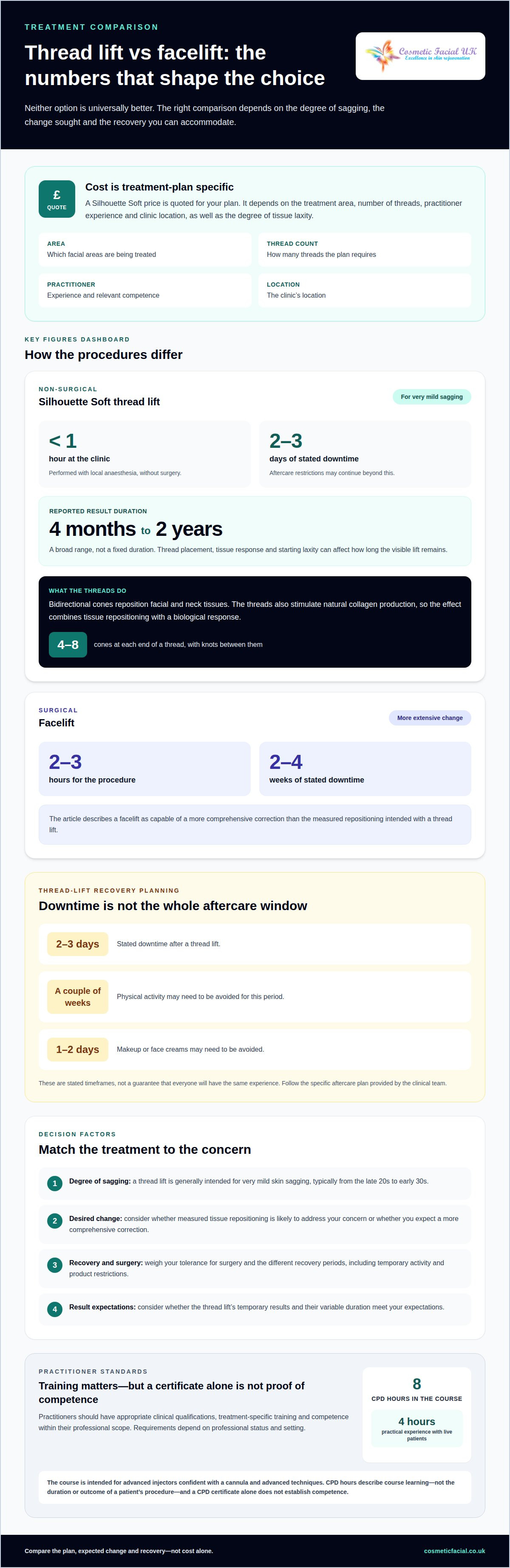
A Silhouette Soft procedure takes less than an hour at the clinic and uses local anaesthesia without surgery. Threads made from poly-L-lactic acid and Poly Lactic-co-Glycolic Acid use bidirectional cones to reposition facial and neck tissues. Each end has 4-8 cones, with knots between them. The treatment also stimulates natural collagen production, so the effect involves both tissue repositioning and a biological response.
The lift is generally intended for very mild skin sagging, typically from the late 20s to early 30s. Its purpose is a measured repositioning rather than the more extensive change associated with surgery. Immediate improvement may be visible, but the final appearance can evolve as swelling settles and collagen production continues. The degree of subtlety depends on the initial laxity and the areas treated.
Results are described as lasting from 4 months to 2 years, a broad range rather than a fixed duration. Thread placement, tissue response and the starting degree of laxity affect how long the visible lift remains. A thread lift therefore suits someone seeking a non-surgical approach to mild sagging, rather than someone expecting the more comprehensive correction possible with a surgical facelift.
The procedures also differ in treatment time and recovery. A surgical facelift takes 2-3 hours, while its stated downtime is 2-4 weeks. After a thread lift, downtime is typically 2-3 days, although aftercare may include avoiding physical activity for a couple of weeks. Makeup or face creams may also need to be avoided for 1-2 days. These differences matter when planning work, events and exercise.
Training is distinct from treatment. A Silhouette Soft training course provides 8 CPD hours, including 4 hours of practical experience with live patients. It is intended for advanced injectors who are confident using a cannula and regularly practise advanced techniques. Attendees must also be competent in advanced dermal filler techniques, including non-surgical facelift and cheek re-volumisation. CPD hours describe course learning, not the duration or outcome of a patient’s procedure.
Neither option is universally better. Your decision depends on the degree of sagging, the change you want, your tolerance for surgery and recovery, and whether temporary results meet your expectations. A clinical assessment should compare the procedure’s limits with your desired outcome, including whether mild tissue repositioning is likely to address your concern.
Silhouette Soft thread lifts should be performed by practitioners with appropriate clinical qualifications, treatment-specific training and competence within their professional scope. Requirements depend on the practitioner’s professional status and setting, and a CPD certificate alone does not establish competence.
Risks and potential side effects
Consider thread-lift risks alongside the cosmetic effect you want, not just the expected change in facial contour. The procedure places threads beneath the skin, so the discussion should cover the planned insertion sites, tissue repositioning and your individual circumstances. A clear explanation distinguishes the intended lift from unwanted effects and explains how concerns will be handled.
Before treatment, use the consultation to work through a practical sequence:
- Describe the facial areas you want treated and the change you expect.
- Discuss relevant medical history, medicines and previous cosmetic procedures.
- Ask what effects may occur during recovery and which signs require clinical review.
- Agree who to contact if a concern develops after the procedure.
These steps make the risk discussion specific to your proposed treatment plan. For example, a plan involving the cheeks and lower face should identify each placement area, rather than relying on a general description of a “lift”. The practitioner should explain the procedure’s limits and how thread placement relates to the intended contour.
Recovery is part of the risk assessment. The stated downtime is 2-3 days, while aftercare may include avoiding physical activity for a couple of weeks. Makeup or face creams may need to be avoided for 1-2 days. These timeframes describe practical restrictions, not a guarantee that every patient will have the same experience. Arrange work and social commitments with enough flexibility to follow the specific aftercare plan.
Potential effects should be explained in clear, plain language before you consent. Ask the practitioner to distinguish expected temporary changes from effects that are unusual or need assessment. Do not rely on a generic list: discuss how the risks relate to the planned treatment areas, thread placement and your circumstances. A member of the clinical team should explain follow-up and provide instructions you can refer to after leaving the clinic.
Do not try to manage discomfort, visible changes or recovery concerns by improvising. Follow the written aftercare instructions and use the agreed clinical contact route for advice. If an effect concerns you, describe when it began, where it appears and whether it is changing. These details help the clinical team understand the concern and advise on the next step.
Suitability also matters. Silhouette Soft is intended for very mild skin sagging, so a more extensive concern may not match the treatment’s purpose. The consultation should connect your desired result with the procedure’s limits, recovery requirements and potential effects. For further context on facial options, review facial treatment information before deciding which questions to raise.
Prices by treatment area and number of threads
The price of Silhouette Soft treatment depends on the areas treated, practitioner experience and clinic location. You receive a quote based on your case. A plan for one facial area differs from one covering several connected areas because the treatment scope and thread placement change. The number of threads is one part of that scope, but it is not the only cost factor.
Treatment areas matter because lifting and tightening are planned around the facial tissues being treated. For example, a plan for the lower face differs from one that also includes the neck. A wider area needs a distinct placement plan, while the intended degree of repositioning also affects thread requirements. The practitioner’s assessment connects the area, skin laxity and desired contour to the proposed plan.
Thread count follows the treatment design, rather than a standard figure for every patient. The plan considers where support is needed and how the threads will be positioned to achieve the intended effect. More threads do not automatically mean a more suitable result. Compare the proposed number with the areas covered and the clinical rationale for each placement.
Practitioner experience and clinic location also affect the quote. These factors help explain why plans for similar concerns can differ. Compare like with like: check that each quote describes the same facial areas, thread count, practitioner involvement and follow-up arrangements. A lower total may reflect a narrower scope, so the treatment details matter as much as the headline figure.
Make sure consultation and follow-up arrangements are clear in the cost breakdown. Establish whether the initial assessment, planned review and any follow-up treatment are included or charged separately. If a later appointment is proposed, ask what it will assess and whether it forms part of the original plan. This helps you compare the expected total cost, not just the procedure fee.
Combining a thread lift with another aesthetic treatment changes the overall plan. Each treatment addresses a different concern, and the sequence should reflect the areas involved and the outcome you want. For example, adding treatment for volume or expression lines is different from extending thread placement to another area. Discuss what each procedure addresses and how the combined plan affects its scope and total cost.
Before proceeding, compare the treatment areas, proposed thread count, practitioner experience, clinic location, consultation arrangements and follow-up costs. These details clarify what the quote covers and whether two plans are genuinely comparable. They also help distinguish a thread lift for localised lifting from a more extensive approach, such as a surgical facelift.
Recovery time and aftercare
Recovery planning starts before the appointment. Allow for the stated 2-3 days of downtime, and avoid scheduling important events immediately afterwards. This is a practical allowance, not a promise that every patient will feel ready for normal activities at the same point. The treatment is non-surgical, but its recovery still requires attention to the aftercare plan.
For the first 1-2 days, patients may be advised not to wear makeup or use face creams. Plan a simple routine around this restriction, and avoid applying products to treated areas unless the practitioner’s instructions permit them. If your usual skincare includes several products, identify which ones to pause before the procedure. Follow the specific written instructions you receive.
You may also need to limit physical activity for a couple of weeks. Arrange work, exercise and social plans around that advice rather than treating the shorter downtime estimate as permission to resume every activity. If you do strenuous training, ask how the restriction applies to your activities. Gentle daily tasks and organised exercise are not necessarily equivalent, so follow your aftercare instructions.
Recovery and visible results are separate stages. The lift may be noticeable immediately, while collagen stimulation contributes to a continuing effect over time. Do not judge the final appearance solely by your first look after treatment. Follow the review arrangements provided, and raise questions about changes in facial contour with the treating practitioner rather than trying to assess thread position yourself.
Before leaving the clinic, confirm which products to avoid, how long to limit physical activity and whom to contact with concerns. Keep your written aftercare instructions accessible at home. If they differ from general guidance, follow the instructions for your treatment plan. This is particularly useful when more than one facial area has been treated or another procedure is planned.
Recovery planning also helps distinguish a thread lift from a facelift. A surgical facelift has a stated downtime of 2-4 weeks, whereas thread-lift downtime is stated as 2-3 days. These figures describe different procedures and do not remove the need to follow individual aftercare. A thread lift is less invasive than surgery, but the skin still needs time and appropriate care after treatment.
Do not add a filler or another cosmetic treatment to your recovery schedule without discussing the timing with your practitioner. A combined plan can affect which areas need care and how appointments are arranged. Confirm whether a review is planned and what it will assess. This gives you a clear sequence for monitoring recovery, following restrictions and discussing the outcome.
UK Silhouette Soft thread lift cost
UK Silhouette Soft costs reflect the planned treatment, not a single standard package. Comparing the areas, thread plan and practitioner experience gives you a clearer basis for assessing quotes.
UK Treatment Cost
The price depends on your case and is provided in a quote for your treatment. It reflects the areas treated, practitioner experience and clinic location. A plan focused on the lower face differs from one covering the lower face and neck because the treatment scope and placement plan change. Compare the proposed treatment details, rather than judging cost without knowing what each plan includes.
Finding and Comparing Providers
To compare prices in your area, look for a clear explanation of the practitioner’s relevant experience and Silhouette Soft training. Ask for a written plan identifying the facial areas, intended thread placement and follow-up arrangements. This lets you compare like with like, including what the consultation and any review cover, rather than relying on an advertised starting price.
Location and practitioner experience can influence quotes across the UK, but they do not explain every difference. The facial area and proposed number of threads also shape the treatment plan. For example, a localised lifting plan and one that includes the neck have different scopes, even if both address facial sagging.
Consider thread count alongside placement, not as a stand-alone measure of value. Ask how each thread contributes to the intended lifting or tightening effect, and why the proposed arrangement suits your facial anatomy. A higher count alone does not show that a plan is more appropriate. The clinical rationale is the useful point of comparison.
Check whether the quoted amount covers the consultation, procedure and any planned follow-up. If a review or additional treatment would be charged separately, include that in your comparison. Also clarify whether the plan combines Silhouette Soft with another cosmetic procedure, such as dermal fillers. Each procedure has a different purpose, so a combined plan should be itemised clearly.
Before deciding, compare the written treatment area, thread plan, practitioner experience, location and follow-up terms. Ask for an explanation of any difference between quotes, using those details rather than the total alone. Your exact cost depends on your treatment case and is set out in its quote. This helps you understand what the price covers and how the proposed procedure relates to your facial goals.
Cosmetic Facial: Botox Treatment
Cosmetic Facial’s Botox Treatment may be relevant if your main concern is facial lines rather than skin laxity and tissue repositioning. A thread lift and Botox address different aesthetic concerns, so the appropriate option depends on the change you want to discuss.
In a clinical discussion, describe the areas that concern you and whether your priority is lifting or addressing expression lines. This keeps the conversation focused on your goals and relevant treatment options, rather than assuming one procedure can achieve every type of facial change.
For information about Botox Treatment and other options, visit Cosmetic Facial’s website.
Make your next step a considered one
Use your priorities to guide the next conversation: identify the facial change you want, the downtime you can accommodate and any questions you still have about suitability. Understanding the silhouette soft thread lift cost in the UK is one part of the decision; matching the proposed approach to your goals matters just as much.
Cosmetic Facial offers Botox Treatment, HIFU Face Lift and IPL Hair Removal Treatment. These treatments address different concerns, so the relevant option depends on what you want to discuss.
A measured discussion can help you take the next step with greater clarity and confidence.
Frequently Asked Questions
Does a thread face lift hurt?
Local anaesthesia is used during a Silhouette Soft thread lift, but each patient’s experience may differ. The procedure takes less than an hour at the clinic. Before treatment, ask the practitioner what sensations may occur during thread placement and what to do if you feel uncomfortable. This gives you a clearer understanding of the process than assuming “non-surgical” means sensation-free.
How long will my thread lift results last?
Silhouette Soft results are described as lasting from 4 months to 2 years. That span reflects variation in how long the visible effect remains, rather than a fixed expiry date for every patient. Tissue response, the areas treated and the degree of initial laxity influence the result. Consider the expected duration alongside your aims, particularly if you are comparing a temporary lift with a more extensive procedure.
What are the side effects of a thread lift?
Potential side effects relate to inserting threads beneath the skin and repositioning facial tissue. Their nature may depend on the placement plan and treatment area, so ask the practitioner which effects are expected and which need clinical review. Before consenting, discuss your medical history and previous cosmetic procedures. Make sure you understand the aftercare instructions and how to raise a concern after treatment.
What areas can be treated with a thread lift?
Silhouette Soft is used to reposition facial and neck tissues, with treatment areas selected according to the concern being addressed. The plan may focus on one area or cover connected areas, depending on the assessment. Ask the practitioner to describe the proposed placement in relation to your facial anatomy. This helps you understand what the lift is intended to change and what it is not designed to address.
How much does a Silhouette Soft thread lift cost in the UK?
The silhouette soft thread lift cost in the UK depends on your treatment case, including the areas treated, thread plan, practitioner experience and clinic location. You receive the exact figure in a quote for your case. When reviewing it, compare treatment scope rather than relying on the headline amount alone. A plan covering additional areas may differ from one focused on a single concern.
What is the average UK price for a Silhouette Soft thread lift by treatment area?
There is no single area-based figure that applies to every treatment plan. Your quote depends on which facial or neck areas are addressed and the proposed thread placement. For example, a plan covering several areas has a different scope from a localised plan. Compare quotes by matching the areas and treatment details, rather than treating an area label as a complete price comparison.
What factors affect Silhouette Soft thread lift prices in the UK?
Key cost factors include the areas treated, number and placement of threads, practitioner experience and clinic location. Thread count is considered in relation to the facial tissues needing support, not as an isolated measure. If another cosmetic treatment is proposed alongside the lift, ask how it changes the quoted scope. Comparing these elements helps explain differences between individual treatment plans.
Are consultation, follow-up, or aftercare fees included in UK Silhouette Soft prices?
Inclusions depend on the quoted treatment plan, so consultation, review appointments and aftercare should be clearly itemised. Look for separate descriptions of the initial assessment, procedure and planned follow-up. If a further appointment or treatment is proposed, establish whether it forms part of the original quote or costs extra. This breakdown helps you understand the overall cost and the care provided around the procedure.
Disclaimer
All content on cosmetic Facial website, including blogs, graphics, logos, images, and software, is the property of CosmeticFacial UK or its content suppliers and is protected by applicable copyright laws. Unauthorized use, reproduction, distribution, or modification of any content without prior written permission is strictly prohibited.


