


Laser treatment and cosmetic surgery are not the same. Cosmetic dermatology in London covers non-surgical care for skin concerns and appearance, including laser procedures, injectables and treatments that target skin texture or tone. Surgery is a separate category, so understanding this distinction can help you identify the kind of appointment you need.
Before choosing a treatment, it is reasonable to expect clear information about what it addresses, how it is performed and which specialist is involved. This guide explains what cosmetic dermatology includes, how private appointments work and how to distinguish common procedures and the professionals who provide them.
You’ll also find practical guidance on laser treatments and other aesthetic options, including factors that shape a suitable treatment plan. The aim is to help you understand the choices available in London and approach your next step with a clearer picture of what to expect.
Key Takeaways
- Cosmetic dermatology can address concerns such as blemishes and unwanted skin features; the right approach depends on the concern being treated.
- Private dermatology appointments can provide a route to discuss skin concerns and treatment options.
- Dermatology specialists and aesthetic practitioners have different roles, so understanding who provides a procedure can help you make an informed choice.
- Laser treatments and cosmetic surgery are distinct approaches, with different procedures and purposes.
- For non-surgical aesthetic care, explore how Botox Treatment may fit your treatment goals.
Cosmetic dermatology - what does it cover?
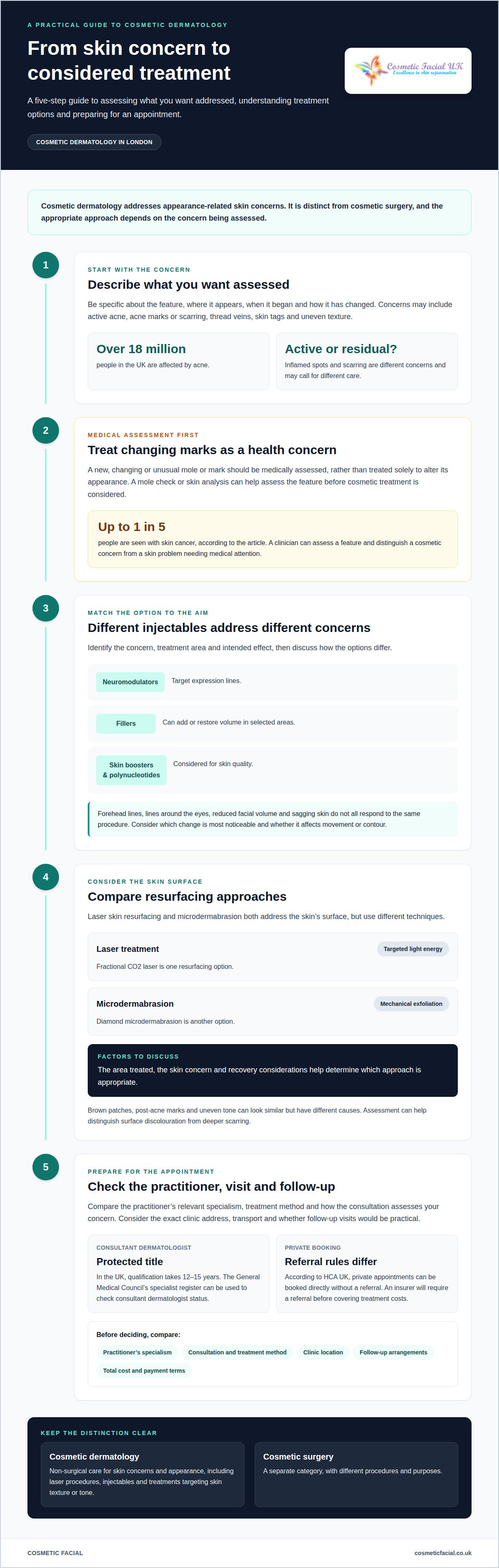
Cosmetic dermatology addresses appearance-related skin concerns, from acne marks to age-related changes. An appointment in London may involve assessing your skin, discussing treatment options and planning care around a specific concern.
Blemishes and unwanted features include active acne, visible thread veins, skin tags and uneven texture. Acne affects over 18 million people in the UK. Treatment depends on whether the concern is active, such as inflamed spots, or a residual change, such as scarring. A clinician can assess the affected area and distinguish a cosmetic concern from a skin problem needing medical attention.
Changes in a mole or other mark need a different approach from routine aesthetic care. Skin cancer is seen in up to 1 in 5 people. A mole check or skin analysis helps assess a feature before cosmetic treatment is considered. New, changing or unusual marks should be medically assessed rather than treated solely to alter their appearance.
Injectable skin treatments
Age-related changes
Age-related changes can include forehead lines, lines around the eyes, reduced facial volume and sagging skin. These do not all respond to the same procedure: a treatment for expression lines differs from one intended to address volume or skin laxity. Consider which change is most noticeable, where it appears and whether it affects facial movement or contour.
Resurfacing treatments
Laser skin resurfacing and microdermabrasion address the skin’s surface, but use different techniques. Laser treatment delivers targeted light energy, while microdermabrasion mechanically exfoliates the outer surface. Fractional CO2 laser is one resurfacing option; diamond microdermabrasion is another. The area treated, skin concern and recovery considerations help determine which approach is appropriate.
Pigmentation and scarring also need careful assessment. Brown patches, post-acne marks and uneven tone can look similar but have different causes. A dermatology clinic can examine the affected skin and consider its history before recommending a procedure. This helps distinguish surface discolouration from deeper scarring and determine whether resurfacing or another approach is suitable.
For example, someone concerned about acne scarring may need a different plan from someone seeking help with thread veins. Describe the feature, when it appeared and how it has changed over time.
Private dermatology clinics and appointment booking
Private clinics offer appointments for skin concerns and aesthetic procedures. Location, the clinician’s specialism and the booking process can help you identify a service suited to your needs.
Clinic locations across London
Central, West and North London offer different travel options, so consider the journey as well as the treatment. Harley Street is a well-known medical address in Central London, but a street name alone does not establish a clinic’s suitability. Check the exact clinic address, transport connections and whether follow-up visits would be practical from your home or workplace. These details matter when a treatment plan involves multiple appointments.
Clinic facilities and consultants
Facilities should suit the procedure: a consultation room supports assessment, while a suitable treatment room accommodates clinical procedures. Consider whether the appointment includes discussion of your skin concern and relevant treatment options. In the UK, “consultant dermatologist” is a protected title. Qualification takes 12-15 years, and the General Medical Council’s specialist register can be used to check consultant dermatologist status.
Clinics differ in their focus and the procedures they provide. For Botox, fillers, laser and other skin treatments, compare the practitioner’s relevant specialism, the treatment method and how the consultation assesses your concern. A clinic focused on medical skin conditions may offer a different range from one centred on aesthetic procedures, while dedicated services such as thehairclinichlcc.com focus specifically on therapeutic and surgical hair restoration. Compare services by the procedure and your treatment goal, not location alone.
Private appointments can be booked directly without a referral, according to HCA UK. HCA UK also says an insurer will require a referral before covering treatment costs. NHS options relate to medical assessment rather than choosing a private cosmetic procedure, while finance arrangements depend on clinic terms. Review the total cost and conditions of any payment agreement before committing.
Reviews can help you assess communication, appointment organisation and reported aftercare. Look for specific descriptions of the procedure and experience rather than relying only on an overall rating. Before-and-after photographs are more useful when they show comparable angles, lighting and treatment areas. Images should relate to the procedure you are considering; a different treatment cannot show its likely effect on your concern.
Before booking, identify the skin issue, the procedure you want to discuss and any relevant medical history. Then compare the appointment format, practitioner’s specialism, location and follow-up arrangements. For a private starting point, explore skin treatment appointments and consider which concern you want assessed.
Dermatology team and specialisms
Choosing a specialist depends on whether you need diagnosis, medical treatment or an aesthetic procedure. In London, “dermatologist” can refer to clinicians with different training and roles, so identify who will assess your skin and perform the treatment. A consultant dermatologist’s specialist status is distinct from a practitioner’s experience with cosmetic procedures.
In the UK, becoming a consultant dermatologist and joining the General Medical Council’s specialist register takes 12-15 years. Consultant dermatologist is a protected title, and the GMC register can be checked to verify specialist status. This is particularly relevant when your concern may involve a skin condition, rather than a cosmetic change alone.
Dermatology covers a broad range of conditions. Consultant dermatologist Dr Anjali Mahto says dermatologists are trained to treat more than 2,000 conditions. That breadth matters when a visible concern could have different causes. For example, pigmentation, a changing mark and post-inflammatory discolouration may need different assessments before any aesthetic procedure is considered.
Cosmetic dermatology specialists may focus on procedures such as injectables, laser treatments or skin rejuvenation. A doctor’s medical specialism is not the same as a practitioner’s procedural focus. For a treatment such as dermal filler, establish who will assess your facial anatomy, discuss the intended change and perform the injection. For persistent inflammation or an uncertain diagnosis, medical dermatology expertise is more relevant than a procedure-led consultation.
Surgical and non-surgical care involve different decisions. Non-surgical treatments address selected appearance concerns without an operation, while surgery requires a separate assessment of the procedure, risks and recovery. A consultation should clarify whether the proposed approach matches your concern. Someone seeking improved skin texture, for instance, needs a different discussion from someone considering a change to facial structure.
CQC and GMC checks answer different questions. A clinic’s CQC information does not, by itself, verify that a doctor is a consultant dermatologist; use the GMC specialist register to check that title. The professional’s role and the service provided are both relevant when assessing oversight. A clinic’s general registration details do not prove an individual clinician’s dermatology specialism.
For an appointment about “my skin”, prepare a concise account of the concern, when it began and any changes you have noticed. Bring details of previous diagnoses, treatments and relevant medicines. This information can help the specialist distinguish a longstanding cosmetic concern from a skin problem that needs medical investigation.
Before proceeding, confirm who will make the diagnosis, who will carry out the procedure and what their specialism covers. If the consultation identifies a medical concern, assessment should take priority over an aesthetic plan. This helps match the clinician’s expertise to the decision you need to make.
Cosmetic dermatology and aesthetic procedures
Cosmetic dermatology and aesthetic medicine address appearance concerns through procedures that affect the skin or facial contours. The right approach starts with a defined concern, such as uneven tone, expression lines or loss of facial volume. A treatment plan should connect that concern to a specific procedure, explain its intended effect and clarify what it cannot address.
Procedures differ in purpose and method. Neuromodulators target selected expression lines, while dermal fillers alter or restore volume in specific areas. Laser treatments address concerns such as pigmentation or texture, and skin resurfacing works at the surface. These categories are not interchangeable: a procedure chosen to address volume will not treat a skin condition such as eczema.
Before treatment, describe the change you want to address and the area involved. For example, distinguish lines visible during facial movement from folds present at rest. The practitioner can then assess your skin, discuss suitable options and record an agreed treatment plan. This conversation should cover the procedure’s expected effect, alternatives and practical considerations relevant to your skin.
Risks and side effects vary by procedure and treatment area. Discuss possible effects such as temporary redness, swelling, bruising or irritation, along with less common complications specific to the technique. Ask how these are managed before consenting.
Skin conditions affect the assessment. For example, include eczema, active irritation or a recent change in the treatment area in your medical history. The condition, its location and current symptoms help determine whether an aesthetic procedure is suitable at that time. If the concern needs diagnosis rather than appearance-focused treatment, medical assessment should come first.
Comfort during a procedure is both practical and personal. Discuss the treatment steps, sensations, preparation and aftercare in advance, and mention any anxiety or previous adverse experience. For an injectable procedure, clarify the intended treatment area and how the plan relates to your facial movement or contours. For resurfacing, ask which skin layers the technique targets and what recovery involves.
Make the decision in stages: define the concern, understand the proposed technique, review its risks and alternatives, then decide whether the plan suits your priorities. Avoid treating several concerns as one problem; pigmentation, scarring and wrinkles may need distinct approaches. A considered plan focuses on the area and outcome that matter most, rather than adding procedures without a clear purpose.
Laser dermatology and cosmetic surgery
Laser dermatology and cosmetic surgery are related, but they are not interchangeable. A cosmetic laser procedure uses light-based technology for a defined skin concern, while cosmetic surgery involves an operation. Some lasers also have surgical uses, so the procedure’s purpose and method matter more than the word “laser” alone.
Laser treatments vary by the concern they address. A practitioner may discuss pigmentation, visible vessels, unwanted hair or changes in skin texture. Fractional CO2 laser is an example used for resurfacing, while other laser systems target different features. Ask which concern the proposed device addresses, what skin area it treats and why that technique fits your treatment goal.
Assessment is particularly important when a skin condition is present. Rosacea can involve visible redness or vessels, whereas psoriasis causes a different pattern of skin changes. These conditions need to be distinguished from cosmetic concerns before planning a procedure. Tell the clinician about diagnoses, current symptoms and previous treatments, including any changes since your last appointment.
Laser suitability depends on the treatment area, the feature being addressed and individual skin characteristics. For example, a plan for facial pigmentation differs from one for hair removal on the legs. The consultation should explain the intended target, the treatment process and the aftercare relevant to that area. Discuss possible side effects and how they are managed before deciding.
Cosmetic surgery involves a different decision pathway. Someone considering a change to facial structure should distinguish that aim from laser treatment for surface texture or pigmentation. Surgery requires its own discussion of the procedure, recovery and risks. A non-surgical option should not be presented as equivalent if it cannot address the same structural concern.
Mole or other skin-feature removal also requires clarity about the reason for treatment. A feature that is changing or causing concern needs assessment before appearance-focused removal is considered. Explain when it appeared, what has changed and whether it has previously been examined. This helps distinguish a cosmetic request from a concern requiring medical evaluation.
Use these points to structure a laser or surgery consultation:
- Name the skin feature or change you want addressed.
- Ask what the proposed laser or surgical procedure is intended to do.
- Discuss how rosacea, psoriasis or another diagnosis affects the plan.
- Clarify the aftercare, recovery and potential side effects for that procedure.
The key distinction is the treatment target: a laser may address selected skin features, while surgery addresses concerns requiring an operative approach. Explore laser treatment options.
Cosmetic Facial: Botox Treatment
Cosmetic Facial offers Botox Treatment for people considering a non-surgical approach to expression lines. An appointment is an opportunity to discuss the areas of concern, the intended effect and whether this option suits your goals. Botox is not a substitute for laser resurfacing or procedures intended to address skin texture, pigmentation or facial volume.
For concerns involving skin laxity or hair removal, Cosmetic Facial also offers HIFU Face Lift and IPL Hair Removal Treatment. These treatments have different purposes, so start by identifying the concern you want addressed. A discussion can help you understand which procedure relates to that concern before you decide how to proceed.
Contact Cosmetic Facial to discuss Botox Treatment and your aesthetic goals.
Make your next step a considered one
For a considered approach to cosmetic dermatology in London, decide what you want an appointment to clarify before booking. You might want to understand which treatment relates to a specific concern, compare non-surgical options or discuss whether an aesthetic procedure suits your priorities. Writing down your main question can help keep the conversation focused.
Cosmetic Facial offers Botox Treatment, HIFU Face Lift and IPL Hair Removal Treatment. These procedures address different goals, so start with the concern you want to discuss rather than choosing a treatment by name alone. A conversation can help you identify a relevant option and consider your next step.
You do not need to arrive with a complete treatment plan. Clearly describing your concern and the questions you want answered is a practical beginning.
Take the time you need to make an informed decision that feels right for you.
Frequently Asked Questions
What can I expect during my first appointment?
Expect to discuss your main concern, relevant medical history and what you hope to address. Before attending, note previous procedures, skincare products and any medicines or allergies you want to mention. You can also bring photographs showing how a concern has changed over time. This gives the practitioner useful context and keeps the discussion focused on your priorities rather than a general list of treatments.
What medical services does it specialise in?
Cosmetic Facial provides GP services, including blood tests and health checks, alongside dermatology services such as mole checks and skin analysis. Its medical skin treatments also address concerns including acne and rosacea. These services have different purposes: a health check assesses general health, while skin analysis focuses on the skin. Describe the concern you want assessed when arranging an appointment so the appropriate service can be considered.
What cosmetic dermatology treatments are available in London?
Options in London include injectable treatments, laser procedures, skin resurfacing and treatments for specific concerns. Cosmetic Facial offers Botox Treatment, dermal fillers, laser treatments, micro-needling and skin peels, among other services. The right category depends on whether your priority is expression lines, skin texture or unwanted hair, for example. Start by identifying your concern, then discuss which treatment approach is relevant.
How do I choose a qualified cosmetic dermatologist in London?
Identify the named practitioner who will assess you and perform the procedure. Review their medical background and training relevant to that treatment, rather than relying on a clinic’s general description or photographs alone. Ask how the practitioner evaluates suitability and explains alternatives. For cosmetic dermatology in London, consider whether the consultation addresses your specific concern rather than treating every appearance goal as the same problem.
What qualifications should a cosmetic dermatologist in the UK have?
Qualifications should be considered in relation to the practitioner’s role and the procedure offered. For example, Faramarz Didar holds an MSc in Dermatology Skills and Treatment with Commendation from the University of Hertfordshire, awarded in 2015, as well as a General Practice qualification. These credentials describe his training; they should not be taken to mean every practitioner has the same route or specialist status.
What should I expect at a cosmetic dermatology consultation in London?
Expect the consultation to connect your stated goal with an assessment and a proposed approach. Explain what you want to change, what you would prefer to avoid and any previous treatment that influenced your decision. Ask what the procedure is intended to address, what alternatives might suit the same concern and what aftercare involves. You should leave with a clear understanding of the proposed next step before deciding whether to proceed.
How do London clinics compare for Botox, fillers, laser, and skin treatments?
Compare the practitioner’s relevant specialism, the treatment method and how the consultation assesses your concern. Clinics may focus on different procedures, so compare them by the treatment and your goal rather than location alone.
Disclaimer
All content on cosmetic Facial website, including blogs, graphics, logos, images, and software, is the property of CosmeticFacial UK or its content suppliers and is protected by applicable copyright laws. Unauthorized use, reproduction, distribution, or modification of any content without prior written permission is strictly prohibited.


