


True facial rejuvenation isn't achieved by simply inflating the skin; it's found in restoring the biological scaffolding that supports it from within. Most patients seeking a sculptra treatment in London are understandably wary of an unnatural or overfilled appearance and instead desire a restoration of their natural facial definition. You may have observed a gradual hollowness in the temples or a loss of volume in the mid-face that contributes to a fatigued appearance, even when well-rested.
This clinical guide explains how poly-L-lactic acid acts as a regenerative catalyst to rebuild the skin’s internal architecture, providing a subtle lift that develops over several months. We'll examine the biological mechanism of collagen biostimulation, the importance of the 5-5-5 aftercare protocol, and how a doctor-led approach ensures results remain discreet and sophisticated. By understanding the transition from temporary volume to long-term structural repair, you can make an informed decision about your facial health and long-term aesthetic outcomes.
Key Takeaways
- Understand how Poly-L-Lactic Acid (PLLA) functions as a clinical biostimulator to regenerate endogenous collagen rather than providing a temporary, synthetic volume increase.
- Learn why a sculptra treatment offers significant longevity compared to standard hyaluronic acid fillers, with results typically persisting for up to 24 months.
- Identify the specific anatomical regions, including the mid-face and temples, where biostimulation can effectively restore the Ogee curve and soften structural hollowing.
- Review the essential 5-5-5 aftercare protocol and the procedural steps required to ensure the even distribution of the product for natural-looking outcomes.
- Recognise the clinical advantages of seeking treatment in a doctor-led Marylebone practice where dermatology expertise guides the rejuvenation process.
Understanding Sculptra Treatment: The Science of Poly-L-Lactic Acid
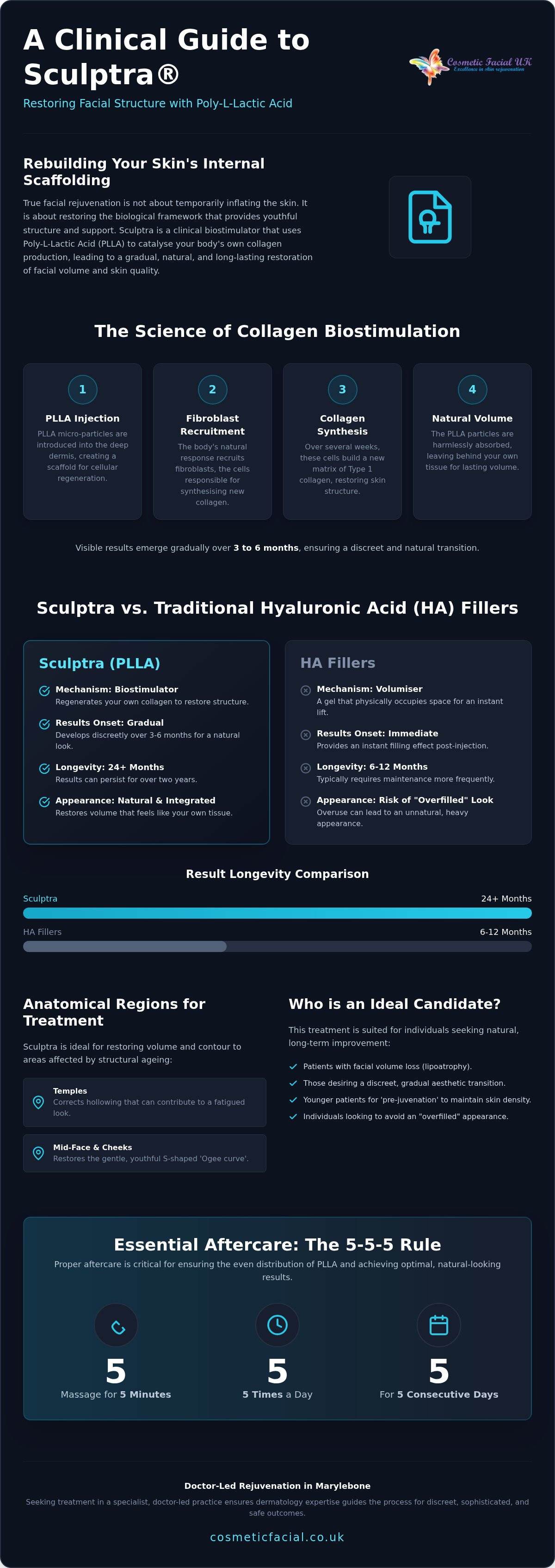
Patients seeking a long-term solution for facial volume loss often turn to Sculptra (Poly-L-Lactic Acid), a biocompatible and biodegradable synthetic material known as PLLA. Unlike traditional dermal fillers that rely on hyaluronic acid to physically occupy space and provide an immediate lifting effect, Sculptra functions as a biostimulator. It's designed to address the underlying causes of facial ageing by restoring the skin's internal structure. This process is particularly relevant because the body’s production of Type 1 collagen, which is responsible for skin firmness and elasticity, begins to diminish significantly after the age of 30. By introducing PLLA micro-particles into the deep dermis, the treatment provides a foundation for the body to replace lost collagen naturally.
To better understand the clinical results of this process, watch this helpful video:
The Biological Mechanism of Biostimulation
The efficacy of a sculptra treatment lies in its ability to initiate a controlled, sub-clinical inflammatory response. Once injected, the PLLA micro-particles act as a scaffold, recruiting fibroblasts to the site. Fibroblasts are the primary cells responsible for the synthesis of collagen and other extracellular matrix components. Over a period of several weeks, the PLLA particles are gradually metabolised and absorbed by the body, whilst the newly formed collagen matrix remains. This ensures that the resulting volume is composed of the patient's own tissue rather than a foreign substance. It's a gradual process; visible improvements in skin quality and facial contour typically appear between 3 to 6 months post-procedure.
Who is the Ideal Candidate for Sculptra?
Clinical indications for Sculptra often include facial wasting, also known as lipoatrophy, where the loss of fat deposits leads to a hollowed appearance in the cheeks and temples. At our Marylebone clinic, we often incorporate this into a broader facial rejuvenation plan for patients who prefer a discreet transition. The results develop slowly, making it difficult for observers to pinpoint that a cosmetic procedure has occurred. Additionally, we're seeing an increase in younger patients utilising sculptra treatment for "pre-juvenation." By stimulating collagen production earlier, these individuals aim to maintain skin density and prevent the more pronounced signs of volume loss before they manifest. This proactive approach focuses on long-term skin health and structural integrity rather than reactive correction.
Sculptra vs Traditional Dermal Fillers: Why Biostimulation Matters
Hyaluronic acid (HA) fillers provide an immediate, mechanical lift by physically occupying space beneath the skin. They're effective for specific lines but don't address the underlying structural decline of the dermis. A sculptra treatment offers a different rheological profile. It is a suspension, not a viscous gel. This means it integrates into the tissue rather than displacing it. The result is a natural feel that's indistinguishable from your own skin, as the volume is created by your own biological processes.
The FDA approval of Sculptra highlights its use for correcting contour deficiencies through its poly-L-lactic acid composition. Whilst HA fillers typically degrade within 6 to 12 months, the collagen matrix produced by Sculptra can persist for over 24 months. Over a three-year period, this longevity often makes it a more cost-effective option. Although the initial phase requires multiple sessions, the reduced frequency of maintenance appointments provides a strategic advantage for long-term skin management.
The "Overfilled Syndrome" and How to Avoid It
Over-reliance on traditional fillers to treat global facial volume loss can lead to what clinicians call "overfilled syndrome" or "pillow face." This heavy, distorted look often results from trying to lift sagging skin with volume alone, which can mask natural bone structure. Because a sculptra treatment stimulates the patient's own biological tissue, it maintains the integrity of facial movement. It's particularly suited for achieving a refined "London Look" where the goal is a refreshed, rested appearance rather than a noticeably altered face. By thickening the dermis itself, we achieve a subtle and sophisticated rejuvenation that respects the patient's original anatomy.
Longevity and Maintenance Protocols
Maintaining a youthful architecture requires a structured approach rather than occasional, reactive treatments. Sculptra is a core component of our Full Face Rejuvenation Plan London, which focuses on multi-layered restoration. We recommend a "top-up" session every 12 to 18 months once the initial collagen bank is established. This ensures the skin's structural integrity is supported as the natural ageing process continues. If you're unsure which approach suits your skin profile, a clinical consultation at our Marylebone centre can provide a bespoke roadmap for your aesthetic journey.
Targeted Areas: Where Can Sculptra Treatment Be Used?
Sculptra’s clinical utility is most evident in regions where structural support has diminished through the loss of subcutaneous fat and bone resorption. Whilst many patients initially seek correction for specific folds, a sculptra treatment is most effective when applied to broader anatomical zones. This global approach addresses the root cause of sagging by thickening the skin’s foundation. Common treatment areas include the temples, mid-face, and jawline. In the temples, PLLA softens the "skeletonised" appearance that often accompanies ageing. In the lower face, it provides a firmer, more defined mandibular border. We also utilise Sculptra for off-face indications, such as horizontal neck lines and skin laxity in the décolletage, where the skin is often too thin for traditional high-viscosity fillers.
Restoring Mid-Face Volume and Cheek Definition
The mid-face is central to a youthful aesthetic, characterised by the "Ogee curve", which is the subtle S-shaped contour of the cheekbones seen from a profile view. As collagen depletes, this curve flattens, causing the skin to drape forward and deepen the nasolabial folds. By injecting PLLA into the lateral cheek and deep malar regions, we provide structural lift that pulls the skin back into a more youthful position. For patients requiring immediate correction of deep static lines alongside long-term biostimulation, we may recommend integrated Dermal Fillers London protocols. This deep-plane approach ensures the results look natural and don't interfere with facial expressions.
Sculptra for the Jawline and Lower Face
Addressing jowl formation and jawline laxity requires a multi-modal strategy. A sculptra treatment is superior for patients with thin, "crepey" skin because it improves dermal density, making the skin more resilient to gravity. To maximise results, we often combine biostimulation with energy-based technologies, a technique that distinguishes our Marylebone practice. For instance, pairing Sculptra with HIFU for jowls and neck can produce synergistic outcomes. The HIFU provides immediate thermal contraction and deep tissue lifting, whilst the injectable poly-l-lactic acid treatment builds a long-term collagen bank. This combination addresses both the "tightness" of the skin and its underlying volume, providing a comprehensive non-surgical facelift effect.
The Treatment Journey: Preparation, Procedure, and the "5-5-5" Rule
The process begins with a detailed clinical consultation at our Marylebone centre. Dr Didar conducts a thorough skin analysis to assess dermal thickness and the degree of volume loss. This stage is vital for determining the appropriate dilution and placement of the product. During the procedure, we typically use micro-cannulas rather than traditional needles. Cannulas have a blunt tip that glides through tissue, which significantly reduces the risk of vascular compromise and minimises bruising. The sculptra treatment itself is made comfortable through the use of topical anaesthesia and the addition of lidocaine directly into the PLLA suspension.
Preparing for Your Sculptra Appointment
To ensure optimal safety and results, patients should avoid blood-thinning medications and certain supplements, such as aspirin, ibuprofen, and high-dose omega-3, for at least one week prior to the procedure. This precaution helps to minimise the risk of ecchymosis at the injection sites. We usually schedule sessions at four-week intervals. This allows the initial inflammatory response to settle and provides a clear baseline for the next phase of biostimulation. It's important to understand that immediately after the session, the face will appear volumised due to the sterile water used in the suspension. This preview typically subsides within 24 to 48 hours as the water is absorbed, leaving the PLLA micro-particles to begin their work.
Post-Treatment Protocols and Massage
The most critical aspect of the patient's role in this journey is the 5-5-5 massage rule. This protocol requires you to massage the treated areas for five minutes, five times a day, for five consecutive days. This mechanical action isn't merely for comfort; it's a clinical requirement to ensure the PLLA micro-particles are evenly distributed within the tissue. Proper distribution prevents the particles from clumping, which reduces the risk of developing small, palpable nodules or granulomas. Whilst mild swelling and tenderness are normal inflammatory responses, any concerns can be addressed by reviewing our FAQ page. A sculptra treatment requires patience, as the true structural changes occur beneath the surface over the coming months.
Choosing a Specialist: Sculptra at Cosmetic Facial London
Selecting a clinic for a sculptra treatment requires looking beyond marketing claims to verified clinical credentials. Unlike standard hyaluronic acid fillers, PLLA is a complex biostimulator that demands precise handling and a deep understanding of dermal biology. Dr Faramarz Didar (GMC 5200505) brings over 30 years of medical experience and an MSc in Dermatology with Commendation to every procedure. This academic background is essential for managing the biological response of the skin and ensuring that the regenerative process remains predictable and safe.
Our approach in Marylebone is defined by clinical precision rather than high-volume throughput. We don't use a universal dilution protocol; instead, we adjust the concentration of the PLLA suspension based on the patient's individual skin thickness and the degree of subcutaneous fat loss. This bespoke method ensures that the collagen stimulation is sufficient to restore facial architecture without creating an over-corrected or unnatural look. Our commitment to safety includes comprehensive follow-up care to monitor the development of the collagen matrix as it matures over several months.
Clinical Expertise and the Marylebone Standard
Sculptra is a highly technique-dependent product. The depth of injection is a critical variable that many practitioners overlook. Placing the micro-particles too superficially can lead to visible dermal irregularities, whilst injecting too deeply may fail to provide the necessary structural support for the mid-face. Dr Didar’s specialised anatomical knowledge allows for the precise placement of the product within the deep dermis or the sub-dermal layers, depending on the specific area of concern. This focus on facial rejuvenation through evidence-based medicine prioritises patient safety and the long-term health of the tissue. Accountability is a cornerstone of our practice, maintained through our location in London’s primary medical district.
Booking Your Consultation
A successful outcome begins with an unhurried, comprehensive skin assessment at our Henger Street clinic in Marylebone. During this visit, we evaluate your medical history, underlying bone structure, and current skin elasticity to determine if a sculptra treatment is the most appropriate intervention for your aesthetic goals. We believe in providing serious-minded, detailed information so you can make an informed decision about your long-term facial health. This consultation is a collaborative process where we establish a realistic roadmap for your rejuvenation journey.
Advancing Your Long-Term Facial Health Strategy
Achieving your aesthetic goals requires a fundamental shift from immediate, mechanical correction to long-term biological restoration. A sculptra treatment provides the necessary scaffold for your body to regenerate its own Type 1 collagen; this results in a subtle, sophisticated lift that traditional fillers cannot replicate. This regenerative approach respects your natural anatomy whilst offering structural improvements that can persist for over 24 months. It's an investment in the health of your skin's internal architecture rather than a temporary mask.
Optimal outcomes depend on both clinical precision during injection and patient adherence to aftercare protocols such as the 5-5-5 massage rule. Our Marylebone-based clinical team, led by Dr Faramarz Didar (GMC 5200505), prioritises this medical rigour at every stage. Holding an MSc in Dermatology with Commendation, Dr Didar ensures that each rejuvenation plan is rooted in deep anatomical expertise and professional accountability. By choosing a doctor-led practice in London’s medical district, you ensure your treatment is managed with the highest standards of care and clinical integrity.
We're committed to helping you achieve a refreshed and naturally youthful appearance through our expert clinical guidance and bespoke care plans.
Frequently Asked Questions
How many Sculptra sessions will I need for optimal results?
Most patients require an average of three sessions to achieve optimal collagen biostimulation. These appointments are typically scheduled four to six weeks apart to allow the dermal layers sufficient time to respond to the poly-L-lactic acid. The exact number of vials and sessions depends on the degree of volume loss and the patient's age. During a clinical consultation in our Marylebone practice, we determine a bespoke plan tailored to your specific anatomical requirements.
Is Sculptra treatment painful?
The procedure is generally well-tolerated as we prioritise patient comfort through specific clinical techniques. We apply a high-strength topical anaesthetic before the sculptra treatment begins. Additionally, the PLLA suspension is mixed with lidocaine, a local anaesthetic, which numbs the area from within during the injection process. Using micro-cannulas further reduces discomfort and minimises tissue trauma compared to traditional needle injections, making the experience relatively painless for most individuals.
How long do Sculptra results actually last?
Results from a sculptra treatment are notably long-lasting, often persisting for over 24 months. Unlike hyaluronic acid fillers that the body metabolises relatively quickly, Sculptra creates a durable matrix of your own natural collagen. Whilst the initial results take three to six months to fully manifest, the structural integrity remains robust for an extended period. We recommend a single maintenance session every 12 to 18 months to preserve the established collagen bank and counteract ongoing ageing.
Can I combine Sculptra with Botox or other dermal fillers?
Sculptra is frequently integrated into a comprehensive Full Face Rejuvenation Plan alongside other non-surgical modalities. Whilst Sculptra addresses global volume loss and skin quality, Botox is used to treat dynamic expression lines. Hyaluronic acid fillers can also be used for immediate, targeted contouring in areas like the lips or deep folds. Combining these treatments allows for a multi-layered approach to facial ageing, provided they are administered by a specialist with advanced anatomical knowledge.
What is the "5-5-5" massage rule and why is it important?
The 5-5-5 rule is a vital aftercare protocol requiring patients to massage the treated area for five minutes, five times a day, for five consecutive days. This mechanical action ensures the poly-L-lactic acid micro-particles are distributed evenly throughout the dermal tissue. Proper distribution is essential to prevent the particles from clumping, which significantly reduces the risk of developing small, palpable nodules. It's a critical step in achieving a smooth, natural-looking restoration of facial volume.
Are there any risks or side effects associated with Sculptra?
Common side effects are typically mild and transient, including swelling, tenderness, and occasional bruising at the injection site. These usually resolve within a few days. Rare complications, such as the formation of small lumps or nodules under the skin, are significantly minimised when the treatment is performed by an experienced practitioner like Dr Didar. Choosing a doctor-led clinic ensures the product is diluted correctly and injected at the precise depth required for safety and clinical efficacy.
How soon can I return to work after my Sculptra treatment?
Most patients return to their normal professional activities immediately or within 24 hours of the procedure. There is minimal downtime associated with the treatment, although some initial swelling is expected due to the sterile water used in the suspension. This swelling typically subsides quickly. We advise avoiding strenuous exercise and excessive heat exposure for the first 48 hours to ensure the inflammatory response remains controlled and to facilitate an uncomplicated recovery process.
Is Sculptra suitable for treating acne scars?
Sculptra can be an effective clinical option for treating certain types of atrophic acne scars by stimulating collagen production beneath the depressions. By thickening the dermis, it helps to level the skin surface and improve overall texture. However, its suitability depends on the specific scar morphology. During a dermatology consultation at our London clinic, Dr Didar assesses whether Sculptra or alternative treatments, such as micro-needling or skin peels, would provide the most effective outcome for your skin.
Disclaimer
All content on cosmetic Facial website, including blogs, graphics, logos, images, and software, is the property of CosmeticFacial UK or its content suppliers and is protected by applicable copyright laws. Unauthorized use, reproduction, distribution, or modification of any content without prior written permission is strictly prohibited.


