


What if the most effective way to manage facial ageing wasn't to treat wrinkles once they appear, but to ensure the skin's structural integrity remains uncompromised from the outset? This is the fundamental premise of preventative botox in your 20s london, a clinical strategy that prioritises preservation over correction. Many patients in their twenties express concern that starting neurotoxin treatments too early might lead to an over-treated or 'frozen' appearance. You likely want to maintain your natural expressions whilst proactively addressing the biological processes that eventually lead to permanent dermal creasing.
This guide details the clinical rationale behind early intervention and explains how a bespoke preventative strategy can protect your skin for the long term. We will examine the physiological mechanism of muscle retraining and address common concerns regarding the safety of starting treatments at a younger age. This article provides a methodical overview of how a professional, medically led approach ensures you receive the expert reassurance needed to build a sustainable anti-ageing plan that delivers a refreshed result without compromising your facial character.
Key Takeaways
- Understand how neurotoxins function as a preventative measure by interrupting the specific muscle contractions that lead to permanent dermal creasing.
- Learn why preventative botox in your 20s london focuses on 'Baby Botox' techniques that prioritise facial mobility and a natural, refreshed appearance.
- Discover the 'movement test' used by clinicians to identify whether your skin is beginning to show the early signs of static line formation.
- Explore the importance of a medical-led consultation in Marylebone to assess how genetics and lifestyle factors influence your unique ageing process.
- Gain insight into developing a long-term anti-ageing strategy that preserves your skin's structural integrity whilst avoiding an over-treated result.
Understanding Preventative Botox and its Role in Modern Skincare
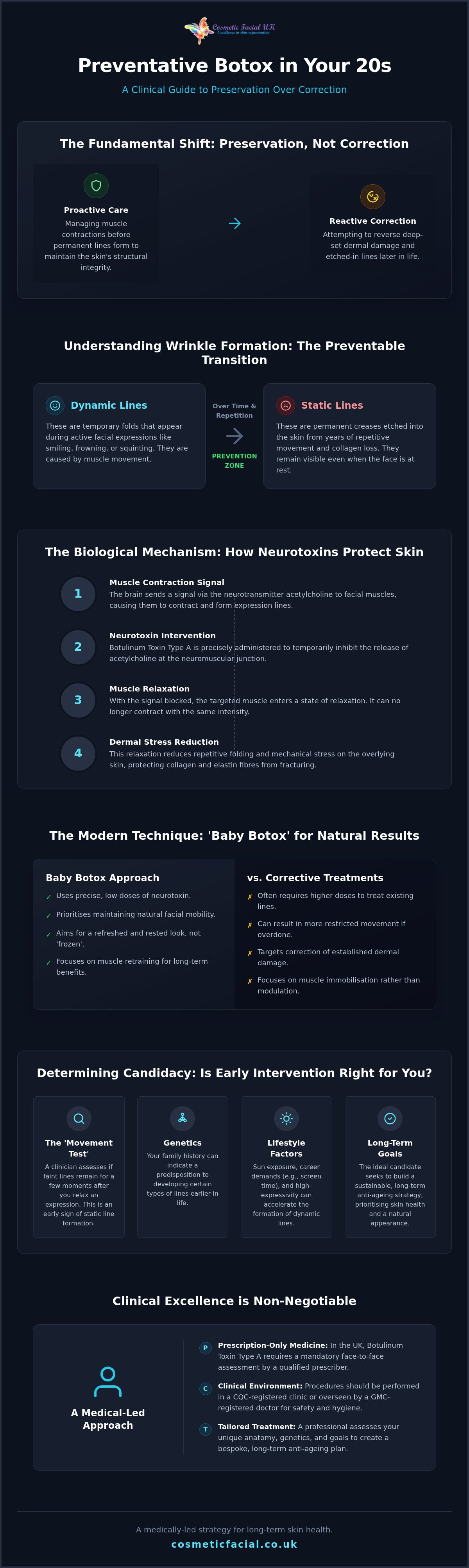
Preventative Botox involves the clinical application of neurotoxins before permanent facial creases, known as static wrinkles, have the opportunity to develop. In a medical context, the primary objective is to manage the repetitive muscular contractions that cause the overlying skin to fold. Over time, these repeated folds lead to a breakdown of collagen and elastin, eventually resulting in lines that remain visible even when the face is at rest. By initiating treatment early, clinicians can reduce this mechanical stress on the dermis. Prevention replaces correction.
The distinction between dynamic and static lines is central to the rationale for preventative botox in your 20s london. Dynamic lines are the temporary folds that appear during active facial expressions, such as frowning, squinting, or smiling. Static lines are those that have become etched into the skin permanently through years of repetitive movement and environmental damage. The goal of early intervention is to prevent the transition from a temporary fold to a permanent scar-like crease. This proactive approach maintains skin smoothness by modulating muscle activity before the skin loses its natural elasticity.
The Rise of Pre-juvenation Amongst London Professionals
Pre-juvenation represents a shift from reactive correction to proactive preservation. Amongst London professionals, the 20s are increasingly regarded as the optimal decade to begin this process. This trend is partially driven by the prevalence of high-definition digital communication, where subtle facial movements and early signs of ageing are magnified on screen. Professionals now seek to maintain a rested, composed appearance that aligns with their career trajectory. A proactive regime focuses on maintaining the skin's structural integrity through strategic, low-dose interventions rather than attempting to reverse deep-set dermal damage later in life.
Terminology: Botox, Neurotoxins, and Anti-Wrinkle Injections
Whilst often referred to by the brand name Botox, the active substance used in these treatments is Botulinum toxin Type A. This is a prescription-only medicine in the United Kingdom, requiring a mandatory face-to-face assessment by a qualified prescriber before administration. Within a broader facial rejuvenation strategy, neurotoxins serve a specific role in muscle modulation and dermal protection. It's essential that these procedures are performed in a clinical environment, preferably one with CQC registration or oversight by a GMC-registered doctor. This ensures that the concentration, placement, and technique used are appropriate for the patient's specific anatomy and long-term skin health.
The Biological Rationale: How Neurotoxins Prevent Permanent Dermal Creasing
Understanding the biological mechanism of neurotoxins is essential for comprehending how preventative botox in your 20s london functions. At the cellular level, Botulinum Toxin Type A inhibits the release of acetylcholine, a neurotransmitter responsible for triggering muscle contraction. By temporarily blocking these chemical signals, the targeted muscle enters a state of relaxation. This interruption isn't merely cosmetic. It fundamentally alters the mechanical relationship between the muscle and the overlying skin. Precision is paramount during this stage. The clinician must target specific motor units to ensure the desired modulation without affecting surrounding tissue.
When a muscle contracts aggressively, it forces the skin to fold. Each fold creates a minute amount of mechanical stress, or 'micro-trauma', within the dermal matrix. In younger skin, the high density of collagen and elastin allows the tissue to spring back. However, repetitive folding eventually causes these structural proteins to fracture. As these fibres snap, the skin loses its ability to remain flat at rest. Preventative intervention reduces the frequency and intensity of this folding. It protects the skin's biological foundation before damage becomes irreversible.
Muscle Retraining and Dermal Stress Reduction
Low-dose neurotoxin treatments perform a dual function by providing immediate relaxation and long-term muscle retraining. By subtly limiting the range of motion in hyperactive muscles, the brain learns to rely less on aggressive facial expressions. This behavioural shift means that even as the toxin naturally metabolises, the patient often maintains a more relaxed facial posture. Dermal creasing is the precursor to permanent scarring of the skin tissue, and by 'resting' the skin, we facilitate the body's natural repair processes. This methodical approach is a cornerstone of the care provided at our London clinical centre.
Collagen Preservation in Your 20s
Initiating treatment in the mid-20s is clinically advantageous because the skin's natural regenerative capacity is at its peak. During this decade, fibroblast cells are highly active, producing robust levels of collagen that provide volume and resilience. Contrast this with older skin, where collagen depletion and structural thinning make wrinkle reversal significantly more complex. When we apply preventative measures whilst the dermal matrix is still intact, we're essentially 'locking in' the skin's current quality. For those seeking a deeper understanding of these processes, our line and wrinkle treatment overview provides further clinical detail on managing age-related dermal changes.
Baby Botox vs Standard Treatments: Finding the Right Balance
'Baby Botox' is a clinical term describing the strategic administration of smaller, micro-dosed volumes of neurotoxin. For patients seeking preventative botox in your 20s london, this approach prioritises the preservation of facial mobility over total muscle immobilisation. Whilst standard treatments focus on smoothing existing deep-set wrinkles, preventative micro-dosing aims to soften muscle activity just enough to protect the skin from mechanical stress. This ensures the patient maintains their natural expressions and character without the risk of looking over-treated.
Precision placement is significantly more critical than high dosage in these cases. The clinician must accurately identify the specific motor points responsible for early dynamic lines. By injecting minute quantities of toxin into these precise locations, we achieve a subtle modulation of muscle behaviour. Because the dosage is lower than in corrective treatments, the duration of results is typically shorter, often lasting approximately three months. This allows for a flexible, iterative approach to anti-ageing that adapts to the patient's changing needs.
The Micro-Dosing Technique for Natural Results
Micro-dosing offers a distinct clinical advantage for first-time patients who often fear a 'frozen' or unnatural appearance. This technique involves distributing the neurotoxin across more injection points but using a lower concentration at each site. It creates a graduated effect that blends seamlessly with untreated areas of the face. Whilst neurotoxins manage muscle-driven lines, patients may also consider future options like non-surgical face lifts to address volume loss or skin laxity as they age. Starting with a conservative approach establishes a baseline for long-term facial harmony.
Preventative vs. Corrective Botox: A Clinical Comparison
The philosophical difference between preventative and corrective care is reflected in the treatment parameters. Preventative strategies are nuanced, focusing on the principle that 'less is more' to achieve a refreshed rather than altered look. For a comprehensive overview of these differences, patients should consult the Botox in London guide which provides deeper context on modern treatment options.
| Parameter | Preventative Botox | Corrective Botox |
|---|---|---|
| Primary Goal | Dermal matrix preservation | Wrinkle depth reduction |
| Typical Age | Mid-20s to early 30s | Late 30s onwards |
| Dosage Level | Low (Micro-dosing) | Standard to High |
| Frequency | Every 3 to 4 months | Every 4 to 6 months |
Determining Candidacy: Is Your 20s the Correct Time to Start?
Deciding when to begin treatment is a clinical decision based on the current state of the dermal tissue rather than a specific chronological age. Whilst many patients consider preventative botox in your 20s london as a standard milestone, the necessity of the procedure is determined by the 'movement test'. This clinical assessment involves observing the skin as expressions neutralise. If fine lines linger for several seconds after a smile or frown has ended, it indicates that the skin's elastic recoil is beginning to diminish. Identifying these subtle shifts ensures that intervention occurs at the optimal biological window.
Genetic predispositions and lifestyle factors play a significant role in this timeline. Individuals with thinner skin types or those with a history of significant sun exposure may notice dynamic lines transitioning into static ones earlier than others. Smoking and poor sleep hygiene also accelerate the degradation of the extracellular matrix. It's vital to note that treatment should not begin if no dynamic lines are present. Starting in the early teens, for example, is clinically inappropriate as there is no mechanical stress to mitigate. A professional consultation is required to determine if preventative botox in your 20s london is the right choice for your specific skin health.
Clinical Indicators for Early Intervention
Clinicians focus on three primary areas when assessing candidacy: the glabella (frown lines), the horizontal forehead lines, and the lateral canthal lines, commonly known as 'crow's feet'. The thickness of the patient's skin and the underlying muscle strength dictate the timing and dosage of the initial treatment. Patients with hyperactive facial muscles may require intervention sooner to prevent deep-set creases. The 'etching' of a wrinkle marks the specific point where preventative Botox becomes corrective, as the damage has moved from the muscle-skin interface into the deeper layers of the dermis itself.
The Role of Lifestyle and Environment in London
Living in an urban environment like London introduces unique stressors to the skin. Atmospheric pollution generates free radicals that deplete antioxidants, whilst 'tech neck', the repetitive bending of the neck to view digital devices, creates premature horizontal creasing. To maintain optimal results, professional skin peels can be utilised to improve surface texture and support the effects of neurotoxins. For patients who observe volume loss alongside these early lines, the Dermal Fillers London guide provides a detailed clinical overview of how to manage structural changes in the face during 2026.
Clinical Excellence in Marylebone: The Cosmetic Facial Approach
At Cosmetic Facial, we prioritise a medical-led methodology for preventative botox in your 20s london. Our practice is directed by Dr Faramarz Didar (GMC 5200505), whose MSc in Dermatology with Commendation ensures that every treatment plan is rooted in biological science. Unlike high-street beauty settings, our Marylebone clinic operates as a centre of medical excellence. We treat neurotoxins as a precise pharmacological tool for dermal preservation rather than a simple cosmetic enhancement. This rigorous academic perspective allows us to assess skin health holistically, ensuring that early intervention remains safe and effective for the long term.
Our commitment to clinical integrity means that we often advise against treatment if the skin does not yet show the necessary indicators. We believe that the best results are those that remain undetectable, respecting the natural anatomy of the face whilst proactively managing the ageing process. This measured approach has established our clinic as a trusted resource for patients who take their long-term skin health seriously.
Bespoke Consultations with Dr Faramarz Didar
The journey towards preventative botox in your 20s london begins with a comprehensive, unhurried clinical assessment. This process includes a detailed review of medical history, an analysis of current skin quality, and a thorough muscle mapping session to identify hyperactive motor units. Dr Didar's postgraduate training in non-surgical facial aesthetics allows for a highly nuanced approach to dosage and placement. Choosing a GMC-registered doctor provides a critical layer of safety, as medical professionals possess the deep anatomical knowledge required to avoid complications and ensure facial symmetry. Our clinic also offers integrated GP and dermatology services, facilitating a multi-faceted approach to skin health that addresses both surface texture and underlying structural integrity.
What to Expect During Your Visit to our Marylebone Clinic
Our clinical environment is designed to be professional, calm, and discreet, reflecting the serious nature of the treatments we provide. During the procedure, Dr Didar uses ultra-fine needles to administer micro-doses of neurotoxin into the pre-mapped areas. Most patients report only minimal discomfort, similar to a light pinch. Because we focus on precision and low concentration, downtime is negligible; most individuals return to their professional duties immediately. We provide comprehensive aftercare instructions to ensure the stability of the product and the health of the injection sites. Our commitment to natural, undetectable results means that your facial character is respected whilst the biological signs of ageing are proactively managed.
Establishing Your Long-Term Dermal Preservation Strategy
Establishing a sustainable anti-ageing plan involves a shift from reactive correction to proactive preservation. By choosing preventative botox in your 20s london, you manage the physiological triggers of wrinkle formation whilst your skin's regenerative capacity is at its peak. This clinical approach focuses on subtle muscle modulation to prevent the micro-trauma that eventually leads to deep dermal fracturing. It's a methodical process that rewards early intervention with long-term structural integrity.
Our Marylebone clinic provides an environment of medical excellence where your skin health is the primary focus. Dr Faramarz Didar (MSc Dermatology, GMC 5200505) develops bespoke 'Baby Botox' plans that respect your natural facial expressions. This ensures that your preventative strategy remains undetectable and entirely tailored to your specific anatomical needs. Trusting your care to a GMC-registered practitioner ensures the highest standards of safety and precision.
Investing in your skin's future today establishes a foundation for lasting health and a refreshed appearance for years to come.
Frequently Asked Questions
Is 25 too young for preventative botox in your 20s london?
Age 25 is not universally too young for preventative botox in your 20s london, as the decision depends on your specific skin state. A clinician assesses whether dynamic lines are beginning to linger after facial expressions neutralise. If the skin's elastic recoil is diminishing, starting treatment can prevent these lines from becoming permanent static creases. It's a proactive measure based on biological indicators rather than a fixed chronological milestone.
Will my face look 'frozen' if I start Botox in my 20s?
Your face will not look 'frozen' if the treatment is administered using a micro-dosing technique. This approach, often called 'Baby Botox', focuses on precision placement of low-concentration neurotoxins. The goal is to soften muscle contractions just enough to protect the skin whilst maintaining natural facial mobility. Choosing a qualified medical practitioner ensures that your unique facial anatomy is respected, resulting in a refreshed and undetectable appearance.
What happens if I stop getting Botox after starting it young?
If you decide to stop treatment after starting at a young age, your facial muscles will gradually regain their original strength and range of motion. Your skin will simply resume the natural ageing process from its current state. There is no evidence of accelerated wrinkling or negative rebound effects. In fact, the muscle retraining achieved during treatment often results in less aggressive expressions even after the toxin has metabolised.
How much does preventative Botox cost in a London clinic?
The cost of botulinum toxin treatments in London typically ranges from £175 to £500 per session, depending on the complexity and the number of areas addressed. Single areas generally fall between £149 and £300, whilst three areas often range from £249 to £500. UK regulations require a mandatory, face-to-face consultation with a qualified prescriber, which may involve a separate fee of approximately £50 to ensure clinical suitability.
Can preventative Botox help with heavy brows or 'tech neck'?
Neurotoxins can effectively address heavy brows by relaxing the muscles that pull the forehead down, creating a subtle lift. For 'tech neck', injections into the platysma bands in the neck can soften horizontal lines caused by repetitive downward looking. Whilst other treatments like radiofrequency address skin laxity, Botox manages the muscular component of these early ageing signs, providing a smoother and more contoured appearance.
How long do the results of 'Baby Botox' typically last?
Results from micro-dosed or 'Baby Botox' treatments typically last for approximately three months. Because a lower concentration of neurotoxin is used to maintain natural movement, the body's metabolic processes break down the product more quickly than standard doses. Patients seeking to maintain a consistent preventative effect generally schedule follow-up appointments every twelve to sixteen weeks to ensure the dermal matrix remains protected from repetitive mechanical stress.
Are there any long-term side effects of starting neurotoxins early?
There are no documented long-term adverse effects of starting neurotoxin treatments early when they are managed by a GMC-registered clinician. The primary long-term outcome is muscle retraining, where the patient naturally adopts less aggressive facial expressions. This behavioural shift can actually reduce the amount of product required in later years. Safety is ensured through precise anatomical targeting and the use of regulated, prescription-only medicines in a clinical environment.
What is the difference between Botox and dermal fillers for younger patients?
Botox and dermal fillers serve distinct clinical purposes for younger patients. Botox is a muscle relaxant used to prevent the formation of dynamic and static lines by modulating movement. Dermal fillers are used to restore volume or enhance structural contours, such as the lips or cheeks. In a preventative botox in your 20s london strategy, neurotoxins are usually the first line of defence against the mechanical causes of skin ageing.
Disclaimer
All content on cosmetic Facial website, including blogs, graphics, logos, images, and software, is the property of CosmeticFacial UK or its content suppliers and is protected by applicable copyright laws. Unauthorized use, reproduction, distribution, or modification of any content without prior written permission is strictly prohibited.


