


Effective body contouring no longer necessitates the invasive risks of the operating theatre or the prolonged recovery periods associated with traditional liposuction. When researching non-surgical fat removal london patients often encounter a fragmented landscape of competing technologies that promise results but frequently fail to address the underlying structural integrity of the skin. It's common to feel a justifiable hesitation toward general anaesthesia and the disruption of a busy professional schedule, particularly when the distinction between various modalities remains unclear.
You may find yourself frustrated by stubborn adipose tissue that resists conventional diet and exercise, yet you require a solution that aligns with a demanding lifestyle and maintains your privacy. This clinical case study demonstrates how a multi-modal approach, utilising medical-grade technologies such as T-Shape 2 and HIFU, achieves measurable reductions in fat layer thickness whilst simultaneously enhancing skin elasticity. We will examine the physiological mechanisms of radiofrequency, vacuum aspiration, and high-intensity focused ultrasound to explain how these integrated interventions deliver a contoured, natural result within a discreet clinical environment.
Key Takeaways
- Understand the biological mechanisms of apoptosis that facilitate non-surgical fat removal london, providing targeted volume reduction without the inherent risks of anaesthesia.
- Analyse how the integration of radiofrequency and laser technology within the T-Shape 2 system addresses skin laxity whilst simultaneously reducing adipose tissue.
- Evaluate the clinical distinctions between cryolipolysis and HIFU to determine which modality provides the most effective response for your specific body composition.
- Examine a 12-week patient timeline to understand the progression from a formal clinical consultation to achieving visible and measurable results.
- Recognise the importance of medical oversight in aesthetic procedures, ensuring your treatment is managed by a GMC-registered clinician in a professional setting.
Understanding Non-Surgical Fat Removal in London: A Clinical Overview
Non-surgical fat removal london describes a specific category of medical interventions designed to eliminate localised adipose tissue without the requirement for incisions or general anaesthesia. These procedures utilise energy-based technologies, such as radiofrequency, high-intensity focused ultrasound, and laser, to target subcutaneous fat deposits that are often resistant to traditional diet and exercise. Unlike surgical alternatives, these treatments are performed in a clinical outpatient setting, allowing patients to resume their professional responsibilities immediately.
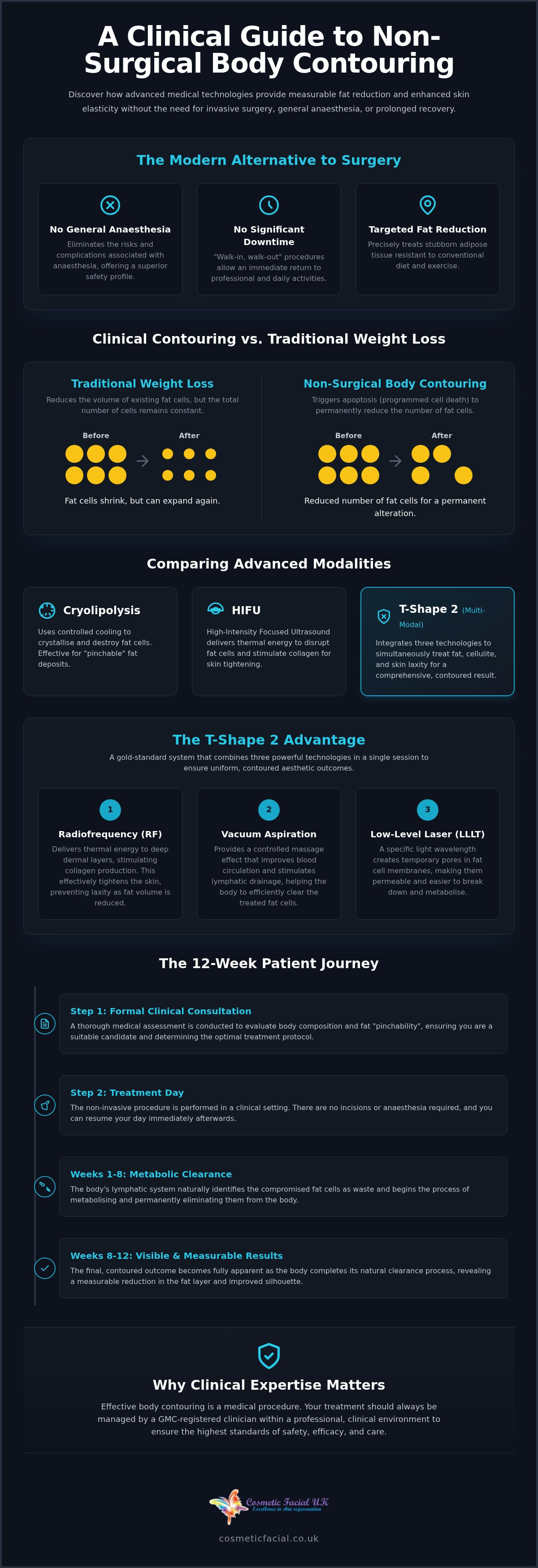
It's essential to distinguish between systemic weight loss and clinical body contouring. Traditional weight loss reduces the volume of fat cells, but the total number of cells remains constant. Clinical contouring triggers apoptosis, which is a process of programmed cell death. By reducing the absolute cell count in a specific area, the treatment provides a more permanent alteration to the body's silhouette. This biological destruction of adipocytes ensures that the treated area maintains its new proportions more effectively than through lifestyle changes alone.
To better understand this concept, watch this helpful video:
The Science of Adipose Tissue Reduction
Adipose tissue reduction relies on the precise delivery of thermal or mechanical energy to disrupt the integrity of the fat cell membrane. Various modalities achieve this differently; for instance, Cryolipolysis uses controlled cooling to crystallise fat cells, whilst radiofrequency treatments use heat to achieve a similar outcome. Once the cells are compromised, the body's lymphatic system identifies the cellular debris as waste. This metabolic clearance is not instantaneous. The body requires a specific physiological window to process and eliminate these cells, with final results typically manifesting between 8 and 12 weeks post-treatment. A thorough medical assessment is vital during the consultation phase to evaluate fat "pinchability". This ensures the subcutaneous layer is sufficiently pliable for the chosen technology to be effective.
London’s Shift Toward Non-Invasive Body Sculpting
Demand for non-surgical fat removal london has increased significantly amongst West End professionals who cannot accommodate the recovery times associated with invasive surgery. These "walk-in, walk-out" procedures offer a superior safety profile by eliminating the complications linked to general anaesthesia and surgical trauma. Modern clinical practice often favours combination therapy, where multiple technologies are layered within a single session. For example, our body sculpting protocols often integrate radiofrequency for skin tightening alongside fat reduction. This dual-action approach ensures that as volume is lost, the overlying skin remains firm and elastic, preventing the laxity that can sometimes follow rapid fat reduction.
The T-Shape 2 Advantage: Combining Radiofrequency, Vacuum, and Laser
T-Shape 2 represents a significant advancement in multi-modal body contouring. Unlike single-modality devices that only address volume, this system integrates three distinct technologies to treat fat, cellulite, and skin laxity in a single session. This integrated approach ensures that the aesthetic outcome is uniform and contoured, which is why it's considered a gold standard for non-surgical fat removal london. It addresses the multi-faceted nature of body shaping, ensuring that volume loss doesn't result in poor skin texture.
The biological efficacy of the system relies on Low-Level Laser Therapy (LLLT) to permeabilising adipose cell membranes. This specific wavelength of light creates temporary pores in the cells, allowing stored triglycerides to leak into the interstitial space. Once released, the vacuum-assisted massage component becomes vital. This mechanical aspiration improves local microcirculation and lymphatic drainage, ensuring the liberated lipids are efficiently transported and metabolised. These Non-Invasive Body Contouring Technologies offer a sophisticated, evidence-based alternative to the trauma of mechanical fat extraction. This synergy reduces the likelihood of the irregular appearance sometimes associated with poorly managed fat reduction.
Bipolar Radiofrequency for Dermal Tightening
The bipolar radiofrequency (RF) component targets the deeper dermal layers of the skin. By generating controlled thermal energy, it stimulates the immediate contraction of existing collagen fibres. This thermal stress triggers a fibroblastic response, facilitating the production of new collagen and elastin over several months. Tightening the dermis is essential when fat volume is reduced. Without this intervention, the skin may appear loose or deflated after the adipocytes are cleared. This focus on structural quality mirrors our clinical expertise in facial rejuvenation, where maintaining skin density is paramount for a natural appearance.
Targeting Stubborn Areas: From Abdomen to Double Chin
Precision applicators allow for versatile application across various anatomical regions. The system is particularly effective for the abdomen, flanks, and thighs, where stubborn fat deposits often persist despite rigorous lifestyle efforts. Specialised applicators also enable effective double chin treatment by contouring the submental area with high precision. When considering non-surgical fat removal london, patients often prioritise technologies that offer such comprehensive tissue management. The T-Shape 2 mechanism serves as a non-thermal, non-invasive alternative to surgical liposuction. For those seeking a bespoke clinical plan, our practitioners at Cosmetic Facial in Marylebone provide thorough assessments to ensure the treatment parameters are calibrated to your unique physiological requirements.
Comparing Modalities: Cryolipolysis vs. HIFU vs. T-Shape 2
Choosing the appropriate technology for non-surgical fat removal london requires a detailed understanding of how different energy forms interact with biological tissue. Cryolipolysis, frequently referred to as fat freezing, targets lipid-rich cells by applying controlled cooling to induce apoptosis. Whilst this method is effective for reducing bulk volume in "pinchable" fat pockets, it lacks a specific mechanism for dermal contraction. This absence of skin tightening can occasionally lead to residual laxity or an irregular "shelving" effect in the treated area. This FDA overview of non-surgical body contouring confirms that selecting the right modality depends heavily on whether the primary clinical goal is volume reduction, structural lifting, or skin smoothing.
High-Intensity Focused Ultrasound (HIFU) offers a more aggressive approach to structural tissue remodelling. It delivers concentrated ultrasound energy to the deeper subcutaneous layers, including the Superficial Muscular Aponeurotic System. This creates precise thermal coagulation points that trigger a significant lifting effect from within. HIFU is particularly effective for patients with substantial skin laxity who require deep-tissue precision rather than superficial smoothing. In contrast, T-Shape 2 functions as a versatile, multi-modal system that manages fat, cellulite, and texture simultaneously, providing a more uniform aesthetic result for the majority of patients.
HIFU Body Sculpting: Deep Tissue Precision
HIFU technology focuses energy at specific depths, bypassing the epidermis to reach the structural foundation of the tissue. This results in a structural "lifting" effect that is difficult to achieve with surface-based technologies. However, the intensity of HIFU can be more pronounced than the smoother, more comfortable sensation of T-Shape 2 treatments. For individuals presenting with significant skin laxity alongside fat deposits, a HIFU Body Treatment may be the clinically indicated choice to ensure the underlying structure supports the new contour. It's a precise tool for targeted lifting in areas like the lower abdomen or inner thighs.
Decision Matrix: Which Treatment Suits Your Goals?
Selecting the correct intervention is a clinical decision based on tissue quality and patient objectives. We typically use the following framework to guide treatment selection:
- Cryolipolysis: Best for isolated, high-volume fat pockets where skin elasticity remains optimal.
- HIFU: Indicated for patients requiring deep structural lifting and significant skin tightening.
- T-Shape 2: The preferred choice for comprehensive contouring, cellulite reduction, and immediate texture improvement.
Developing a bespoke plan is essential to avoid the limitations of a "one-size-fits-all" approach. During a private consultation at our Marylebone clinic, we evaluate your physiological profile to determine the most effective sequence of treatments. We may also consider Lipofirm Pro as a complementary sibling treatment for those requiring specific muscle-toning benefits alongside fat reduction. This ensures the final result is both proportionate and natural.
The Patient Journey: A Case Study from Consultation to 12-Week Results
Patients seeking non-surgical fat removal london at our Marylebone practice undergo a rigorous medical protocol. We don't employ sales-led consultations; instead, each case begins with a clinical evaluation to ensure patient safety and treatment efficacy. This methodical approach allows us to manage expectations and tailor the energy parameters of the T-Shape 2 or HIFU systems to the individual's tissue density. By prioritising a medical assessment, we ensure that the selected modality aligns with the patient's specific physiological requirements.
Step 1: The Clinical Assessment and Mapping
The journey starts with a detailed mapping of the treatment area. We use precise callipers to measure the subcutaneous fat layer and mark the boundaries with clinical accuracy to ensure symmetrical results. This phase is also used to screen for contraindications, such as hernias in the treatment area, active skin conditions, or specific metabolic disorders. Accuracy at this stage is paramount for achieving a balanced silhouette that looks natural. For specific queries regarding medical suitability and preparation, patients should review our FAQ page.
Step 2: The Treatment Experience and Aftercare
A standard session typically lasts between 30 and 60 minutes per anatomical region. During the procedure, you'll feel a consistent sensation of warmth combined with rhythmic vacuum pressure. It's not painful. Most patients find the process comfortable enough to read or relax during the application. There's no downtime required, meaning professionals can return to their offices in Central London immediately after the appointment. To support the lymphatic system in processing the liberated fat cells, we recommend high hydration levels and light cardiovascular activity like walking. Avoiding alcohol for at least 48 hours is also advised to ensure the liver can focus entirely on lipid metabolism without distraction.
Step 3: Monitoring the Transformation
Transformation occurs gradually as the body's metabolic processes clear the damaged adipocytes. We schedule follow-up assessments at week four and week eight to document progress and adjust the treatment programme if necessary. Peak aesthetic results are usually visible at the 12-week mark. Clinical data suggests that a 20 to 30% reduction in fat layer thickness is common in the treated area after completing a full course of non-surgical fat removal london. This timeline respects the body's natural biological pace for cell clearance. The gradual nature of the change ensures that the skin has time to adapt to the new contours, resulting in a firm and natural finish.
Why Clinical Expertise Matters: Non-Surgical Fat Removal at Cosmetic Facial
The effectiveness of non-surgical fat removal london is determined by the practitioner's clinical expertise as much as the technology itself. Whilst advanced platforms provide the mechanical means for adipose reduction, the precise application of these energies requires an advanced understanding of tissue biology and anatomical structures. At Cosmetic Facial, all treatment protocols are developed under the guidance of Dr Faramarz Didar (GMC 5200505). Dr Didar's MSc in Dermatology Skills and Treatment, awarded with Commendation, ensures that every body contouring plan is based on empirical evidence and medical necessity. This level of oversight is what distinguishes a medical practice from a standard aesthetic centre.
The Value of a Doctor-Led Aesthetics Clinic
A doctor-led clinic prioritises patient safety through rigorous screening and evidence-based practice. Having a GMC-registered doctor oversee your care means that your treatment isn't just a technical procedure; it's a medical intervention. This is particularly important when using high-intensity energies that must be adjusted for different skin types and fat thicknesses. Our Marylebone site serves as a centre of excellence for non-surgical aesthetics, where we maintain a professional clinical environment focused on long-term health. We don't advocate for "quick fixes" that might compromise tissue health. Instead, we offer the advantage of combining fat reduction with medical-grade skin treatments to ensure the overlying dermis remains healthy and resilient throughout the transformation.
Bespoke Contouring Plans in Marylebone
Our commitment to bespoke care means that every patient receives a personalised strategy designed to achieve specific physiological outcomes. We utilise the T-Shape 2 and HIFU systems to target stubborn fat deposits whilst ensuring that skin elasticity is maintained or improved. This nuanced approach is essential for preventing the sagging or irregularities that can occur with less sophisticated methods. Our Marylebone clinic provides a discreet setting where patients can discuss their goals with a medical expert who understands the limits of current evidence. This intellectual honesty builds trust and ensures that you're in capable hands. Modern non-surgical fat removal london offers a safe, predictable, and effective route to body confidence when managed with clinical precision.
Advancing Your Body Contouring Objectives with Clinical Precision
Achieving a refined silhouette requires a sophisticated understanding of tissue biology and energy-based technology. This clinical overview has demonstrated that successful outcomes depend on a multi-modal approach that addresses both adipose volume and dermal structural integrity. By integrating T-Shape 2 and HIFU LAB DUAL systems, we provide a comprehensive, evidence-based alternative to traditional surgical interventions. These technologies ensure that volume reduction is accompanied by necessary skin tightening, preventing the laxity often associated with rapid fat loss.
The safety and efficacy of non-surgical fat removal london are significantly enhanced when managed within a doctor-led environment. Dr Faramarz Didar’s extensive background in dermatology ensures that each treatment plan is calibrated to the patient's unique physiological profile. Located in our private Marylebone clinic, this professional oversight provides the reassurance that your health and aesthetic goals are being managed with clinical precision. The transition from initial assessment to the 12-week peak result follows a predictable, medically supervised timeline.
You can move forward with confidence, knowing that modern medical advancements offer a predictable and discreet path to achieving your desired body contours through a structured, professional programme.
Frequently Asked Questions
How much fat can actually be removed without surgery?
Clinical studies demonstrate that non-surgical interventions typically achieve a 20% to 30% reduction in the thickness of the subcutaneous fat layer in the treated area. It's important to understand that these procedures are designed for targeted body contouring rather than significant weight loss. They effectively address localised deposits that persist despite lifestyle efforts, providing a more refined silhouette without the physiological trauma associated with mechanical fat extraction.
Is non-surgical fat removal permanent?
Fat cell destruction through apoptosis is permanent. Once the body's lymphatic system processes and eliminates the damaged adipocytes, those specific cells cannot return. However, the remaining fat cells in the surrounding tissue can still expand if a significant calorie surplus occurs. Maintaining a stable weight through balanced nutrition and exercise is essential to preserve the clinical results achieved during your treatment course.
Does the procedure hurt or require anaesthetic?
These treatments don't require general anaesthesia, local anaesthetic, or topical numbing agents. Patients typically report a sensation of deep thermal warmth and mechanical vacuum pressure, but the experience is generally well-tolerated. Unlike surgical liposuction, there's no sharp pain or post-operative trauma. Most individuals find the procedure comfortable enough to remain relaxed or even read during the session, making it a viable option for those with busy schedules.
How many sessions of T-Shape 2 or HIFU will I need?
The number of sessions depends on the specific technology used and your individual physiological response. For T-Shape 2, a course of 6 to 10 sessions performed at weekly intervals is standard for optimal contouring. HIFU treatments are more intensive and may only require 1 to 3 sessions to achieve a structural lifting effect. Your practitioner will determine the precise frequency during your initial clinical assessment in Marylebone.
What is the difference between fat freezing and T-Shape 2?
Fat freezing, or Cryolipolysis, targets fat cells through cooling but lacks a mechanism for skin tightening. T-Shape 2 is a more versatile option for non-surgical fat removal london because it combines radiofrequency and laser to improve skin elasticity whilst reducing fat volume. This integrated approach ensures the skin remains firm and contoured as the underlying fat layer diminishes, preventing the loose appearance sometimes seen with single-modality treatments.
Can I return to work immediately after the treatment?
You can return to your professional and social activities immediately after the session. There's no clinical downtime or recovery period required, as the skin surface remains entirely intact. Many professionals in the West End schedule their appointments during a lunch break and resume work without any visible signs of treatment. This convenience is a primary reason why non-invasive sculpting has become the preferred alternative to traditional surgical procedures.
Are there any side effects to non-surgical fat dissolving?
Side effects are generally mild and transient. You may experience temporary erythema, which is redness of the skin, or slight swelling in the treated area. Some patients report a minor feeling of tenderness similar to muscle soreness after exercise. These effects typically resolve within 24 to 48 hours. Because these methods don't involve incisions, the risks of scarring, infection, or anaesthetic complications are effectively eliminated from the treatment profile.
Who is the ideal candidate for non-surgical fat removal in London?
The ideal candidate for non-surgical fat removal london is an individual within their healthy weight range who has localised fat deposits resistant to diet and exercise. This treatment is particularly effective for those with mild to moderate skin laxity who seek a more contoured appearance without undergoing surgery. A thorough medical consultation is required to assess your suitability and ensure that your expectations align with the clinical possibilities of the technology.
Disclaimer
All content on cosmetic Facial website, including blogs, graphics, logos, images, and software, is the property of CosmeticFacial UK or its content suppliers and is protected by applicable copyright laws. Unauthorized use, reproduction, distribution, or modification of any content without prior written permission is strictly prohibited.


