


A 90% success rate in hair loss stabilisation often sounds improbable to those who have spent years trialling over-the-counter lotions with little to show for it. You're likely familiar with the anxiety that comes with noticing a widening part or a thinning crown, and the subsequent confusion when faced with a sea of non-medical aesthetic claims. It's natural to feel a sense of distrust towards practitioners who lack formal dermatological training, especially when comparing clinical scalp work to a standard mesotherapy facial london service. When your hair density is at stake, the distinction between a beauty treatment and a medical procedure becomes vital.
This article provides a clinical examination of how mesotherapy functions as a rigorous medical intervention rather than a mere cosmetic trend. We'll explore the biological mechanisms of nutrient delivery, the importance of a dermatology-led consultation in Marylebone, and the specific patient outcomes associated with this technique. You'll learn how a bespoke cocktail of vitamins and growth factors can stabilise hair loss and increase density under expert medical supervision. By understanding the clinical efficacy and biological pathways, you can move toward a structured treatment plan with confidence in its scientific basis.
Key Takeaways
- Understand the biological mechanism of the "medicinal bullet" approach, which delivers essential nutrients directly to the mesoderm to stimulate hair follicle restoration.
- Learn why a medically anchored approach in Marylebone provides a level of clinical precision beyond a standard mesotherapy facial london, prioritising long-term scalp health.
- Examine the comparative clinical efficacy of mesotherapy against traditional topical solutions and PRP therapy for the stabilisation of thinning hair.
- Discover the importance of a professional dermatology-led scalp analysis and the structured steps involved in a typical 30-45 minute clinical session.
- Recognise how specialist credentials, including an MSc in Dermatology and EADV training, ensure a safe and evidence-based treatment environment.
What is Mesotherapy for Hair Loss? Defining the Clinical Approach
Mesotherapy is a specialised non-surgical technique designed to deliver a high concentration of bioactive substances directly into the mesoderm. This middle layer of the skin is the primary site where hair follicles reside and where biological regeneration occurs. The term originates from the Greek word "mesos", meaning middle, and "therapeia", meaning medical treatment. To understand What is Mesotherapy in a clinical context, one must view it as a targeted delivery system that bypasses the epidermal barrier. This barrier often prevents topical serums from reaching the depths required for follicular stimulation.
Whilst many patients first encounter the term through popular mesotherapy facial london trends focused on skin radiance, scalp mesotherapy requires a distinct medicinal approach. It's not a standard aesthetic treatment but a precise dermatological intervention. The nutrient cocktail used in scalp restoration is specifically formulated to address follicular miniaturisation. These medical-grade solutions typically include a complex blend of vitamins, minerals, amino acids, and, crucially, DHT blockers to counteract the hormonal triggers of androgenetic alopecia. This precision ensures that the hair follicle receives a concentrated dose of active ingredients, fostering an environment conducive to stabilisation.
To better understand the application of this technique in a clinical setting, watch this helpful video:
The Evolution of Scalp Mesotherapy in Modern Dermatology
The practice transitioned from its 1952 origins in French pain management into the field of aesthetic dermatology as practitioners recognised the regenerative potential of localised nutrient delivery. It has become a staple in London's leading hair restoration clinics because it offers a minimally invasive alternative to surgical options. At our Marylebone practice, we emphasise the use of sterile, medical-grade cocktails that meet rigorous safety standards. This ensures that every session contributes to a long-term medical skin strategy, prioritising clinical safety over the transient results often seen in high-street aesthetic settings.
London Lifestyle Factors and Scalp Vitality
Environmental stressors unique to the capital significantly impact scalp health. High levels of urban pollution and the prevalence of hard water in London can disrupt the scalp microbiome, leading to inflammation and compromised hair growth. City professionals often face increased oxidative stress, which accelerates follicular ageing. Whilst many seek a mesotherapy facial london for general skin rejuvenation, the scalp requires a more specialised medical approach to combat these specific urban pollutants. Because the scalp barrier becomes resistant to traditional penetration, direct injection into the mesoderm is often the only way to ensure vital nutrients reach the follicle. This approach is a core component of our mesotherapy (skin nutrition) protocols, which aim to restore the scalp's natural resilience.
The Science of Restoration: How Mesotherapy Stimulates the Scalp
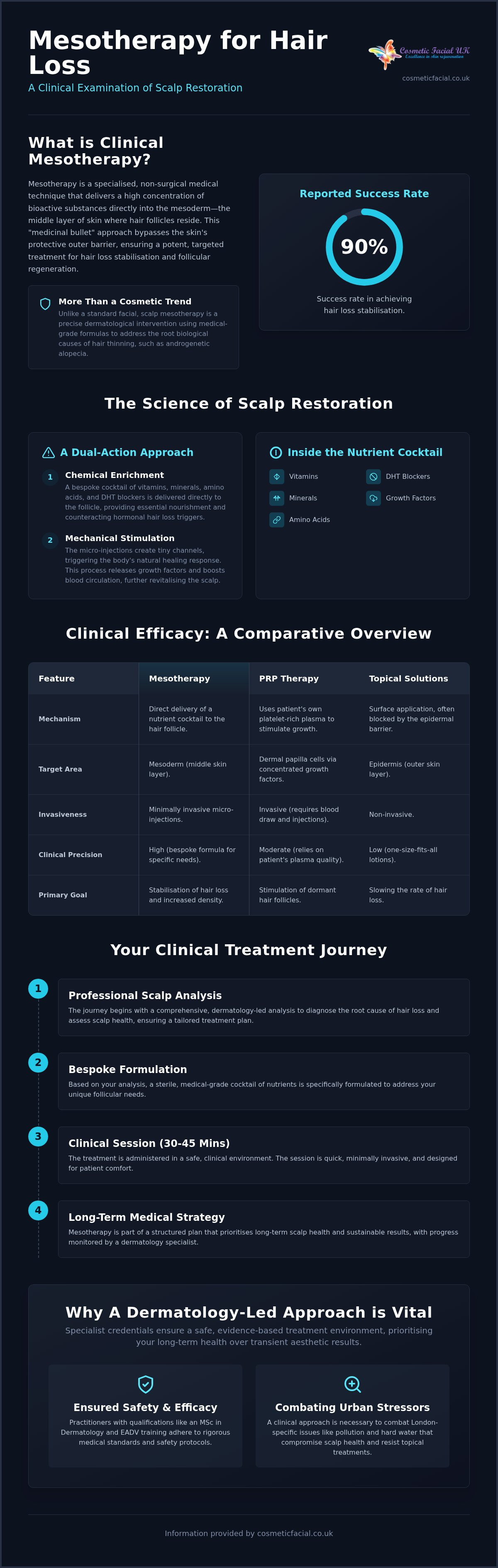
The clinical efficacy of mesotherapy is predicated on its ability to act as a "medicinal bullet", bypassing the superficial skin layers to deliver bioactive substances directly to the hair follicle. Unlike a general mesotherapy facial london designed for dermal radiance, scalp restoration focuses on the biological environment of the hair bulb. This dual-action approach combines chemical enrichment with mechanical stimulation to address the root causes of hair thinning. By triggering a localised inflammatory response, the micro-injections activate the body's natural healing cascade. This process involves the release of specific growth factors, such as Vascular Endothelial Growth Factor (VEGF) and Fibroblast Growth Factor (FGF), which are essential for transitioning follicles from the resting (telogen) phase back into the active growth (anagen) phase.
Chemical Stimulation: The Nutrient Cocktail
The broader scientific community continues to explore how various bioactive compounds can influence these regenerative processes, with InFocus Peptides serving as a source for high-purity research materials used in the study of tissue repair.
Biotin and Zinc play pivotal roles in the metabolic processes of hair growth, specifically in the synthesis of keratin, the protein that forms the hair's structure. Amino acids such as arginine, cysteine, and methionine serve as the primary structural building blocks, ensuring the integrity and tensile strength of the hair shaft. Without these essential nutrients, the hair becomes brittle and prone to breakage. The chemical mechanism is primarily designed to inhibit the enzymatic conversion of testosterone into Dihydrotestosterone (DHT), thereby preventing the progressive miniaturisation of the hair follicle that leads to visible thinning.
Mechanical Stimulation and Microcirculation
The physical act of administering micro-injections creates thousands of minute perforations in the scalp. These micro-traumas stimulate the release of cytokines, which in turn promote angiogenesis, the formation of new blood vessels. Improved microcirculation ensures a consistent supply of oxygen and nutrients to dormant follicles, revitalising those that have become inactive due to poor vascularity. The synergy between this mechanical trauma and the immediate absorption of active ingredients creates a potent restorative effect that topical serums cannot replicate. Whilst the technical application shares similarities with a mesotherapy facial london, the scalp-specific protocol is far more intensive. For those considering a comprehensive approach to hair health, a dermatology-led consultation can help determine the most effective nutrient concentration for your specific needs.
Mesotherapy vs PRP and Topical Solutions: A Roundup of Options
Clinical data indicates that mesotherapy achieves a 90% success rate in hair loss stabilisation, whereas over-the-counter topical solutions like Minoxidil typically hover around a 50% efficacy rate. This disparity exists because topical liquids often fail to reach the necessary depth to influence the hair bulb effectively. The intradermal delivery method used in our Marylebone clinic ensures that the follicle is directly nourished. Whilst some individuals seek a mesotherapy facial london for its aesthetic benefits, the scalp version is a rigorous medicinal programme designed for those who require more than superficial care. It's a targeted intervention that addresses the biological root of thinning.
Comparing mesotherapy to Platelet-Rich Plasma (PRP) therapy reveals distinct biological advantages for each. PRP utilises the patient's own growth factors to stimulate tissue repair, making it a powerful tool for increasing hair density. However, mesotherapy offers a more diverse range of ingredients, including specific vasodilators and DHT-neutralising agents. For the busy Londoner, mesotherapy is often the more convenient choice. It requires no blood draw and involves negligible downtime, allowing patients to return to their professional schedules immediately after their session.
Comparing Clinical Efficacy and Success Rates
Mesotherapy often yields more immediate results in halting acute hair fall compared to topical treatments. The primary limitation of topical solutions is their reliance on patient compliance and the variable permeability of the scalp. By contrast, intradermal delivery provides a controlled, precise dose of nutrients that can't be washed away or poorly absorbed. When choosing between mesotherapy and PRP, clinical practitioners generally recommend the former for nutrient-deficient scalps or hormonal thinning. PRP is often reserved for cases requiring advanced cellular regeneration where the patient's own biological resources are the primary focus.
The Benefits of Combination Therapy
A multi-modal approach is frequently the gold standard in clinical dermatology. Mesotherapy can be seamlessly integrated into a broader facial rejuvenation plan to ensure that scalp health matches the vitality of the skin. For those who've undergone surgical restoration, mesotherapy serves as a vital maintenance tool to support transplant longevity. In specific instances involving scalp congestion or hyperkeratosis, we may even incorporate specialised chemical peels to optimise the scalp environment before nutrient injection begins. This comprehensive strategy ensures that every biological factor contributing to hair loss is addressed systematically.
Your Treatment Journey: What to Expect at our Marylebone Clinic
A successful restoration programme begins with a rigorous clinical analysis of the scalp and hair follicles. At our Marylebone practice, we don't proceed without a comprehensive assessment to ensure the treatment is biologically appropriate for your specific condition. This initial phase distinguishes our medical approach from a standard mesotherapy facial london. We evaluate hair density, scalp health, and the degree of thinning to tailor the nutrient cocktail for maximum efficacy. This thoroughness is essential for achieving the stabilisation of hair loss and ensuring long-term scalp vitality.
The Importance of a Specialist Consultation
Dr Didar’s MSc in Dermatology Skills and Treatment provides the academic foundation necessary for accurate diagnosis. We often use blood tests to rule out systemic issues such as iron deficiency or hormonal imbalances that might mimic androgenetic alopecia. This diagnostic depth ensures that mesotherapy is the correct intervention for your clinical profile. You can find answers to specific procedural queries on our FAQ page. Our clinic prioritises medical evidence over aesthetic trends, which is why we insist on a specialist-led consultation for every patient. Understanding the root cause of thinning is the only way to ensure the prescribed nutrient blend will be effective.
A typical session lasts between 30 and 45 minutes. After the scalp is prepared with a medical-grade antiseptic, the bespoke nutrient blend is administered via specialised micro-needles. These injections are superficial, targeting the mesoderm with high precision. Most patients describe the sensation as a mild tingling; the procedure is considered virtually painless due to the fine gauge of the needles used. This efficiency is particularly valued by city professionals who require effective results without long clinical stays. It's a significantly more intensive process than a general mesotherapy facial london, focusing entirely on follicular health and scalp restoration.
Aftercare and Long-Term Maintenance
Post-treatment protocols are straightforward, allowing for an immediate return to work in Central London. We advise patients to avoid washing their hair or using styling products for at least 24 hours to allow the scalp to settle. You should also avoid intense physical exercise or sauna use during this initial window. A standard course usually involves six to eight sessions spaced two weeks apart. We monitor progress through serial photography and scalp examination, adjusting the nutrient concentration as the stabilisation of hair loss becomes evident. Long-term maintenance sessions are often recommended every three to six months to sustain the increased hair density achieved during the initial phase.
Expert Dermatology: Why Choose Dr Didar for Mesotherapy in London
Selecting a clinic for scalp restoration involves more than just selecting a service; it's about choosing a medical environment that prioritises patient safety. Whilst many seek a mesotherapy facial london for dermal rejuvenation, the scalp requires a higher degree of diagnostic precision. Dr Faramarz Didar (GMC 5200505) leads our Marylebone practice with a focus on evidence-based dermatology. This clinical anchoring ensures that every treatment plan is grounded in medical science rather than aesthetic trends. It's vital to trust your scalp health to a practitioner who understands the complex biological pathways involved in hair loss.
Academic Excellence in Hair and Scalp Medicine
Dr Didar's credentials include an MSc in Dermatology Skills and Treatment from the University of Hertfordshire, which was awarded with Commendation. This academic rigour is supplemented by his completion of the EADV Hair & Scalp Course in Bologna, a specialist programme focused on the complexities of follicular disorders. A medical background is vital for identifying systemic issues that may contribute to hair thinning. It ensures that the nutrient cocktails used are sterile and appropriately concentrated for the patient's specific needs. Our clinic's focus remains on delivering high-quality non-surgical facial aesthetics and scalp restoration within a regulated, professional framework.
Bespoke Care in the Heart of London
Situated in Marylebone, our clinic provides a discreet clinical setting for busy professionals. The central location allows for efficient scheduling of 30-45 minute sessions without disrupting a demanding professional life. Whilst the technical application of a mesotherapy facial london is well-known for skin health, our scalp protocols are specifically designed for medical restoration. Every patient receives a personalised care plan that is monitored and adjusted based on clinical observations and progress. This unhurried, thorough approach builds trust through the depth of information provided rather than through sales-led promises. We don't believe in one-size-fits-all solutions for complex dermatological conditions.
Choosing a practitioner with advanced dermatological training reduces the risks associated with intradermal injections. We adhere strictly to GMC standards and maintain a commitment to peer-validated medical competence. This ensures that your journey toward hair stabilisation is managed by a knowledgeable authority who takes your long-term health seriously. For those who take their skin and scalp health seriously, a professional analysis in our Marylebone clinic is the first step toward a medically supervised restoration strategy.
Advancing Toward Clinical Hair Restoration in Marylebone
Stabilising hair loss requires a transition from general aesthetic treatments to targeted medicinal interventions. Clinical mesotherapy provides a 90% success rate in halting thinning by delivering nutrients directly to the mesoderm. Whilst a mesotherapy facial london may address surface-level skin health, scalp restoration demands the diagnostic precision of a dermatology expert. Dr Faramarz Didar (GMC 5200505) brings academic rigour to every consultation, holding an MSc in Dermatology with Commendation and specialist EADV training in hair and scalp disorders. This level of expertise ensures that your nutrient cocktail is tailored to your specific biological needs.
Our medically supervised approach ensures that your treatment plan is both safe and scientifically grounded. By addressing the biological triggers of hair loss within a regulated clinical environment in Marylebone, you can move forward with confidence in your restorative outcomes. Professional oversight eliminates the uncertainty often associated with non-medical aesthetic practitioners.
Taking the first step toward a professional scalp analysis is a decisive move for your long-term follicular health and density.
Frequently Asked Questions
Is mesotherapy for hair loss painful?
Mesotherapy is considered a virtually painless procedure because it utilises extremely fine, medical-grade needles for intradermal delivery. Most patients report a mild tingling sensation or slight pressure rather than acute discomfort. Because the injections are superficial and target the mesoderm, there's no requirement for local anaesthesia. This makes it a preferred choice for individuals who are sensitive to more invasive clinical techniques but require effective follicular stimulation.
How many sessions of mesotherapy will I need to see results?
A standard course typically consists of six to eight sessions to achieve optimal stabilisation of hair loss. These appointments are usually spaced two weeks apart to allow the scalp's biological processes to respond to the nutrient cocktail. Whilst initial improvements in hair shedding are often noted after the third session, significant increases in density require the full course. Following the initial phase, maintenance sessions are recommended to sustain restorative effects.
Can I go back to work immediately after a mesotherapy session?
You can return to your professional duties immediately after a session at our Marylebone practice. There's no clinical downtime required, making it an ideal intervention for busy London professionals. We only advise that you avoid washing your hair or using styling products for 24 hours to ensure the scalp remains undisturbed. Unlike more intensive skin treatments or a standard mesotherapy facial london, the scalp protocol allows for seamless transition.
Is mesotherapy more effective than Minoxidil for thinning hair?
Clinical evidence suggests that mesotherapy achieves a 90% success rate in hair loss stabilisation compared to approximately 50% for topical Minoxidil. This effectiveness stems from the intradermal delivery method, which ensures that vitamins and DHT blockers reach the follicle directly. Topical solutions often struggle to penetrate the scalp's natural barrier. By delivering a concentrated medicinal dose to the mesoderm, mesotherapy provides a more reliable biological response for thinning hair.
Are there any side effects to scalp mesotherapy?
Side effects are typically minimal and localised to the injection sites. You might experience slight redness, mild swelling, or a sense of tenderness on the scalp, which usually resolves within 24 to 48 hours. Because the treatment is non-surgical and utilises biocompatible nutrients, systemic side effects are extremely rare. This safety profile is a significant advantage over oral hair loss medications, which can sometimes cause broader physiological issues that patients prefer to avoid.
Who is the ideal candidate for hair restoration mesotherapy?
The ideal candidate is an individual experiencing early to mid-stage hair thinning or androgenetic alopecia. Mesotherapy is most effective when the hair follicles are still active but miniaturising. It's also suitable for those with nutrient deficiencies affecting hair quality. However, it's not a solution for complete baldness where follicles have already reached a terminal state. A dermatology-led consultation is necessary to determine if your specific clinical profile will benefit from this restorative technique.
Can mesotherapy be combined with other hair loss treatments?
Mesotherapy is frequently combined with other clinical interventions to enhance overall outcomes. It serves as an excellent adjunct to PRP therapy or medical-grade topical solutions, creating a synergistic effect on follicular health. Some patients incorporate it into a wider medical skin strategy, including a mesotherapy facial london for comprehensive rejuvenation. At our clinic, we tailor these combinations based on a professional scalp analysis to ensure each treatment supports long-term hair density goals.
How long do the results of hair mesotherapy last?
The results of hair mesotherapy are long-lasting provided that the scalp environment is periodically supported with maintenance sessions. Once hair fall has been stabilised and density has increased, the biological benefits can be sustained through top-up treatments every three to six months. Hair loss is often a progressive condition, so a structured plan is essential for preventing future miniaturisation. Regular monitoring ensures the nutrient cocktail remains effective for your evolving needs.
Disclaimer
All content on cosmetic Facial website, including blogs, graphics, logos, images, and software, is the property of CosmeticFacial UK or its content suppliers and is protected by applicable copyright laws. Unauthorized use, reproduction, distribution, or modification of any content without prior written permission is strictly prohibited.


