


A non-surgical nose job creates a temporary change rather than permanently reshaping the nose. How long the result lasts depends on the filler used and how your body breaks it down. Filler can alter nasal contours, but it cannot make the nose smaller or narrower. If you are considering more definition at the tip, the key question is whether filler can achieve the change you want.
It’s understandable to want a clear idea of how long results may last before deciding on treatment. This article explains what affects their duration, when a top-up may be considered and how filler-based reshaping compares with surgery.
You’ll also learn what to consider when discussing the nose tip, how treatment works and which changes filler can and cannot address. This can help you decide whether a temporary adjustment suits your aims or surgical reshaping is more appropriate.
Key Takeaways
- Understand why filler may shift and which treatment and aftercare considerations can affect the result.
- Learn how to recognise when a review or top-up may be relevant, rather than treating repeat treatment as automatic.
- Compare temporary filler-based changes with surgical reshaping, including the differences in recovery and the outcomes each can achieve.
- Explore what nose-tip enhancement can address and where the limits of filler-based reshaping matter.
How long does non surgical rhinoplasty last?
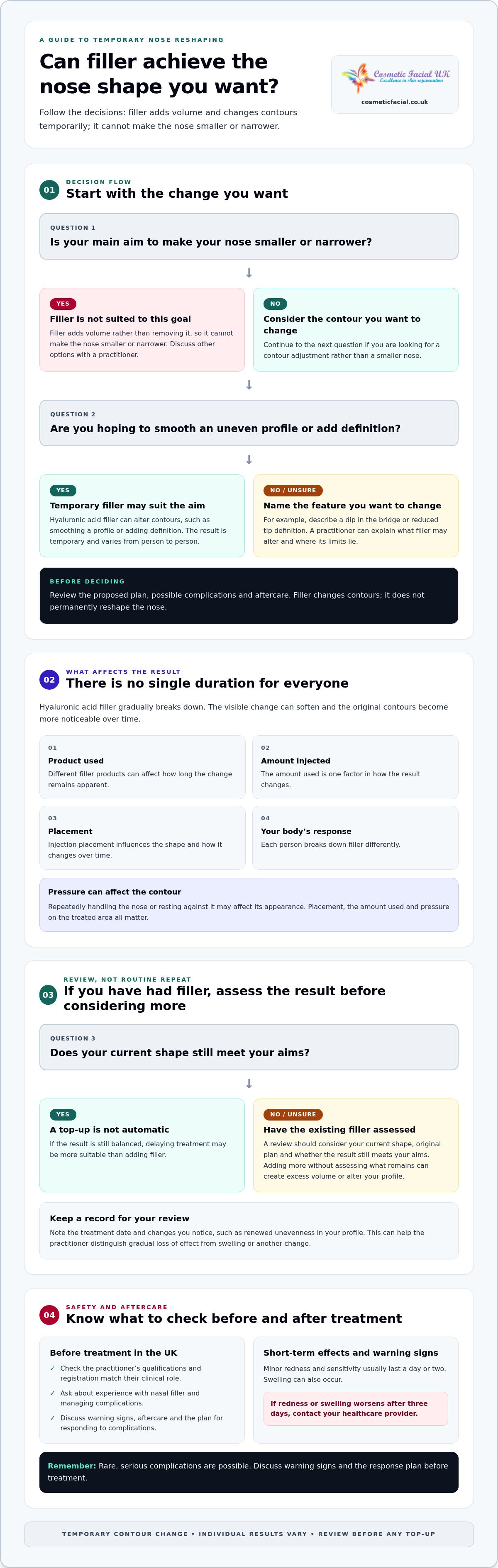
Nonsurgical rhinoplasty uses dermal filler to alter the nose’s contours temporarily. Fillers used for this treatment usually contain hyaluronic acid, a substance that adds volume beneath the skin. The result’s duration varies as the filler gradually breaks down, so there isn’t one lasting time that applies to everyone. The product used, injection placement and the individual’s response all influence how the shape changes. Filler can smooth an uneven profile or add definition, but it cannot make the nose smaller or narrower.
For a visual explanation of realistic results, maintenance and safety, watch this educational video:
Filler movement can affect the intended contour. Placement, the amount used and pressure on the treated area all matter. For example, repeatedly handling the nose or resting against it may affect its appearance. A practitioner should assess your nasal anatomy and treatment history, then plan placement carefully to limit unwanted changes and potential complications.
In the UK, nose filler should be performed by a licensed professional to help reduce the risk of complications. Check that their qualifications and registration match their clinical role, and ask about their experience with nasal filler and managing complications.
Filler may suit someone seeking a temporary contour adjustment, such as a smoother profile or added definition. It is not suitable if your main aim is a smaller or narrower nose, because injections add volume rather than remove it. The treatment plan should match the specific change you want.
Common short-term effects include minor redness and sensitivity, which usually last a day or two. Swelling can also occur; contact your healthcare provider if redness or swelling worsens after three days. Rare, serious complications are possible, so discuss warning signs and the response plan before treatment.
Combining nose filler with another treatment requires a clear plan for each concern. If you are considering filler alongside another injectable treatment, discuss the desired outcomes, treatment order and recovery expectations before proceeding. Nose filler should not be assumed to improve unrelated facial concerns, and combining procedures does not make its results permanent.
To assess a proposed result, describe the feature you want to change, such as a dip in the bridge or reduced tip definition. The practitioner can explain how hyaluronic acid filler may alter that contour and where its limits lie. Review the plan, possible complications and aftercare instructions before deciding whether temporary reshaping suits your aims.
Results duration and top-up treatments
Hyaluronic acid filler gradually breaks down, so the visible change diminishes over time. How long it remains apparent depends on the product, the amount injected, its placement and your body’s response. A subtle adjustment may become less noticeable before the filler has fully dissipated, particularly as the surrounding tissue changes.
There is no fixed top-up timetable that suits every nose. A review should focus on your current shape, the original treatment plan and whether the result still meets your aims. For example, a bridge that looks smoother at first may need reassessment as the filler settles, rather than an automatic repeat injection.
A top-up is not simply a routine appointment. The practitioner should assess the existing filler and decide whether more is appropriate. Adding filler without considering what remains can create excess volume or alter your profile. If the result is still balanced, delaying treatment may be more suitable than adding more.
During an appointment, expect a consultation about your goals, medical history and nasal anatomy, followed by a discussion of the proposed procedure. If you proceed, filler is injected at planned points to change the contour. Results are immediate, although early swelling can affect the appearance. Most people can resume normal activities right away.
Before booking in the UK, check the practitioner’s qualifications and registration, experience with nose injections, and plan for responding to complications. Confirm that the consultation covers your desired change, filler’s limitations, aftercare and follow-up. A clear explanation should distinguish temporary contour adjustment from surgical reshaping.
The treatment price depends on the case and is given after a quote request. Cost factors include the filler required, injection plan, practitioner time and any included follow-up. Cost information should clearly distinguish a consultation fee from the treatment charge. Do not assume another person’s price will apply to you, as their treatment plan may differ.
Payment plans are a separate consideration from clinical suitability. Before agreeing to instalments, review the total amount payable, payment dates and any interest or charges in the written terms. Financing does not change the temporary nature of treatment or mean that a top-up will be needed at a particular time.
Keep a record of the treatment date and the changes you notice, such as renewed unevenness in your profile. This gives the practitioner useful context at a review and helps distinguish gradual loss of effect from swelling or another change. For an assessment of your options, review treatment information before deciding on a further procedure.
How long results last
Hyaluronic acid filler changes the nose’s appearance immediately, but the result is temporary. The filler is gradually broken down, so definition can soften and the original contours become more visible. There is no single duration that applies to everyone. Product choice, injection placement, the amount used and individual response all influence how long the change remains noticeable.
Reversibility is one difference between filler and permanent surgical reshaping. A change made with hyaluronic acid filler can be reversed, but that does not make the procedure risk-free or guarantee that the result can be predicted exactly. Discuss reversal during the consultation, including the circumstances in which it might be considered. This helps clarify the treatment’s benefits and limitations.
The procedure’s timing depends on the consultation, planned injection points and adjustments required. The appearance changes immediately after filler is injected, although the first view may not represent the settled result. For example, a smoother bridge may be visible straight away, but the final assessment should account for early changes around the treated area.
Before-and-after photographs can help you assess a proposed result, provided the images show comparable views. Look for a consistent profile angle, lighting and facial expression. A front view alone may not clearly show changes to the bridge or tip. Ask which feature changed in each example, and compare it with your own goal rather than expecting the same result.
Patient testimonials can describe an individual’s experience, including their satisfaction and maintenance choices. They cannot establish how long filler will last for you, because products, placement and individual responses differ. Read comments alongside clinical photographs and the treatment plan, not as a guarantee. A useful account explains the change sought and whether the person later chose further treatment.
To track your result, take a clear baseline photograph before treatment and later images from the same angles. Note when the appearance begins to change, such as when a previously smoothed profile becomes more noticeable. This record can support a review and help distinguish fading results from a preference for a different contour.
A minimally invasive procedure may appeal if you want a temporary contour adjustment without surgical reshaping. Its benefits are limited to changes that added filler can create: it cannot reduce nose size or narrow the nose. Use the consultation to agree on the intended change, review realistic examples and decide whether an immediate but temporary alteration fits your priorities.
Non-surgical versus surgical rhinoplasty
A non-surgical nose job uses injected dermal filler to adjust the nose’s contour temporarily. Non-surgical rhinoplasty can change the appearance of the nose, but it may not be suitable for every concern.
What Non-Surgical Rhinoplasty Involves
The procedure starts by identifying the feature you want to change, such as a dip along the bridge or an uneven profile. A practitioner plans where filler might add volume to create a more continuous contour. Treatment does not remove tissue or alter the underlying nasal structure. Discuss the intended change and the limits of filler before proceeding.
How Nose Filler Works
Hyaluronic acid filler adds volume beneath the skin at selected points. Carefully placed injections can make a dip appear less pronounced by bringing nearby areas into a more even line. Results are immediate, although early swelling can affect the initial appearance. Most people can resume normal activities right away, and changes are reversible.
Benefits and Treatment Scope
Filler may suit someone seeking a temporary adjustment without surgery or a prolonged recovery period. It can refine a contour or create the appearance of a straighter profile. It cannot reduce nasal size, narrow the nose or correct every structural concern. A slight change may be possible even when a more substantial alteration is not achievable with added volume.
Surgical rhinoplasty differs because it changes the nose’s structure and can address goals that filler cannot. Surgical recovery usually requires 10-14 days off work, and a splint, bandages or dressings may be needed for at least a week. Full results can take up to a year to develop. These stages matter when planning work and daily commitments.
This figure is a general comparison, not a price for filler treatment. The procedures also differ in permanence: filler results are temporary and reversible, while surgery is intended to reshape the nose structurally. The appropriate option depends on the change you want, not simply your preferred recovery time.
Consider your goal in practical terms. If you want a dip in the bridge to look less visible, filler may create a temporary contour adjustment. Filler may alter the appearance of the nose, but it is not intended to make it smaller. If structural change is your priority, the difference between injected volume and surgical reshaping is central to your decision.
At consultation, describe the feature you want to change and review what each approach can achieve. Ask how swelling may affect the early appearance, whether the proposed contour relies on added volume, and what recovery involves. Comparing these points helps you weigh an immediate, temporary adjustment against the downtime and longer development of surgical results.
Nose-tip enhancement and reshaping
The nose tip may be a particular focus if its definition looks uneven beside the bridge. Hyaluronic acid adds volume rather than removing tissue, so treatment changes how contours appear instead of physically reducing the nose. The key question is whether added volume can create the facial balance you want.
Start by describing the feature precisely. For example, you might want the tip to look more defined in profile, or its transition into the bridge to appear smoother. These goals are not identical: an adjustment that changes one view may not have the same effect from the front. Compare your concern across photographs and facial angles before discussing a treatment plan.
Filler changes appearance by adding volume at selected points. At the nose tip, the intended effect may be a clearer contour or a more continuous line with the bridge. The practitioner should explain where the added volume would sit and how that placement relates to the shape you want. Ask to review the proposed change from the front and side.
There are important limits. Adding volume cannot make the tip smaller, narrow the nose or remove tissue. If your goal is to reduce tip size, filler does not address it; surgery may be relevant for structural reshaping. Wanting a more defined-looking tip is different from wanting a physically smaller tip.
Consider changes to the tip in relation to the whole nose. For example, adding volume near the tip can affect its visual relationship with the bridge, rather than changing the tip in isolation. Discuss whether the proposed contour suits your profile and other facial features. A clearly defined goal helps distinguish a subtle contour adjustment from a request for broader reshaping.
Before treatment, agree on what “more balanced” means in practical terms. Identify a particular transition in profile, describe the view that concerns you, and discuss what filler can realistically change. The treatment plan should state the intended contour and its limitations. If your desired result depends on removing volume or altering nasal structure, filler cannot achieve it.
The main takeaway is straightforward: nose-tip filler may adjust appearance by adding volume, but it cannot reduce or structurally reshape the nose. Compare your specific goal with the possible contour change, including how it may look beside the bridge. If you are considering this approach, explore nose reshaping treatment.
Cosmetic Facial: Botox Treatment
Cosmetic Facial’s Botox Treatment is a separate option for readers considering aesthetic care beyond nose reshaping. It is not a substitute for nose filler or surgical rhinoplasty, so it is relevant if your concern involves another treatment goal. A discussion can help clarify whether Botox Treatment matches what you want to address and how it differs from the options covered above.
If you are exploring Botox Treatment rather than nasal contour changes, contact Cosmetic Facial to discuss your next step. You can also visit cosmeticfacial.co.uk.
Choose your next step with a clear goal
Before arranging treatment, write down the change you want and what you would consider a satisfactory outcome. For a non-surgical nose job, a clear goal focuses the discussion on the specific contour you hope to alter, rather than an undefined wish to change your appearance. Note which views concern you most, such as your profile or the relationship between your nose tip and bridge.
Cosmetic Facial offers Botox Treatment, HIFU Face Lift and IPL Hair Removal Treatment for other aesthetic concerns. These treatments address different aims and are not alternatives to nose reshaping. A considered discussion can help you identify which option relates to your priorities and whether further information would help you decide.
Take the time you need to make a decision that reflects your goals and comfort with treatment.
Frequently Asked Questions
What is a non-surgical nose job?
A non-surgical nose job uses injectable dermal filler to adjust the nose’s visible contours without an operation. Filler may soften the appearance of a dip or create a smoother line in profile. It adds volume rather than removing tissue, so it cannot reduce nasal size. The change is temporary, and a consultation helps establish whether filler can address the particular feature you want to alter.
How long does the treatment take?
The appointment involves more than the injection itself. It starts with discussing your goals and reviewing the proposed treatment area, followed by planning and administering filler. The practitioner should explain what to expect afterwards and how to respond to concerns. Ask about the full appointment schedule when arranging a visit, especially if you need to plan travel or other commitments.
How can I make nose fillers last longer?
No aftercare measure can guarantee that filler will last longer, because the product is gradually broken down by the body. Follow the practitioner’s instructions and avoid pressing or repeatedly handling the treated area, which could affect its appearance. Keep a record of changes rather than arranging repeat injections automatically. At review, discuss whether the existing contour still suits your aims before considering more filler.
What does the nose filler treatment involve?
Treatment involves a consultation, assessment of the nose and a plan for where filler could create the intended contour. The practitioner injects dermal filler at selected points, then assesses the new shape. Before proceeding, explain the feature you want to change and mention any previous nose treatments. This keeps the discussion specific, for example, whether your priority is the bridge, tip or overall profile.
What is the “10-minute nose job”?
“10-minute nose job” is an informal phrase for a quick filler-based nose reshaping procedure, not a guaranteed appointment length. Consultation and planning are also part of treatment, so the time spent at the clinic can be longer than the injection itself. The phrase describes convenience, not a different technique or a promise of a particular result. Ask what the appointment includes before scheduling it.
Why choose nose fillers instead of traditional surgery?
Filler may suit someone seeking a temporary contour change without surgical reshaping. It may address selected concerns, such as a dip that makes the profile look uneven. Surgery is a different option for structural changes, including reducing or narrowing the nose. Choose based on your desired outcome: added volume cannot produce the same changes as surgery that alters nasal structure.
Can a non-surgical nose job narrow your nose?
No. Filler adds volume, so it cannot make the nose physically narrower or smaller. It may create a visual contour adjustment, but it cannot remove tissue or change nasal structure. If narrowing is your main goal, discuss that distinction before treatment rather than expecting filler to achieve it. Clearly describing the change you want helps the practitioner explain whether filler is suitable.
Do you offer aftercare?
Aftercare guidance matters following nose filler, and Cosmetic Facial offers Nose Reshaping (Dermal Filler) in London. Follow the practitioner’s instructions and contact your healthcare provider if redness or swelling worsens after three days. Before leaving your appointment, make sure you understand the recommended care and which changes should prompt medical advice. This gives you a clear plan for monitoring the treated area.
Disclaimer
All content on cosmetic Facial website, including blogs, graphics, logos, images, and software, is the property of CosmeticFacial UK or its content suppliers and is protected by applicable copyright laws. Unauthorized use, reproduction, distribution, or modification of any content without prior written permission is strictly prohibited.


