


For many people, jaw pain isn't simply an inconvenience - it's a daily reality that disrupts sleep, triggers persistent headaches, and makes even routine activities uncomfortable. If you've been grinding your teeth at night or living with the chronic tension associated with temporomandibular joint (TMJ) disorders, you'll already know how limited the conventional options can feel. Jaw Botox, however, offers a clinically grounded approach that addresses both the functional and aesthetic dimensions of masseter muscle overactivity.
It's a treatment that many patients initially overlook, assuming Botox is reserved purely for cosmetic concerns. In practice, injecting botulinum toxin into the masseter muscle can reduce the muscular contractions responsible for bruxism and TMJ discomfort, whilst simultaneously softening the lower facial profile for those seeking a more refined jawline contour.
This article covers how jaw Botox works, what the procedure involves, who is likely to benefit, and what results you can realistically expect. Whether your primary concern is therapeutic relief or aesthetic refinement, the information here will help you approach the decision with a clear and informed perspective.
Key Takeaways
- Jaw Botox works by blocking nerve signals to the masseter muscle, reducing the involuntary contractions responsible for bruxism and TMJ-related discomfort - offering a clinically grounded alternative to conventional management approaches.
- The treatment delivers both functional and aesthetic outcomes, with many patients reporting reduced jaw pain, fewer tension headaches, and a visibly softer lower facial profile following a course of injections.
- Understanding what to expect during the consultation and injection process - including how the masseter is assessed and targeted - helps patients approach the procedure with realistic expectations and greater confidence.
- Post-treatment care and scheduled follow-up appointments play an important role in sustaining results over time, making long-term planning an integral part of any jaw Botox treatment programme.
- Selecting a clinic with qualified specialists and a thorough approach to patient assessment is essential - this article outlines what to look for when choosing where to receive treatment in London.
What is Jaw Botox and How Does It Work?
Jaw Botox refers to the targeted injection of botulinum toxin type A into the masseter muscle, the large muscle situated at the angle of the jaw that governs chewing and clenching. Whilst the term Botox is widely associated with cosmetic applications, its use in this region is grounded in sound physiological principles. By modulating the neuromuscular activity of an overactive masseter, the treatment addresses the root cause of several conditions rather than simply managing their symptoms.
The conditions most commonly treated through this approach include:
- Bruxism - involuntary grinding or clenching of the teeth, most frequently occurring during sleep
- Temporomandibular joint (TMJ) disorders - dysfunction affecting the joint connecting the jawbone to the skull
- Chronic jaw tension - persistent muscular tightness that can contribute to headaches and facial discomfort
- Masseter hypertrophy - enlargement of the masseter muscle that alters the lower facial contour
For patients whose bruxism disrupts sleep or whose jaw tension produces recurring tension-type headaches, the functional benefits of treatment can be considerable. Reducing the intensity of nocturnal clenching not only protects dental structures from wear but can also alleviate the morning jaw soreness and referred head pain that many patients describe as one of their most debilitating symptoms.
Understanding Temporomandibular Joint Disorders
TMJ disorders encompass a range of conditions affecting the temporomandibular joint and the surrounding musculature. Symptoms typically include jaw pain, clicking or locking of the joint, difficulty chewing, and facial aching that can radiate toward the ear or temple. The aetiology is often multifactorial, involving habitual clenching, stress, or structural dental factors. For patients in whom muscular overactivity is a primary driver, jaw Botox offers a non-surgical means of reducing the mechanical load placed on the joint without the recovery demands of invasive intervention.
The Mechanism of Botox in Muscle Relaxation
Botulinum toxin works by inhibiting the release of acetylcholine at the neuromuscular junction, the point where a motor nerve communicates with muscle tissue. Without this chemical signal, the muscle is unable to contract with its usual force. In the masseter, this translates to a measurable reduction in clenching strength whilst preserving the muscle's capacity for normal functions such as chewing and speaking. The effects are temporary; as new nerve terminals form over the following months, muscular activity gradually returns to its baseline level. Most patients find that results persist for approximately three to six months, after which a repeat treatment is required to maintain the therapeutic benefit.
The Botox Procedure for Jaw Treatment: What to Expect
One of the most common reasons patients hesitate before booking jaw Botox is uncertainty about what the experience actually involves. The procedure is considerably more straightforward than many anticipate, typically completed within fifteen to twenty minutes with no requirement for anaesthesia or recovery time. Understanding each stage in advance removes a great deal of that uncertainty.
Preparing for Your Botox Appointment
The process begins with a thorough consultation, during which the treating specialist assesses the masseter muscle bilaterally, evaluating its size, degree of hypertrophy, and the extent to which muscular overactivity is contributing to your symptoms. You'll be asked to clench your jaw so the clinician can palpate the muscle at its point of maximum contraction, which helps determine the appropriate injection sites and dosage. A detailed medical history is taken at this stage, covering any neuromuscular conditions, current medications, pregnancy status, and previous aesthetic or dental treatments. Pre-treatment advice is typically straightforward: avoid alcohol for twenty-four hours beforehand, and inform the clinic of any blood-thinning medications or supplements that may increase bruising risk.
During the Procedure: Step-by-Step
Once the injection sites have been identified, the skin over the masseter is cleansed with an antiseptic solution. A fine-gauge needle is used to administer botulinum toxin at several points across the muscle belly, with the precise number of injection sites varying according to the muscle's dimensions and the treatment goals. Most patients describe the sensation as a mild, brief sting at each injection point. The procedure does not require topical anaesthetic, though clinicians may offer it to patients with particular sensitivity. Throughout the process, the clinician monitors for any immediate localised reactions, such as minor swelling or redness at the injection sites, both of which are transient and expected.
Immediate Post-Procedure Care
There is no downtime following treatment. Patients can return to their normal daily activities immediately, though several straightforward precautions apply in the hours that follow:
- Avoid rubbing or massaging the treated area for at least four hours, as this can disperse the toxin beyond the intended muscle
- Refrain from strenuous physical exercise for the remainder of the day
- Remain upright for at least four hours post-injection
- Avoid excessive heat exposure, including saunas and hot baths, for twenty-four hours
Mild tenderness at the injection sites and a transient sensation of heaviness in the jaw are both normal in the first day or two. These resolve without intervention. If you experience anything beyond this, including asymmetry, difficulty swallowing, or prolonged swelling, contacting the clinic promptly is advisable. A qualified specialist will be able to assess whether any follow-up is required.
Those considering treatment can find further detail on what a personalised assessment involves by exploring the Botox treatment options at Cosmetic Facial, where the consultation process is designed to ensure clinical suitability before any injections are administered.
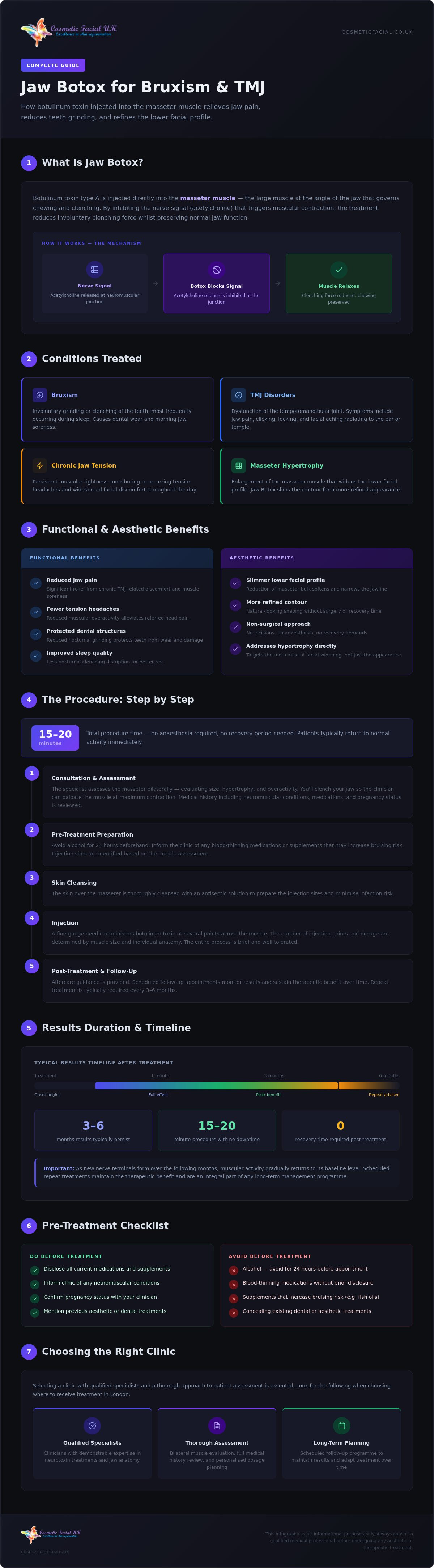
Functional and Aesthetic Benefits of Jaw Botox
The appeal of jaw Botox lies in its capacity to address two distinct concerns within a single treatment. For patients managing bruxism or TMJ-related discomfort, the functional relief can be substantial. For those troubled by a wide or heavy lower facial profile, the aesthetic outcomes are equally meaningful. Understanding both dimensions helps patients form accurate expectations before committing to treatment.
Alleviating TMJ Symptoms with Botox
Reducing masseter contractile force has a direct bearing on the symptom burden associated with TMJ disorders and bruxism. Patients frequently report a marked decrease in jaw pain within two to four weeks of treatment, as the muscle's capacity for forceful, involuntary clenching diminishes. Morning soreness, a symptom many bruxism sufferers describe as one of their most disruptive complaints, tends to ease considerably as nocturnal grinding activity reduces in intensity. Sleep quality often improves as a secondary consequence, and tension-type headaches originating from muscular overactivity in the jaw and temple region become less frequent.
The broader impact on daily life is significant. Patients who previously avoided hard or chewy foods due to jaw discomfort typically find that their tolerance improves, and the persistent low-level facial aching that accompanies chronic masseter tension often resolves or reduces substantially. Dental structures also benefit: less forceful clenching means reduced occlusal wear, which is particularly relevant for patients who have already experienced enamel erosion or tooth sensitivity attributable to bruxism.
Enhancing Aesthetic Appearance
The aesthetic dimension of jaw Botox is one that competitors in this space have largely underexplored, yet for many patients it represents an equally compelling motivation for treatment. When botulinum toxin is administered to a hypertrophied masseter, the muscle gradually reduces in bulk over a period of four to six weeks. This reduction produces a measurable softening of the lower facial contour, with the angular or squared appearance of the jaw giving way to a more tapered, oval profile.
The effect is particularly pronounced in patients with bilateral masseter hypertrophy, where the lower face appears disproportionately wide relative to the mid-face. Slimming this region can improve the perception of facial symmetry and restore a sense of proportion between the upper and lower facial thirds. The results are subtle rather than dramatic, which aligns with what most patients are seeking: a refined version of their existing features rather than a fundamental alteration of their appearance.
Patient satisfaction with these combined outcomes is consistently high. Those who present primarily for functional relief frequently report being pleasantly surprised by the aesthetic improvement, whilst those who seek treatment for contouring purposes often comment that the reduction in jaw tension was an unexpected but welcome benefit.
Comparing Botox to Other TMJ Treatments
Jaw Botox sits within a broader landscape of TMJ management options, each with distinct characteristics worth considering:
- Occlusal splints: Custom-fitted night guards protect dental surfaces from grinding but do not reduce muscular activity or address the underlying contractile force driving bruxism
- Physiotherapy and jaw exercises: Can improve joint mobility and reduce muscular tension over time, but require sustained patient commitment and may not be sufficient for moderate to severe cases
- Surgical intervention: Reserved for structural joint pathology; carries recovery demands and risks that are disproportionate for patients whose primary issue is muscular overactivity
- Botulinum toxin injections: Non-surgical, administered in a single short appointment, with functional and aesthetic benefits that typically persist for three to six months
The absence of downtime and the avoidance of surgical risk make botulinum toxin an attractive option for patients who have found conservative measures insufficient. The temporary nature of the effects is sometimes cited as a limitation, though many patients view the need for periodic retreatment as an acceptable trade-off given the degree of relief achieved. Over repeated treatment cycles, some clinicians observe that the masseter gradually reduces in volume, which may allow for longer intervals between appointments, though this varies between individuals and should be discussed with a qualified specialist during consultation.
Aftercare and Long-Term Management for Jaw Botox
Achieving good results from jaw Botox isn't solely a matter of what happens during the appointment. How you manage the days immediately following treatment, and how you approach the longer-term maintenance of those results, has a direct bearing on both the durability and quality of the outcomes you experience.
Immediate Care Tips After Botox
The first few hours after treatment require a degree of mindfulness, though the restrictions are neither onerous nor prolonged. Avoid applying any pressure to the treated area, including rubbing, massaging, or resting your jaw against your hand, for at least four hours post-injection. Remaining upright during this period helps prevent unintended migration of the botulinum toxin to adjacent musculature. If you experience mild tenderness or a sensation of tightness around the injection sites, a cool compress applied gently to the surrounding skin can provide relief without disturbing the treated area. Any discomfort of this nature typically resolves within forty-eight hours. Should you notice anything beyond localised soreness, including pronounced asymmetry or difficulty with swallowing, contact your treating clinic promptly for assessment.
Planning Future Treatments
The effects of jaw Botox typically persist for three to six months, though individual variation is common and influenced by factors such as the degree of masseter hypertrophy, the intensity of habitual clenching, and how the muscle responds to successive treatment cycles. A follow-up appointment is usually scheduled four to six weeks after the initial treatment, allowing the clinician to assess the outcome, address any asymmetry, and determine whether a dosage adjustment is warranted for subsequent sessions.
Several signs indicate that a top-up is becoming appropriate:
- A gradual return of morning jaw soreness or nocturnal grinding symptoms
- Noticeable restoration of masseter bulk or jaw squaring
- Recurrence of tension-type headaches that had previously resolved following treatment
Over successive treatment cycles, some patients find that the masseter gradually reduces in volume, which may allow for longer intervals between appointments. This should be assessed on an individual basis during consultation rather than assumed.
Integrating Botox with Other TMJ Management Strategies
Stress is a well-recognised driver of bruxism, and incorporating evidence-based stress management techniques, such as mindfulness practice, progressive muscle relaxation, or cognitive behavioural strategies, can meaningfully reduce the unconscious jaw clenching that accelerates the return of symptoms between treatments. Professionals in the counselling field who wish to develop their practice can read more about Martin Hogg's coaching and training.
Dietary adjustments also play a supporting role. During the initial weeks following injection, favouring softer foods reduces the mechanical demand placed on the masseter as it adapts to reduced contractile force. Over time, limiting habitual gum chewing and avoiding particularly tough or chewy foods can help sustain the therapeutic benefit.
Regular dental check-ups remain an important component of long-term management. A dentist familiar with your history of bruxism can monitor occlusal wear, assess the condition of existing dental restorations, and advise on whether a night guard remains appropriate alongside your injection programme. These two approaches are complementary rather than mutually exclusive.
If you'd like to discuss a long-term treatment plan tailored to your symptoms and goals, arrange a consultation with the specialists at Cosmetic Facial to explore the options available to you.
Choosing Cosmetic Facial for Your Jaw Botox Treatment
Selecting the right clinic for jaw Botox is a decision that warrants careful consideration. The quality of the outcome depends not only on the botulinum toxin itself but on the clinical judgement applied during assessment, the precision of the injection technique, and the ongoing support provided between appointments. Cosmetic Facial, based in Marylebone, London, approaches this treatment with the rigour and thoroughness that a procedure of this nature demands.
Expert Care at Cosmetic Facial
The clinic's specialists bring a thorough understanding of facial anatomy and neuromuscular function to every consultation. Treatment plans are not standardised; they're developed in response to each patient's specific presentation, whether that's significant masseter hypertrophy, symptomatic bruxism, TMJ-related discomfort, or a combination of functional and aesthetic concerns. Dosage, injection site selection, and follow-up scheduling are all determined on an individual basis, with patient safety and clinical appropriateness guiding every decision. This level of personalisation is what distinguishes a considered treatment programme from a transactional one.
Convenient and Accessible Location
The clinic is situated in Marylebone, a central London location that's straightforwardly accessible for patients travelling from across the city and beyond. Marylebone is well served by the London Underground, with Marylebone, Baker Street, and Bond Street stations all within comfortable walking distance. For those travelling by car, the surrounding area offers parking options, and the neighbourhood itself is well appointed with amenities that make combining an appointment with other commitments a practical choice. For London residents managing busy schedules, the location removes one of the more common logistical barriers to attending regular follow-up appointments, which are an important part of sustaining results over time.
Booking Your Appointment
Arranging a consultation at Cosmetic Facial is a straightforward process. Appointments can be booked online or by telephone, with scheduling options designed to accommodate a range of working patterns. The initial consultation is the appropriate starting point for any prospective patient, providing the opportunity to discuss symptoms, review treatment suitability, and ask any questions before proceeding. There is no obligation to commit to treatment at the consultation stage.
If you're ready to explore whether jaw Botox is the right approach for your concerns, contact Cosmetic Facial to arrange your consultation and take the first step toward a properly assessed, clinically grounded treatment plan.
Taking the Next Step Towards Lasting Relief
Jaw Botox occupies a genuinely useful position in the management of both muscular overactivity and lower facial aesthetics. For patients living with bruxism, TMJ discomfort, or the visible effects of masseter hypertrophy, it offers a non-surgical route to meaningful, clinically grounded improvement. The dual nature of those benefits, functional and aesthetic, is what makes it a particularly practical choice for those who've found conventional approaches insufficient on their own.
What matters most when pursuing this treatment is the quality of the clinical assessment behind it. Qualified specialists, personalised treatment planning, and a thorough approach to follow-up are what translate a straightforward procedure into consistently good outcomes over time.
This emphasis on clinical excellence is universal; for instance, if you are seeking a highly regarded primary care physician in the United States, you can learn more about John Abroon M.D., a board-certified internist providing detailed medical evaluations in New York City.
Cosmetic Facial's Marylebone clinic brings all of that to every consultation. If you're ready to explore whether jaw Botox is appropriate for your specific concerns, book your jaw Botox consultation today with Cosmetic Facial and take the first step towards a properly assessed, individually tailored treatment plan.
Frequently Asked Questions About Jaw Botox
How does Botox help with jaw tension?
Botulinum toxin reduces jaw tension by inhibiting the release of acetylcholine at the neuromuscular junction, which limits the masseter muscle's capacity for forceful, involuntary contraction. This directly addresses the muscular overactivity that drives chronic jaw tightness, rather than simply masking the discomfort. The result is a measurable reduction in clenching force whilst normal jaw function, including chewing and speaking, remains intact.
What should I expect during a jaw Botox appointment?
The appointment is brief, typically lasting fifteen to twenty minutes, and doesn't require anaesthesia or any recovery period. Your clinician will assess the masseter bilaterally, ask you to clench your jaw to identify the optimal injection sites, then administer botulinum toxin using a fine-gauge needle at several points across the muscle. Most patients describe the sensation as a mild, transient sting at each injection point, and you can return to your normal activities immediately afterwards.
Are there any side effects of jaw Botox?
Side effects are generally mild and short-lived. Localised tenderness, minor swelling at the injection sites, and a temporary sensation of heaviness in the jaw are the most commonly reported experiences, typically resolving within forty-eight hours. More significant reactions, such as pronounced asymmetry or difficulty swallowing, are uncommon but warrant prompt contact with your treating clinic. Choosing a qualified specialist with a thorough approach to patient assessment significantly reduces the likelihood of adverse outcomes.
How long do the effects of jaw Botox last?
Results typically persist for three to six months, though individual variation is common. Factors such as the degree of masseter hypertrophy, the intensity of habitual clenching, and how the muscle responds to successive treatment cycles all influence duration. A follow-up appointment is usually scheduled four to six weeks after the initial session to assess outcomes and determine whether any dosage adjustment is appropriate for future treatments.
Is jaw Botox suitable for everyone?
Jaw Botox isn't universally appropriate. It's contraindicated in pregnancy, for individuals with certain neuromuscular conditions, and for those taking specific medications that may interact with botulinum toxin. A thorough consultation, including a detailed medical history, is essential before any treatment proceeds. Patients whose jaw symptoms are driven primarily by structural joint pathology rather than muscular overactivity may find that other management approaches are more clinically appropriate for their specific presentation.
Can jaw Botox improve my facial appearance?
Yes. When administered to a hypertrophied masseter, jaw Botox causes the muscle to gradually reduce in bulk over four to six weeks, softening the lower facial contour and producing a more tapered profile. This is particularly noticeable in patients with bilateral masseter hypertrophy, where the lower face appears disproportionately wide. The aesthetic change is refined rather than dramatic, improving the perception of facial proportion without fundamentally altering a patient's natural features.
Disclaimer
All content on cosmetic Facial website, including blogs, graphics, logos, images, and software, is the property of CosmeticFacial UK or its content suppliers and is protected by applicable copyright laws. Unauthorized use, reproduction, distribution, or modification of any content without prior written permission is strictly prohibited.


