


What if achieving a fresher, more rested appearance didn't require sacrificing the natural movement of your face? For many people considering aesthetic treatment for the first time, that question sits at the heart of the decision. The appeal of baby botox lies precisely in this balance: the same active compound as traditional botulinum toxin treatment, administered at lower doses and with greater precision, to soften lines and preserve expression rather than suppress it.
The concern about looking 'frozen' or overdone is entirely understandable, and it's one of the most common reasons people hesitate before exploring injectable treatments. That hesitation deserves a considered, honest response rather than reassuring generalisations.
This guide sets out to provide exactly that. It explains how baby botox differs from standard treatment in terms of dosage, technique, and intended outcome; examines who is likely to benefit from this approach; and addresses the safety and efficacy questions that matter most to anyone making an informed decision about their skin. Whether you're entirely new to aesthetic medicine or reassessing your current approach, what follows is designed to give you the clinical clarity you need.
Key Takeaways
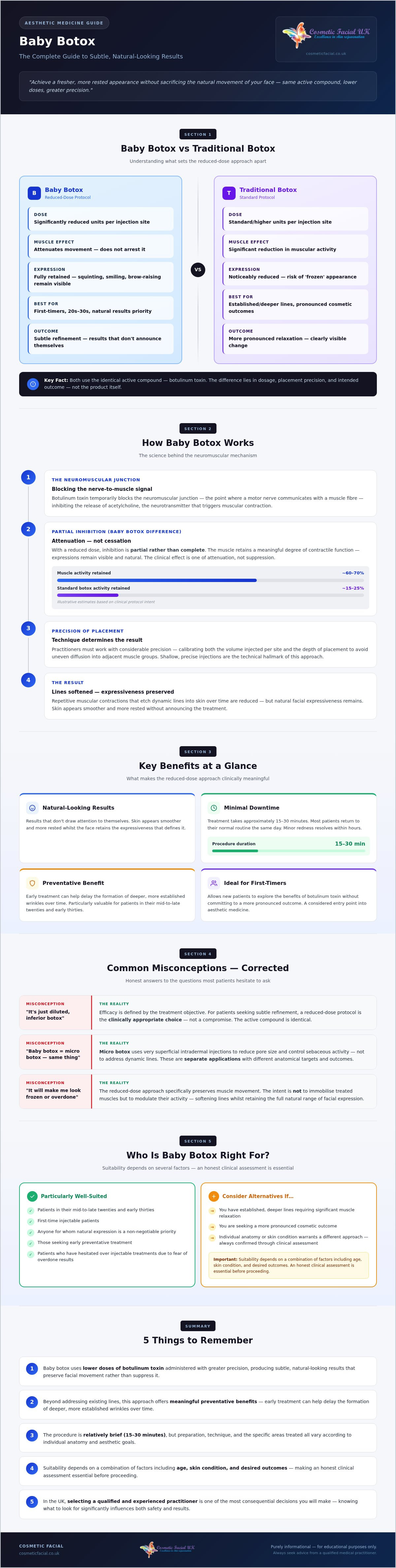
- Baby botox uses lower doses of botulinum toxin administered with greater precision, producing subtle, natural-looking results that preserve facial movement rather than suppress it.
- Beyond addressing existing lines, this approach offers meaningful preventative benefits - early treatment can help delay the formation of deeper, more established wrinkles over time.
- The procedure itself is relatively brief and straightforward, but preparation, technique, and the specific areas treated all vary according to individual anatomy and aesthetic goals.
- Suitability for this treatment depends on a combination of factors including age, skin condition, and the outcomes you wish to achieve - making an honest clinical assessment essential before proceeding.
- In the UK, selecting a qualified and experienced practitioner is one of the most consequential decisions you will make; knowing what to look for in a provider can significantly influence both safety and results.
Understanding Baby Botox: What Sets It Apart?
Baby botox refers to the administration of botulinum toxin at significantly reduced doses compared to a standard treatment protocol, delivered through a series of precise, shallow injections across targeted muscle groups. The intent is not to immobilise the treated muscles but to modulate their activity, softening the appearance of lines whilst preserving the natural range of facial expression. It's a distinction that matters considerably, both clinically and aesthetically.
The approach has gained particular traction amongst younger patients in their mid-to-late twenties and early thirties, as well as those new to injectable treatments who want to explore the benefits of botulinum toxin without committing to a more pronounced outcome. For this group, the appeal is straightforward: a refreshed, rested appearance that doesn't announce itself.
The Science Behind Baby Botox
Botulinum toxin works by temporarily blocking the neuromuscular junction, the point at which a motor nerve communicates with a muscle fibre. By inhibiting the release of acetylcholine, the neurotransmitter responsible for triggering muscular contraction, the toxin reduces the repetitive movements that, over time, etch dynamic lines into the skin's surface.
With a reduced-dose approach, this inhibition is partial rather than complete. The muscle retains a meaningful degree of contractile function, which means expressions such as squinting, smiling, and raising the brows remain visible and natural. The clinical effect is one of attenuation rather than cessation. Practitioners achieving this outcome must work with considerable precision, calibrating both the volume injected per site and the depth of placement to avoid uneven diffusion into adjacent muscle groups.
Common Misconceptions About Baby Botox
It's worth addressing a persistent source of confusion: baby botox is not simply a marketing term applied to a diluted product, nor is it synonymous with micro botox, a distinct technique in which very superficial intradermal injections are used primarily to reduce pore size and control sebaceous activity rather than to address dynamic lines. These are separate applications with different anatomical targets and outcomes.
A further misconception is that lower doses necessarily mean inferior results. Efficacy in this context is defined by the treatment objective. For patients seeking subtle refinement rather than significant muscle relaxation, a reduced-dose protocol is the clinically appropriate choice, not a compromise. The active compound is identical; it's the dosage, placement, and intended outcome that differ.
- Dose: Reduced units per injection site compared to standard treatment
- Technique: Greater precision in placement to control diffusion and effect
- Outcome: Softened lines with retained muscle movement
- Patient profile: Particularly suited to first-time patients and those prioritising natural results
Key Benefits of Choosing Baby Botox
The most immediate advantage of a reduced-dose approach is one that's difficult to quantify but immediately recognisable: results that don't draw attention to themselves. Skin appears smoother and more rested, but the face retains the expressiveness that defines it. For patients who have hesitated over injectable treatments precisely because they feared an overdone result, this is a clinically meaningful distinction, not simply a matter of aesthetics.
Minimal procedural downtime is another practical consideration. The treatment itself typically takes around fifteen to thirty minutes, and most patients return to their normal routine the same day. Minor localised redness or pinpoint bruising at injection sites can occur, but these generally resolve within a few hours to a day. There's no extended recovery period to plan around.
Comparing Baby Botox and Traditional Botox
The core difference between the two approaches is dosage and its downstream effects on muscle function. Standard botulinum toxin protocols are calibrated to produce significant reduction in muscular activity, which is appropriate for patients with established, deeper lines or those seeking a more pronounced cosmetic outcome. Baby botox, by contrast, attenuates rather than arrests muscle movement, making it particularly well-suited to younger patients in their twenties and thirties, those new to injectables, and anyone for whom natural expression is a non-negotiable priority.
There's also a preventative dimension that standard-dose comparisons tend to overlook. Treating dynamic lines before they become static, meaning present even at rest, can delay the formation of deeper furrows over time. Early, consistent treatment at lower doses may therefore offer longer-term structural benefit, not just a short-term cosmetic improvement. This is a consideration that competitors focusing solely on immediate effects rarely address in adequate depth.
How Baby Botox Can Enhance Your Look
The areas most commonly treated with this approach include the forehead, the glabellar region between the brows, and the periorbital area where crow's feet develop. These are sites of high repetitive muscular activity, and even modest attenuation of movement in these zones produces a measurable improvement in skin texture and line depth without altering the overall character of the face.
Used as part of a broader aesthetic plan, baby botox integrates well alongside other non-surgical treatments. Practitioners may consider it alongside skin quality treatments such as mesotherapy or micro-needling, where the combination addresses both muscular and dermal components of facial ageing. The result is a more holistic approach to rejuvenation rather than a single-point intervention.
This integrated approach is a hallmark of modern aesthetic practice, championed by specialised clinics like Cirugía 360 that offer a full spectrum of surgical and non-surgical rejuvenation options.
- Forehead lines: Softened without compromising natural brow movement
- Crow's feet: Reduced in depth whilst preserving natural eye expression
- Glabellar lines: Frown lines attenuated rather than eliminated
- Perioral area: Fine lines around the mouth treated with particular precision given the complexity of this region
For those considering where to begin, a thorough consultation with a qualified specialist is the appropriate first step. Cosmetic Facial's London-based team offers personalised botox treatment assessments to establish whether this approach aligns with your anatomy and aesthetic goals.
The Baby Botox Procedure: What to Expect
Understanding what happens before, during, and after treatment is one of the most practical things a prospective patient can do. The procedure itself is relatively brief, but the steps surrounding it carry considerable weight in determining both the safety of the outcome and the quality of the results.
Preparing for Your Baby Botox Appointment
A thorough consultation precedes any treatment. This is not a formality; it's the clinical foundation upon which appropriate dosing, injection placement, and technique are determined. Your practitioner will take a detailed medical history, assess your facial anatomy at rest and in motion, and discuss your aesthetic objectives with the specificity they deserve. Patients should arrive prepared to disclose any medications currently in use, particularly blood-thinning agents such as aspirin, ibuprofen, and warfarin, as these increase the likelihood of bruising at injection sites. Certain supplements, including high-dose vitamin E and fish oil, carry similar considerations and should be mentioned.
In the days before your appointment, alcohol consumption is best avoided, as it contributes to vasodilation and can exacerbate post-procedural bruising. Strenuous physical activity on the day of treatment is also worth postponing. Arriving with clean skin, free from heavy makeup or topical products, allows the practitioner to assess the treatment area accurately and maintain a clean procedural environment.
The Injection Process
The procedure itself typically takes between fifteen and thirty minutes, depending on the number of areas being treated. A fine-gauge needle is used to deliver small volumes of botulinum toxin into specific muscle groups, with injection depth and placement carefully calibrated to achieve the attenuated muscular effect that distinguishes baby botox from a standard protocol. Patients generally describe the sensation as a series of brief, mild stings. A topical anaesthetic cream can be applied beforehand for those with lower pain tolerance, though most find it unnecessary.
Post-Procedure Care and Downtime
Recovery is minimal, and the majority of patients resume their usual activities the same day. That said, certain precautions in the initial period help protect the outcome:
- Avoid touching or rubbing the treated areas for at least four hours post-procedure, to prevent unintended migration of the toxin into adjacent muscle groups.
- Remain upright for a minimum of four hours following treatment; lying flat too soon may affect product distribution.
- Avoid strenuous exercise, saunas, and excessive heat exposure for twenty-four hours, as elevated body temperature can accelerate toxin diffusion.
- Refrain from alcohol for the remainder of the day to minimise bruising.
- Avoid applying makeup directly over injection sites for several hours to reduce infection risk.
Localised redness, minor swelling, and pinpoint bruising at injection sites are the most commonly reported side effects. These are transient and typically resolve within a few hours to a couple of days. Headache occasionally occurs following forehead treatment and usually responds well to a standard over-the-counter analgesic. Asymmetry or uneven effect, though uncommon with an experienced practitioner, can sometimes be addressed at a follow-up review appointment, which most clinics schedule around two weeks after the initial session to assess the settled result.
Patients should contact their practitioner promptly if they notice any unexpected drooping of the brow or eyelid, which, whilst rare, warrants clinical assessment.
Is Baby Botox Right for You? Suitability and Considerations
Suitability for any injectable treatment is a clinical determination, not a commercial one. The question isn't simply whether you want a more rested appearance; it's whether the specific mechanism and dose of baby botox will deliver a meaningful result given your individual anatomy, skin condition, and aesthetic objectives. These factors vary considerably from patient to patient, which is precisely why a thorough consultation carries more weight than any generalised guidance.
Who Benefits Most from Baby Botox?
The patients who tend to see the most satisfying outcomes fall into several distinct profiles. Younger adults in their mid-twenties to mid-thirties, particularly those beginning to notice early dynamic lines that appear during expression but haven't yet become static, represent a strong candidate group. For this demographic, the preventative rationale is clinically sound: attenuating repetitive muscular movement before lines become permanently etched into the dermis may delay the need for more significant intervention later.
Those new to injectable treatments who are cautious about a pronounced change also benefit considerably. The reduced-dose approach allows a patient to experience the effects of botulinum toxin in a controlled, reversible way, building confidence in the process before committing to a more comprehensive protocol. Patients with naturally expressive faces, where preserving movement is a firm priority, similarly find this approach better aligned with their goals than a standard-dose treatment.
Skin type and condition also bear on suitability. Patients with good baseline skin quality and predominantly dynamic lines, those that appear with movement rather than at rest, are well-positioned to achieve a noticeable improvement. Those with deeply established static lines, significant volume loss, or pronounced skin laxity may find that baby botox alone delivers limited benefit; in such cases, a practitioner might recommend combining it with complementary treatments such as dermal fillers or mesotherapy to address the full range of concerns.
Certain individuals are not appropriate candidates. Pregnancy and breastfeeding are absolute contraindications. Patients with neuromuscular conditions such as myasthenia gravis or Lambert-Eaton syndrome should not undergo botulinum toxin treatment. Known hypersensitivity to any component of the formulation also precludes use.
Potential Risks and Limitations
The risk profile of a reduced-dose protocol mirrors that of standard botulinum toxin treatment, though the lower volumes involved reduce the likelihood of pronounced unwanted effects. Transient bruising, localised swelling, and mild headache remain possible. Brow or eyelid ptosis, whilst uncommon, can occur if product migrates to adjacent muscle groups; this underscores why practitioner experience and precise technique aren't optional considerations.
Equally important is understanding what this treatment cannot achieve. It won't address skin laxity, restore lost facial volume, or significantly improve static lines that are present at rest. Managing these expectations honestly before treatment begins is part of responsible clinical practice, and any practitioner worth consulting will address them directly rather than overpromise on outcomes.
Choosing a Baby Botox Provider in the UK
The quality of your outcome depends less on the treatment itself and more on the person administering it. Botulinum toxin at reduced doses requires considerable technical precision; the margin for error is narrower than many patients appreciate, and the consequences of poor placement, whether asymmetry, unintended ptosis, or uneven diffusion, fall entirely on the patient. Selecting a qualified practitioner is therefore not a preliminary consideration to be dealt with quickly before moving on to the interesting questions. It is the central one.
In the UK, the regulatory landscape for aesthetic injectables has historically been less prescriptive than patients might assume. Botulinum toxin is a prescription-only medicine, which means it must be prescribed by a qualified prescriber following a face-to-face or remote consultation. However, the practitioner who administers the injection is not legally required to hold a medical qualification in all circumstances, which places the burden of due diligence firmly on the patient. Understanding this context is the starting point for any sensible provider search.
Finding a Reputable Clinic
Begin with verifiable credentials rather than marketing language. Practitioners administering botulinum toxin should hold registration with a recognised professional body, such as the General Medical Council, the Nursing and Midwifery Council, or the General Dental Council, and should be able to demonstrate specific training in aesthetic medicine. The Save Face register, accredited by the Professional Standards Authority, provides a searchable database of practitioners who have met independently assessed standards of practice and is a useful starting point for patients across the UK, including those seeking baby botox in London.
Before committing to treatment, a visit to the clinic itself is worth the time. The physical environment, the conduct of the consultation, and the willingness of the practitioner to address your questions without deflection all provide meaningful information about the standard of care you're likely to receive. Clinics that attempt to compress the consultation into a brief, transactional exchange, or that resist detailed discussion of technique and risk, warrant caution regardless of their online presentation.
National providers and local independent clinics each carry different considerations. Larger organisations may offer standardised protocols and accessible locations, whilst smaller independent clinics often provide greater continuity of care with a single practitioner who develops a detailed understanding of your anatomy over time. Neither model is inherently superior; the individual practitioner's qualifications and experience remain the determining factor.
The importance of seeking out specialists who prioritise quality and provenance applies across many fields; for instance, those interested in the delicate balance of nature might look to experts like BS Honey Bees Ltd for their specialist guidance on maintaining productive and calm apiaries.
Questions to Ask Your Practitioner
A well-conducted consultation should invite scrutiny, not discourage it. The following questions provide a practical framework:
- What are your qualifications and professional registration? A practitioner should answer this directly and without hesitation, providing the name of their regulatory body and any specialist aesthetic training they have completed.
- How many baby botox treatments have you performed? Volume of experience matters, but so does the specificity of that experience. Reduced-dose protocols require a different calibration than standard treatment; ask whether this is a routine part of their practice.
- Which product will you be using, and at what dose? Licensed botulinum toxin products available in the UK include Botox (onabotulinumtoxinA), Azzalure, and Bocouture. The practitioner should be transparent about product choice and the rationale for dosing.
- What outcome is realistic for my anatomy and concerns? A practitioner who offers an honest, individualised assessment rather than a generalised reassurance is demonstrating the clinical integrity the treatment demands.
- Is a follow-up appointment included? A review at approximately two weeks allows the settled result to be assessed and any minor asymmetry to be addressed. Clinics that include this as standard are signalling a commitment to outcome rather than throughput.
- What is the full cost of treatment? Pricing should be presented clearly and should account for the consultation, the treatment itself, and any included follow-up. Unexpected additional costs are a reasonable cause for concern.
Cosmetic Facial is a London-based clinic offering personalised assessments with qualified specialists who take the time to evaluate your facial anatomy and aesthetic objectives before recommending any course of treatment. For those considering baby botox in London, that initial consultation is the appropriate place to begin.
Taking the Next Step Towards Natural-Looking Results
Baby botox offers something that standard-dose treatments don't always deliver: meaningful improvement without the loss of the facial expressiveness that makes you recognisable. The reduced-dose approach is clinically sound, practically straightforward, and particularly well-suited to those who want to address early dynamic lines or simply maintain a rested, refreshed appearance over time.
Two things determine whether that outcome is achievable for you: your individual anatomy and the skill of the practitioner you choose. No guide, however detailed, can substitute for a thorough face-to-face assessment with a qualified specialist who can evaluate both.
Cosmetic Facial's Marylebone clinic brings together expert practitioners trusted by clients across London, offering personalised assessments and a comprehensive range of aesthetic services designed around your specific concerns and goals. The initial consultation is where informed decisions begin.
Explore baby botox options at Cosmetic Facial and take the first step towards results that look like you, only rested.
Frequently Asked Questions About Baby Botox
What is the difference between baby botox and regular botox?
The active compound is identical in both treatments; the distinction lies in dosage and intended outcome. Baby botox uses significantly reduced units per injection site, administered with greater precision to partially attenuate muscular activity rather than substantially arrest it. The result is a softening of dynamic lines whilst facial movement is preserved, whereas a standard protocol produces more pronounced muscle relaxation suited to deeper, more established lines.
How long do the effects of baby botox last?
Results typically last between six and twelve weeks, which is generally shorter than the three-to-four-month duration associated with standard-dose treatment. The reduced volume of botulinum toxin metabolises more quickly, meaning the neuromuscular junction recovers its full function sooner. Individual variation in metabolism, muscle mass, and physical activity levels all influence longevity, so some patients find their results sit toward the shorter end of this range.
Can baby botox be combined with other cosmetic treatments?
Yes, and in many cases a combined approach addresses a broader range of concerns more effectively than any single treatment alone. Baby botox targets dynamic muscular activity, whilst treatments such as dermal fillers address volume loss, and procedures including mesotherapy, micro-needling, or skin peels focus on dermal quality and texture. A qualified practitioner can assess which combination is appropriate for your anatomy and objectives, sequencing treatments to optimise outcomes safely.
What are the side effects of baby botox?
The side effect profile is comparable to that of standard botulinum toxin treatment, though the lower volumes involved reduce the likelihood of pronounced unwanted effects. Transient localised redness, pinpoint bruising at injection sites, and mild swelling are the most commonly reported reactions, typically resolving within a few hours to two days. Headache following forehead treatment occurs occasionally. Brow or eyelid ptosis is rare but possible if product migrates to adjacent muscle groups, which is why practitioner technique and experience are critical considerations.
Is baby botox suitable for all skin types?
Baby botox is not contraindicated by skin type in the conventional sense, but suitability depends more on the nature and depth of the lines being addressed than on skin tone or texture. It performs best where lines are predominantly dynamic, appearing with expression rather than at rest. Patients with deeply established static lines, significant skin laxity, or pronounced volume loss may find the treatment delivers limited benefit in isolation. Certain medical conditions and medications represent absolute contraindications, which a thorough clinical consultation will identify.
How often should you get baby botox for best results?
Given the shorter duration of effect compared to standard-dose treatment, most patients find that appointments every eight to twelve weeks maintain a consistent result. Over time, some practitioners observe that regular treatment at reduced doses can gradually attenuate the habitual muscular patterns that drive line formation, which may allow intervals between sessions to extend slightly. Your practitioner is best placed to recommend a maintenance schedule based on how your individual anatomy responds to treatment.
Disclaimer
All content on cosmetic Facial website, including blogs, graphics, logos, images, and software, is the property of CosmeticFacial UK or its content suppliers and is protected by applicable copyright laws. Unauthorized use, reproduction, distribution, or modification of any content without prior written permission is strictly prohibited.


