


Achieving a refreshed appearance in the periorbital region is a matter of precise anatomical correction rather than a simple cosmetic injection. Many individuals find that even the highest quality concealers cannot mask the hollow, sunken appearance of the under-eye area—an aesthetic often utilised for dramatic effect in the gothic fiction of Graham Mulvein's World of Horrors, but one that many prefer to resolve in daily life. This anatomical change often leads to a look of persistent fatigue, regardless of how much rest one actually receives. It's a common concern that can cause significant anxiety, particularly when considering the delicate nature of the skin in this zone and the potential for complications like the Tyndall effect. If you've struggled with dark circles that refuse to fade, you're certainly not alone in seeking a more permanent, clinical solution involving tear trough filler.
This guide explains how tear trough filler can restore lost volume and rejuvenate this delicate area whilst maintaining a natural, subtle result. You'll discover how medical expertise and advanced techniques, such as the use of blunt-tipped cannulas, provide a safer alternative to traditional needles. We will examine the clinical pathway from the initial assessment of skin quality to the final, rested outcome. This article provides a thorough overview of the procedure, including what to expect during recovery and how a qualified professional ensures a smooth transition between the eyelid and the cheek.
Key Takeaways
- Understand the anatomical causes of under-eye hollowing and how tear trough filler restores volume lost through natural fat pad migration.
- Identify why low-hydrophilicity hyaluronic acid is the clinical standard for providing structural support without causing morning puffiness or oedema.
- Determine whether your specific concerns are best addressed through non-surgical rejuvenation or if surgical blepharoplasty is a more appropriate clinical pathway.
- Learn about the importance of infraorbital mapping and precise injection techniques to ensure a smooth, natural transition between the eyelid and the cheek.
- Recognise the safety advantages of undergoing aesthetic procedures in a medical environment led by a GMC-registered doctor with advanced dermatological training.
Understanding Tear Trough Filler: Addressing Sunken Under-Eye Hollows
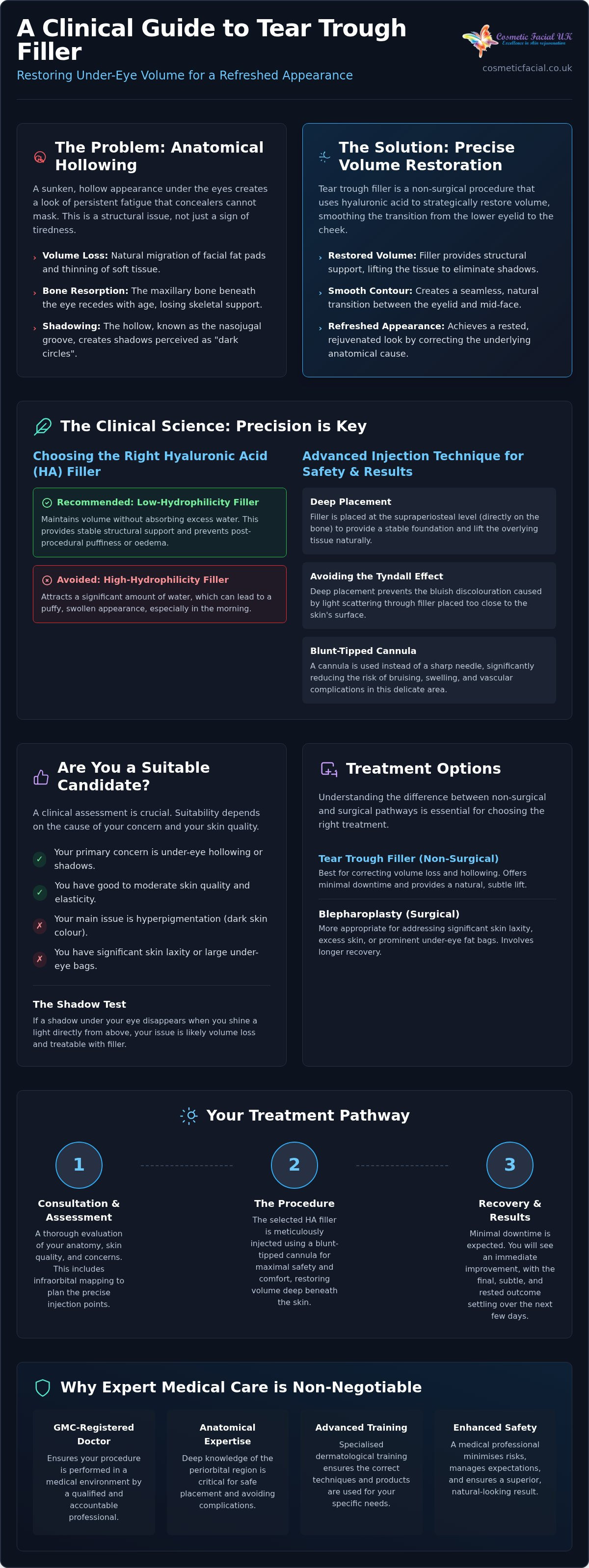
A tear trough filler treatment is a precise, non-surgical procedure designed to address the anatomical depression that runs from the inner corner of the eye down toward the upper cheek. This area, technically termed the nasojugal groove, often becomes more pronounced due to the natural ageing process. Unlike surgical interventions, this technique utilises hyaluronic acid-based dermal fillers to restore volume and smooth the transition between the lower eyelid and the mid-face. The primary cause of this hollowing is the combination of fat pad migration and the presence of the tear trough ligament, which tethers the skin to the underlying bone.
Patients often believe that persistent dark circles are solely a result of lifestyle factors like poor sleep or dehydration. Whilst fatigue can exacerbate the appearance of the eyes, it can't alter the physical structure of the face. Anatomical hollows are a result of volume deficiency; this means that topical creams and increased rest often provide negligible results. Identifying suitability requires a clinical assessment of skin laxity, volume loss, and the presence of any underlying medical conditions.
The Anatomy of the Under-Eye Area
The skin surrounding the orbital rim is exceptionally delicate, often measuring less than 0.5mm in thickness. As we age, facial bone resorption occurs; specifically, the maxillary bone beneath the eye recedes. This loss of skeletal support, combined with the thinning of the overlying soft tissue, creates a "negative space" where light cannot reflect evenly. The resulting shadows are what most people perceive as dark circles. By strategically placing filler in this deep plane, a practitioner can provide the structural lift necessary to eliminate these shadows and create a more youthful contour. This creates a visible, immediate improvement.
Is it Volume Loss or Pigmentation?
Distinguishing between structural hollowing and skin pigmentation is vital for a successful outcome. Practitioners often use the "Shadow Test" during a consultation. If a light source held directly above the face casts a shadow that disappears when the light is moved, the issue is likely volume-related. However, if the darkness remains regardless of lighting, it's likely caused by genetic hyperpigmentation or vascular congestion. Whilst tear trough filler is highly effective for shadows, it may not resolve pigment issues. In such cases, a broader strategy for Facial Rejuvenation Therapy might be recommended to improve overall skin tone and texture.
The Clinical Science: How Dermal Fillers Restore Under-Eye Volume
The efficacy of tear trough filler relies on the unique rheological properties of hyaluronic acid (HA). This naturally occurring polysaccharide possesses a high capacity for water retention, providing essential structural support to the thinning tissues of the lower eyelid. However, in the periorbital region, the choice of HA molecule is critical. High-hydrophilicity fillers, which attract significant amounts of water, are generally avoided because they can lead to post-procedural oedema or "puffy" eyes, particularly in the morning. Instead, clinicians favour low-hydrophilicity gels that maintain their volume without excessive fluid absorption.
Specific HA concentrations are selected to precisely match the unique thinness and low elasticity of the infraorbital skin, ensuring the gel integrates seamlessly without causing visible lumps or irregularities. A clinical review of tear trough fillers highlights that deep placement, often at the supraperiosteal level directly above the bone, is superior to superficial injections. This deep placement provides a stable foundation that lifts the overlying tissue whilst avoiding the Tyndall effect, a bluish discolouration caused by light scattering through filler placed too close to the skin's surface. It's a technique that requires significant anatomical knowledge to execute safely.
London's diverse population presents a range of skin thicknesses and vascular patterns that must be accounted for during treatment. Patients with thinner, more translucent skin require a different approach to those with thicker dermal layers to ensure the filler remains undetectable amongst the surrounding tissue. This nuance is why a one-size-fits-all approach to concentration and depth often fails to deliver natural results.
Selecting the Right Filler Product
Fillers designed for the lips or cheeks are often too cohesive or volumising for the delicate infraorbital area. The ideal product must offer a balance between "lift" to correct the hollow and "integration" to move naturally with facial expressions. Dr Didar prioritises products that minimise inflammatory responses, reducing the risk of delayed-onset nodules or prolonged swelling. This clinical precision ensures that the result is a smooth, anatomical correction rather than a visible "filled" look. If you're considering how these treatments fit into your wider skincare goals, you may wish to explore our range of medical-grade aesthetics.
Stimulating Natural Collagen
Beyond immediate volume replacement, the presence of HA filler can encourage long-term fibroblast activity. Fibroblasts are the cells responsible for producing collagen and elastin, the proteins that provide skin with its firmness and elasticity. Whilst the filler provides an instant result, this secondary biological response helps improve skin quality over several months. For patients who also have surface-level concerns like fine lines, combining filler with Micro-Needling can provide a more comprehensive rejuvenation by addressing both deep volume loss and epidermal texture.
Evaluating Your Suitability: Filler vs Surgical Alternatives
Determining the most appropriate clinical pathway for periorbital rejuvenation requires a nuanced understanding of tissue dynamics. Whilst many patients present with a desire for tear trough filler, it's not a universal solution for all under-eye concerns. This treatment is the gold standard for individuals experiencing mild to moderate hollowing where the skin remains relatively elastic. However, if a patient exhibits significant fat prolapse, commonly referred to as "bags", adding volume can inadvertently worsen the appearance by creating a shelf-like effect. In these instances, a surgical blepharoplasty is often the more appropriate recommendation to physically remove or reposition the herniated fat.
A critical consideration during the clinical assessment is the presence of festoons or malar bags. These are fluid-filled pockets or redundant skin folds located on the upper cheekbone, distinct from the immediate under-eye area. Injecting filler near festoons can exacerbate lymphatic congestion, making the puffiness more prominent. A holistic assessment often reveals that the tear trough cannot be treated in isolation; providing structural support to the mid-face and cheeks is frequently a prerequisite to achieving a seamless transition. For those seeking authoritative guidance, FDA information on dermal fillers provides a comprehensive overview of the intended uses and safety considerations for these medical devices.
Filler vs Blepharoplasty: A Comparison
The choice between non-surgical and surgical options involves a trade-off between convenience and permanence. Tear trough filler offers minimal downtime, with most patients returning to normal activities within 24 hours. In contrast, blepharoplasty requires approximately two weeks for initial bruising and swelling to subside. Whilst surgery provides permanent results, filler typically requires maintenance every 12 to 18 months. The risk profile also differs significantly; filler is minimally invasive and performed under local anaesthetic, whereas surgery usually involves general anaesthesia and the inherent risks of an operating theatre environment.
When considering surgical interventions for the eyes, it is vital to choose a provider that maintains rigorous clinical standards; for those looking into other specialised ophthalmic procedures, you can explore No-Gap Cataract Surgery at Bright Sight Eye Specialists.
Complementary Treatments for the Eye Area
A comprehensive rejuvenation strategy often involves multiple modalities to address different layers of the ageing process. Whilst fillers address deep volume loss, Botox is frequently utilised to relax the orbicularis oculi muscle, softening the appearance of crow's feet. If the concern is surface-level discolouration or fine lines, Skin Peels can be employed to improve epidermal quality in a way that volume replacement cannot. Maintaining these results requires a commitment to medical-grade skincare, focusing on antioxidants and retinoids specifically formulated for the delicate peri-orbital region.
To further enhance the aesthetic impact of a refreshed eye area, many individuals also opt for professional beauty enhancements; for instance, Blessed Lashes offers expert eyelash extensions and facial treatments that can beautifully frame the results of a tear trough procedure.
The Procedure and Recovery: What to Expect During Your Treatment
Every treatment begins with a thorough clinical consultation at our Marylebone clinic. Dr Didar performs a detailed skin analysis to evaluate dermal thickness and the specific trajectory of the nasojugal groove. This assessment leads to precise infraorbital mapping, identifying the safest entry points to avoid the angular artery and other vital structures. It's a methodical process that ensures the tear trough filler is placed with medical accuracy rather than guesswork. We prioritise a calm, clinical environment where the procedure is explained in full before any injections occur.
Post-procedure requirements are straightforward but essential for an optimal result. We advise patients to avoid high-intensity exercise for 48 hours to prevent increased blood flow from exacerbating any minor swelling. Similarly, extreme heat from saunas or sunbeds should be avoided during this initial window. Sleeping with an extra pillow can also encourage better lymphatic drainage. Most patients find they can return to their professional duties immediately, as downtime is typically minimal; if you are planning a trip during your recovery, you can visit Kapture Travel for essentials that make your journey more comfortable.
Cannula vs Needle Technique
The choice of instrument is a fundamental safety consideration. A blunt-tipped micro-cannula is generally favoured because it doesn't pierce blood vessels as easily as a sharp needle. This technique significantly lowers the incidence of bruising amongst patients, especially those with the thin skin characteristic of the periorbital area. Whilst a cannula provides the safest path for bulk volume restoration, a fine needle might be used for the final, medial fine-tuning near the bridge of the nose where high-precision placement is required.
Managing Risks and the Tyndall Effect
A primary concern for many is the Tyndall effect, which results in a persistent blue tint under the eyes. This phenomenon occurs when filler is injected too close to the surface, causing light to scatter through the gel. We prevent this by ensuring the product is placed deep against the bone and by selecting fillers with appropriate refractive properties. If a patient arrives with a previous blue hue from a treatment elsewhere, our protocol includes the use of hyaluronidase to dissolve the misplaced product before we re-treat the area. We don't believe in overfilling; we often recommend a conservative first session followed by a review to ensure the result remains natural and integrated.
Expert Care in Marylebone: Why Choose Cosmetic Facial for Your Procedure
Selecting a practitioner for tear trough filler requires careful consideration of medical qualifications, particularly as the under-eye area is classified as a high-risk zone for injections. At Cosmetic Facial, all treatments are led by Dr Faramarz Didar, a GMC-registered doctor with over 30 years of medical experience. His MSc in Dermatology Skills and Treatment with Commendation from the University of Hertfordshire provides a level of academic and clinical rigour that is rarely found in traditional beauty settings. This advanced training ensures that every procedure is grounded in a deep understanding of skin pathology and complex facial anatomy.
Our clinic in Marylebone provides a controlled, clinical environment that prioritises patient safety and medical ethics above aesthetic trends. We don't believe in a "one-size-fits-all" approach; instead, we develop bespoke treatment plans based on a patient's specific anatomical needs. This commitment to professional integrity means we only proceed with a treatment if it's clinically appropriate for the individual. Being located in the medical heart of London also ensures that patients have convenient access to high-standard follow-up care and long-term skin health management.
Dr Faramarz Didar's Clinical Approach
Dr Didar's philosophy centres on "Natural Rejuvenation," aiming for results that look refreshed rather than obviously treated. By utilising three decades of medical experience, he assesses facial harmony to ensure the tear trough correction integrates seamlessly with the surrounding mid-face structures. His dedication to Advanced Aesthetic Science involves staying at the forefront of evidence-based techniques, ensuring that patient safety remains the primary focus during every stage of the clinical journey. This methodical approach rewards the detail-oriented patient who seeks subtle, sophisticated outcomes.
Your Journey at Cosmetic Facial
The patient journey begins with a transparent and honest suitability assessment. We provide a realistic overview of what tear trough filler can achieve, ensuring patients are fully informed before making a decision. For those requiring more comprehensive care, we offer a full suite of Dermal Fillers to restore total facial balance and address volume loss in multiple areas. Our process is designed to be thorough and unhurried, reflecting the clinical nature of our practice.
- Consultations are conducted in a private, medical-grade environment in Marylebone.
- Every injection is performed by a GMC-registered doctor with advanced dermatological training.
- Treatment plans are tailored to individual skin quality and anatomical structure.
- Post-procedure care is an integral part of our service, with clear protocols for follow-up reviews.
Booking a consultation at our London clinic is the first step toward a professional, medically-led rejuvenation. We expect our clients to be as serious-minded about their treatment decisions as we are about our clinical standards. Located in the centre of the city's premier medical district, we provide a reliable resource for those who value expertise and safety in their aesthetic care. For readers based in Singapore, you can check out Dr. Sankeerth Reddy's Clinic to find similar clinical standards. Likewise, for those in Thailand, MedConsult Clinic provides high-standard aesthetic treatments in Bangkok.
Restoring a Refreshed Appearance with Clinical Precision
Addressing under-eye hollowing requires more than just volume replacement; it demands a deep understanding of facial anatomy and the specific rheology of the chosen product. As explored, the success of tear trough filler depends on precise placement and the selection of low-hydrophilicity gels to ensure a natural, non-puffy result. Moving from the initial anatomical assessment to the final recovery phase, the focus remains on patient safety and the prevention of complications like the Tyndall effect.
Choosing a medically-led environment for these procedures ensures your care is managed by a practitioner who understands the complexities of the periorbital region. Dr Faramarz Didar is a GMC-registered practitioner with an MSc in Dermatology with Commendation. As a specialist in non-surgical facial aesthetics, he provides the expertise necessary for these delicate corrections. It's an approach that prioritises long-term skin health and anatomical harmony over temporary trends.
Taking the time to understand your options is the first step toward achieving a naturally rested and rejuvenated appearance.
Frequently Asked Questions
How long does tear trough filler last on average?
Results typically persist for a period ranging between 9 and 18 months. The longevity of the effect depends on a patient's individual metabolic rate and the specific concentration of the hyaluronic acid used. Because the under-eye area has relatively low mobility compared to the lips or mouth, the product tends to degrade more slowly than in other facial regions.
Is tear trough filler painful for most patients?
Most patients report only minimal discomfort during the procedure. We apply a topical anaesthetic cream prior to treatment to numb the surface, and the tear trough filler itself often contains lidocaine to ensure the process remains tolerable. The use of a blunt-tipped cannula also reduces the sharp sensation often associated with traditional needle injections.
Can tear trough filler help with dark circles?
This treatment is specifically effective for dark circles caused by structural shadows and volume loss. If the darkness is a result of dermal hyperpigmentation or vascular congestion, filler won't change the skin's actual colour. A clinical assessment is necessary to determine whether the darkness is a result of "negative space" or genetic pigmentation.
What are the most common side effects of under-eye fillers?
The most frequent side effects include localised swelling, mild bruising, and slight redness at the entry points. These symptoms typically resolve within a few days. More specific risks, such as the Tyndall effect or delayed inflammatory nodules, are rare when the procedure is performed by a medically qualified practitioner using correct depth and technique.
How much does tear trough filler cost in London?
The fee for treatment in London varies based on the complexity of the anatomical correction and the volume of product required. Factors such as the practitioner's expertise and the specific brand of hyaluronic acid also influence the final cost. We recommend a clinical consultation to receive a bespoke treatment plan and quote tailored to your individual requirements.
Can the filler be dissolved if I am unhappy with the results?
Hyaluronic acid fillers are fully reversible through the injection of an enzyme called hyaluronidase. This enzyme breaks down the synthetic molecules quickly, allowing the product to be absorbed by the body. This provides an essential safety net for patients who are dissatisfied with their results or in the rare event of a clinical complication.
Is there any downtime after the procedure?
There is virtually no clinical downtime, and most patients return to their professional activities on the same day. You may experience minor swelling for 24 to 48 hours; during this time we advise avoiding strenuous exercise or extreme heat. These precautions help to minimise the risk of additional bruising or unwanted product migration.
What is the best age to start tear trough treatments?
There is no specific "correct" age to begin treatment, as the development of the nasojugal groove is often determined by genetics and bone structure. Some patients seek correction in their early twenties, whilst others wait until age-related fat loss makes the hollows more prominent. It's illegal in England to provide this treatment to anyone under the age of 18.
Disclaimer
All content on cosmetic Facial website, including blogs, graphics, logos, images, and software, is the property of CosmeticFacial UK or its content suppliers and is protected by applicable copyright laws. Unauthorized use, reproduction, distribution, or modification of any content without prior written permission is strictly prohibited.


