


Choosing co2 laser skin resurfacing involves more than deciding how much improvement you want. Fully ablative treatment addresses 100% of the skin in the treated area, while fractional treatment targets selected columns and leaves surrounding skin untreated. Skin tone, the concern being treated and the recovery involved all affect which approach may be suitable.
It’s understandable to focus on the difference in intensity: these options can involve distinct treatment and healing experiences. This article explains how CO2 laser resurfacing works, how fully ablative and fractional approaches compare, and why skin type matters when considering suitability. You’ll also learn which factors shape the treatment decision, so you can better understand the options before discussing them with a qualified practitioner.
Key Takeaways
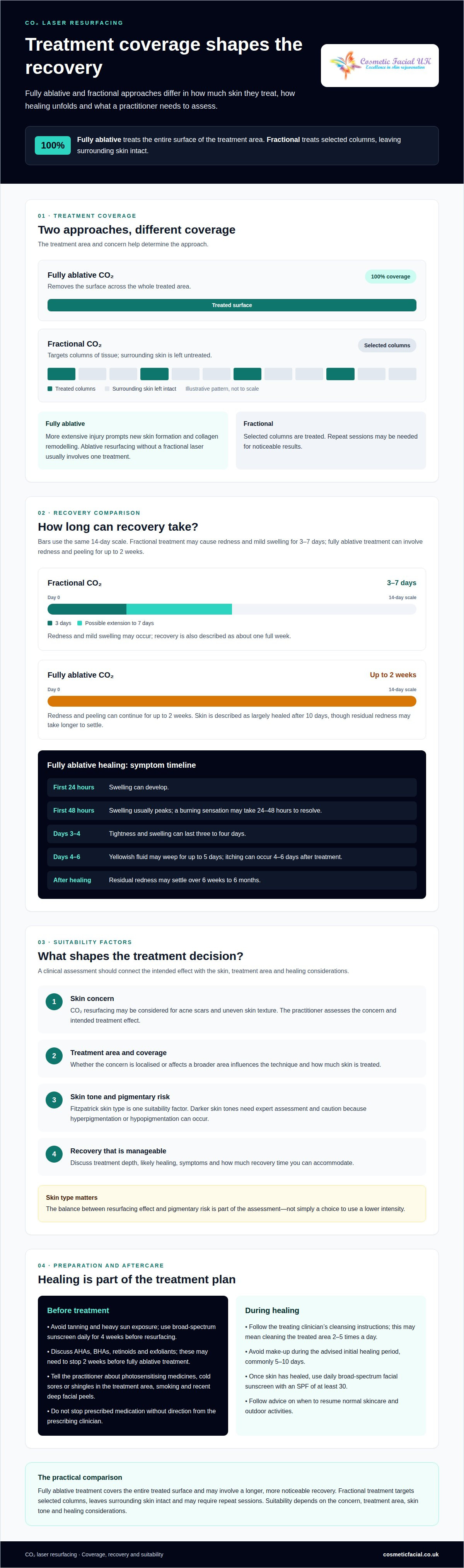
- Fully ablative treatment covers 100% of the treated skin, while fractional treatment targets selected areas and leaves surrounding skin untreated.
- Recovery differs by treatment intensity: fractional treatment may cause redness and mild swelling for 3 to 7 days, while ablative treatment can involve redness and peeling for up to 2 weeks.
- After healing, daily broad-spectrum facial sunscreen with an SPF of at least 30 helps protect the treated skin.
- Fitzpatrick skin type is an important suitability factor; darker skin tones need careful assessment because of the risk of pigment changes.
- Results can develop over 2 to 3 months as collagen production continues, and how long they last depends partly on factors such as age, skin type and sun exposure.
How does a fully ablative CO2 laser differ from fractional laser?
Fully ablative treatment removes the surface across 100% of the treated skin, whereas fractional treatment targets columns of tissue and leaves surrounding skin intact. This difference affects treatment intensity, expected recovery and the approach to concerns such as scarring, pigmentation and uneven surface texture.
With fully ablative CO2 laser skin resurfacing, the treated area undergoes more extensive injury, prompting new skin formation and collagen remodelling. Ablative resurfacing without a fractional laser usually involves one treatment, while fractional approaches may need repeat sessions for noticeable results. The appropriate method depends on the concern, treatment area and how much recovery time is manageable.
Recovery Times by Laser Type
Fractional CO2 treatment may cause redness and mild swelling for 3 to 7 days, while recovery after fractional laser resurfacing is described as one full week. Erbium laser resurfacing also has a one-full-week recovery estimate. Fully ablative CO2 treatment can involve redness and peeling for up to 2 weeks, so compare both healing time and symptom intensity.
After fully ablative treatment, swelling can develop during the first 24 hours and usually peaks over the first 48 hours. A burning sensation may take 24-48 hours to resolve; tightness and swelling can last three to four days. Yellowish fluid may weep for up to 5 days, and itching can occur 4-6 days after treatment. Skin is described as largely healed after 10 days, although residual redness may settle over 6 weeks to 6 months.
Aftercare is part of recovery, not an optional extra. Follow the treating clinician’s instructions for cleansing, which may mean cleaning the treated area two to five times a day. Once the skin has healed, use daily broad-spectrum facial sunscreen with an SPF of at least 30. During the initial healing phase, avoid make-up for the advised period, commonly 5 to 10 days.
Comparing Resurfacing Treatments
CO2 laser resurfacing removes or treats skin tissue with laser energy; erbium laser is another resurfacing option, while chemical peels use exfoliating agents and microneedling creates controlled punctures. Their depth, recovery and suitability differ, so compare the intended concern and healing requirements rather than treating them as interchangeable. In the UK, choose a practitioner with relevant CO2 treatment training, a clear assessment process and written aftercare guidance. Ask how the plan addresses your skin type, scarring risk and recovery symptoms.
Who Is Suitable for CO2 Laser Treatment?
Suitability depends on the skin concern, skin tone, treatment area and healing considerations. A clinical assessment should connect these factors with the intended effects, such as changes to texture or acne scarring, before selecting a CO2 procedure.
CO2 resurfacing may be considered for acne scars and uneven skin texture. The treatment plan also depends on whether the concern is localised or affects a broader area, since this influences the technique and treatment coverage. Whether speaking to a local provider or a leading cosmetic dermatologist beverly hills residents trust for advanced laser work, the clinician assesses the skin and discusses the likely treatment depth, healing process and possible pigmentary effects. That assessment helps distinguish a suitable laser approach from one that may carry unnecessary risk.
Skin tone needs particular attention. CO2 laser treatment on darker skin tones requires expert assessment and caution because hyperpigmentation or hypopigmentation can occur. These pigment changes may affect the treated area’s colour, so the clinician should consider skin type alongside the concern being treated. This is not simply a question of selecting a lower intensity: the balance between resurfacing effect and pigmentary risk matters.
Preparation includes managing sun exposure and reviewing products or medicines before treatment. Avoid tanning and heavy sun exposure, and use broad-spectrum sunscreen daily for four weeks before resurfacing. Photosensitising medicines may affect preparation; discuss them with the prescribing clinician and treatment practitioner. Do not stop prescribed medication without their direction.
- Discuss products containing AHAs, BHAs, retinoids or exfoliants, which may need to be stopped two weeks before fully ablative treatment.
- Tell the practitioner about a history of cold sores or shingles in the treatment area. This may affect whether antiviral medication is prescribed around treatment.
- Discuss smoking before treatment, as it can interfere with wound healing. Preparation advice may include stopping beforehand.
- Share recent deep facial peels, since these may affect the timing of laser resurfacing.
These steps allow the practitioner to assess healing factors and plan the procedure. Topical anaesthesia is applied to minimise discomfort during resurfacing. Ablative laser treatment typically takes 30 minutes to two hours, depending on the technique and treatment area. A partial-face procedure takes less time than full-face treatment because the area covered differs.
Sun protection remains relevant after treatment as well as during preparation. Once the skin has healed, daily broad-spectrum facial sunscreen with an SPF of at least 30 is recommended. UV exposure can affect healing skin and pigmentation, so follow the practitioner’s aftercare instructions about when to resume normal skincare and outdoor activities. A clinical assessment can help connect these factors with your treatment goals; explore skin treatment options.
Fitzpatrick skin types and laser suitability
The Fitzpatrick scale classifies skin into six types and helps assess pigmentary risk before laser treatment. For CO2 resurfacing, skin type is one part of suitability, alongside the condition being treated, the laser approach and the intended treatment depth. A facial treatment for acne scarring, for example, needs a different suitability assessment from treatment intended to address general texture.
Guidance differs according to the procedure and its purpose. Fully ablative resurfacing is most often considered for Fitzpatrick skin types I to III, where pigmentary-change risk is lowest. Non-fractional CO2 resurfacing is described as unsuitable for skin types 3 or higher. These thresholds overlap, so the treatment method and indication matter; a type III classification alone does not explain every decision.
Acne scarring has its own stated suitability range: ablative carbon dioxide or Er:YAG lasers can be used for this concern in types 1 to 4, but should not be used in types 5 and 6. This does not mean every person within types 1 to 4 is automatically a candidate. Scar pattern, treatment area and the planned depth still shape the choice of technique.
- Types I to III: fully ablative resurfacing is most often considered within this range, based on lower pigmentary-change risk.
- Type III and above: non-fractional CO2 resurfacing is described as unsuitable, making the distinction between fractional and non-fractional treatment important.
- Types I to IV with acne scars: ablative CO2 or Er:YAG may be used for scarring, while types V and VI fall outside that stated range.
Darker skin tones need particular care because resurfacing can cause hyperpigmentation or hypopigmentation, meaning the treated area becomes darker or lighter. This risk can affect whether ablative treatment is suitable and how its depth and coverage are planned. Tell the practitioner if you have previously developed uneven pigmentation, as this history is relevant to your assessment.
Skin type also needs to be considered with the desired result. CO2 resurfacing stimulates collagen production, and full results can develop over 2 to 3 months. That gradual change may matter when weighing potential improvement against pigmentary risk and recovery. The assessment should connect the Fitzpatrick classification with the specific concern, such as acne scarring, and the selected laser type, rather than rely on skin type alone.
Before a facial procedure, discuss your goals, skin classification, pigmentation history and the proposed laser approach. Treatment intensity also affects swelling and healing, so recovery expectations should be part of the conversation. These factors help explain why a treatment suitable for one Fitzpatrick skin type or condition may not suit another.
What is a CO2 Laser Resurfacing?
CO2 laser skin resurfacing uses controlled laser energy to remove damaged surface tissue and stimulate collagen production. It is a cosmetic procedure for concerns such as wrinkles, uneven texture and acne scarring. Unlike surgery that changes facial structure, resurfacing works on the skin’s surface. Treatment depth and coverage shape both the visible effects and the healing process.
As treated skin heals, new tissue develops and collagen production continues beneath the surface. Initial changes may become visible within 5 to 7 days as the skin heals, but this is not the final result. Full results develop over 2 to 3 months, as collagen remodelling continues. The gradual timeline means early redness or peeling does not show the eventual texture.
Longevity varies with age, skin type and sun exposure. Results may last for several years, with fully ablative resurfacing results reported by Midland Skin as lasting around 3 to 10 years. This range describes a possible duration, not a fixed lifespan for every person. Changes in skin and ongoing environmental exposure influence how results appear over time.
It helps to separate the first visible improvement from the longer-term outcome. At 5 to 7 days, healing skin may show an early difference, whilst collagen-related changes continue for 2 to 3 months. A patient review reported results becoming more visible 3-6 months after treatment. Individual experiences vary, so a review should not be treated as a standard timetable.
CO2 resurfacing does not prevent future skin changes. Sun exposure can affect how long results remain apparent, whilst ageing continues to alter skin over time. Daily sun protection after healing supports the skin and helps limit further sun-related damage. The treatment’s effect on existing wrinkles or scars should therefore be considered separately from the development of new concerns.
Possible complications also matter when assessing expected results. Zenith Cosmetic Clinics identifies pigmentation changes and scarring as rare possible risks of CO2 laser resurfacing. Hyperpigmentation means darker patches; hypopigmentation means lighter areas. These effects differ from the intended improvement in skin texture, and their relevance depends on skin type and the treatment approach.
After treatment, follow the practitioner’s wound-care instructions instead of adding products on your own. A doctor may recommend moisturiser or antibacterial ointment twice daily while the skin heals. Use the product and resume your usual skincare only as directed in your individual aftercare plan.
CO2 and fractional laser resurfacing
CO2 describes the laser source; fractional describes how its energy is delivered. A fully ablative CO2 treatment removes the surface across 100% of the treated skin. Fractional CO2 instead creates microscopic treatment columns, leaving intervening tissue untreated. That difference changes treatment coverage and healing demands, so “CO2” and “fractional” are not opposing laser types.
Fully ablative treatment may be considered for selected concerns that need broader resurfacing, such as pronounced texture irregularity or acne scarring. It is generally more intensive because it affects the entire treatment surface. Fractional delivery treats columns of skin while leaving areas between them untouched, allowing repair from surrounding tissue. It may be an option when targeted resurfacing is preferred over treating the whole surface.
Session numbers reflect this distinction, but also depend on the technique and treatment goal. Ablative resurfacing without fractional delivery usually requires one treatment, and many people achieve results from one CO2 session. Fractional ablative and fractional non-ablative resurfacing commonly require 2 to 4 treatments for noticeable results. These approaches should not be treated as identical simply because both use fractional delivery.
Fractional CO2 is still ablative: it creates controlled columns of tissue injury. Fractional non-ablative treatment heats tissue without removing it in the same way. That difference affects the depth and type of response. For fine lines or uneven texture, the relevant comparison is not just the word “fractional”, but whether the laser is ablative and how its energy is applied.
Recovery depends on treatment intensity. Fully ablative resurfacing affects the entire treatment surface, while fractional delivery leaves untreated areas between treated columns. Skin response also varies with the settings and area treated. When comparing options, discuss expected redness, peeling and time away from normal activities rather than assuming all fractional laser treatments have the same recovery.
Sun exposure and skin type belong in the decision alongside fine lines, scarring and texture. Pigmentary changes are a particular consideration for darker skin tones, so treatment coverage and depth need careful assessment. A useful consultation clarifies the concern being treated, whether the proposed CO2 approach is fractional or fully ablative, and why its expected effects suit that concern.
The practical takeaway is to compare treatment mechanism, coverage, session plan and recovery together. One session may be appropriate for fully ablative resurfacing, whereas fractional approaches may involve 2 to 4 treatments. Explore fractional CO2 laser treatment
Cosmetic Facial: Botox Treatment
Cosmetic Facial offers Botox Treatment as a separate option for people considering facial aesthetic treatments. CO2 laser resurfacing addresses skin surface concerns, whilst Botox Treatment may be relevant when your priorities differ from texture or scarring. It isn’t a replacement for resurfacing, and the appropriate option depends on the concern you want to address.
If you’re weighing these approaches, clarify your treatment goal first: surface texture and acne scarring call for a different discussion from other facial aesthetic concerns. Cosmetic Facial can help you explore Botox Treatment as part of your options. For information about the clinic and its treatments, contact Cosmetic Facial or visit the website.
Make your next step an informed one
Before deciding, identify which skin concern matters most, how much recovery time you can accommodate and what result would feel meaningful. Sharing these priorities can keep a clinical discussion focused on your needs, not just on treatment names.
For CO2 laser skin resurfacing, bring your questions about suitability, treatment approach and aftercare to that discussion. Your skin type and personal circumstances help shape the assessment, so use the conversation to understand how they relate to your goals. Take time to consider the information before deciding whether to proceed.
A useful next step does not have to mean committing to treatment. It can simply help you understand the options and make a considered decision.
A clear idea of your priorities and an informed discussion can help you decide how to move forward.
Frequently Asked Questions
Can CO2 laser be used on dark skin?
CO2 laser treatment on darker skin requires careful assessment because pigment may become lighter or darker after treatment. Suitability depends on the Fitzpatrick skin type, laser approach and condition being treated. For acne scarring, ablative CO2 lasers may be used for types I to IV, but not types V and VI. Fully ablative treatment is most often considered for types I to III, so these categories need interpreting in context.
What’s the recovery like?
Recovery involves temporary skin changes, and the pattern depends on treatment intensity. Fractional CO2 may cause redness and mild swelling for 3 to 7 days; ablative treatment can involve redness and peeling for up to 2 weeks. Avoid make-up during the initial healing phase, typically 5 to 10 days, and avoid activities that cause flushing for two weeks. Follow the aftercare instructions for your specific treatment.
Can CO2 fractional laser remove scars?
Fractional CO2 laser can improve the appearance of acne scars by treating columns of skin while leaving surrounding areas intact. It does not guarantee complete scar removal, and the result depends on scar characteristics and treatment settings. For acne scarring, ablative CO2 or Er:YAG lasers may be used for Fitzpatrick types I to IV, but should not be used for types V and VI. Fractional approaches may involve multiple sessions.
Does CO2 laser hurt?
Topical anaesthesia is applied to minimise discomfort during CO2 laser resurfacing. The experience can vary with the treatment area, depth and technique used. After fully ablative treatment, a burning sensation may take 24-48 hours to resolve, and swelling can develop during the first day. Discuss pain relief and post-treatment symptoms before the procedure, so you understand the planned approach and aftercare.
Does CO2 laser really work?
CO2 laser resurfacing can improve concerns such as acne scarring, wrinkles and uneven texture by treating skin tissue and stimulating collagen production. The degree of change depends on the concern, skin type and treatment method. Results can last several years, but ageing and sun exposure continue to affect the skin. Pigment changes and scarring are also recognised as rare possible risks.
How long after CO2 laser will I see results?
Early changes may become visible within 5 to 7 days as the skin heals, but this is not the complete result. Collagen production continues, and full results develop over 2 to 3 months. Redness can make the treated area look different during recovery, so assess progress over time rather than judging the outcome during the first few days.
How much does it cost?
The cost depends on the treatment area, whether the laser is fractional or fully ablative, the treatment depth and the number of sessions in the plan. For CO2 laser resurfacing in London, the individual price is provided after a quote request rather than as a single general figure. The treatment approach and area covered are key factors in the quote.
What is CO2 laser skin resurfacing and how does it work?
CO2 laser skin resurfacing uses laser energy to remove or treat damaged skin tissue and encourage collagen production. Fully ablative treatment covers the entire treated surface, while fractional delivery targets separate columns and leaves intervening skin intact. The approach affects treatment coverage and healing. In London, suitability depends on the skin concern, skin type and the laser method being considered.
Disclaimer
All content on cosmetic Facial website, including blogs, graphics, logos, images, and software, is the property of CosmeticFacial UK or its content suppliers and is protected by applicable copyright laws. Unauthorized use, reproduction, distribution, or modification of any content without prior written permission is strictly prohibited.


