
A cryotherapy wart treatment in Marylebone is usually a brief appointment, with the time depending on the lesion and treatment required. Liquid nitrogen is applied to each wart for 10 to 30 seconds, freezing the affected tissue. The appointment is brief, although the skin may take longer to settle afterwards.
It’s understandable to want to know how much time to set aside, especially when you’re fitting wart or verruca treatment around work and other commitments. The freezing itself lasts seconds, but the full visit also includes assessing and treating the area and explaining what to expect as it heals.
This guide explains how liquid nitrogen works, what affects treatment time and why more than one session may be needed. It also covers common after-effects, practical aftercare and when cryotherapy may be considered for warts or verrucas, so you can understand the process before deciding on your next step.
Key Takeaways
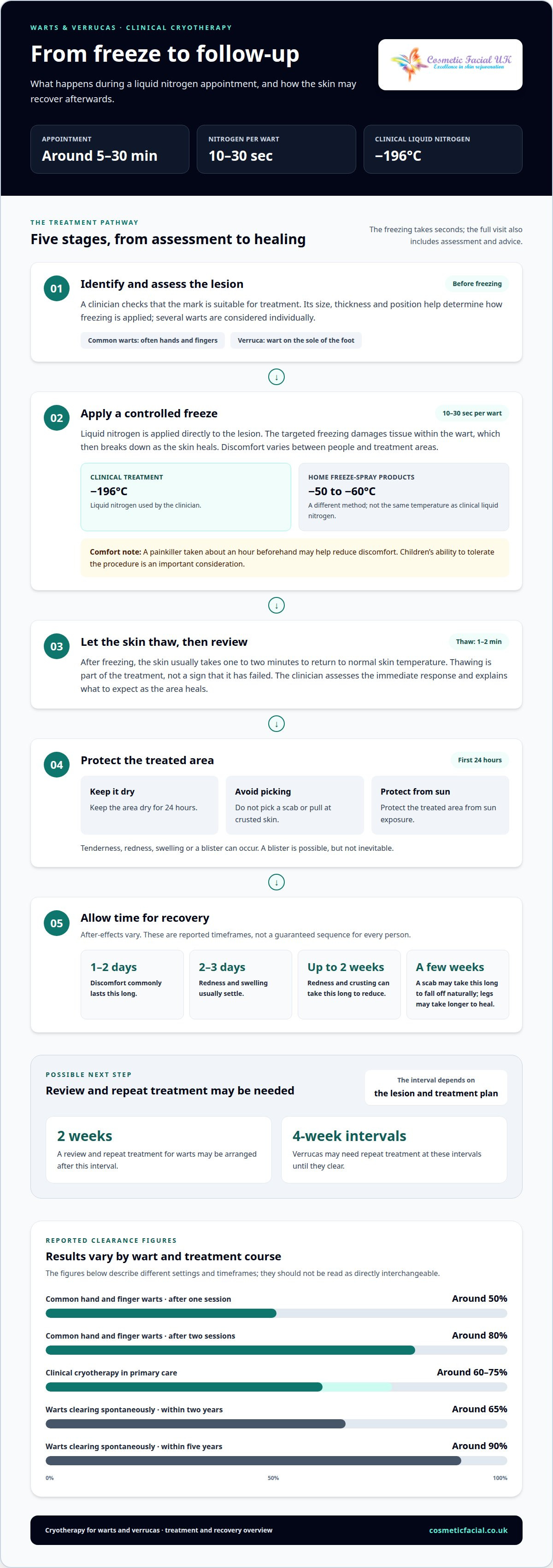
- A wart cryotherapy appointment takes around 5 to 30 minutes, while liquid nitrogen is applied to each wart for 10 to 30 seconds.
- The lesion’s size and thickness affect how long treatment takes, and persistent warts or verrucas may need further sessions.
- After treatment, keep the area dry for 24 hours and avoid picking any scab as the skin heals.
- Tenderness, redness, swelling and blistering can occur; knowing what to expect helps you plan for short-term aftercare.
- Read on to understand how treatment works and which factors can affect healing and the need for follow-up.
Cryotherapy for warts, verrucas and other skin lesions
Cryotherapy uses extreme cold to treat viral warts by damaging the affected tissue. A verruca is a wart on the sole of the foot, where pressure can make it uncomfortable. Common warts often appear on the hands and fingers. Cryotherapy may also be considered for other suitable skin lesions, but the lesion needs to be identified before it is frozen.
For warts, a clinician applies liquid nitrogen directly to the lesion. Freezing damages the wart tissue, which then heals as the area recovers. Cryotherapy may be considered for persistent or spreading warts, particularly when over-the-counter treatments have not worked. Verrucas may need repeat treatment at four-week intervals until they clear. A review and repeat treatment for warts may be arranged after two weeks.
Results vary by wart and treatment course. Around 50% of common warts on hands and fingers clear after one cryotherapy session, rising to around 80% after two sessions. Clinical cryotherapy clears around 60 to 75% of warts in primary care. Warts can also disappear without treatment: around 65% clear spontaneously within two years, and around 90% within five years. These figures help explain why treatment decisions depend on symptoms, persistence and spread.
Children’s ability to tolerate freezing is an important consideration. Treatment can be difficult for children, typically those under 16, and particularly those under 12-13. Treatment may be offered to children aged 8 and above when they can tolerate the procedure. For a facial viral wart, the NHS may fund treatment for under-18s experiencing significant psychological distress, provided they can tolerate cryotherapy.
Cryotherapy is less often recommended for facial warts; laser treatment or cauterisation may be preferred. CO₂ laser should not be assumed to be the automatic next step for a resistant wart. The lesion’s location and suitability need to be assessed before choosing a treatment. If you’re unsure whether a mark is a wart or suitable for freezing, see your regular GP or book a GP consultation rather than treating an unidentified mark.
Liquid nitrogen cryotherapy
Clinical cryotherapy uses liquid nitrogen to freeze a wart or another suitable lesion. The temperature, application time and area being treated help explain what happens during the procedure.
How liquid nitrogen freezes skin lesions
Liquid nitrogen is used at minus 196 degrees Celsius, rapidly cooling the targeted tissue. This controlled freezing damages cells within the lesion, prompting the treated tissue to break down as the skin heals. The clinician focuses treatment on the lesion rather than surrounding skin. Its thickness, size and position help determine how freezing is applied.
After freezing, the skin usually takes one to two minutes to thaw back to normal skin temperature. This thawing phase is part of the treatment, not a sign that the procedure has failed. A dermatologist assesses the lesion and its response when deciding whether further freezing may be needed.
Liquid nitrogen application method
At a clinic, liquid nitrogen is applied directly to each wart for 10 to 30 seconds. The exact application depends on the lesion and its characteristics. The treated area is targeted, and the freezing time is controlled. For several warts, each lesion is considered separately, rather than assuming the same application suits every site.
Freezing can be uncomfortable, and the sensation varies between people and treatment areas. A painkiller taken about an hour beforehand may help reduce discomfort. Children may find wart treatment difficult if they cannot tolerate the sensation, so their ability to stay still and manage the procedure matters.
Home freeze-spray products are different from clinical liquid nitrogen treatment. They reach temperatures of minus 50 to minus 60 degrees Celsius, compared with minus 196 degrees Celsius for liquid nitrogen used clinically. This temperature difference is one reason the products should not be treated as identical methods. A lesion’s appearance also matters: freezing an unidentified mark may be inappropriate.
At a clinical appointment, the practitioner identifies the lesion, selects the treatment area and applies nitrogen for the required time. The skin then thaws before the clinician assesses the immediate response. Avoid rubbing or picking the area afterwards, as the skin needs time to recover. If a mark is changing, bleeding or difficult to identify, seek medical assessment before considering wart removal.
For a wart that persists after treatment, a further session may be required. The interval depends on the lesion and the treatment plan, rather than the brief freezing time alone. A clinical assessment can help establish whether cryotherapy is appropriate for the specific lesion. You can explore clinical treatment options as a next step.
What aftercare is required for Wart Treatment?
After cryotherapy, the treated area can feel tender and may blister. Keep it dry for 24 hours, protect it from sun exposure and allow the skin to heal without picking at a scab.
Healing after wart treatment
Discomfort commonly lasts 1 to 2 days after freezing. Redness and swelling usually settle after two to three days, although redness and crusting can take up to two weeks to reduce. These changes form part of the skin’s response as the treated tissue recovers.
A scab may take a few weeks to fall off naturally, and healing can take longer on the legs. Don’t pull at crusted skin to speed this up, as it can disrupt healing. A blister may form, but it is not inevitable; tenderness around the treated area can also occur.
For discomfort during the first 24 hours, painkillers may provide relief. Follow the medicine’s instructions and consider any advice given during your consultation. The healing timeline can vary with the treatment area; a scab on the leg, for example, may persist longer than expected.
Infection prevention for treated skin
Keep the treated area dry for 24 hours after cryotherapy, then follow the aftercare instructions provided for your skin. Avoid picking a blister or scab, since breaking the surface can interfere with normal healing. Infection is a possible side effect, so protecting the skin while it recovers is an important part of aftercare.
Check the area as it heals. Seek medical advice if discomfort increases or a change concerns you, particularly if the skin appears infected. Don’t apply additional treatments without advice, as wart-removal products may irritate skin that has just been frozen.
Sun protection after treatment
Protect the treated area from sun exposure while it heals. Cryotherapy can cause temporary skin discolouration, and sunlight may affect the appearance of recovering skin. Where practical, cover the area with clothing, especially if it is exposed during daily activities.
Keep protecting the area from the sun until redness and crusting have reduced, which can take up to two weeks. Don’t pick the scab, even if the surrounding skin looks nearly normal. Letting it fall away naturally supports recovery and helps avoid unnecessary damage to the treated area.
Aftercare is straightforward: keep the site dry for 24 hours, avoid picking, and protect it from the sun. Healing may continue for a few weeks as the scab separates. If the area becomes increasingly painful or looks infected, seek medical advice rather than attempting further removal yourself.
Treatment duration
The time needed for a clinic procedure can vary with the treatment required. For cryotherapy wart treatment in Marylebone, the freezing itself is only one part of the appointment.
Treatment procedure duration
The appointment allows the clinician to assess the wart and treat the affected area. Liquid nitrogen is applied to each wart for 10 to 30 seconds, so several lesions require separate applications. A single small wart and several thicker warts will not require identical treatment. The number, size and thickness of the lesions help determine how long the full procedure takes.
This is why the freezing time for one wart doesn’t give the total appointment duration. A clinician must target each lesion, rather than treating several separate warts as one area. The time needed may also reflect the procedure required for the particular lesion. For patients planning their day, the 5 to 30-minute range refers to the clinic procedure, not just the seconds of nitrogen application.
Treatment duration and thawing
After freezing, skin usually takes one to two minutes to thaw back to normal skin temperature. This brief thaw follows the application and is not the full appointment. For cryotherapy wart treatment in Marylebone, allow time for the whole procedure, including treatment of each wart.
A lesion’s thickness and size affect treatment time. A small wart may need a different application from a thicker lesion, while several warts require treatment at several points. These factors explain why appointment duration varies. The freezing time for each wart is only one part of the visit.
During treatment, the clinician applies liquid nitrogen to the selected lesion and allows the skin to thaw. For example, if two separate warts are treated, each site needs attention. Any additional session takes place at a later visit, rather than extending the initial application. The clinician assesses the lesion’s response before deciding whether further treatment is appropriate.
Keep procedure time separate from recovery time. A blister, tenderness or redness may occur afterwards, but these effects don’t lengthen the freezing process. Healing continues after the appointment. Infection is a possible side effect, not a measure of how long cryotherapy takes.
For practical planning, allow for the full clinic procedure rather than only the application. The 5 to 30-minute duration reflects treatment as a whole, while the lesion’s characteristics and number affect where an appointment falls within that range. The key distinction is seconds for freezing each wart, one to two minutes for thawing, and several minutes for the overall procedure.
What are the side effects of cryotherapy?
Cryotherapy can cause a short-lived local skin reaction, alongside less common risks such as infection or scarring. The type and location of the wart, as well as its response to treatment, all matter when considering possible effects.
For private wart cryotherapy in the UK, a GP referral is not usually needed. A clinician can assess the lesion before treatment. An NHS referral is a separate route and depends on the care pathway.
In Marylebone, look for a clinic that treats warts and verrucas with cryotherapy. Opening hours differ between clinics, so there is no single schedule for the area.
Possible side effects and risks
Common effects include pain, redness, swelling and blistering around the treated area. A blister may form after treatment, but it does not happen in every case. The skin can also become temporarily lighter or darker, and healing may take longer than expected.
Less common risks include infection, slow healing, a small scar or recurrence of the lesion. For example, a wart may remain or return after the surrounding skin has healed. Avoid picking a blister or scab, and follow the aftercare instructions for the treated area. Seek medical advice if you notice signs of infection or worsening symptoms.
Effectiveness across wart types
The response to cryotherapy varies by lesion. Pressure and thickened skin can affect a verruca on the sole, while a wart on a finger has different surrounding tissue. These differences influence the treatment approach and the clinician’s assessment after freezing.
Facial warts need particular consideration because of their location and the possibility of visible skin changes. Cryotherapy is less often recommended for facial warts; laser treatment or cauterisation may be preferred. The doctor considers the lesion’s position and appearance before choosing a treatment.
Some warts need more than one session, particularly if they persist after initial treatment. The clinician assesses whether the wart has reduced, remains visible or has returned. A further session may be considered based on that response, rather than assuming one application will resolve every lesion.
Choosing a clinic and arranging assessment
Before treatment, expect the clinician to examine the lesion and assess whether it appears suitable for freezing. If a mark is changing or its identity is uncertain, seek medical assessment before wart treatment. This helps distinguish a viral wart from another skin lesion.
After the procedure, monitor the treated area as it heals. Increasing pain, spreading redness or suspected infection needs medical attention. A blister can occur after freezing, but worsening symptoms should not be dismissed as a routine part of recovery.
Cosmetic Facial: Botox Treatment
Cosmetic Facial offers Botox Treatment for people considering a separate aesthetic treatment; it does not treat warts or verrucas. If you have a wart or verruca, the relevant next step is an assessment for appropriate treatment, not Botox. The earlier sections explain how cryotherapy works, its possible after-effects and the importance of aftercare while the skin heals.
If your concern is unrelated to warts, Botox Treatment may be relevant to your aesthetic interests. Cosmetic Facial also offers HIFU Face Lift, IPL Hair Removal Treatment and HIFU Body Treatment. Each addresses a different goal, so consider the specific concern you want to discuss. For information about a suitable next step, contact Cosmetic Facial or visit cosmeticfacial.co.uk.
Choose your next step with confidence
For cryotherapy wart treatment in Marylebone, the useful next step is to have the skin concern assessed and discuss whether freezing is appropriate. A wart-like mark can have another cause, so treatment decisions should follow an examination, not appearance alone. Consider how the lesion affects you, whether it has persisted and what outcome you hope to achieve. These details can help make a consultation focused on your needs.
Cosmetic Facial offers wart and verruca removal for people considering treatment. Contact the clinic to discuss your concern and the next step. There’s no need to rush your decision; understanding the options can help you proceed with clarity.
With the right information, you can make a considered choice about caring for your skin.
Frequently Asked Questions
How long does treatment take?
A clinic appointment generally takes around 5 to 30 minutes, depending on the lesion and treatment required. If you have several warts, allow for each one to be assessed and treated separately. The freezing itself takes seconds per wart, so it doesn’t represent the full visit. For planning, consider the appointment duration rather than assuming you’ll be finished as soon as the liquid nitrogen is applied.
What can I expect after a cryotherapy session?
The treated skin may feel tender, and a blister can develop in response to freezing. Its appearance may change during healing, so don’t judge the result immediately after your appointment. Follow the aftercare advice for the specific site, especially if the wart is on a foot or another area exposed to friction. Seek medical advice if the skin becomes increasingly painful or appears infected.
Can I return immediately to normal activities?
Most routine activities can usually continue after treatment, but protect the site and keep it dry for the first 24 hours. Consider how its position affects your plans: a treated sole may feel uncomfortable inside a shoe, for example. Avoid picking or rubbing the area, particularly if a blister forms. If activity causes pain or friction at the site, reduce that pressure while the skin settles. For active individuals managing foot irritation, sports rehabilitation clinics such as ABI Promedical highlight that temporarily modifying footwear and training load can protect recovering tissue while maintaining overall physical conditioning.
How many sessions will I need and when should I book?
The number of sessions depends on the wart’s size, thickness, location and response to freezing. Some lesions need further treatment, so ask for a review plan before leaving your appointment. Verrucas may be treated at four-week intervals, while wart treatment may be reviewed after two weeks. Follow the schedule provided for your lesion rather than booking repeat freezing early without an assessment.
Is cryotherapy painful?
Cryotherapy can be uncomfortable during freezing, and the sensation varies between people and treatment sites. The area may also feel tender afterwards. A painkiller taken about an hour beforehand may help reduce discomfort, provided it is suitable for you and taken according to its instructions. Mention any concern about tolerating the procedure during your consultation, particularly if treatment involves several warts or a sensitive area.
How does cryotherapy remove a wart, and how many sessions are usually needed?
Liquid nitrogen freezes wart tissue, damaging the treated cells so the lesion can break down as the skin heals. The wart’s characteristics influence whether further treatment is needed. For example, a thick verruca may respond differently from a small wart on a finger. At follow-up, the clinician assesses the lesion’s progress and bases any further session on its appearance and response.
What should I expect during and after wart cryotherapy?
During the appointment, the clinician identifies the wart and applies liquid nitrogen directly to it. Afterwards, the treated skin can become red or swollen, and a blister may form. Protect the area from sun exposure and avoid disturbing any scab. Healing continues after the appointment, so plan work, footwear and other activities with the treated site’s position and possible tenderness in mind.
What are the risks and side effects of freezing a wart?
Possible effects include pain, redness, swelling, blistering, skin discolouration and slow healing. Infection, a small scar or recurrence can also occur. These risks depend partly on the treated area and how the skin heals. Avoid picking blisters or scabs, and watch for worsening symptoms rather than assuming they are routine. Seek medical advice if the area appears infected or becomes increasingly painful.
Disclaimer
All content on cosmetic Facial website, including blogs, graphics, logos, images, and software, is the property of CosmeticFacial UK or its content suppliers and is protected by applicable copyright laws. Unauthorized use, reproduction, distribution, or modification of any content without prior written permission is strictly prohibited.


