


The most successful aesthetic interventions are those that remain entirely undetectable to the casual observer. You likely recognise that while fine lines are becoming more visible under makeup, the prospect of a frozen or over-processed appearance remains a significant deterrent. It's entirely reasonable to prioritise the preservation of your natural facial expressions whilst seeking a more refreshed, well-rested version of yourself. This clinical guide examines the science of baby botox, a technique utilising precise micro-doses of botulinum toxin to soften dynamic lines without compromising muscle mobility.
We'll detail how this preventative dermatological tool functions within a professional medical setting, the implications of the 2026 UK aesthetics licensing regulations, and the methodology required to achieve subtle, anatomically harmonious results. By understanding the physiological mechanism of micro-dosing, you can make an informed decision about maintaining your skin health. We'll also explore why a mandatory face-to-face consultation with a GMC-registered practitioner is essential to ensure your treatment plan is both clinically safe and tailored to your specific facial movements.
Key Takeaways
- Understand the clinical distinction between conventional administration and the baby botox technique, which prioritises subtle muscle softening over total immobilisation.
- Learn the physiological mechanism of micro-dosing and how precise toxin placement inhibits acetylcholine release to prevent the formation of deep-set wrinkles.
- Identify the clinical criteria for suitability, focusing on individuals with early-stage dynamic lines who wish to maintain their full range of facial expression.
- Gain insight into the 2026 UK aesthetics regulations and the necessity of a face-to-face consultation with a GMC-registered medical professional.
- Discover how anatomical mapping and clinical precision at our Marylebone practice ensure a refreshed, well-rested appearance whilst adhering to the highest safety standards.
What is Baby Botox? Defining the Micro-Dosing Technique
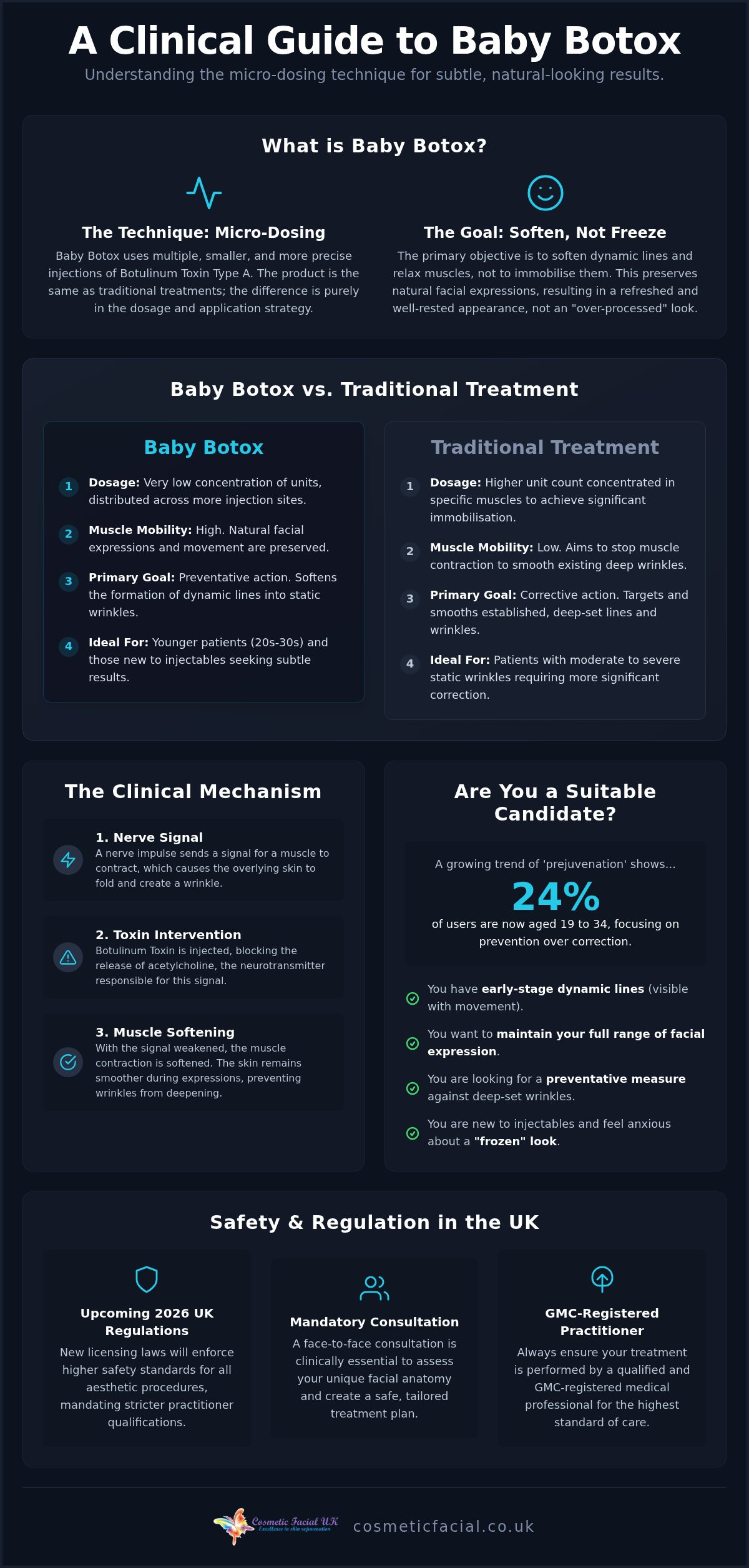
Baby Botox describes a precise clinical strategy involving the administration of reduced volumes of botulinum toxin type A. Unlike standard protocols that aim for significant muscle immobilisation, this technique focuses on softening the transition between facial expressions. It's a method defined by the distribution of smaller, more frequent micro-doses across targeted muscle groups. The product itself remains identical to conventional Botulinum toxin preparations; the distinction lies entirely in the volume injected and the density of the injection sites. This approach allows for a more nuanced modulation of muscle contraction, ensuring the face retains its natural character whilst reducing the impact of repetitive movement on the skin's surface.
The Rise of Preventative Aesthetics
There's been a notable shift in patient behaviour amongst Londoners toward 'prejuvenation' throughout 2026. Younger demographics now represent a growing segment of the aesthetics market. Data suggests that approximately 24% of current users are now aged between 19 and 34. This trend reflects a psychological move from corrective interventions to preventative dermatology. Patients in their 20s and early 30s are choosing baby botox to delay the conversion of dynamic lines into permanent, static wrinkles. Social media has accelerated this demand. High-definition digital environments have made patients more aware of fine texture changes, leading them to seek professional interventions that offer a 'filter-like' skin quality without the obvious signs of clinical work.
Baby Botox vs Traditional Treatment
The primary difference between these two approaches is the balance between longevity and mobility. Traditional treatments typically utilise a higher unit count to achieve a result that lasts three to four months. In contrast, micro-dosing uses a lower concentration of units spread more widely. This results in a shorter duration of effect but offers a significantly higher degree of facial movement. It's a bespoke approach to line management that prioritises muscle mobility over total suppression. At our Marylebone practice, Dr Faramarz Didar applies this technique to ensure that facial markers of emotion remain visible. The outcome is a refreshed appearance that doesn't sacrifice the patient's unique expressions. It's an ideal entry point for those new to injectables who feel anxious about looking over-processed.
The Clinical Mechanism: How Micro-Dosing Botulinum Toxin Works
The physiological foundation of botulinum toxin involves the inhibition of acetylcholine, which is the neurotransmitter responsible for triggering muscle contraction. When injected into targeted areas, the toxin prevents this chemical messenger from reaching the muscle fibres. In a baby botox procedure, the objective shifts from complete muscle paralysis to controlled muscle weakening. This nuanced approach requires significant anatomical precision. The clinician must accurately identify the depth and strength of muscles such as the frontalis in the forehead, the corrugators in the glabella, and the orbicularis oculi responsible for crow's feet. Achieving this softening effect relies on a specialist's understanding of dermatological depth to ensure the toxin remains localised within the intended muscle layer.
Targeting Dynamic vs Static Wrinkles
Dynamic wrinkles are the primary focus of micro-dosing. These lines occur only during facial movement, such as the vertical furrows that appear when frowning. By reducing the intensity of these contractions, the skin is given a reprieve from repetitive folding, which prevents the transition of dynamic lines into permanent features. Static wrinkles, however, are lines that remain visible even when the face is at rest. Whilst micro-dosing can prevent these from deepening, established static lines often require a different clinical approach, such as dermal fillers, to restore lost volume. The success of preventative micro-dosing is also influenced by the patient's existing skin elasticity, which determines how effectively the dermis can bounce back after treatment.
Pharmacology and Concentration
The efficacy of micro-dosing is determined by the relationship between the concentration of the toxin and its diffusion within the tissue. A higher number of injection points using lower units per site creates a more uniform distribution. This technique results in a soft focus effect rather than the stark, immobilised appearance associated with traditional high-dose protocols. Clinicians must carefully manage the dilution to ensure the product doesn't spread into adjacent muscle groups, which could lead to unintended outcomes like brow ptosis. As noted in this Baby Botox overview, the goal is always a subtle enhancement of the patient's natural features. It's imperative that all treatments use MHRA-approved products within a sterile, clinical environment. A thorough facial rejuvenation consultation allows for the mapping of these precise injection sites to ensure a balanced, refreshed outcome.
Is Baby Botox Right for You? Suitability and Clinical Criteria
Determining if baby botox is appropriate for your needs requires a detailed assessment of your facial anatomy. The ideal candidate is typically an adult over 18 who's noticing early-stage dynamic lines that haven't yet become static. For those new to injectables, the primary objective is often a refreshed look that doesn't alert others to clinical intervention. This clinical guide to micro-dosing highlights that patient selection is as much about psychological comfort as it's about physiological suitability.
Patients with deep, established furrows, which are lines visible even at rest, may require a standard dose rather than micro-doses. When lines are etched deeply into the skin, a reduced unit count mightn't provide the level of correction expected. In these instances, Dr Faramarz Didar may suggest combination therapy to address both muscle activity and volume loss. A private dermatologist consultation is the only way to establish a realistic treatment outcome based on your unique skin laxity. This session allows for a thorough examination of how your muscles interact, ensuring the final result is balanced and symmetrical across all facial planes.
Treatment Areas for Micro-Dosing
Achieving a smooth brow whilst maintaining the ability to raise eyebrows involves precise placement in the frontalis muscle. Glabellar lines, or '11s', are softened to reduce the appearance of tension without losing facial character. For the periorbital area, micro-dosing treats crow's feet to refresh the eyes whilst preserving the natural movement associated with a smile. This targeted approach ensures that your face remains expressive, avoiding the 'frozen' look that many patients fear when first considering aesthetic treatments. For individuals seeking further definition, specialised permanent makeup from Advanced PMU can provide a lasting aesthetic foundation that complements the softening effects of micro-dosing.
Certain medical conditions, such as neuromuscular disorders, are absolute contraindications for treatment. Pregnancy and breastfeeding also remain restricted categories in 2026. You must disclose all current medications and supplements during your facial rejuvenation assessment to ensure clinical safety. Dr Didar prioritises patient health above all else, using these consultations to screen for potential adverse reactions or contraindications that might make alternative treatments more suitable for your specific profile.
The Patient Journey: Consultation, Treatment, and Aftercare
The clinical journey begins with a mandatory face-to-face consultation, a requirement solidified by the 2026 UK aesthetics regulations for all prescription-only medicines. During this initial assessment, Dr Faramarz Didar performs a detailed mapping of facial muscle strength. This process is critical for identifying subtle asymmetries that could affect the final result. By observing the patient's dynamic expressions, the clinician determines the precise units required for a baby botox treatment. This methodical approach ensures that the micro-dosing protocol is tailored to the individual's unique muscular activity rather than following a generic template.
What to Expect During Your Appointment
The procedure itself is typically completed within 15 to 30 minutes at our Marylebone clinic. Dr Didar's extensive clinical background as a GMC-registered doctor with an MSc in Dermatology ensures a calm, professional environment where safety is prioritised. We utilise ultra-fine needles specifically designed for micro-dosing to ensure minimal discomfort. The process begins with a thorough skin cleansing followed by the strategic administration of the toxin into the dermis or superficial muscle layers. Once the injections are complete, light pressure is applied to the sites to reduce the risk of immediate swelling.
Precision aesthetics often involves a two-week review, which we consider an essential part of the 'top-up' philosophy. Because botulinum toxin can take up to 14 days to fully bind to the neuromuscular receptors, this follow-up allows the clinician to assess the symmetry and effectiveness of the initial dose. It's an opportunity to perform minor adjustments if the muscle softening requires further refinement to achieve the desired natural outcome.
Aftercare Essentials for London Patients
Following your appointment, specific protocols must be observed to prevent toxin migration and ensure optimal uptake. We advise patients to avoid strenuous exercise and heat treatments, such as saunas or steam rooms, for at least 24 to 48 hours. Increased blood flow to the face can cause the product to diffuse into unintended muscle groups. It's also imperative to remain upright for four hours post-treatment. This precaution helps prevent ptosis, or eyelid drooping, by ensuring the toxin remains localised. Any minor bruising or swelling can be managed with clinical-grade topical care, though most patients resume their professional activities immediately after leaving the clinic.
Book a clinical consultation in Marylebone
Why Choose Cosmetic Facial for Baby Botox in Marylebone?
Selecting a clinic for baby botox requires a careful evaluation of the practitioner's clinical background and their specific approach to facial anatomy. Cosmetic Facial, situated in Marylebone, provides a discreet and professional environment that prioritises patient safety and natural outcomes. It's a medical practice first. Unlike high-street aesthetic bars or retail-focused clinics, our practice is entirely doctor-led. This ensures that every intervention is grounded in medical science and rigorous dermatological expertise. For patients seeking Botox in London, the clinical setting of a private medical practice offers a level of reassurance and precision that high-volume environments cannot replicate.
Expertise You Can Trust: Dr Faramarz Didar
Dr Faramarz Didar (GMC 5200505) leads the clinic with dual expertise in General Practice and Dermatology. He holds an MSc in Dermatology Skills and Treatment from the University of Hertfordshire, which was awarded with Commendation. This academic foundation allows for a sophisticated understanding of skin pathology and the complex biological processes of ageing. His postgraduate qualifications in Non-Surgical Facial Aesthetics enable him to perform line and wrinkle treatments with extreme anatomical precision. Because he's a GMC-registered doctor, he adheres to CQC-level standards within a private medical environment. Patients benefit from a practitioner who's trained to manage both aesthetic outcomes and the broader clinical health of the skin.
A Bespoke Rejuvenation Plan
We don't view aesthetic interventions in isolation. Instead, we often integrate baby botox into a broader full face rejuvenation plan. This comprehensive strategy considers the face as a functional unit, addressing skin quality and texture alongside muscle activity. Long-term skin health monitoring is a core component of our Marylebone practice. We focus on gradual, cumulative improvements that respect the natural ageing process and maintain your unique facial character. This methodical approach rewards the detail-oriented patient who values expertise and intellectual honesty over marketing showmanship. Every treatment plan is personalised to the individual's specific anatomical needs, ensuring that the results remain subtle and harmonious across all facial planes. For patients who value a multi-dimensional approach, traditional practices like those at Zhong Centre can offer a valuable perspective, utilising specialised cosmetic acupuncture to support facial vitality alongside clinical treatments.
The transition toward preventative dermatology relies on the precise modulation of muscle activity. By utilising micro-doses of botulinum toxin, patients can effectively manage early-stage dynamic lines whilst preserving their natural range of facial movement. This clinical approach prioritises long-term skin health and anatomical integrity over temporary, high-impact immobilisation. It's a strategy designed for the detail-oriented individual who values subtle, natural results.
Dr Faramarz Didar, a GMC-registered practitioner (5200505) with an MSc in Dermatology (Commendation) ensures that every baby botox intervention at our Marylebone practice meets the highest medical safety standards. His dual expertise in general practice and dermatology allows for a comprehensive assessment of your facial anatomy. Taking a proactive approach to facial rejuvenation allows for well-rested outcomes that align with your unique features and professional requirements.
Frequently Asked Questions
How long does Baby Botox last compared to standard Botox?
Baby Botox typically lasts between two and three months, which is slightly shorter than the three to four months expected from a standard dose. Because micro-dosing involves smaller volumes of the toxin, the body's metabolic processes break down the product more quickly. This shorter duration is a deliberate trade-off for patients who prioritise natural facial movement and a more subtle aesthetic over the longevity of a traditional, higher-unit treatment.
Is there any downtime after a micro-dosing treatment?
There's virtually no clinical downtime after a micro-dosing session, allowing patients to return to their professional activities in London immediately. You might experience minor localised swelling or redness at the injection sites, but these symptoms typically resolve within thirty minutes. We advise avoiding strenuous exercise, saunas, and steam rooms for 24 to 48 hours to prevent the toxin from diffusing into unintended muscle groups; this ensures the product remains precisely where it was administered.
Can Baby Botox really prevent wrinkles from forming in the future?
Micro-dosing functions as an effective preventative dermatology tool by inhibiting the repetitive muscle contractions that cause skin creasing. By softening these movements before lines become permanent, baby botox prevents dynamic expressions from etching into the dermis as static wrinkles. This 'prejuvenation' approach is particularly successful for younger patients in their 20s and 30s who wish to maintain their skin's structural integrity and delay the need for more intensive corrective procedures later in life.
Will I still be able to move my forehead after the procedure?
You'll maintain a significant range of facial expression because the technique focuses on muscle softening rather than total immobilisation. Dr Faramarz Didar precisely maps the injection sites to ensure that the frontalis muscle retains enough activity for you to raise your eyebrows and express emotion naturally. The goal is a refreshed, well-rested appearance that eliminates the 'frozen' look often associated with higher-dose protocols, making it an ideal choice for professionals who require expressive communication.
How many units are typically used in a Baby Botox session?
A micro-dosing session typically utilises approximately half the number of units administered during a traditional treatment. While a standard procedure might involve 20 to 50 units across multiple areas, baby botox often uses between 10 and 20 units in total. This reduced volume is distributed across a higher density of injection points to create a uniform, soft-focus effect. The exact unit count is always determined during your face-to-face consultation based on your specific muscle strength and anatomical requirements.
What is the best age to start preventative Baby Botox?
Most patients begin preventative treatments in their mid-20s or early 30s when the first signs of dynamic lines appear. In England, it's illegal to administer cosmetic botulinum toxin to anyone under the age of 18. Statistics from 2026 indicate that approximately 24% of current users fall within the 19 to 34 age demographic. Starting at this stage allows for the maintenance of skin elasticity before repetitive movements cause deep-set, static furrows that are technically harder to treat.
Are there any side effects specific to micro-dosing?
The side effects of micro-dosing are identical to standard treatments, including potential minor bruising, swelling, or a temporary headache. However, the risk of more significant complications, such as brow ptosis or eyelid drooping, is substantially lower due to the reduced volume of toxin used. Because the product is placed superficially and in smaller quantities, there's less risk of unintended diffusion into adjacent muscle groups, provided the patient follows the recommended post-treatment aftercare protocols and upright positioning requirements.
How often should I return for maintenance treatments in London?
Maintenance appointments for patients in London are generally recommended every eight to twelve weeks to sustain the softening effect. Because micro-doses metabolise faster than standard units, a more frequent treatment cycle is necessary to prevent the full return of dynamic line formation. Regular monitoring during these visits allows Dr Didar to adjust the dosage and placement as your skin's needs evolve; this ensures your results remain consistent, balanced, and naturally harmonious over the long term.
Disclaimer
All content on cosmetic Facial website, including blogs, graphics, logos, images, and software, is the property of CosmeticFacial UK or its content suppliers and is protected by applicable copyright laws. Unauthorized use, reproduction, distribution, or modification of any content without prior written permission is strictly prohibited.


