


The aesthetic landscape in 2026 has shifted decisively away from exaggerated volume toward a philosophy of anatomical restoration and subtle refinement. For many individuals seeking lip augmentation London, the primary concern is the avoidance of an unnatural "trout pout" that disrupts facial harmony. It's common to seek the restoration of lost volume or the definition of the Cupid's bow without compromising the natural character of the face. Many patients also face confusion regarding technical decisions, such as the appropriate volume of filler required, or experience anxiety concerning the physical sensations of the procedure and potential bruising.
This clinical guide provides a structured framework for achieving sophisticated, natural-looking results through evidence-based techniques and medical safety standards. We'll examine the specific properties of hyaluronic acid fillers, the role of symmetry in facial aesthetics, and the protocols that ensure a high level of clinical precision. By understanding the mechanisms of modern injectables, you can approach your treatment with the confidence that it'll be managed with the expertise and detail-oriented care required for a successful medical outcome.
Key Takeaways
- Understand why Hyaluronic Acid is the preferred biocompatible medium for restoring volume and defining anatomical structures such as the vermilion border.
- Learn how applying the Golden Ratio of 1:1.6 between the upper and lower lips maintains facial symmetry and prevents unnatural outcomes.
- Discover the clinical protocols used to manage patient comfort, including the application of topical anaesthetics and the use of dental blocks.
- Identify how to select a practitioner for lip augmentation london by evaluating medical credentials and specialist dermatological expertise.
- Explore the advantages of a consultation-led approach in a professional Marylebone environment to ensure results are tailored to your unique facial anatomy.
Understanding Lip Augmentation: More Than Just Volume
Lip augmentation is a clinical procedure that utilises injectable dermal fillers to improve the structural integrity, shape, and volume of the lips. Whilst historically associated with significant enlargement, modern Understanding Lip Augmentation involves a more nuanced approach focused on anatomical balance. Within the context of lip augmentation london, practitioners now prioritise the restoration of the vermilion border and the refinement of the Cupid's bow to achieve a result that's proportional to the patient's existing facial features.
To better understand the subtle results achievable with smaller volumes of filler, watch this video demonstration:
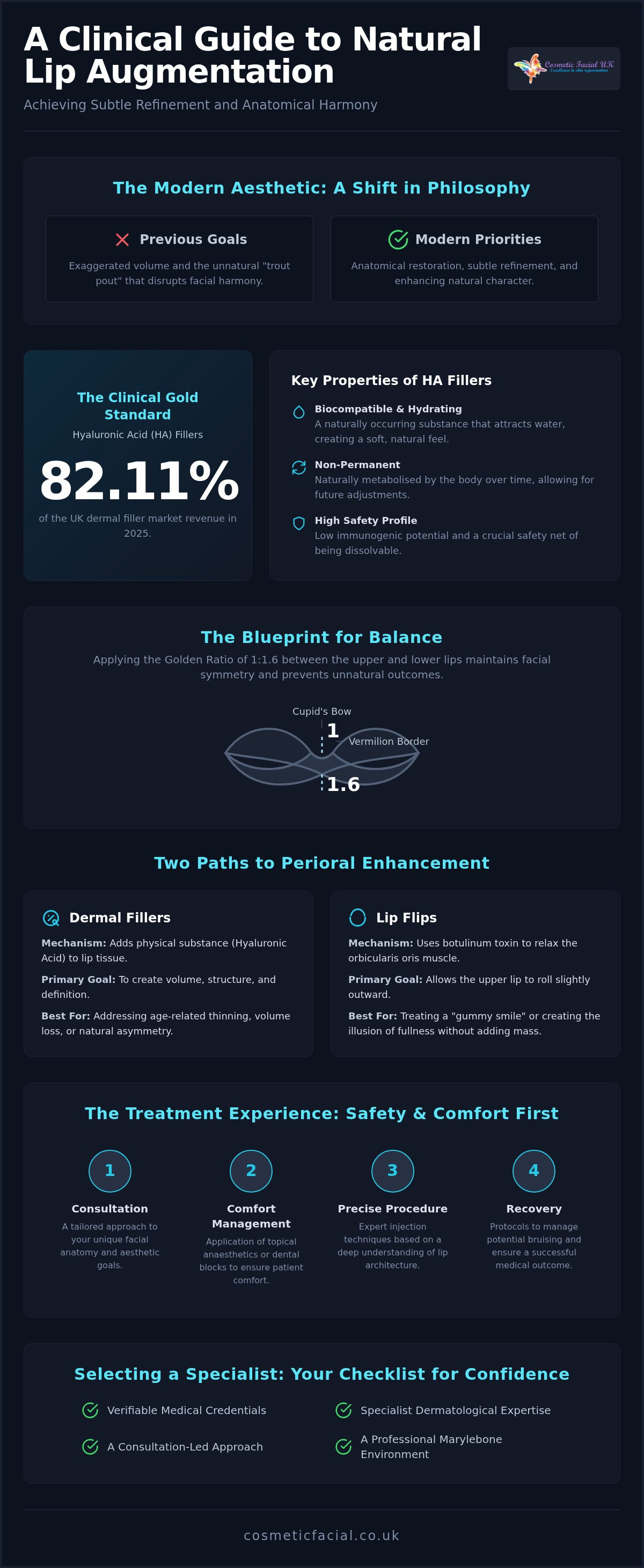
The aesthetic landscape in London has transitioned from the "over-filled" look of previous decades toward a preference for harmonised and natural aesthetics. This shift reflects a growing medical understanding of how lip proportions contribute to overall facial symmetry. Beyond the physical changes, many patients report a notable improvement in self-confidence when asymmetrical features are corrected or when age-related volume loss is addressed. Hyaluronic Acid (HA) has emerged as the primary agent for these procedures because it's a naturally occurring substance in the body, offering a high degree of safety. Its dominance in the sector is evident, as HA fillers accounted for 82.11% of the UK dermal fillers market revenue in 2025, according to industry data. This preference is due to the material's biocompatibility and the clinical advantage of being dissolvable, which provides an essential safety net.
The Difference Between Lip Fillers and Lip Flips
Dermal fillers add physical substance to the lip tissue to create volume and structure. In contrast, a "lip flip" involves the precise injection of botulinum toxin to relax the orbicularis oris muscle, allowing the upper lip to roll slightly outward. While fillers address volume loss, a lip flip is often used to treat a gummy smile or to create the illusion of a fuller lip without adding mass. These techniques are often integrated into a broader plan for facial rejuvenation to ensure the perioral area complements the rest of the face.
Who is the Ideal Candidate for Lip Augmentation in London?
Ideal candidates for lip augmentation london include individuals experiencing age-related thinning of the lips or a loss of definition along the vermilion border. It's also suitable for those with naturally thin lips or congenital asymmetry who desire a more balanced appearance. Clinical assessment is essential to identify contraindications, such as active infections, blood clotting disorders, or specific allergies. A thorough medical consultation ensures that the treatment is safe and that the aesthetic goals are realistic based on the patient's unique anatomy.
The Clinical Choice: Hyaluronic Acid Fillers and Lip Anatomy
Hyaluronic acid (HA) represents the clinical gold standard for lip augmentation london because of its inherent biocompatibility and low immunogenic potential. As a naturally occurring polysaccharide, HA acts as a humectant within the skin, attracting up to 1,000 times its weight in water. This property allows for a result that feels soft and moves naturally during speech and expression. Unlike permanent implants, HA fillers are metabolised by the body over time, which allows for adjustments as facial structures evolve with age.
Successful enhancement requires a deep understanding of the three-dimensional architecture of the lips. The anatomy is comprised of the mucosa, which is the internal lining; the orbicularis oris muscle, providing motor function; and the vermilion border, the critical junction where the lip meets the surrounding skin. Precise placement of filler within these specific layers determines whether the result looks structured or diffuse. High-quality formulations, such as those from the Juvederm or Restylane ranges, are engineered to integrate seamlessly with the host tissue. The extracellular matrix is a complex network of proteins and carbohydrates that provides structural support to lip tissue whilst facilitating the retention of water molecules for sustained hydration.
The Science of Dissolvable Fillers
The primary safety advantage of HA fillers is their reversibility. In the rare event of a vascular compromise or if a patient experiences "filler fatigue" from previous overfilling, the product can be degraded using hyaluronidase. This enzyme breaks down the cross-linked HA molecules rapidly, returning the tissue to its pre-treatment state. Dr Didar’s background in dermatology ensures that fillers are placed with anatomical accuracy, significantly reducing the risk of migration into the cutaneous lip. Patients can explore these clinical options during a consultation at our London clinic.
Premium Brands vs. Generic Alternatives
Choosing a practitioner who uses MHRA-approved and FDA-tested brands is vital for long-term health. Many non-clinical settings offer "no-name" or generic fillers that lack the rigorous safety data of premium products. Following FDA safety guidelines for dermal fillers is essential to avoid complications such as granulomas or chronic inflammation. Premium fillers are available in various rheologies or "weights", allowing the clinician to select a softer gel for hydration or a more cohesive gel for defining the Cupid’s bow. This level of customisation ensures the filler behaves predictably within the dynamic environment of the mouth.
Designing Your Results: Volumes, Shapes, and Aesthetic Harmony
The design of the lips is governed by the principles of facial morphology, specifically the "Golden Ratio" or Phi. In aesthetic medicine, the ideal proportion between the upper and lower lip is approximately 1:1.6. Adhering to this ratio ensures that the lower lip remains slightly fuller than the upper, which is a hallmark of natural beauty. When this balance is ignored, the result is often the "duck lip" appearance, where the upper lip becomes disproportionately heavy and loses its anatomical grace. Achieving a refined outcome for lip augmentation london requires a clinician to respect these proportions whilst considering the patient's unique facial profile.
It's often safer and more effective to build volume gradually over multiple sessions. This incremental approach allows the tissue to expand naturally and reduces the risk of filler migration into the surrounding skin. Clinical excellence in this field is supported by UK government safety regulations, which aim to ensure that only qualified professionals perform these intricate procedures. By prioritising anatomical harmony over immediate, extreme changes, patients achieve a more sustainable and dignified result that complements their features rather than overwhelming them.
Comparing 0.5ml vs. 1ml: Which is Right for You?
The choice between 0.5ml and 1ml of filler depends entirely on the patient's baseline anatomy and their desired clinical outcome. A 0.5ml dose is typically reserved for subtle hydration or the refinement of small asymmetries. It provides a "refresh" rather than a transformation. For many patients considering lip augmentation london, 1ml is often the standard starting point for a visible yet conservative change. Dr Didar's clinical philosophy favours a "less is more" strategy; it's always possible to add more filler in a follow-up appointment, but overfilling in a single session can compromise tissue health and result in a stiff appearance.
Defining the Cupid’s Bow and Philtrum Columns
Modern lip enhancement isn't just about the vermilion border. Sharpening the Cupid’s bow, the "M" shaped curve of the upper lip, provides immediate youthful definition. Equally important are the philtrum columns, the vertical lines extending from the lip to the base of the nose. Restoring these columns improves the lip's projection and creates a more structured profile. This technique is often combined with line and wrinkle treatments to address perioral lines, ensuring the entire mouth area looks rejuvenated and cohesive. By focusing on these structural elements, the clinician can create a lift that looks entirely natural.
The Treatment Experience: Safety, Procedure, and Recovery
The journey toward successful lip augmentation london begins with a rigorous medical consultation. This isn't merely a preliminary step but a clinical requirement to assess your medical history, identify potential allergies, and establish a baseline for your facial anatomy. To ensure a seamless booking experience, many professional clinics now use AI-driven tools like DeskOwl to manage patient enquiries and appointment scheduling effectively. During this session, the clinician evaluates the suitability of the dermal filler for your specific needs. It's also the time when a definitive treatment plan is formulated, ensuring that the aesthetic goals align with the clinical possibilities of the procedure.
Patient comfort is prioritised through the use of advanced anaesthetic techniques. Most modern fillers contain lidocaine, a local anaesthetic that numbs the area as the product is injected. For patients with higher sensitivity, a topical anaesthetic cream is applied to the mucosal surface. In some cases, a dental block may be administered to provide complete numbness, ensuring the procedure is as comfortable as possible.
The injection process itself involves the use of either a fine-gauge needle or a micro-cannula technique. A needle allows for high precision in defining the vermilion border or the Cupid's bow. A micro-cannula, which has a blunt tip, is often preferred for adding volume as it requires fewer entry points and may reduce the risk of bruising. The procedure typically takes 30-45 minutes with immediate visible results.
Clinical Aftercare and Managing Downtime
Managing the 24-48 hours post-treatment is essential for achieving the best aesthetic result. You should expect some degree of swelling, bruising, and tenderness, which are normal inflammatory responses. Following this roadmap helps ensure a smooth recovery:
- Avoid strenuous exercise for 24 hours to prevent increased blood flow to the area.
- Refrain from consuming alcohol for at least 24 hours to minimise the risk of bruising.
- Avoid extreme heat, such as saunas or steam rooms, until the initial swelling has resolved.
- Keep the area clean and avoid applying makeup for at least 12 hours.
Clinicians also suggest avoiding the repetitive pursing motion of the lips immediately following treatment; if you are looking for UK-regulated nicotine alternatives, UK Vape Sales allows you to explore E-commerce retail of vaping hardware and nicotine salts once the initial healing period has passed.
If you notice unusual blanching of the skin, severe pain, or skin that feels excessively cold to the touch, you must contact the clinic immediately. While these reactions are rare, they require prompt clinical assessment to ensure tissue health is maintained.
Safety First: Identifying a Reputable London Clinic
Safety should be your primary consideration when choosing a practitioner for lip augmentation london. It's vital to verify that your clinician is GMC registered and holds appropriate clinical insurance for aesthetic procedures. Non-medical injectors or those offering "home visits" lack the clinical environment and emergency protocols necessary to manage potential complications. A professional clinic in Marylebone provides a sterile, controlled setting where safety is never compromised. For more detailed information on our specific safety protocols, please visit our FAQ page.
Expert Lip Augmentation in Marylebone with Cosmetic Facial
Cosmetic Facial is situated in the professional district of Marylebone, providing a clinical setting for dermal fillers in London. The practice is led by Dr Faramarz Didar, who has been GMC registered since 2006 and holds an MSc in Dermatology Skills and Treatment with Commendation from the University of Hertfordshire. This advanced academic background ensures that lip augmentation london is approached with a high level of medical precision and anatomical understanding. Unlike high-street beauty salons, our environment is structured as a medical clinic where safety protocols and dermatological knowledge are the primary focus. We also integrate a personalised "skin nutrition" approach, often utilising mesotherapy to improve the hydration and health of the perioral tissue before or alongside volume restoration.
Our medical environment differs fundamentally from standard commercial settings because every procedure is treated as a clinical intervention. We prioritise the long-term health of the lip tissue, ensuring that the extracellular matrix is supported and that the fillers integrate seamlessly with your natural anatomy. This method prevents the stiff or "frozen" appearance often seen with less precise techniques. By combining medical-grade skincare with advanced injectables, we achieve results that are both aesthetically pleasing and biologically sustainable.
Why Clinical Expertise Matters for Lip Fillers
Dr Didar’s deep understanding of skin pathology is essential for identifying potential contraindications and preventing complications such as vascular compromise or inflammatory nodules. In a medical environment, we adhere to international standards for injectable treatments, ensuring every product used is MHRA-approved and has a proven safety profile. This expertise is particularly important when managing complex cases, such as correcting migrated filler from previous treatments elsewhere. Patients seeking to understand the typical outcomes of these high standards can view our before and after gallery for real patient results. The clinic’s commitment to ongoing medical education ensures that we utilise the most current and safest injection techniques available in the UK.
Booking Your Consultation at Cosmetic Facial
We encourage a no-pressure consultation as the first step in your treatment journey. This allows for a detailed discussion of your aesthetic goals and a thorough examination of your facial proportions. Many patients find that their concerns about the perioral area are linked to other signs of aging; we also specialise in tear trough fillers to address sunken eyes and provide a comprehensive facial refresh. During your appointment, we'll discuss the specific rheology of fillers best suited to your lip tissue and provide a clear, evidence-based roadmap for your results.
Achieving Anatomical Harmony with Expert Care
The transition toward natural aesthetics in 2026 underscores the importance of a medical approach to lip enhancement. By adhering to the Golden Ratio of 1:1.6 and prioritising the structural integrity of the vermilion border, you can achieve results that are both subtle and sophisticated. Successful lip augmentation london is not merely about increasing volume; it's about restoring balance, improving hydration, and ensuring that any adjustments complement your unique facial profile. Using premium, dissolvable hyaluronic acid fillers provides a high degree of safety whilst allowing for the fine-tuned precision required for a natural appearance.
At our Marylebone clinic, Dr Faramarz Didar (GMC 5200505) applies his MSc in Dermatology with Commendation to every procedure, ensuring that your treatment is grounded in clinical excellence. This expertise allows for the management of complex anatomical concerns with a level of detail that standard beauty settings cannot provide. You're invited to discuss your aesthetic goals in a professional, no-pressure environment where your long-term tissue health is the primary priority.
You can move forward with the reassurance that your facial rejuvenation is in the hands of a qualified medical expert dedicated to achieving your best, most balanced results.
Frequently Asked Questions
How long does lip augmentation in London typically last?
Lip augmentation london results typically persist for six to twelve months before the hyaluronic acid is naturally metabolised by the body. The exact duration depends on the rheology of the specific filler used and the patient's individual metabolic rate. Factors such as high levels of physical activity or frequent sun exposure can also influence how quickly the product degrades. Regular maintenance appointments are usually scheduled once the initial volume begins to diminish.
Is lip filler painful, and what anaesthetic do you use?
Most patients experience only mild discomfort during the procedure because modern dermal fillers contain lidocaine, a built-in local anaesthetic. We also apply a high-concentration topical anaesthetic cream to the mucosal surface before starting. For those with significant needle anxiety or high sensitivity, a dental block can be administered to provide complete numbness. This clinical approach ensures the treatment is manageable and allows for precise placement of the product.
Can lip fillers be dissolved if I am unhappy with the result?
Hyaluronic acid-based fillers are fully reversible through the injection of hyaluronidase, an enzyme that rapidly breaks down the cross-linked molecules. This clinical intervention is used to manage complications or to correct aesthetic dissatisfaction from previous treatments. The dissolution process typically takes effect within 24 to 48 hours. It provides an essential safety mechanism that isn't available with permanent implants or non-HA materials, ensuring patients maintain control over their results.
What is the difference between 0.5ml and 1ml of filler?
The primary difference lies in the clinical objective: 0.5ml is generally utilised for subtle hydration or the correction of minor asymmetries, whilst 1ml is the standard volume for creating visible but conservative enhancement. Choosing the correct volume requires a detailed assessment of your existing lip tissue and facial proportions. Dr Didar prioritises a "less is more" philosophy, often starting with a lower volume to ensure the result remains harmonised with your features.
Will my lips feel "fake" or hard after the treatment?
High-quality hyaluronic acid fillers are designed to integrate with the natural lip tissue, meaning they shouldn't feel hard or "fake" once the initial healing phase is complete. The gel is engineered to mimic the softness and elasticity of human tissue, allowing for natural movement during speech and facial expressions. If a filler feels palpable or lumpy after two weeks, it may indicate improper placement or the use of an unsuitable product weight.
How much does lip augmentation cost at a London clinical practice?
The cost of lip augmentation london varies significantly based on the practitioner's medical qualifications and the premium brand of filler selected. In reputable clinical settings, prices typically range from £250 to £600 per syringe, reflecting the use of MHRA-approved products and a sterile environment. Patients should be cautious of prices significantly below this range, as they often indicate the use of generic materials or a lack of medical oversight and insurance.
Can I have lip fillers if I have a history of cold sores?
Patients with a history of cold sores can still undergo treatment, but it's essential to disclose this during your medical consultation. The injection process can trigger a recurrence of the herpes simplex virus. We typically recommend a course of prophylactic antiviral medication starting a few days before the procedure. This clinical precaution reduces the risk of an outbreak during the healing phase and ensures the skin remains healthy and the results are not compromised.
How soon after treatment will I see the final results?
While you'll see an immediate change in volume, the final aesthetic result is usually visible after approximately fourteen days. This period allows for the initial post-injection swelling and any minor bruising to resolve fully. The hyaluronic acid also takes time to settle and integrate with the surrounding extracellular matrix. We recommend waiting for this full two-week period before assessing the symmetry and volume to determine if any further refinement is required.
Disclaimer
All content on cosmetic Facial website, including blogs, graphics, logos, images, and software, is the property of CosmeticFacial UK or its content suppliers and is protected by applicable copyright laws. Unauthorized use, reproduction, distribution, or modification of any content without prior written permission is strictly prohibited.


