


Can a more defined jawline in a treatment photo show what RF skin tightening may achieve for jowls? RF skin tightening jowls before and after photographs can offer a visual reference, but lighting, camera angle, facial expression and timing all affect how the face appears. A striking image alone cannot show how much of the change is due to treatment or whether it will last.
If you are considering treatment, it is reasonable to want a clear idea of what might change and what may remain. This article explains what to look for in jowl-area photographs, why images cannot predict an individual outcome, and how to interpret results without relying on promotional claims.
You will also learn how skin laxity and facial structure affect what photographs can show, and what to discuss during a clinical assessment. At Cosmetic Facial’s Marylebone clinic in London, an assessment can relate your concerns to the clinic’s radiofrequency treatment approach and consider whether it is suitable for you.
Key Takeaways
- Use RF skin tightening jowls before and after photographs as examples of individual results, not predictions of what treatment will achieve for you.
- Compare images more fairly by checking camera angle, head position, expression, lighting and distance.
- Look for captions explaining when photos were taken and whether other treatments may have contributed to the visible change.
- Understand how radiofrequency treatment relates to skin firmness without assuming it will create a facelift-like result.
- Prepare to discuss your facial anatomy, skin condition, medical history and desired changes during a clinical assessment.
RF Skin Tightening Jowls Before and After: What Do the Photos Show?
Radiofrequency (RF) skin tightening is a category of non-surgical treatment that uses radiofrequency energy to address skin concerns. It is not a guaranteed facelift, and RF treatments can differ in their approach. A photograph may show a visible change after treatment, but it cannot establish what every person will experience or prove that RF alone caused the difference.
Before-and-after photographs show how one person’s jowl-area contour and skin appearance differed at two recorded points in time. They are a visual example, not a forecast. A more defined jawline in a photograph does not automatically mean that facial structure changed or that a particular degree of lifting occurred.
Jowls are influenced by several factors, including skin characteristics, facial anatomy and the distribution of facial volume. Image presentation can also affect what stands out. A clearer contour may reflect a genuine visible difference, but the photographs alone may not explain its cause.
What counts as a visible change around the jowls?
Look for a specific, observable difference rather than relying on broad claims such as “rejuvenated” or “lifted”. For example, the lower face may appear to have a smoother outline, or the transition between cheek and jaw may look different. These descriptions relate to what is visible in the image; they do not establish why it changed.
- Skin appearance: Consider whether the surface looks smoother or less loose in the photographed area.
- Jawline contour: Notice whether the outline appears more or less defined, without assuming the underlying facial shape has changed.
- Volume and proportion: Check whether fullness or facial balance looks different, as these features can affect the appearance of jowls.
Unless the caption gives treatment details and relevant context, it is not possible to attribute a visible difference to RF alone. Other interventions, changes over time or differences in how the images were taken may also be relevant.
Why one before-and-after pair cannot predict your result
Everyone has individual skin characteristics and facial anatomy, and responses to treatment can vary. A selected photograph records one person’s appearance at particular points in time. It may help you understand the type of change shown in that case, but it cannot establish that someone else will have the same result.
A pair of images also cannot show, by itself, whether a change is permanent or how much lifting another person can expect. The apparent difference may be modest, and the images may not provide enough information to interpret it fully. Treat them as an illustration, not a promise.
When reviewing RF skin tightening jowls before and after examples, keep any claim proportionate to what the photographs actually show. A visible difference is one piece of information, not a substitute for assessing your own concerns, facial features and suitability for treatment.
How RF Skin Tightening Works Around the Jowl Area
Radiofrequency (RF) treatment uses electrical energy to produce heat in tissue. In skin-focused treatments, energy is delivered to the area being treated. The intended clinical focus is the skin, where collagen is one of the structural proteins associated with firmness. This general principle does not establish how much change a particular person will see.
RF describes the energy used, not a guaranteed result: the device, delivery method, treatment approach and individual response all matter. The mechanism alone cannot predict how a person’s jowl area will look afterwards.
What happens when radiofrequency energy is applied to skin?
RF devices deliver energy to tissue, where it generates heat. This is a general explanation, not a treatment protocol. Devices differ in how they deliver energy, and clinical approaches can vary. The term “radiofrequency” alone does not tell you the treatment settings, the area addressed or the likely visible effect. Those details require device-specific information and clinical assessment.
Collagen forms part of the skin’s supporting structure and is relevant to its firmness. RF is used in treatments intended to address skin concerns, but this does not mean collagen will remodel uniformly or predictably for everyone. Individual skin characteristics and the treatment approach influence what may be observed. A photograph can show appearance at a given time, but cannot reveal the biological process behind it.
What makes the jowl area different from general skin resurfacing?
The visible lower-face contour reflects more than the skin surface. Skin, facial structure and the distribution of underlying volume all contribute to how the jawline and jowls appear. A skin-focused treatment should not be described as though it can change every factor shaping that contour. RF treatment is not a surgical lift, and it should not be presented as repositioning deeper tissues or removing fat.
It is also useful to distinguish treatment categories. RF uses radiofrequency energy, whereas laser and intense pulsed light (IPL) treatments use light-based energy. Within RF, superficial fractional radiofrequency (SFR) is a particular approach; it is not automatically equivalent to other RF methods, including radiofrequency microneedling. The terminology describes differences in treatment approach, not a guaranteed degree of tightening or a specific jowl outcome.
At Cosmetic Facial in Marylebone, radiofrequency treatment uses a Superficial Fractional Radiofrequency handpiece with a dual-channel delivery system. This identifies the handpiece used, but does not by itself establish a protocol or predict an individual result. The relevance of this approach to a lower-face concern depends on a clinical assessment of your skin and facial anatomy.
Understanding these distinctions can help you interpret claims more accurately and discuss what treatment is intended to address. Read about the clinic’s radiofrequency treatment and facial rejuvenation, then consider how the treatment category relates to your own concerns before drawing conclusions from a photograph.
How to Judge RF Jowl Before-and-After Photos Fairly
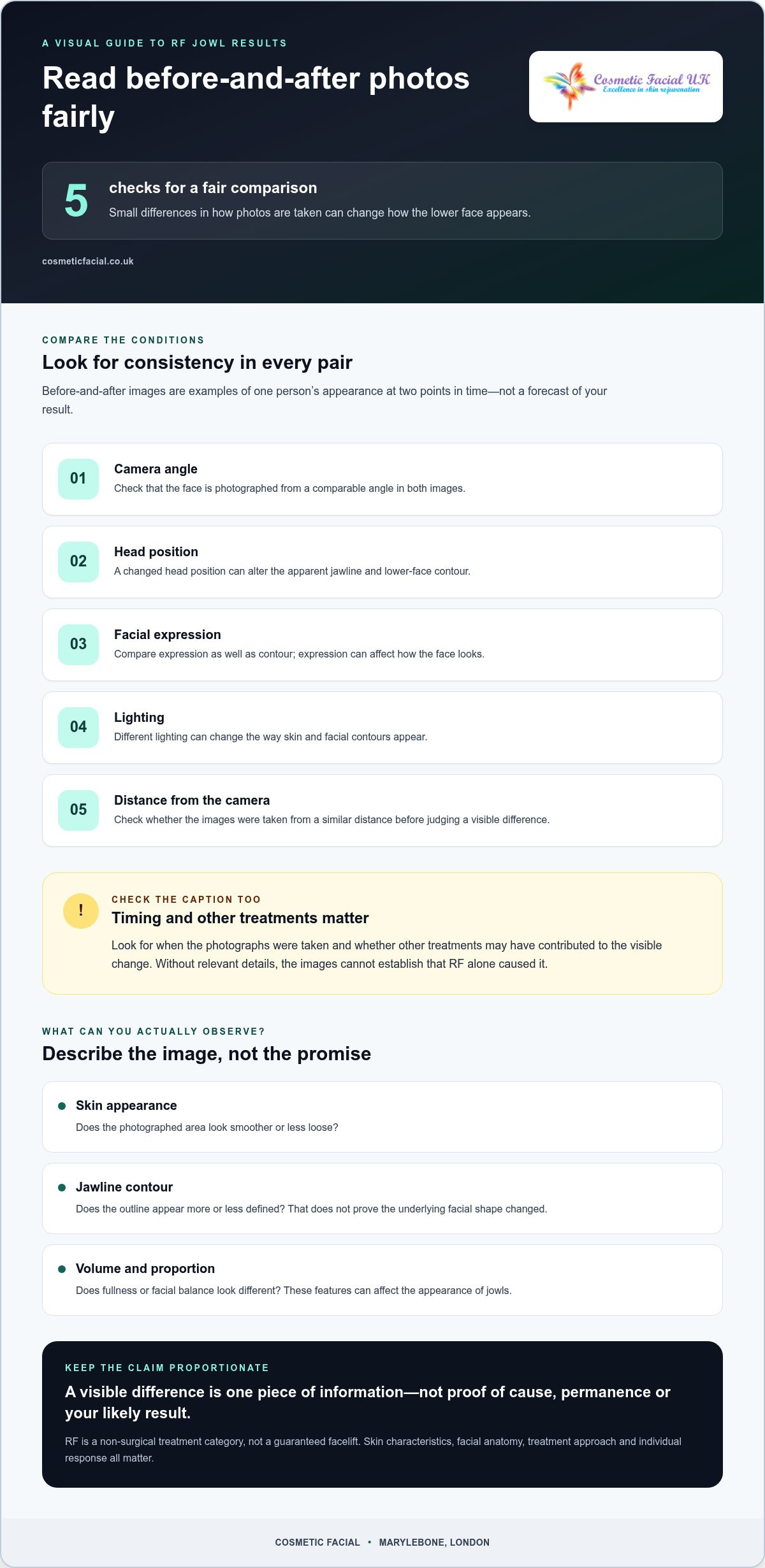
A useful comparison depends on more than the apparent change in the jawline. Before interpreting RF skin tightening jowls before and after photographs, check whether the images show the face under similar conditions and whether their captions provide enough treatment context. If key details are missing, note that uncertainty rather than assuming the photographs are directly comparable.
Which image details make a comparison more useful?
Compare the same areas of the face, then check whether the photographs use similar framing, lighting and camera distance. Even a slight change in head position or expression can alter the apparent jawline. Captions should identify the treatment and the interval between images, and state whether other treatments were also received. Missing details limit interpretation; they do not prove that conditions differed.
- Camera angle and head position: Look for a similar viewpoint and a level, forward-facing head. A turned or tilted face can make one side of the jaw seem more defined.
- Expression and posture: Compare relaxed expressions and similar neck and shoulder positions. Smiling, clenching the jaw or extending the neck can change the outline of the lower face.
- Lighting and distance: Stronger shadows may emphasise contours, while differences in distance or framing can affect how prominent the jowl area appears.
- Image and treatment context: Check for captions giving treatment details, timing and information about any other procedures. Makeup, retouching or image processing may affect the visible appearance; an image alone cannot confirm whether these were used.
For example, if the “after” image has brighter, more frontal lighting and the person is holding their chin differently, the jawline may look sharper even if the photographs do not show matching conditions. That does not establish that the image is misleading. It means the visible difference should be interpreted cautiously.
What can photographs not establish about RF results?
Photographs can document appearance, but they cannot show the full treatment protocol, verify whether an image was edited or prove that another person will have a similar result. Appearance alone cannot establish safety, how long a result lasts or whether the person was satisfied. Those questions require information beyond a visual comparison.
| Visible observation | Context to look for | What you can’t conclude from the image alone |
|---|---|---|
| The jawline appears more defined. | Matching angle, head position, expression and camera distance. | That RF alone caused the difference or that the same change will occur for you. |
| The skin looks smoother or firmer. | Consistent lighting, image processing, makeup and timing. | That the appearance is permanent or demonstrates a specific treatment effect. |
| The lower face looks different overall. | Captions identifying other treatments and relevant changes between images. | That RF changed facial volume, underlying structure or the position of deeper tissues. |
Use the comparison as a prompt for further questions, not as proof of a predictable outcome. A clear caption and consistent photography make an example easier to assess, but they do not remove the limits of what a photograph can show.
What to Expect When Considering RF for Jowls
A useful assessment starts by defining your concern and considering whether RF is a suitable approach. Before deciding, separate what you hope to change from what a treatment can reasonably address. The aim is an individual discussion, not a promise based on somebody else’s photographs.
- Identify the concern. Describe what you notice in the lower face, such as skin looseness, a change in jawline definition or fullness around the jowls. These features can have different contributors, so being specific helps the clinician understand what matters to you.
- Review photographs critically. Use examples to understand the kind of visible change shown, while remembering that images cannot forecast your result. Note what the captions tell you about treatment, timing and any other procedures, as well as what information is missing.
- Discuss suitability clinically. An assessment should take account of your facial anatomy, skin condition, medical history and desired change. These details help inform whether RF is appropriate to consider and what limitations or other approaches should be discussed.
Thinking through RF skin tightening jowls before and after examples can help you describe the result you have in mind. The clinical discussion should focus on your own features rather than on matching a photograph.
Questions to discuss during a clinical assessment
Ask which visible concern RF is intended to address in your individual case, what degree of change may be realistic and what the treatment may not change. Discuss relevant risks and alternatives, too. You can also ask how progress would be assessed and what signs would inform the next discussion, without assuming there is one standard appointment schedule for everyone.
It may help to explain what you consider a worthwhile change. For example, you may be seeking a subtle difference in skin appearance rather than a major alteration to the lower-face contour. The clinician can relate that expectation to your anatomy and skin condition. Reviewing broader facial rejuvenation options can also place the jowl concern in the context of your overall aims.
When a different approach may be discussed
RF is not automatically suitable for every cause or degree of jowling. If your main concern relates to facial volume or deeper structural changes rather than skin appearance, the assessment may consider whether another approach is more relevant, or whether treatment is appropriate at all. This decision is based on the concern and clinical findings, not on photographs alone.
Non-surgical facelift approaches describe a broader category of options and should not be treated as interchangeable with RF. The clinician can explain how the approaches differ and discuss their respective limitations, so expectations remain grounded in the treatment being considered.
RF Skin Tightening in Marylebone: A Clinically Informed Next Step
For people in London considering radiofrequency treatment, Cosmetic Facial provides RF treatment and facial rejuvenation at its Marylebone clinic. The clinic has a professional anti-ageing specialist team. A clinical assessment can relate your lower-face concerns to your skin, facial anatomy and desired change, rather than treating a photograph as a prediction.
How the clinic’s RF information fits into treatment planning
The clinic uses a Superficial Fractional Radiofrequency handpiece with a dual-channel delivery system. This describes the handpiece’s delivery system, not a promise about a particular jowl result or a substitute for discussing the treatment approach. General explanations of radiofrequency describe the energy category; they cannot establish what an individual will experience with a specific device.
Assessment should begin with the concern you want addressed. Describe whether your priority is the appearance of skin laxity, jawline definition or another feature of the lower face. The clinician can consider this alongside your skin condition, facial anatomy, medical history and expectations. This provides a more relevant basis for discussing suitability and limitations than choosing a treatment based only on an image.
It can also help to consider how your concern fits within your wider aims. Facial rejuvenation care provides broader context for discussing the face as a whole, rather than viewing jowls in isolation. The purpose is to understand what you would like to change and whether the treatment being considered addresses that concern, without assuming that every option is interchangeable.
What to take away before making a decision
Before-and-after photographs show an individual’s appearance at particular points in time. Their value depends partly on the information accompanying them, including treatment details, timing and any other procedures. Even a carefully captioned comparison cannot guarantee that another person will have the same result or replace an assessment of individual suitability.
As you review examples, note whether the photographs appear comparable and whether their captions explain the context. Use them to clarify your questions, not to set a fixed expectation. Ask what visible change is being considered in your case, what RF is intended to address, what it may not change and how progress would be evaluated. A measured discussion should allow for uncertainty and individual variation.
Cosmetic Facial’s Marylebone clinic offers a local point of reference for discussing RF treatment and facial rejuvenation in relation to your concerns. Explore the clinic’s information at Cosmetic Facial in Marylebone, then consider your questions before making a treatment decision.
Make Your Next Step an Informed One
Use what you have learned to turn a general interest in treatment into a clear discussion about your priorities. Note the change you hope to see, what matters most to you in a result and any uncertainties that remain. This can help keep an assessment focused on your goals rather than on matching a selected photograph.
When revisiting RF skin tightening jowls before and after examples, treat them as conversation prompts, not benchmarks. Base your decision on how the treatment’s aims and limitations relate to your individual concerns, with space to consider whether the expected change feels appropriate for you.
A considered decision does not need to be rushed. Taking time to ask questions and weigh your options is a constructive step towards choosing an approach that feels right for you.
Frequently Asked Questions
Can RF skin tightening improve jowls?
RF treatment may be considered for skin concerns around the jowl area, but the visible effect depends on your anatomy, skin characteristics and the treatment approach. If your concern is mainly skin laxity, discuss that specifically. Fullness or a change in facial structure may have different contributors. RF should not be described as a surgical facelift or as repositioning deeper facial structures. A clinician can explain what change is realistic in your case.
How long does it take to see RF skin tightening results on jowls?
There is no single timeline that applies to every person or RF device. The treatment approach and individual response affect how changes may appear, so another person’s follow-up photograph cannot set a reliable date for your own assessment. Ask the clinician when they would review your progress and what they would look for. This gives you a timeframe relevant to your treatment plan rather than a social-media claim.
Are RF jowl before-and-after photos reliable?
They can be useful examples, but their value depends on the accompanying context. For RF skin tightening jowls before and after photos, check whether the captions identify the treatment, timing and any other procedures, and compare the image conditions. A photograph cannot independently verify editing, confirm that the same protocol would suit you or guarantee a similar result. Use images to frame questions, not as proof of your likely outcome.
Does RF skin tightening hurt?
Sensation can vary with the device, treatment approach and individual sensitivity, so there is no single experience to expect from every RF treatment. Before proceeding, discuss comfort with the clinician and ask what sensations may occur during your proposed treatment. Also ask about possible side effects and relevant risks in your own circumstances. A before-and-after photograph cannot show how treatment felt, so image examples are not a useful guide to comfort.
How many RF treatments are needed for jowls?
The number of appointments should be based on an individual clinical plan, not copied from someone else’s images. One social-media post refers to six weekly treatments, but that claim does not establish a standard schedule for other people or devices. Ask the clinician to explain the rationale for any proposed course and how they will assess whether it remains appropriate. A clear plan should relate to your concern and response, rather than a generic number.
Is RF skin tightening the same as a facelift?
No. RF is a non-surgical treatment category, while a surgical facelift is an operation. A photograph showing a different lower-face appearance does not demonstrate that RF produces surgical lifting or the same type of result. This distinction matters if your expectation involves a substantial change in facial contour. Discuss your desired outcome and anatomy with a clinician to understand the limits of RF and consider whether it aligns with your aims.
What should I look for in RF jowl before-and-after pictures?
Look for photographs with similar camera angles, lighting, facial expressions and distance, then check whether captions identify the treatment and when each image was taken. A change in head position, for example, can affect how the jawline appears. Note whether other treatments or image edits are disclosed. These checks help you judge how much context is available. If you are in London, bring specific questions about an example to a clinical assessment in Marylebone.
Disclaimer
All content on cosmetic Facial website, including blogs, graphics, logos, images, and software, is the property of CosmeticFacial UK or its content suppliers and is protected by applicable copyright laws. Unauthorized use, reproduction, distribution, or modification of any content without prior written permission is strictly prohibited.


