


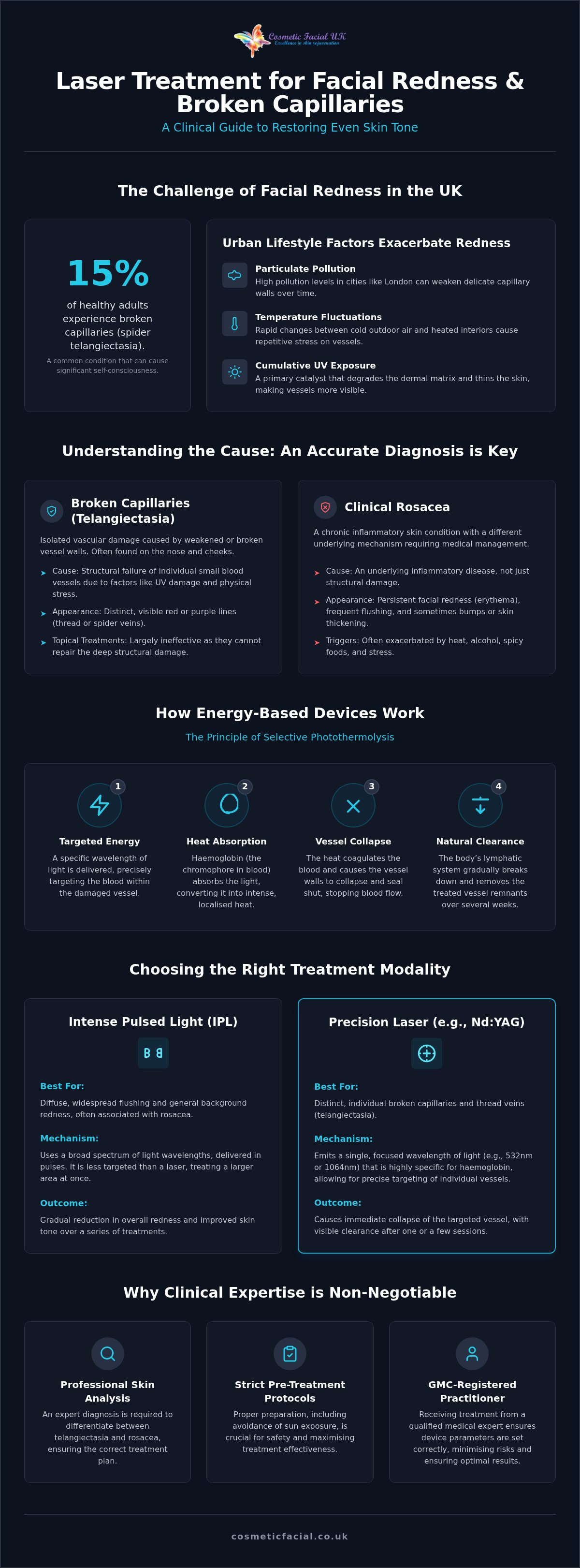
Did you know that up to 15% of healthy adults live with spider telangiectasia, commonly known as broken capillaries? Whilst these visible red or purple vessels are medically common, they frequently cause significant self-consciousness for those who find that even high-coverage makeup fails to conceal persistent flushing. For individuals seeking a permanent solution, laser treatment for broken capillaries on face london offers a clinical pathway to restoring an even skin tone. It's often difficult to distinguish between general rosacea and specific vascular damage, yet identifying the underlying cause is essential for selecting the correct intervention.
We understand that the search for a qualified medical practitioner in Marylebone can be overwhelming given the variety of energy-based devices available. This comprehensive medical guide provides a detailed comparison of the most effective solutions for facial redness and thread veins. You'll gain a clear understanding of the mechanical differences between Intense Pulsed Light (IPL) and advanced laser systems like the 1064 nm Nd:YAG. We'll examine how these technologies target haemoglobin to collapse damaged vessels while preserving the surrounding tissue; this ensures you're equipped to make an informed decision about your dermatological care.
Key Takeaways
- Understand the biological mechanism of selective photothermolysis and how energy-based devices collapse damaged vessel walls whilst sparing healthy tissue.
- Compare the clinical outcomes of IPL for diffuse flushing against precision laser treatment for broken capillaries on face london to find your ideal solution.
- Discover how urban lifestyle factors and environmental triggers in London contribute to the development of visible telangiectasia.
- Learn why a professional skin analysis and strict pre-treatment protocols are necessary to ensure safety and maximise the effectiveness of your vascular care.
- Explore the benefits of receiving treatment from a GMC-registered dermatology expert in the clinical setting of Marylebone.
Understanding Facial Redness and Broken Capillaries
Facial redness is a common dermatological concern that often stems from permanently dilated blood vessels. In clinical terms, these are referred to as Telangiectasias. For residents in the capital, urban lifestyle factors significantly exacerbate these conditions. High levels of particulate pollution and the frequent transition between heated interiors and cold outdoor air during winter months create a cycle of rapid vasodilation and vasoconstriction. Over time, this repetitive stress weakens the delicate vessel walls. London's hard water can also compromise the skin's natural lipid barrier, leading to chronic low-grade inflammation that makes the underlying vasculature more visible amongst those with fairer skin types.
Many individuals initially attempt to manage these concerns with topical vitamin C serums or colour-correcting creams. Whilst these products may provide antioxidant support or temporarily mask the appearance of redness, they don't repair the structural damage to the vessel wall. Because the biological target is located deep within the dermis, topical applications are functionally incapable of collapsing the damaged capillary. This structural limitation is why many patients eventually seek professional laser treatment for broken capillaries on face london to achieve a definitive and lasting result.
The Anatomy of a Thread Vein
A thread vein, or spider vein, occurs when the valves within the small vessels fail or the walls lose their structural integrity. As elasticity diminishes, the vessel remains permanently engorged with blood rather than allowing it to flow through efficiently. Cumulative UV exposure is a primary catalyst for this process; it degrades the dermal matrix and thins the overlying skin layers. The nose and cheeks are particularly susceptible because they are prominent facial features with minimal subcutaneous fat, which ensures any vascular dilation is immediately apparent.
When Redness Indicates Rosacea
It's vital to distinguish between isolated vascular damage and clinical rosacea. Rosacea is a chronic inflammatory condition characterised by persistent erythema and frequent flushing episodes triggered by heat, alcohol, or spicy foods. If left unmanaged, the repeated inflammation leads to permanent vascular changes and occasional thickening of the skin tissue. An accurate diagnosis is the first step toward effective management. A private dermatologist consultation london is recommended to differentiate between these conditions and assess any underlying triggers. Understanding whether the redness is symptomatic of an underlying inflammatory disease or simple photo-damage allows for a more bespoke approach to laser treatment for broken capillaries on face london.
How Energy-Based Devices Resolve Vascular Concerns
Energy-based interventions rely on the principle of selective photothermolysis to address vascular lesions. This process involves the delivery of specific wavelengths of light that are preferentially absorbed by the target tissue, in this case, the blood within the vessel. When performing laser treatment for broken capillaries on face london, practitioners select parameters that ensure energy is concentrated within the damaged vessel whilst sparing the surrounding epidermis and dermis. This precision prevents unnecessary trauma to the healthy skin layers.
Once the light energy is absorbed by the target, it's converted into heat. This rapid thermal rise causes the blood to coagulate and the vessel walls to collapse. Following the procedure, the treated capillary remnants are no longer functional. Over the subsequent weeks, the body's lymphatic system naturally identifies these remnants as waste. Macrophages then clear the debris through a process of phagocytosis, which results in the gradual fading of visible redness and a return to a more uniform skin tone.
The Role of Haemoglobin as a Chromophore
In vascular dermatology, haemoglobin acts as the primary chromophore. It possesses high absorption peaks at specific light frequencies, particularly in the green and yellow spectrums. Clinical research has demonstrated the effectiveness of 532 nm laser treatment for superficial facial veins, as it allows for precise targeting of oxygenated blood. Selective photothermolysis is defined as the precise delivery of energy to a specific target to induce thermal destruction without causing collateral damage to adjacent structures. Controlling the pulse duration is critical; the energy must be delivered faster than the time it takes for heat to dissipate into the surrounding skin.
Long-Term Results and Skin Health
While the primary goal is the removal of visible vessels, these energy-based treatments often provide secondary benefits. The controlled thermal energy can stimulate fibroblasts, leading to increased collagen production in the treated area. This contributes to a broader strategy of facial rejuvenation, which improves skin texture and resilience alongside vascular clearance. It's important to understand that while treated veins are permanently removed, the underlying predisposition to vascular dilation remains. Future lifestyle factors and UV exposure may lead to the development of new vessels over time. Maintaining a consistent clinical skin care regime is vital for preserving the clarity of the complexion. To explore professional-grade options, you can learn more about Synergy Therm Cosmetics. You can also learn more about our specialised approach at Cosmetic Facial.
Selecting the appropriate clinical modality for vascular clearance requires a precise assessment of the vessel's characteristics. Patients often present with a combination of distinct, linear thread veins and a more diffuse, background erythema. The choice between laser, Intense Pulsed Light (IPL), and radiofrequency-based systems depends on the depth, diameter, and colour of the vessels, alongside the patient's position on the Fitzpatrick scale. Professional laser treatment for broken capillaries on face london involves tailoring these technologies to the individual's specific skin health needs; this ensures that energy is delivered at the correct depth without compromising the surrounding tissue.
Laser vs IPL: Which is Best for You?
The primary difference between these technologies lies in the nature of the light delivered. Laser systems emit a monochromatic, coherent beam of light, which makes them precision tools for targeting individual, well-defined vessels. Clinical evidence supports the use of the Nd:YAG laser for facial telangiectasia, especially for deeper or larger vessels that require greater penetration. Intense Pulsed Light, whilst often grouped with lasers, actually uses a broad spectrum of non-coherent light. This makes IPL highly effective for treating diffuse redness and flushing, as the multiple wavelengths can address various depths of the skin simultaneously. A combination approach is frequently the most effective strategy for those seeking laser treatment for broken capillaries on face london. By using IPL to clear general background redness and a precision laser for stubborn, isolated veins, practitioners can achieve a more uniform and natural-looking result.
The ThermaVein Alternative
For patients with very fine, stubborn vessels on the wings of the nose that may be resistant to light-based therapies, ThermaVein provides a targeted alternative. This device utilises high-frequency radiofrequency energy delivered via a microscopic, uninsulated needle to induce thermocoagulation. The heat causes the vessel walls to collapse and seal instantly. Unlike laser or IPL, this method doesn't rely on the absorption of light by haemoglobin, which makes it a versatile option for all skin types. It's particularly useful for treating vessels that are too small for certain laser spot sizes or for patients who have reached a plateau with light-based treatments. Recovery is generally rapid; patients typically experience only minor, temporary redness at the insertion site. This needle-based therapy offers a high degree of precision, which is essential for delicate areas where distinct vessels are visible against otherwise clear skin.
The Patient Journey: Consultation to Recovery
A successful outcome for laser treatment for broken capillaries on face london begins long before the device is activated. A comprehensive clinical skin analysis is the foundational requirement for any vascular intervention. This assessment allows the practitioner to determine the specific depth and diameter of the target vessels whilst screening for contraindications. It's during this phase that we distinguish between simple telangiectasia and complex inflammatory conditions. We require patients to strictly avoid sun exposure and tanning beds for at least four weeks prior to treatment, as increased melanin in the epidermis can absorb the laser energy and lead to unwanted thermal injury.
The treatment session is a precise medical procedure that typically concludes within thirty minutes. You'll experience a sensation often compared to the snap of a small elastic band, which is immediately followed by a cooling effect from the device's sapphire tip or a chilled air system. Protective goggles are worn throughout to shield the retinas from the intense light pulses. Immediately following the procedure, the skin will appear flushed, and some vessels may appear darker or greyer, which is a positive sign of successful thermocoagulation.
Preparing for Your Appointment
A patch test remains an essential safety protocol in our Marylebone clinic. It ensures the selected energy parameters are appropriate for your specific skin type and reduces the risk of blistering or pigmentary changes. Patients using topical retinoids or high-strength exfoliating acids must cease these applications seven days before their appointment to allow the skin's natural barrier to stabilise. You should also organise your social calendar to account for two to three days of potential redness or mild swelling, particularly if the treatment area is extensive.
Recovery and Aftercare Essentials
Aftercare is focused entirely on supporting the skin's recovery and protecting the newly treated areas. The recovery period for laser treatment for broken capillaries on face london is typically straightforward, but it requires diligent adherence to clinical advice. You'll need to apply a bland, occlusive moisturiser to prevent the skin from drying out and to protect the dermal matrix. If micro-crusting occurs, it's vital to let these tiny scabs shed naturally to avoid scarring. Strict adherence to a broad-spectrum SPF 50 is mandatory for several weeks post-procedure, as UV rays can trigger new vascular dilation or cause darkening of the treated sites. If you have concerns about specific reactions, reviewing our frequently asked questions provides a detailed guide on expected post-laser behaviour.
Expert Vascular Care at Cosmetic Facial Marylebone
Achieving optimal results for vascular concerns requires a combination of advanced technology and profound clinical insight. At Cosmetic Facial, our approach to laser treatment for broken capillaries on face london is led by Dr. Faramarz Didar, a GMC-registered practitioner with over 30 years of medical experience. Unlike high-street beauty settings, we treat facial redness as a medical dermatological condition. Every facial thread vein treatment we perform is preceded by a thorough diagnostic assessment to ensure the underlying cause of the vascular dilation is addressed alongside the visible symptoms.
Our Marylebone clinic is situated within London's prestigious medical district, providing a controlled environment where safety and clinical excellence are the primary objectives. We recognise that vascular clearance is often one component of a broader aesthetic goal. For many patients, resolving persistent redness is integrated into a comprehensive nonsurgical facelift or rejuvenation plan. By addressing the skin's vascular health, we create a clearer canvas that enhances the outcomes of other age-management procedures. This bespoke methodology ensures that each patient receives a treatment sequence tailored to their unique skin phenotype and lifestyle requirements.
Clinical Excellence in Marylebone
Dr. Didar holds an MSc in Dermatology Skills and Treatment with Commendation, a qualification that informs every parameter selection and treatment protocol. This level of academic and clinical background is vital when managing complex vascular cases where skin sensitivity or underlying rosacea is present. Being under the care of a GMC-registered professional (5200505) provides patients with the reassurance that their treatment is grounded in established medical evidence and rigorous safety standards. To ensure the highest efficacy for varied vessel depths, our clinic utilises dual-wavelength technology that allows for the precise targeting of both superficial and deeper vascular structures in a single session.
Begin Your Transformation
The path to clearer, more resilient skin begins with an initial clinical assessment in our Marylebone surgery. During this consultation, we conduct a detailed skin analysis and discuss your medical history to formulate a personalised treatment plan. We don't believe in one-size-fits-all solutions; instead, we adjust energy concentrations and pulse durations to match the specific diameter and depth of your capillaries. This meticulous attention to detail is what defines our laser treatment for broken capillaries on face london and ensures consistent, professional outcomes.
Restoring Vascular Health and Skin Clarity
Managing facial redness effectively requires a transition from superficial cosmetic cover-ups to targeted clinical interventions. The distinction between diffuse erythema and isolated telangiectasia dictates whether Intense Pulsed Light or precision vascular lasers are the optimal choice for your skin type. Selecting the most appropriate laser treatment for broken capillaries on face london is a clinical decision that necessitates a thorough understanding of selective photothermolysis and dermal anatomy.
Under the guidance of Dr. Faramarz Didar, who holds an MSc in Dermatology (Distinction) and is a GMC-registered practitioner (5200505), patients receive a level of care rooted in over three decades of medical experience. As a specialist in advanced energy-based skin solutions, Dr. Didar ensures our Marylebone clinic delivers treatments that prioritise safety whilst achieving measurable improvements in skin tone. By following a bespoke treatment plan and rigorous aftercare protocols, it's possible to achieve a more uniform complexion and long-term vascular resilience.
We look forward to assisting you in achieving your dermatological goals through expert clinical oversight and advanced technology.
Frequently Asked Questions
Is laser treatment for broken capillaries permanent?
Laser treatment for broken capillaries on face london results in the permanent thermocoagulation of the targeted vessels. Once the vessel wall collapses and is reabsorbed by the body, that specific vein cannot reappear. It's important to understand that the treatment doesn't prevent the development of new capillaries in the future. Ongoing sun protection and managing inflammatory triggers like rosacea are essential to maintain the clarity of your complexion over the long term.
How many sessions will I need for facial thread vein removal in London?
Most patients require between one and three sessions to achieve optimal clearance of facial thread veins. The exact number depends on the diameter, depth, and density of the vessels being treated. During your clinical assessment in Marylebone, we'll evaluate your skin's response to a patch test and outline a bespoke schedule. Larger or more established vascular networks typically require multiple interventions spaced four to six weeks apart to ensure thorough reabsorption.
Does laser treatment for facial redness hurt?
Patients typically describe the sensation as a brief, sharp pinch similar to the snap of a small elastic band. Modern laser systems utilise integrated cooling technologies, such as chilled sapphire tips or cryogen sprays, to protect the epidermis and minimise discomfort. Whilst the procedure is generally well tolerated without anaesthesia, certain sensitive areas like the wings of the nose may feel more reactive. Any residual heat sensation usually subsides within an hour of the session.
Can broken capillaries on the face be treated on darker skin tones?
Broken capillaries can be treated on darker skin tones using specific long-pulse wavelengths such as the 1064 nm Nd:YAG. These devices bypass the melanin in the upper layers of the skin to target the haemoglobin safely. It's critical that a GMC-registered practitioner performs the treatment, as conservative settings and a mandatory patch test are required to prevent post-inflammatory hyperpigmentation. This ensures the procedure remains effective whilst protecting the integrity of your natural skin tone.
What is the difference between IPL and laser for facial redness?
The primary difference lies in the light delivery system. Laser treatment for broken capillaries on face london uses a single, focused wavelength to target distinct, visible vessels with high precision. In contrast, Intense Pulsed Light (IPL) emits a broad spectrum of wavelengths, which makes it the preferred modality for treating diffuse background redness and general flushing. Many clinical rejuvenation plans utilise both technologies to address different vascular depths and achieve a more uniform skin tone.
Will I need any downtime after my vascular laser treatment?
Most patients experience minimal downtime and can return to their daily activities immediately after the procedure. You should expect some mild erythema and slight swelling, which typically resolves within 24 to 48 hours. In some cases, treated vessels may appear darker or develop tiny crusts as they heal; these should not be picked or disturbed. We recommend avoiding strenuous exercise, saunas, and direct sun exposure for at least five days to support the healing process.
Are there any side effects to laser thread vein removal?
Temporary side effects include redness, localised swelling, and occasional micro-crusting at the treatment site. These are normal inflammatory responses indicating that the thermocoagulation process has been successful. More significant complications, such as blistering or persistent pigmentary changes, are rare when the procedure is conducted by an experienced medical professional. Following strict pre-treatment and post-treatment protocols, particularly regarding UV protection and the avoidance of active skincare ingredients, significantly reduces the risk of adverse reactions.
How much does laser treatment for broken capillaries cost in London?
Fees for vascular treatments in London are typically charged on a per-session basis and vary depending on the size of the treatment area. A single, isolated vein will require a different approach and duration compared to treating the entire face or chest. During your initial consultation at our Marylebone clinic, we provide a detailed breakdown of the sessions required for your specific condition. This ensures your investment is focused on the most effective technology for your needs.
Disclaimer
All content on cosmetic Facial website, including blogs, graphics, logos, images, and software, is the property of CosmeticFacial UK or its content suppliers and is protected by applicable copyright laws. Unauthorized use, reproduction, distribution, or modification of any content without prior written permission is strictly prohibited.


