


A convincing before-and-after photograph can still give an incomplete picture of recovery. Thread lift recovery time photos may show a settled result without revealing earlier swelling, bruising, tenderness or unevenness. If you’re trying to judge when you might feel comfortable returning to work or social activities, a single image offers limited guidance.
It’s reasonable to look for visual examples, but recovery varies with the technique used and individual healing. Lighting, facial expression, camera angle and the timing of a photograph can all affect how someone appears. Photos aren’t a timetable or a guarantee of how your own recovery will look.
This article explains how visible changes may evolve, how to compare recovery photos more fairly and what aftercare to discuss with your clinician. It also covers when changes warrant clinical advice, so you can distinguish normal variation in appearance from a concern that needs assessment.
Key Takeaways
- Recovery is individual, so visible changes don’t follow a fixed timeline or predictable photo sequence.
- Read thread lift recovery time photos in context. Images alone can’t show how healing feels or whether recovery is progressing normally.
- Compare photos fairly by considering timing, camera angle, lighting, facial expression and possible editing.
- Follow your treating clinician’s aftercare instructions and learn which symptoms should prompt clinical advice.
- Before considering a thread lift, discuss recovery, suitability, technique and realistic expectations.
Thread lift recovery time: why photographs can look different
Thread lift recovery is an individual healing process, not a single date or predictable sequence of photographs. The face may look different immediately after treatment than it does as swelling settles and tissues adapt. Bruising, swelling and temporary asymmetry may be visible, but their presence and appearance vary between people. A photograph captures one moment. It can’t show how healing feels, diagnose a complication or predict another person’s result.
Recovery photographs document appearance at a particular point in time; they aren’t guaranteed evidence of an eventual outcome. This matters when reviewing thread lift recovery time photos online. An image can help show what was visible when it was taken, but it can’t provide the full clinical context or confirm what happened before or after.
What thread lift recovery photos can show
A photograph may record visible swelling, bruising, skin irregularity or asymmetry. These features can change as recovery progresses, so an early image shouldn’t be treated as a representation of a later appearance. A later photograph can’t show whether someone experienced discomfort or other symptoms in between.
Check whether the timing is stated clearly, including whether a photo was taken immediately after treatment or at a later review. Without that context, images may look like a direct comparison despite showing different stages. Even dated photographs show appearance only. They can’t confirm that healing is proceeding normally or that a particular result will follow.
Why one person’s recovery may not match another’s
Visible recovery can be influenced by the technique used, the area treated and individual healing. A comparison between two people may therefore involve differences beyond the number of days since treatment. Their starting facial features and the extent of treatment may differ too, limiting what the images can tell you.
Image conditions also affect perception. A different camera angle can alter how facial contours appear; lighting may emphasise or soften shadows; and expression can change the visible position of the cheeks and mouth. Makeup may conceal discolouration, while editing can alter appearance further. These factors make small differences difficult to assess reliably.
For general background on facial-lift terminology and techniques, see Rhytidectomy (Facelift) - Wikipedia. It isn’t a guide to an individual’s thread lift recovery and shouldn’t be used to interpret a clinical outcome.
For a fairer comparison, look for photos taken under similar conditions and labelled with their timing. Treat them as records of one person’s appearance, not proof of typical results or a forecast for your recovery. If a change concerns you, a photograph can’t replace advice from the clinician responsible for your care.
Thread lift recovery time, stage by stage: what to look for
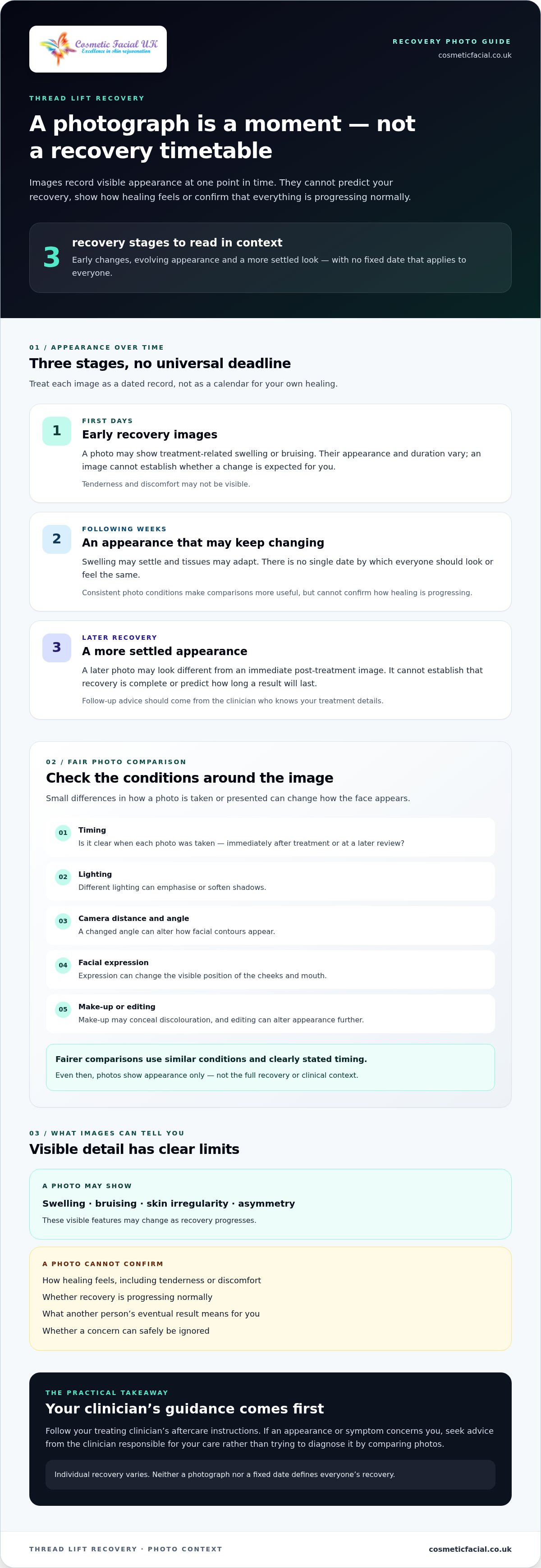
Thread lift recovery doesn’t follow the same timetable for everyone, so read photographs as dated records rather than a calendar. The American Society of Plastic Surgeons describes possible recovery effects and aftercare considerations, but general guidance can’t determine what’s appropriate for an individual patient. Your treating clinician’s instructions take priority, particularly if your procedure involved a specific technique or treatment area.
The first days: interpreting early recovery images
An early photograph may show treatment-related changes such as swelling or bruising. Their extent and duration vary, so an image alone can’t establish whether a particular change is expected for you. It also can’t show tenderness, discomfort or other symptoms that may not be visible. If an appearance or symptom concerns you, contact your treating clinician rather than trying to diagnose the cause by comparing photos.
Following weeks: looking for change without assuming a deadline
After the initial photographs, appearance may continue to change as swelling settles and tissues adapt. There isn’t one date by which everyone should look or feel the same. If you’re tracking changes, note when each photograph was taken and use similar lighting, camera distance, angle and facial expression. This makes comparisons more useful, but still can’t confirm how healing is progressing.
Later recovery: interpreting a more settled appearance
A later image may look different from an immediate post-treatment photograph, but it can’t establish that recovery is complete or predict how long any result will last. Follow-up timing and advice should come from the clinician who knows your treatment details. Don’t use another person’s photographs to set a deadline for your recovery or decide that a concern can safely be ignored.
The American Society of Plastic Surgeons’ thread lift recovery guidance provides general information about recovery and aftercare. Read it as background, not as a substitute for individual clinical advice. A photograph records visible appearance at a particular stage; it can’t assess symptoms, diagnose a problem or confirm a specific outcome.
In brief: early images may record treatment-related changes, while later images may show an evolving appearance. No photograph or fixed date can define everyone’s recovery. Individual timelines vary, and your treating clinician’s guidance should take precedence.
If you’re considering treatment, include recovery expectations in a discussion about your circumstances and thread treatment at Cosmetic Facial.
How to compare thread lift recovery photos fairly
A useful comparison depends on context, not just the visible difference between two images. An immediate post-treatment photograph and one taken later record different points in recovery. Without clear dates, viewers may mistake a change in timing for a direct measure of treatment outcome. When looking at thread lift recovery time photos, look for consistent framing and clear context rather than dramatic visual promises.
Use this checklist to assess what an image comparison can reasonably tell you:
| Factor | What to check | Why it matters |
|---|---|---|
| Elapsed time | Are the dates or intervals since treatment stated? | An immediate image and a later image can’t be compared fairly without knowing when each was taken. |
| Camera angle and distance | Are the face and camera positioned similarly? | A changed angle or distance can alter the appearance of facial contours. |
| Lighting | Are the images lit in a comparable way? | Shadows and brightness can emphasise or soften visible features. |
| Expression | Is the person’s face relaxed in both photographs? | Expression affects the appearance of facial features and skin. |
| Editing and presentation | Are filters, retouching, makeup or cropping apparent? | These may conceal or exaggerate differences, limiting a fair comparison. |
A checklist for reading before-and-after images
Captions should identify the treatment and when each photograph was taken. Check whether camera distance, angle, lighting and expression appear consistent, and note whether makeup or cropping obscures relevant areas. If key details are missing, treat the comparison as limited rather than filling in the gaps yourself. A neutral, clearly dated pair of images is more informative than one framed to maximise contrast.
Recovery photos versus treatment results
Keep short-term healing changes separate from a later appearance. A photograph may show a visible difference, but can’t establish its cause, assess symptoms or confirm that recovery is progressing as expected. An individual result also doesn’t demonstrate what another person will experience. Photos shared by a clinic should be presented with appropriate consent and context, not as guaranteed outcome evidence.
For treatment context, Cosmetic Facial provides information about its non-surgical facelift options. The appropriate approach depends on individual goals and clinical assessment; an image comparison can’t determine suitability. Use photos to prepare questions, not as a substitute for discussing technique, recovery and expectations.
Thread lift aftercare and when to seek clinical advice
Aftercare should be guided by the clinician who performed your thread lift, not by a generic recovery timeline or someone else’s photographs. The technique, area treated and individual circumstances can affect what advice is appropriate. General guidance, including the American Society of Plastic Surgeons’ thread lift recovery information, can help you prepare questions, but can’t replace instructions based on your procedure.
Practical recovery guidance to discuss with the clinician
Before treatment, ask for clear written instructions covering the first part of recovery and how to get help if you have a concern. Make sure you understand any advice about activity, facial movement, sleeping position, skincare, medicines, and touching or massaging the treated area. Don’t assume that instructions for a different thread technique or treatment area apply to you.
Raise routine questions with the treating clinic if you’re unsure how to follow an instruction or what to do before a planned follow-up. Cosmetic Facial’s frequently asked questions can provide general information, but individual aftercare advice should come from the clinician familiar with your treatment. Keep the clinic’s contact details accessible and make a note of any instructions that are unclear.
When photographs are not enough
A photograph can help you describe a visible change, but it can’t assess how you feel, examine the treated area or establish the cause of a symptom. Contact your treating clinician promptly if a symptom is worsening, feels concerning or differs from the advice you were given. Explain when it began, whether it’s changing and whether you have other symptoms. Don’t delay seeking advice because an image appears reassuring.
For a routine question, use the contact route and follow-up arrangements provided by your treating clinic. If you need urgent medical advice and can’t reach the clinic, NHS 111 can help you identify the appropriate next step. If you or someone with you has a life-threatening emergency, call 999 or go to A&E. The appropriate response depends on severity; this article can’t diagnose a complication or determine urgency from a photograph.
Keep a brief record of symptoms and when they began if you need to explain what has changed. You may also take a photograph to show the clinician, provided doing so doesn’t delay seeking care. Images are supplementary information, not a substitute for clinical assessment. The same applies to thread lift recovery time photos found online: they can’t establish what’s safe or expected in your individual case.
Clear aftercare planning is part of considering a thread lift, alongside treatment goals, suitability and realistic expectations. A consultation should give you the opportunity to discuss the technique, likely recovery considerations, potential risks and individual instructions before deciding whether to proceed.
Considering a thread lift in London: make recovery part of the decision
A thread lift decision should account for more than the appearance you hope to achieve. Consider your treatment goals, whether the likely recovery fits your work and social commitments, and whether the procedure is suitable for your facial anatomy and health. Recovery images may help you prepare questions, but thread lift recovery time photos can’t predict your experience or guarantee an outcome.
Cosmetic Facial offers PDO thread treatment and Silhouette Soft Face Lift at its Marylebone clinic in London. These are treatment options to discuss in relation to your needs, not a promise of a particular result. A considered consultation should clarify what a treatment may address, its limitations and what recovery planning could involve.
Questions a thread lift consultation should address
Use the discussion to understand the proposed treatment in practical terms. Ask which area is being considered, what changes may be achievable and what the limitations are. Your clinician should also consider how your medical history and facial anatomy affect suitability, potential risks and recovery. Ask what aftercare will involve, what follow-up is planned and whom to contact if you have concerns.
Be specific about commitments that could affect your decision, such as a work event or social occasion. Rather than relying on a photograph or a general timeline, discuss how much flexibility you may need if visible signs remain. The aim is to make an informed decision with realistic expectations, not to fit recovery to a fixed date.
Clinical experience and treatment context at Cosmetic Facial
Dr Faramarz Didar earned an MSc in Dermatology Skills and Treatment with Commendation in 2015 and completed a postgraduate diploma in non-surgical facial aesthetics in 2013. In 2013, he assisted with a course module on the application of sutures with cones. This describes course participation, not a specialist qualification. Understanding a clinician’s documented education and experience is one part of a wider discussion about the proposed treatment, its risks and your individual care.
Facial planning should take account of your concerns and the areas you wish to address. Cosmetic Facial’s facial rejuvenation information provides broader treatment context. In consultation, discuss how the area being treated relates to your overall goals, what a thread technique can and can’t address, and whether the proposed approach is suitable for you.
Before deciding, make sure you understand the proposed technique, likely recovery considerations, risks and aftercare plan. A clear discussion can help you weigh potential benefits against your own tolerance for recovery and decide whether to proceed, defer or consider another option.
Make your next step an informed one
Use thread lift recovery time photos as prompts for discussion, not as a personal forecast. Before deciding, consider whether your goals, health and recovery plans align with the treatment, and give yourself time to understand the options without pressure. A useful next step is a consultation focused on your circumstances, with space to discuss suitability, risks and aftercare.
At Cosmetic Facial’s Marylebone clinic, PDO thread treatment and Silhouette Soft Face Lift are available to discuss. Dr Didar’s MSc in Dermatology Skills and Treatment with Commendation is part of his documented clinical background. These details provide context for a discussion, not a guarantee of outcome. Your decision should be based on individual assessment and realistic expectations.
With clear information and a recovery plan that reflects your needs, you can take the next step with greater confidence.
Frequently Asked Questions
How long does thread lift recovery usually take, and why can it vary?
There isn’t one recovery duration that applies to every patient. The treated area, technique and individual response can all affect how recovery progresses, so a date in another person’s account isn’t a personal estimate. Ask your treating clinician what changes to monitor and when they expect to review you. Plan some flexibility around important commitments rather than relying on a fixed recovery deadline.
What should thread lift recovery look like in photos during the first few days?
Early photographs may show changes such as swelling or bruising, but appearance differs between people and images can’t determine whether your healing is on course. Note when a photo was taken and use it to describe a concern to your clinician, not to assess yourself against an online example. If you’re concerned about a change, contact the clinician responsible for your care for individual guidance.
Can thread lift recovery photos show whether a complication has occurred?
No. Thread lift recovery time photos can record a visible change, but they can’t diagnose its cause or assess symptoms such as pain or altered sensation. A reassuring-looking photo doesn’t rule out a problem, and an unfamiliar appearance doesn’t confirm one. If something is worsening or concerning, contact your treating clinician and describe when it began, how it has changed and any symptoms you’re experiencing.
When can I return to work after a thread lift?
There isn’t a reliable return-to-work date for everyone. Consider the nature of your work, whether your role involves physical activity or close public contact, and how comfortable you’d feel if visible signs remain. Discuss your schedule with your treating clinician before treatment, especially if you have a fixed event soon afterwards. Follow the individual advice you’re given rather than using another patient’s timeline.
Is bruising or swelling visible in thread lift recovery photos?
It can be. Bruising or swelling may appear in photographs, but images vary according to when they were taken, the lighting and what’s included in the frame. A photo can’t show how the area feels or establish whether a particular change is expected for you. If you’re monitoring your appearance, note the date and report any concern to your clinician instead of judging it against someone else’s image.
What should I look for when comparing thread lift before-and-after photos?
Look for captions stating when each image was taken and what treatment is shown. Check whether the person’s expression, camera position and lighting are similar; otherwise, presentation may influence apparent differences. Makeup, filters or cropping can also limit what you can assess. Treat the images as examples of one person’s appearance, not evidence that you’ll have the same experience or outcome.
When should I contact my clinician after a thread lift?
Contact the clinician who treated you promptly if a symptom is worsening, feels concerning or differs from the aftercare advice you received. Clearly describe what has changed and when it started; don’t wait for a photograph to confirm your concern. If you can’t reach the clinic and need urgent advice, NHS 111 can guide you. For a life-threatening emergency, call 999 or go to A&E.
Disclaimer
All content on cosmetic Facial website, including blogs, graphics, logos, images, and software, is the property of CosmeticFacial UK or its content suppliers and is protected by applicable copyright laws. Unauthorized use, reproduction, distribution, or modification of any content without prior written permission is strictly prohibited.


