


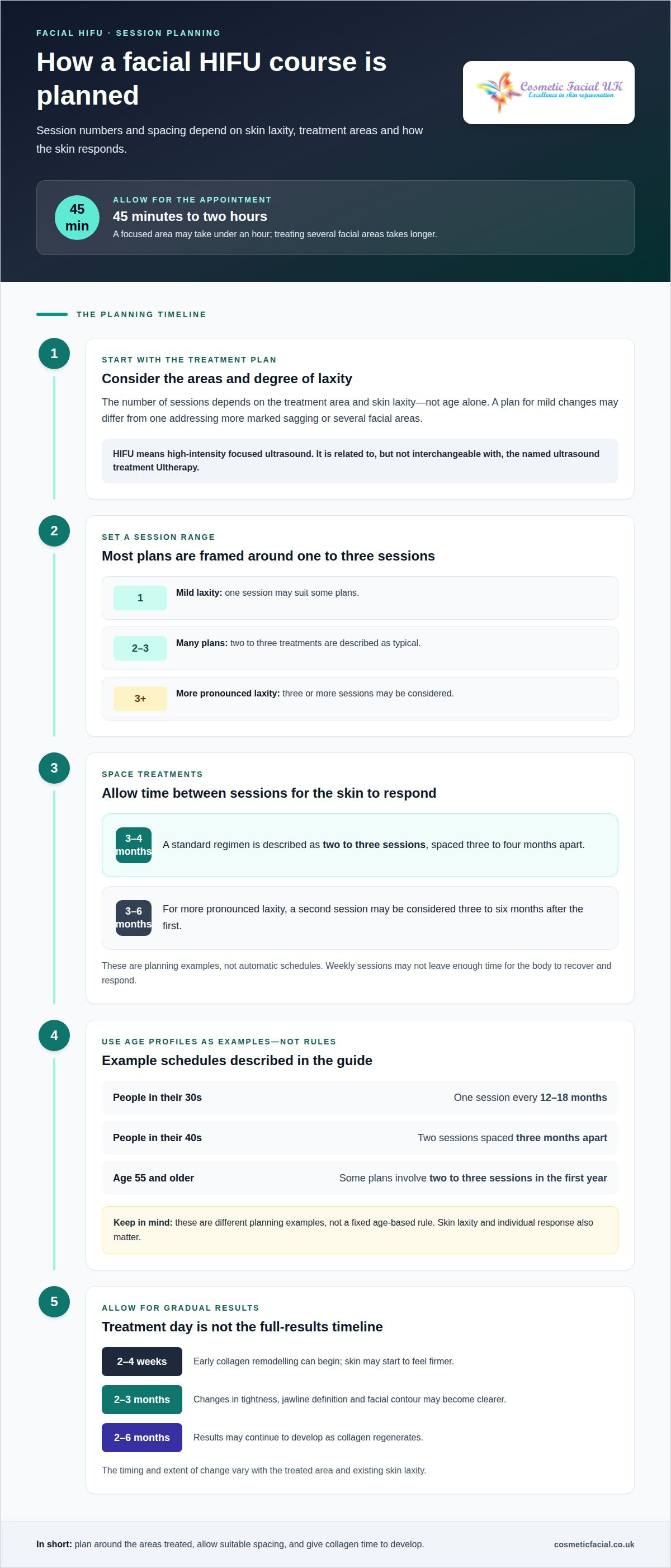
A facial HIFU session usually takes 45 minutes to two hours, depending on the areas treated. For anyone asking how many HIFU sessions are needed for the face, a typical course involves one to three sessions, with the number shaped by skin laxity and the treatment plan. Results can continue to develop over two to six months as collagen regenerates.
It’s understandable to want a clear idea of the time commitment before deciding whether treatment suits you. This guide explains how long an appointment may take, how session numbers and spacing can vary, and what influences the timing and development of results. It also outlines what to consider when planning facial HIFU around your own goals.
Key Takeaways
- Allow around 45 minutes to two hours for a facial HIFU appointment, depending on the areas treated.
- A typical treatment plan may involve one to three sessions; the right schedule depends on skin laxity and individual response.
- HIFU results develop gradually as collagen regenerates, so allow time for changes to become more apparent.
- Age, skin tone and skin elasticity can affect how the skin responds and how often treatment is considered.
- Cosmetic Facial’s HIFU Face Lift is a relevant next step when you want to discuss facial treatment and a schedule suited to your goals.
How long does one HIFU session take?
A facial HIFU appointment typically takes between 45 minutes and two hours, depending on the areas treated. A focused treatment around the eyes and brow, or for a double chin alone, takes under an hour. Treating several facial areas takes longer because the practitioner works across each selected zone.
The treatment area affects appointment length and the pattern of results. The forehead and jawline may show changes relatively quickly, while treating the jowls, eyes or neck can form part of a broader facial plan. Each additional area can extend the appointment. The duration depends on the planned coverage, not simply the treatment name.
Appointment time and the time it takes to see results are different. HIFU may produce noticeable changes after one treatment, but collagen production continues afterwards. Early collagen remodelling can begin within two to four weeks, when skin may start to feel firmer. Visible improvements in tightness, jawline definition and facial contour may develop over two to three months.
This gradual response explains why the first day does not show the full outcome. HIFU stimulates collagen beneath the skin, and the body needs time to form and remodel it. Results may continue improving for two to six months. The intensity and extent of change depend on the treated area and existing skin laxity, including sagging around the lower face.
Results also have a longer-term timeline. Most people keep their HIFU results for 12 to 18 months, although individual duration varies. Some results may last up to three years. These timeframes are not interchangeable: the treatment area, degree of laxity and natural changes in skin can influence how long lifting and tightening remain noticeable.
For practical planning, separate the appointment itself from the period needed to assess the outcome. A single-zone visit, such as the brow, may fit within an hour; a wider facial and neck treatment can take closer to the longer end of the 45-minute-to-two-hour range. Allow several months for collagen production and facial contour changes to develop before judging the full result.
- Appointment: 45 minutes to two hours, depending on coverage.
- Early response: firmness may begin to emerge within two to four weeks.
- Developing result: facial changes may become clearer over two to three months and continue for two to six months.
- Duration: results commonly last 12 to 18 months, with some lasting longer.
The appointment may therefore be relatively short compared with the time needed to see the full effect. Considering the treatment area and allowing time for collagen to develop gives a more realistic picture of both the visit and the results timeline.
Typical number of HIFU sessions for the face
A typical facial HIFU plan involves one to three sessions, depending on skin laxity and treatment goals. HIFU means high-intensity focused ultrasound. Ultherapy is a named ultrasound treatment, so the terms are related but not interchangeable.
Session numbers by age profile
Age profiles can help frame session planning, but skin laxity remains relevant. People in their 30s may have one session every 12 to 18 months, while those in their 40s may have two sessions spaced three months apart. For people aged 55 and older, some plans involve two to three sessions in the first year.
These examples describe different schedules, not a fixed age-based rule. People in their 40s or 50s may need one or two sessions, while younger people may also need one or two. The reason is that age alone does not show how much laxity is present or how the skin may respond.
Recommended session numbers
One to three sessions is a useful general range when considering how many HIFU sessions are needed for the face. One session may suit mild laxity, while two to three treatments are described as typical for many plans. More pronounced laxity may lead to consideration of three or more sessions.
The recommended number depends on the treatment area and degree of laxity, not age alone. A plan for mild changes differs from one addressing more marked sagging. HIFU uses focused ultrasound on selected skin layers to support collagen production over time, rather than to create an immediate surgical result.
Session spacing
Spacing gives the skin time to respond between treatments. A standard regimen is described as two to three sessions, spaced three to four months apart. For more pronounced laxity, a second session may be considered three to six months after the first.
Schedules vary with the treatment area and degree of laxity. Weekly HIFU sessions may not leave enough time for the body to recover and respond. A course may instead be spread over a longer period, with maintenance considered later rather than treatments being added close together.
These intervals are planning examples, not a schedule to apply automatically. The practitioner considers the distribution of laxity, the areas being treated and the response to the first session. For example, someone with mild lower-face laxity may have a different plan from someone treating several facial areas.
HIFU and Ultherapy should not be compared by session count alone. The treatment name does not establish the device, protocol or number of appointments, and the terms do not guarantee equivalent outcomes. A surgical facelift is a different procedure, so its treatment pathway cannot be used to estimate HIFU sessions.
If you are considering facial ultrasound treatment, you can discuss a suitable facial treatment plan based on your areas of concern and skin laxity.
HIFU benefits for facial lifting and tightening
Facial HIFU uses high-intensity focused ultrasound to deliver energy into selected tissue. This controlled heating creates points of thermal stimulation, with temperatures around 60 to 70 degrees Celsius. The aim is to stimulate collagen production and support skin tightening, rather than remove skin or perform a surgical facelift.
As collagen remodels, areas with mild laxity can appear firmer and more defined. Noticeable tightening and lifting may appear within 4 to 8 weeks after the first session. For example, a softer jawline or early jowling may become less apparent as the treated tissue responds. The degree of change depends on the starting laxity and the area treated.
HIFU may be used on facial areas such as the forehead, lower face and neck. Each area has a different treatment purpose: the forehead and brow relate to upper-face lifting, while the jawline and jowls concern lower-face contour. Treating around the eyes requires attention to delicate anatomy, and a double chin is a distinct area beneath the jaw.
HIFU is generally discussed as an approach to targeted lifting and tightening. Its main purpose in this context is lifting and tightening, not reducing overall facial volume. A double chin concern can involve tissue beneath the jaw, but the treatment goal should distinguish contouring from addressing skin laxity. This matters because a slimmer appearance and firmer skin are different outcomes.
Session frequency depends on the result sought and the skin’s response. Maintenance treatments are typically considered every 12 to 18 months. This interval is a planning guide, not an instruction to repeat treatment automatically. The visible changes, degree of laxity and areas previously treated all inform whether another session is relevant.
HIFU also differs from a surgical facelift in how it approaches lifting. A facelift is surgery; HIFU delivers focused ultrasound without surgically repositioning tissue. Compare the intended outcome, not just the word “lifting”. HIFU may suit someone seeking gradual tightening, while more extensive sagging calls for a different clinical consideration.
For a practical assessment of potential benefits, consider these distinctions:
- Skin tightening: collagen stimulation supports gradual firmness in treated areas.
- Facial contour: jawline and jowl treatment targets definition, not general fat reduction.
- Timing: visible lifting may emerge within 4 to 8 weeks.
- Frequency: maintenance is typically considered every 12 to 18 months, depending on response.
How HIFU Works?
HIFU uses focused ultrasound energy to heat small points within selected tissue. The heat stimulates an internal response that supports collagen formation. In the protocol described, those points reach around 60 to 70 degrees Celsius. The intended effect is gradual tightening, rather than immediate surgical repositioning of facial tissue.
Ultrasound energy is directed at different depths according to the target layer. A depth of 1.5 mm targets the superficial dermis, whilst 3.0 mm reaches the deep dermis and stimulates collagen production. A 4.5 mm depth targets the SMAS layer, a deeper support layer beneath the skin. The chosen depth changes which tissue receives energy.
This layered approach helps explain why HIFU treatment can address concerns such as mild jawline laxity. It is most effective for people over 30 with mild-to-moderate skin laxity. The treatment does not produce the same effect for every patient, because age, skin tone and skin elasticity influence response. These factors matter when matching the treatment to a specific concern.
People considering HIFU for mild or moderate laxity should distinguish firmer skin from more advanced sagging. The treatment stimulates collagen within targeted tissue; it does not remove excess skin. For example, early loss of jawline definition differs from substantial loose skin. The extent and location of laxity affect whether this approach is suitable.
Suitability also depends on the treatment area and medical history. A proper assessment considers the skin condition, the concern being treated and the intended ultrasound depth. For example, a plan targeting the lower face differs from one covering the brow. This helps establish whether HIFU’s effect on targeted tissue matches your goals.
Contraindications are considered during the assessment, rather than inferred from age alone. The clinician reviews relevant medical history and the condition of the intended treatment area before planning HIFU. A treatment that may suit one person’s jawline laxity may not suit someone else’s circumstances. No single age or skin type determines suitability by itself.
HIFU is a non-surgical option, not a substitute for every form of facial lifting. It relies on focused ultrasound and collagen stimulation, while a surgical facelift uses a different approach. If you are considering treatment for mild-to-moderate laxity, these distinctions can help you discuss realistic aims, including which facial layers and areas need attention.
Factors affecting session frequency
The interval between HIFU sessions depends on the skin’s starting condition and response. Age, skin tone and elasticity can all influence results. These factors help explain why two people with similar concerns may follow different schedules.
Skin laxity is a central consideration. Mild laxity may need fewer treatments than more pronounced sagging, and the areas involved also shape the plan. For example, treatment focused on the jawline differs from a plan covering the lower face and neck. The number of areas alone does not determine frequency; their condition and the treatment goals matter too.
HIFU uses focused ultrasound to stimulate tissue, followed by a gradual collagen response. Because this process takes time, the schedule should allow the skin to respond before another session is considered. Treatments are commonly spaced three to four months apart. Weekly sessions may not give the body enough time to recover and respond.
The response after the first session is another practical factor. Early collagen remodelling can begin within two to four weeks, while visible changes may develop over several months. Assessing the evolving result helps distinguish an incomplete response from one that is still developing. Scheduling further treatment too soon could make that assessment less useful.
The intended outcome also affects treatment frequency. Someone seeking subtle lifting for early laxity may have different needs from a person addressing more visible changes across several facial areas. The plan should account for the depth and distribution of laxity, rather than applying the same interval to everyone.
Maintenance timing is separate from the initial course. HIFU maintenance sessions are typically recommended every 12 to 18 months. The interval can depend on how long the lifting effect remains noticeable and changes in skin elasticity. A maintenance appointment should relate to the observed result, not simply follow a calendar without considering the face.
Downtime is another planning consideration, although HIFU involves no downtime. Treated skin may still feel mildly sensitive for up to a week. This can matter when scheduling around personal plans, even though it does not determine the number of sessions. Distinguishing the treatment date from the timeline for developing results makes planning clearer.
In practice, session frequency reflects several connected factors:
- Skin characteristics: age, tone, elasticity and degree of laxity.
- Treatment scope: the facial areas and depth being addressed.
- Response: how the skin changes as collagen remodelling develops.
- Timing: sufficient spacing between treatments and maintenance based on results.
These considerations help shape a schedule around your skin rather than a fixed routine. The treatment goal, areas involved and response over time all contribute to session frequency.
Cosmetic Facial
Cosmetic Facial provides personalised care for people considering facial HIFU and its treatment schedule. A discussion can put typical session numbers, spacing and the gradual development of results into context alongside the skin laxity and areas you want to address. This can help if you are unsure whether one session may be enough or want to understand why a plan could involve further treatments.
This article offers general guidance, while your goals and skin characteristics shape what may be appropriate for you. Cosmetic Facial’s qualified specialists can help you consider these factors as part of your care.
Contact Cosmetic Facial to discuss your questions about facial HIFU.
Plan your next step with confidence
Use the information on session timing as a starting point for an informed treatment decision. Before proceeding, identify the facial areas you want to address and the change you hope to see. These details help shape a focused discussion about whether HIFU is appropriate for your concerns and what plan may suit you. Session count is only one part of the decision; your priorities and treatment approach matter too.
Cosmetic Facial offers HIFU Face Lift, alongside Botox Treatment and IPL Hair Removal Treatment. If you are considering facial HIFU, a discussion can help you explore how the treatment relates to your goals and circumstances. The final plan depends on an assessment of your individual needs.
Take the time you need to make an informed choice. A clear discussion of your goals is a practical next step towards deciding whether facial HIFU is right for you.
Frequently Asked Questions
When will I see my HIFU results?
Early changes may become noticeable within four to eight weeks, although results develop progressively. For example, you might first notice firmer skin before seeing a clearer change in facial contour. Collagen remodelling continues after treatment, so your appearance in the first few weeks may not represent the eventual outcome. Assess changes over time rather than relying only on how your skin looks immediately afterwards.
Does HIFU make you look younger?
HIFU may create a firmer, more lifted appearance in areas affected by mild or moderate skin laxity, which some people associate with looking younger. It does not stop the natural ageing process, and results vary. For example, improved definition around the lower face may make the facial contour appear more defined. HIFU is not a surgical facelift and should not be expected to reproduce surgical results.
How long does the treatment take?
A facial HIFU appointment generally takes between 45 minutes and two hours, depending on the treatment areas. A session focused on the eyes and brow, or the double chin alone, takes under an hour. Treating several zones requires more appointment time. For instance, a plan covering both the lower face and neck involves a broader area than treatment focused on the brow.
Are there any side effects?
Temporary tenderness, warmth or mild sensitivity can occur after HIFU. Treated skin may feel sensitive for up to a week, and mild tenderness or warmth can occur during the first seven days. Numbness around delicate areas, such as the eyes and lips, may last around two weeks. These effects differ from the gradual collagen response, so note where and when sensations occur and discuss concerns with your practitioner.
Does it hurt?
Discomfort during HIFU varies between individuals and treatment areas. Focused ultrasound delivers energy beneath the skin, so sensations may differ as the practitioner treats areas such as the jawline or brow. There is no single pain level that applies to everyone. If you are concerned about comfort, raise this before treatment so the practitioner can explain what to expect for your planned facial treatment.
How does HIFU work?
HIFU stands for high-intensity focused ultrasound. It directs ultrasound energy to selected points beneath the skin, where controlled heating stimulates a collagen response. The aim is gradual tightening without surgically repositioning facial tissue. Treatment depth and location matter: a plan for the brow may target different tissue from one addressing the lower face. The effect develops as the skin’s collagen response progresses.
How long do results take to appear, and how long do they last?
Results can develop over several months rather than appearing fully on treatment day. Collagen production continues after the session, so changes may become clearer as the skin remodels. Most people retain results for 12 to 18 months, although some results may last up to three years. These timeframes describe different possible durations; they don’t mean every person will experience the same timing or longevity.
How many HIFU sessions are recommended for facial skin tightening?
For anyone asking how many HIFU sessions are typically needed for the face, the general range is one to three. Mild laxity may be treated with one session, while more pronounced laxity can call for additional treatments. Sessions are often spaced three to four months apart, allowing time to assess the skin’s response. The recommended plan depends on the treatment areas, degree of laxity and intended result.
Disclaimer
All content on cosmetic Facial website, including blogs, graphics, logos, images, and software, is the property of CosmeticFacial UK or its content suppliers and is protected by applicable copyright laws. Unauthorized use, reproduction, distribution, or modification of any content without prior written permission is strictly prohibited.


