


An aesthetic smile is defined by the precise balance between the lips, teeth, and gingival tissue rather than the mere presence of a smile itself. Many individuals find that an excessive display of gum tissue when they laugh or smile creates a sense of self-consciousness, often leading them to hide their expressions in photographs or social settings. Choosing botox for gummy smile london provides a sophisticated alternative to invasive maxillofacial surgery, offering a clinical solution that's both efficient and minimally disruptive to your daily routine.
This medical intervention uses precision injections to moderate the activity of the muscles responsible for elevating the upper lip, ensuring a natural result that preserves the unique character of your expression. In this guide, we detail the anatomical principles behind the treatment, the safety protocols involved in professional clinical care, and the specific outcomes you can expect whilst visiting a GMC-registered practitioner in Marylebone for your facial rejuvenation. By understanding the clinical mechanism of botulinum toxin, you can make an informed decision about your aesthetic care.
Key Takeaways
- Identify the clinical causes of Excessive Gingival Display, ranging from muscular hypermobility to skeletal factors, to ensure your treatment plan is anatomically appropriate.
- Explore how targeted botox for gummy smile london provides a non-surgical alternative to traditional gum contouring with minimal downtime and predictable clinical results.
- Understand the significance of receiving treatment from a GMC-registered doctor who specialises in the complex musculature of the perioral region to maintain natural facial expressions.
- Preview the complete patient journey, from the initial diagnostic consultation and smile assessment through to the precision injection phase and subsequent follow-up care.
Understanding Gummy Smiles: Causes and Clinical Solutions in London
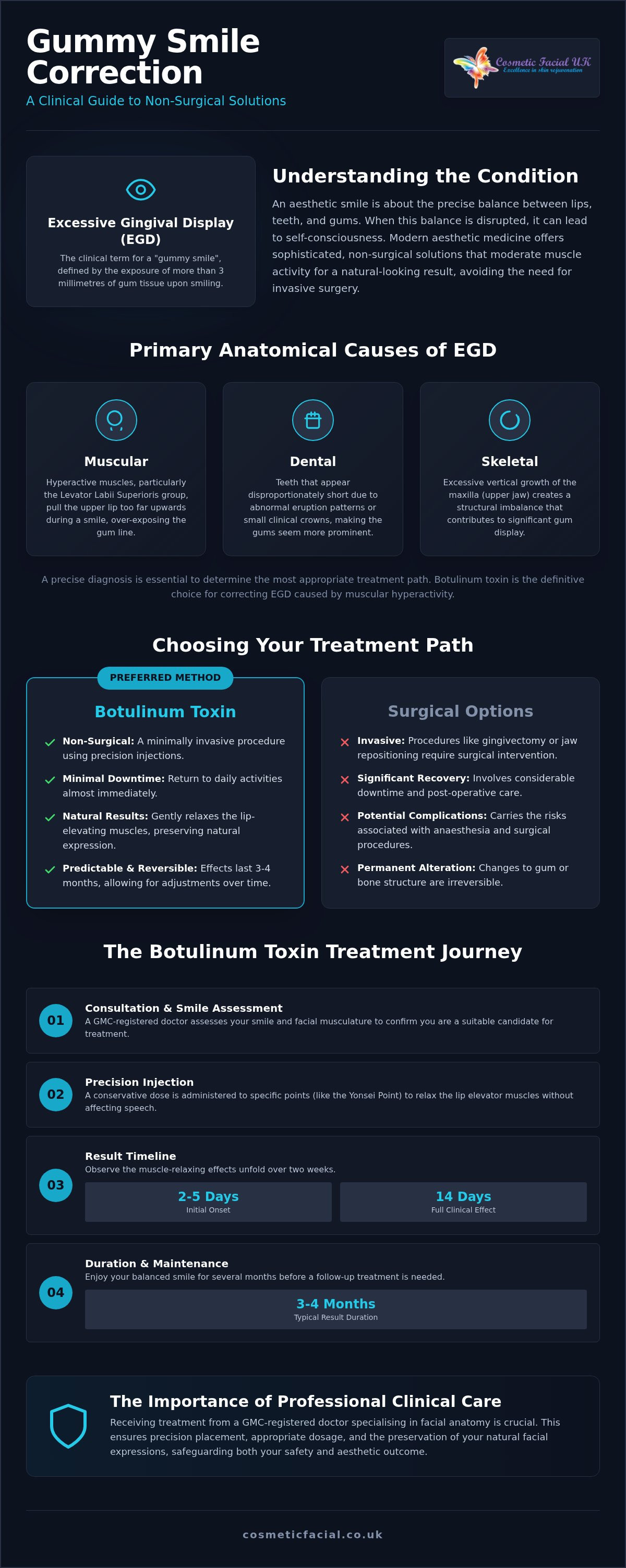
In clinical aesthetic medicine, What is a gummy smile? is formally referred to as Excessive Gingival Display (EGD). This condition is defined by the exposure of more than three millimetres of gum tissue during a full smile. Whilst the perception of an attractive smile is subjective, EGD often leads to persistent self-consciousness. This psychological impact frequently results in individuals concealing their expressions in social or professional settings. In London, where the non-surgical cosmetics industry is now valued at approximately £3.2 billion, patients are increasingly opting for refined clinical interventions rather than invasive maxillofacial surgeries.
Determining the appropriate treatment path requires a precise diagnosis of the underlying cause. EGD typically originates from one of three primary anatomical factors:
- Dental: This involves abnormal tooth eruption or small clinical crowns that make the teeth appear disproportionately short compared to the gums.
- Skeletal: This is caused by excessive vertical growth of the maxilla, or upper jaw, which creates a structural imbalance.
- Muscular: This occurs when the muscles responsible for lifting the upper lip are hyperactive, pulling the lip too far upward during a smile.
The Anatomy of a Smile: Why Your Gums Show
The mechanics of a smile involve the complex coordination of several perioral muscles. The Levator Labii Superioris muscle group, specifically the Levator Labii Superioris Alaeque Nasi (LLSAN), is the primary driver of lip elevation. When these muscles are hyperactive, they exert excessive force. This results in the upper lip retracting significantly higher than the dental arch. It's essential to distinguish this muscular hyperactivity from a short upper lip. In many cases, the lip is of a standard length but is simply over-retracted by the underlying musculature during emotional expression.
Non-Surgical vs. Clinical Interventions
Botulinum toxin has become the definitive non-surgical choice for correcting muscular EGD. Unlike surgical gingivectomy or jaw repositioning, which involve significant recovery periods and potential complications, botox for gummy smile london offers a refined modulation of muscle activity. The procedure's success depends on a professional facial rejuvenation assessment. This consultation confirms that the display is muscular in origin rather than skeletal. Suitable candidates are typically those seeking a balanced, natural-looking smile without the risks associated with surgical sedation or permanent structural alteration.
The Science of Botulinum Toxin for Excessive Gingival Display
Botulinum toxin type A acts as a potent neuromodulator by interfering with the transmission of nerve impulses to the muscles. Specifically, it inhibits the release of acetylcholine, a chemical messenger required for muscle fibres to contract. By introducing a controlled amount of the toxin into the perioral muscles, we can effectively reduce the elevation of the upper lip. This relaxation ensures that less gum tissue is visible during emotional expression, creating a more proportionate smile.
When considering botox for gummy smile london, it's vital to understand the timeline of the biological response. The onset of action isn't immediate; patients typically observe the initial weakening of the muscles within two to five days. The full clinical effect is generally reached at the fourteen-day mark. Because the body naturally metabolises the protein over time through enzymatic processes, the effects are temporary. Results typically persist for three to four months, after which the muscle activity gradually returns to its baseline.
The Injection Process: Precision and Placement
Precision is paramount in the mid-face to ensure speech preservation and natural movement. Practitioners often target the Yonsei Point, a landmark located at the intersection of the levator labii superioris, levator labii superioris alaeque nasi, and zygomaticus minor muscles. A conservative dosage is applied here, as achieving botox for gummy smile london with precision requires a "less is more" approach. Using excessive units can lead to a "heavy" lip or a "frozen" appearance. Expert placement ensures the patient retains full functional capacity for speech and mastication whilst reducing gum visibility.
Safety and Medical Standards in Marylebone
Clinical safety depends on the use of MHRA-approved botulinum toxin products, which ensure consistency in potency and purity. Whilst the procedure is minimally invasive, it carries risks if performed by untrained individuals. Potential complications include temporary lip asymmetry or a flattened philtrum if the toxin migrates. Such issues are mitigated by the deep anatomical knowledge required for professional line and wrinkle treatment. Our clinical environment in Marylebone prioritises these medical standards to ensure patient safety and predictable outcomes. If you're considering this procedure, you may wish to book a clinical consultation to discuss your specific anatomical needs.
Botox vs Surgical Options: Choosing the Right Treatment Path
When patients seek a reduction in gingival display, they often weigh the merits of pharmaceutical intervention against surgical alternatives like gingivectomy. Gingivectomy is a periodontal procedure that involves the surgical excision of excess gum tissue to expose more of the natural tooth crown. Whilst this provides a permanent structural change, it is an invasive process requiring local anaesthesia and a recovery period of several days. In contrast, botox for gummy smile london addresses the muscular hyperactivity of the lip without altering the gum line itself. This makes it a preferred choice for those who prioritise immediate results and minimal disruption to their professional lives.
For individuals with significant skeletal discrepancies, such as vertical maxillary excess, orthognathic surgery might be the only definitive clinical solution. This involves the surgical repositioning of the jaw bone. However, for the majority of cases where the cause is muscular, the non-surgical path is frequently selected due to its superior safety profile. Although Botox requires maintenance treatments every few months, the cumulative risk and recovery time remain significantly lower than a single major maxillofacial operation. Clinical decision-making must therefore be based on a thorough anatomical assessment of the underlying cause.
Comparing the Patient Experience
Procedural differences between these paths are stark. A Botox session typically concludes within fifteen minutes, whereas surgical options can span several hours. Pain management for Botox is often limited to topical anaesthetic creams, whilst surgery necessitates local or even general anaesthesia. Longevity remains the primary trade-off. Botox results are temporary and reversible, which provides a psychological safety net for patients who are hesitant about committing to permanent facial alterations. Most patients find that the lack of downtime and the subtle nature of the results outweigh the need for periodic maintenance.
The Role of Dermal Fillers in Smile Correction
Clinical outcomes are often improved by addressing lip volume alongside muscle activity. A thin upper lip can exacerbate the appearance of a gummy smile by failing to provide adequate coverage of the gingival tissue. By combining botulinum toxin with dermal fillers London, practitioners can add structural support to the vermillion border. This dual approach elongates the philtrum and increases lip height, creating a more balanced aesthetic. It's a comprehensive strategy for botox for gummy smile london that ensures the smile is framed elegantly whilst maintaining natural movement.
What to Expect: Your Gummy Smile Treatment Journey in London
The clinical journey for correcting an excessive gingival display begins with a comprehensive diagnostic evaluation. During this initial session, Dr Didar performs a detailed smile analysis to determine the exact degree of lip elevation and muscle involvement. This stage is critical for ensuring that botox for gummy smile london is the most effective intervention for your specific facial structure. We also review your medical history and any previous Botox London experiences to tailor the dosage and injection sites accurately.
Preparing for Your Appointment
Patients should follow specific clinical protocols to ensure the best possible outcome. We recommend avoiding blood-thinning supplements, such as aspirin, ibuprofen, or vitamin E, for at least forty-eight hours before the procedure. This precaution significantly reduces the risk of localised bruising at the injection site. We also document your "before" smile through clinical photography, which provides a necessary baseline for tracking the effectiveness of the treatment during your follow-up review.
The administration itself is highly efficient, typically requiring approximately fifteen minutes. After the skin is cleansed with a medical-grade antiseptic, the precise injection points are marked based on your unique anatomy. Using an ultra-fine needle, the botulinum toxin is delivered into the target muscles with minimal discomfort. Most patients describe the sensation as a brief pinprick, and because the procedure is non-surgical, you can return to your professional duties immediately afterward.
Aftercare and Results
Post-treatment behaviour is essential for maintaining the precision of the results. You should remain upright for at least four hours and avoid rubbing or massaging the perioral area. Strenuous exercise should be postponed for twenty-four hours to prevent the toxin from migrating to unintended muscle groups. Whilst some patients notice a change within forty-eight hours, the full clinical effect usually manifests between five and ten days post-injection. For more detailed guidance on recovery, you may review our FAQ section.
Maintenance appointments are usually scheduled every three to four months to ensure the results remain consistent. This timeline matches the period when the neuromodulator is naturally metabolised by the body. Our Marylebone clinic provides a discreet, medical environment for these brief follow-up sessions, ensuring that your long-term satisfaction with botox for gummy smile london is managed with professional clinical care. Consistent maintenance prevents the hyperactive muscles from fully regaining their previous strength, often leading to more stable results over time.
Why Choose Cosmetic Facial for Your London Botox Treatment?
Selecting a provider for botox for gummy smile london is a decision that should be grounded in clinical evidence and medical accountability. Our practice in Marylebone operates as a dedicated medical facility rather than a high-street beauty salon. This distinction is vital for patients who prioritise safety and predictable outcomes. We maintain a composed, matter-of-fact approach to aesthetic medicine, ensuring that every patient receives professional reassurance. Our clinic positions itself as a knowledgeable authority, valuing technical expertise above marketing showmanship. This intellectual honesty ensures that you are fully informed about the nuances of your treatment before proceeding.
Expertise of Dr Faramarz Didar
Dr Faramarz Didar leads our clinical services with over three decades of medical experience. He qualified in 1991 and holds GMC registration (5200505), ensuring that all treatments meet the highest UK clinical standards. His academic credentials include an MSc in Dermatology Skills and Treatment with Commendation from the University of Hertfordshire. This advanced training allows for a sophisticated understanding of the biological processes involved in muscle modulation. As a member of the European College of Aesthetic Medicine & Surgery, Dr Didar integrates international techniques into his rejuvenation protocols. This ensures that your botox for gummy smile london is performed with the precision required to avoid common perioral complications whilst maintaining natural movement.
Comprehensive Skin and Facial Care
We believe in a holistic approach to facial harmony. Smile correction is often most effective when viewed as part of a broader clinical strategy. For instance, we may suggest integrating your treatment with chemical peels to enhance the skin's surface quality and luminosity. For those seeking more significant structural changes, we offer comprehensive non-surgical face lifts that address volume loss and tissue laxity across the mid and lower face. Our diagnostic process is thorough and unhurried, reflecting our commitment to clinical integrity. We acknowledge the limits of aesthetic medicine and provide realistic expectations for every outcome based on your unique anatomy. To begin your clinical journey, you can book a consultation today via Cosmetic Facial. Our Marylebone clinic provides a discreet and professional environment where your treatment decisions are treated with the seriousness they deserve.
Achieving Smile Harmony Through Clinical Precision
Clinical correction of excessive gingival display through botox for gummy smile london offers a refined path to achieving facial balance and smile harmony. By addressing the underlying muscular hyperactivity with pharmacological precision, patients can achieve a natural aesthetic without the significant downtime or risks associated with invasive periodontal surgery. This medical approach ensures that your unique facial expressions remain intact whilst effectively reducing unwanted gum visibility during emotional expression.
Selecting a practitioner with the appropriate medical credentials remains fundamental to the safety and success of any neuromodulator treatment. Dr Faramarz Didar, a GMC-registered practitioner (5200505) with an MSc in Dermatology from the University of Hertfordshire, provides the technical expertise required for complex perioral injections. Our Marylebone clinic offers a discreet and professional medical environment where high clinical standards and patient safety are always the primary focus.
We invite you to take the next step towards a more balanced smile with professional clinical care. It's a straightforward process when managed by a medical expert who understands your specific anatomical needs. Gaining a full understanding of your treatment options is the first stage in achieving lasting confidence in your smile.
Frequently Asked Questions
How much Botox is typically needed for a gummy smile treatment?
A gummy smile correction typically requires a conservative volume of botulinum toxin, often ranging from two to five units per side. This precise dosage targets the levator labii superioris alaeque nasi muscles without over-relaxing the area. The exact requirements are determined during your clinical assessment in Marylebone, where your specific muscle strength is evaluated. Using a clinical approach ensures the result remains natural whilst effectively reducing gingival display.
Is Botox for a gummy smile painful?
Most patients describe the sensation of the injections as a brief, minor pinprick that doesn't require general anaesthesia. The procedure uses an ultra-fine needle designed for delicate perioral work, which minimises tissue trauma. Whilst the discomfort is minimal, a topical anaesthetic cream can be applied to the skin before the treatment begins to ensure complete comfort. There's no significant pain during the recovery phase, allowing for an immediate return to daily activities.
Can Botox for a gummy smile affect my speech?
When performed by a qualified medical professional, botox for gummy smile london shouldn't interfere with your ability to speak, eat, or drink. Clinical precision is essential to avoid affecting the muscles responsible for lip closure and articulation. By targeting only the muscles that elevate the upper lip too high, we preserve the functional integrity of the mouth. Seeking treatment from a GMC-registered doctor with deep anatomical knowledge is vital to prevent these issues.
How long does Botox for a gummy smile last?
The clinical effects of the treatment generally persist for three to four months before the muscle activity gradually returns to its baseline. This duration is determined by the body's natural rate of protein metabolism, which varies slightly between individuals. To maintain a consistent aesthetic, most patients schedule maintenance appointments three times per year. Regular treatments can lead to longer-lasting results as the hyperactive muscles become less forceful over time.
Are there any risks specific to gummy smile injections?
Potential risks specific to this area include temporary lip asymmetry, a flattened philtrum, or a heavy sensation in the upper lip. These complications usually arise from incorrect injection placement or excessive dosage. Because the perioral anatomy is complex, the risk is significantly mitigated when the procedure is performed by an expert familiar with the Yonsei point. Any side effects are temporary and typically resolve as the neuromodulator naturally wears off.
Can I combine gummy smile Botox with lip fillers?
Combining botulinum toxin with lip fillers is a common clinical strategy to achieve comprehensive facial rejuvenation. Whilst Botox addresses the muscular cause of the gummy smile, dermal fillers can add volume to a thin upper lip for better coverage. This dual approach ensures that the smile is framed elegantly and the proportions between the teeth and gums are balanced. Each treatment targets a different anatomical factor to produce a harmonious and balanced outcome.
How soon can I see results after my London appointment?
You can expect to see the initial onset of botox for gummy smile london within two to five days following your appointment. The full clinical result, where the lip reaches its new resting position during a smile, is typically visible at the fourteen-day mark. We often schedule a follow-up review at this stage to assess the symmetry and effectiveness of the treatment. This timeline allows the neuromodulator to fully bind with the nerve endings.
What happens if I stop getting Botox for my gummy smile?
If you choose to discontinue treatment, your upper lip will gradually regain its original range of motion as the toxin is metabolised. The hyperactive muscle behaviour will return to its pre-treatment state, and the excessive gingival display will become visible again. There aren't any permanent negative effects or structural changes caused by stopping the injections. Your smile simply reverts to its natural baseline, allowing you to reassess your aesthetic goals at any time.
Disclaimer
All content on cosmetic Facial website, including blogs, graphics, logos, images, and software, is the property of CosmeticFacial UK or its content suppliers and is protected by applicable copyright laws. Unauthorized use, reproduction, distribution, or modification of any content without prior written permission is strictly prohibited.


