


The safety of laser hair removal for dark skin is determined by the clinician’s dermatological expertise rather than the machine’s wavelength alone. For many individuals in the capital, the search for laser hair removal for dark skin london is often clouded by a history of ineffective IPL treatments or the legitimate fear of permanent pigment changes and burns. You've likely felt the frustration of managing persistent ingrown hairs, known clinically as pseudofolliculitis barbae, whilst worrying that the very technology meant to help might cause more harm than good. It's a valid concern that stems from a period when aesthetic technology wasn't sufficiently inclusive of all Fitzpatrick skin types.
This article details how modern laser technology and dermatological expertise now ensure safe, permanent hair reduction for melanin-rich skin tones. We'll explore why the 1064nm Nd:YAG laser is the clinical gold standard for darker skin and how the new UK licensing framework introduced in August 2025 impacts your choice of clinic. By understanding the biological processes involved and the necessity of medical oversight, you'll learn how to achieve clearer skin texture and permanent reduction without the risk of adverse side effects.
Key Takeaways
- Understand why traditional IPL treatments are often unsuitable for melanin-rich skin and how specific laser wavelengths ensure safety by bypassing epidermal melanin.
- When researching laser hair removal for dark skin london, it is essential to prioritise clinics that operate under GMC-registered medical oversight to mitigate the risk of hyperpigmentation.
- Learn about advanced fibre-coupled diode technology, such as Fibra DFA, which provides uniform energy distribution for more precise and comfortable clinical outcomes.
- Master essential pre-treatment protocols, including the strict avoidance of waxing and sun exposure, to preserve the hair follicle for successful laser targeting.
- Discover how medical-grade laser treatments can permanently resolve chronic conditions like pseudofolliculitis barbae whilst improving the overall texture of the skin.
Understanding Laser Hair Removal for Darker Skin Tones
Laser technology relies on selective photothermolysis. This process targets specific pigments within the hair follicle to disable growth. For patients seeking laser hair removal for dark skin london, the primary biological challenge is the high concentration of melanin in the surrounding epidermis. Melanin is the natural pigment that gives skin and hair its colour. In lighter skin tones, the laser easily distinguishes between the pale skin and the dark hair. In darker skin tones, specifically Fitzpatrick Types IV, V, and VI, the skin itself contains significant melanin, which can interfere with the laser's path.
The Fitzpatrick Skin Type Scale categorises skin by its reaction to ultraviolet light and its baseline pigment levels. Types IV to VI represent moderate brown to deeply pigmented dark brown or black skin. Historically, these types faced higher risks of thermal injury because older lasers couldn't differentiate between skin and hair melanin. Safety protocols have evolved significantly to address this. The new licensing framework, which came into effect in August 2025, now requires practitioners to demonstrate specific competency in treating these complex skin profiles to ensure patient safety in medical dermatology settings.
The Role of Melanin in Laser Absorption
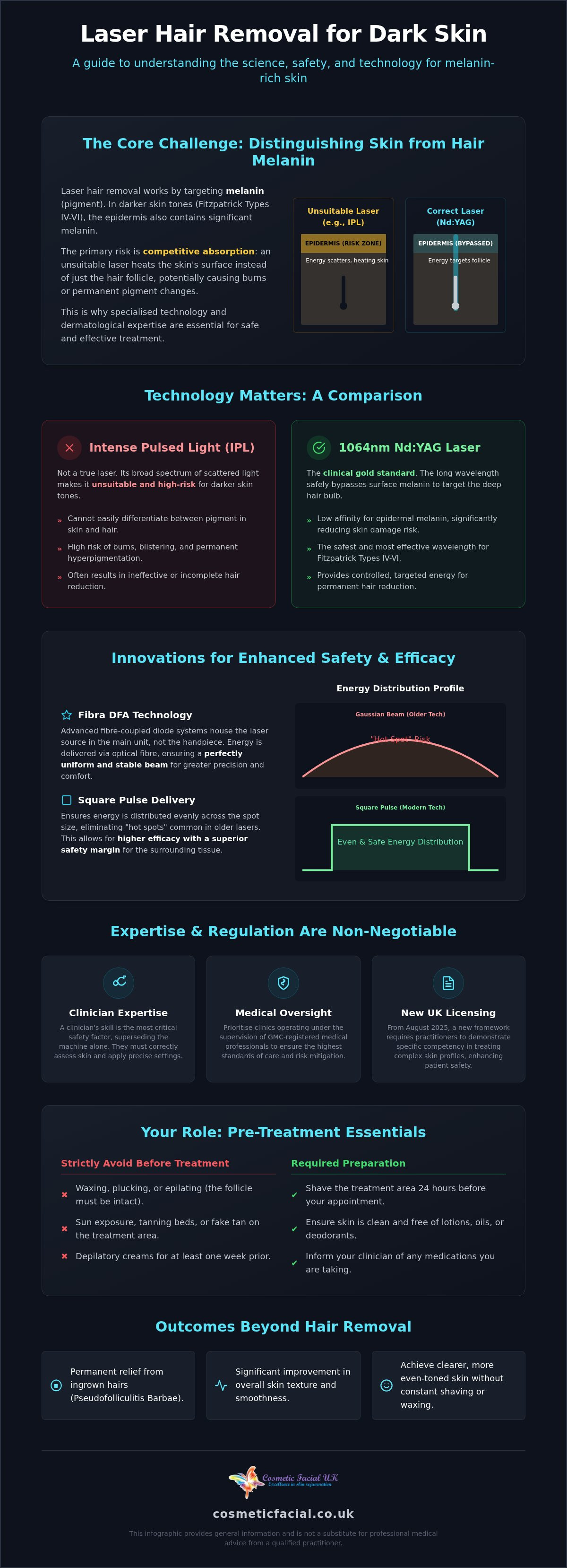
Laser energy is absorbed by chromophores. In this context, the chromophore is melanin. When a laser is applied, the energy should ideally pass through the skin and be absorbed by the hair follicle. Competitive absorption occurs when the epidermis absorbs too much energy instead of the follicle. This hasn't just been a matter of discomfort; it can lead to blistering or post-inflammatory hyperpigmentation if the wrong settings are used. Understanding how laser hair removal works at a cellular level is vital for safety. Wavelength precision is non-negotiable. Practitioners must select a wavelength that has a lower affinity for epidermal melanin but high penetration depth to reach the bulb safely.
Nd:YAG vs. IPL: Why the Difference Matters
Intense Pulsed Light (IPL) is not a laser. It uses a broad spectrum of light wavelengths that scatter as they enter the skin. This scattering makes it nearly impossible to avoid the melanin in the epidermis of darker skin, often leading to burns. Nd:YAG technology, operating at a 1064nm wavelength, is the clinical gold standard because its longer light wave bypasses the surface pigment to reach the deeper hair bulb. This reduces the heat load on the skin's surface significantly. The Nd:YAG 1064nm laser represents the safest and most effective wavelength for individuals with Fitzpatrick Type VI skin. Unlike IPL, which carries a high risk of permanent pigment changes, the Nd:YAG provides a controlled, targeted approach. Choosing a clinic that specialises in laser hair removal for dark skin london ensures that these technical distinctions are managed by experts who understand the nuances of melanin-rich skin.
Advanced Technology: Fibra DFA and Melanin Safety
Clinical advancements in the West End have introduced more precise methods for managing energy delivery during permanent hair reduction. While the selection of the correct wavelength is a fundamental safety requirement, the manner in which that light reaches the skin is equally vital. Fibra DFA, or Direct Fibre Analysis, technology represents a significant evolution from traditional diode systems. In standard diode lasers, the laser source is located within the handpiece, which can sometimes lead to uneven energy distribution. Fibra DFA systems instead utilise a fibre-coupled diode where the light source is housed within the main unit. This energy is then delivered through a high-grade optical fibre, resulting in a more uniform and stable beam profile.
A critical component of this technology is the "Square Pulse" delivery. Many older laser systems produce a Gaussian beam profile, where the energy is highly concentrated in the centre and tapers off at the edges. This concentration creates "hot spots" or energy spikes that significantly increase the risk of thermal injury to the epidermis. Square pulse technology ensures that energy is distributed evenly across the entire spot size. This uniformity allows for higher efficacy in disabling the follicle whilst maintaining a high safety margin for the surrounding tissue. Laser hair removal safety protocols emphasise that controlled, predictable energy delivery is the most effective way to prevent post-inflammatory hyperpigmentation in melanin-rich skin.
Direct Fibre Analysis (DFA) Explained
The mechanism of DFA involves a meticulously focused beam that targets the hair bulb with high precision. By using fibre optics, the light does not scatter as it exits the handpiece, which reduces the "heat halo" effect. This effect occurs when heat radiates into the surrounding dermis, potentially causing inflammation. By confining the thermal energy to the target structure, DFA technology provides a more comfortable experience for sensitive areas such as the face and bikini line. This precision is particularly beneficial for patients seeking laser hair removal for dark skin london, as it allows for effective treatment without the high-heat intensity that older, less focused systems required.
Why Fibra DFA is a Game-Changer for London Clients
Efficiency in a clinical setting is often measured by the balance between speed and safety. Fibra DFA systems allow for faster treatment times due to a high repetition rate, yet they do not compromise the skin's integrity. These systems are equipped with enhanced sapphire cooling tips that maintain a constant, low temperature on the skin surface. This contact cooling is essential for protecting the epidermis whilst the laser energy works at depth. Furthermore, the refined energy profile of DFA is often more successful at targeting fine hairs on darker skin tones, which are frequently missed by standard Nd:YAG systems. Clinicians at Cosmetic Facial utilise these technological refinements to provide a thorough, medically-sound approach to hair reduction.
Choosing a Specialist Clinic in Marylebone and the West End
Selecting a facility for laser hair removal for dark skin london requires a transition from viewing the procedure as a standard beauty service to recognising it as a precise medical intervention. In Marylebone and the wider West End, the density of aesthetic providers is high, yet only a small percentage operate under strict medical oversight. For individuals with melanin-rich skin, the stakes of treatment are significantly higher. CQC registration and the presence of GMC-registered practitioners provide a layer of accountability and safety that high-street salons often cannot match. A dermatology-led approach ensures that the settings used are based on a deep understanding of cutaneous biology rather than standardised machine presets.
The Marylebone location offers a level of discretion and professionalism that aligns with the expectations of serious-minded clients. It provides a quiet, clinical environment away from the high-conversion atmosphere of commercial shopping districts. This setting reflects a commitment to patient-centred care, where the focus remains on clinical outcomes and long-term skin health. When you choose a clinic with specific dermatological expertise, you're investing in the safety of your skin as much as the removal of hair.
The Importance of a Clinical Consultation
A thorough clinical consultation is the foundation of patient safety. For those with Fitzpatrick IV-VI skin, a patch test is mandatory. This test allows the clinician to observe the skin's immediate and delayed reaction to specific energy levels before proceeding with a full session. During this initial meeting, we assess medical history, including hormonal imbalances, current medications, and any predisposition to keloid scarring. A consultation should include a thorough skin analysis by a qualified professional. This step ensures that the treatment plan respects the unique characteristics of your skin whilst aiming for dermatologist-approved hair removal results that are both effective and safe.
Dermatological Expertise: The Dr. Didar Difference
The clinical lead at Cosmetic Facial, Dr. Faramarz Didar, holds an MSc in Dermatology Skills and Treatment with Commendation. This level of academic and practical qualification is rare in the aesthetics industry and allows for a more nuanced interpretation of how different skin types respond to thermal energy. When treating darker skin, the ability to prevent or manage adverse reactions like post-inflammatory hyperpigmentation is paramount. Expertise in dermatology means we don't just operate a machine; we manage the skin's health throughout the entire process. Learn more about our clinical approach to facial rejuvenation to see how we integrate these high medical standards across all our specialised services.
Preparation and Aftercare for Melanin-Rich Skin
The success of laser hair removal for dark skin london depends heavily on the physiological state of the epidermis before the clinical session begins. For individuals with Fitzpatrick IV-VI skin, the primary objective of preparation is to ensure that melanocytes are in a stable, non-reactive state. This stability reduces the risk of post-inflammatory hyperpigmentation (PIH), a condition where the skin produces excess pigment in response to heat or trauma. In London’s variable climate, patients often underestimate UV exposure. Even on overcast days, consistent use of broad-spectrum protection is necessary for at least four weeks prior to treatment to prevent the activation of epidermal melanin.
A fundamental requirement for effective treatment is the "No Waxing" rule. Laser energy targets the melanin within the hair follicle. If the hair is removed from the root through waxing, plucking, or threading, the laser has no target to interact with. This renders the session ineffective. We require the follicle to remain intact, whilst the surface hair should be managed through shaving to ensure the energy is directed beneath the skin surface rather than being wasted on external strands.
Your Pre-Laser Checklist
Shaving the treatment area 24 hours prior to your appointment is a critical safety step. This timeframe allows the skin to recover from any minor irritation caused by the razor whilst ensuring that no hair remains above the surface. If hair is visible, it can absorb the laser energy and cause superficial thermal injury to the skin. Additionally, you must discontinue the use of active skincare ingredients, such as Retinols, AHAs (Alpha Hydroxy Acids), and BHAs, at least seven days before your session. These substances increase cellular turnover and can make the skin more fragile and prone to sensitivity during the procedure.
Frequently Asked Questions about Laser Safety
Clinical Aftercare to Prevent Discolouration
Post-treatment care for darker skin tones focuses on rapid cooling and the prevention of UV-induced PIH. The skin will often exhibit mild erythema, or redness, and perifollicular oedema, which is slight swelling around the hair follicles. These are normal clinical responses. However, it's vital to avoid any activity that retains heat in the body for 48 hours, such as hot baths, saunas, or intense exercise. Applying clinical-grade soothing agents is often more effective than standard aloe vera. We recommend products specifically formulated to calm the dermis without clogging the follicles. Daily application of SPF 50+ is mandatory, even during winter months in London, to protect the treated areas from pigment changes. Recognising the difference between normal clinical heat and a potential burn is essential. If you notice persistent blistering or crusting, you must contact your clinician immediately for a dermatological assessment.
Laser Hair Removal at Cosmetic Facial Marylebone
Cosmetic Facial in Marylebone provides a clinical environment specifically designed for the complexities of melanin-rich skin. Our approach to laser hair removal for dark skin london is grounded in the dermatological expertise of Dr. Faramarz Didar. Every patient receives a personalised treatment plan that accounts for their specific Fitzpatrick skin type and hair density. This bespoke methodology ensures that energy parameters are precisely calibrated to achieve permanent reduction whilst maintaining the integrity of the epidermis. The clinic's location in the West End offers a discreet and professional setting where medical standards take precedence over commercial speed. Book your consultation at our London clinic.
A Holistic Approach to Skin Health
Hair growth is often a symptom of underlying physiological conditions rather than an isolated aesthetic concern. In cases of Polycystic Ovary Syndrome (PCOS), hormonal imbalances can lead to persistent hirsutism, particularly on the face and neck. Our clinical background allows us to manage these cases with medical insight, often combining laser protocols with broader dermatological care to address associated issues like post-inflammatory hyperpigmentation or follicular scarring. Many of our patients also present with pseudofolliculitis barbae, a condition characterised by chronic ingrown hairs and secondary infection. By disabling the hair follicle at the root, we effectively resolve the mechanical cause of these inflammatory responses, leading to a smoother skin texture. For patients interested in comprehensive facial care, we also offer guidance on Understanding Dermal Fillers in London as part of a wider rejuvenation strategy.
Start Your Journey to Smooth Skin
Your initial visit to our Marylebone clinic involves a comprehensive assessment of your skin's health and a mandatory patch test. This session is not merely a formality; it's a vital safety measure to observe how your skin interacts with the laser energy. Long-term results typically require a course of six to eight sessions, depending on the area being treated and individual hair growth cycles. Maintenance sessions may be recommended annually to ensure the skin remains clear and free from unwanted growth. We prioritise intellectual honesty, ensuring you understand the realistic outcomes and the timeline required for permanent reduction. Our goal is to provide a treatment path that is as safe as it is effective for your specific skin profile.
Advancing Your Clinical Skin Health in Marylebone
Successful hair reduction requires a precise intersection of advanced technology and dermatological expertise. By prioritising wavelengths that bypass epidermal melanin and selecting a facility led by a GMC registered doctor, you can effectively mitigate the risks of hyperpigmentation and thermal injury. Effective laser hair removal for dark skin london is no longer a matter of chance; it's the result of rigorous medical standards and the application of fibre-coupled systems like Fibra DFA.
At Cosmetic Facial, Dr. Faramarz Didar (MSc Dermatology with Commendation, GMC 5200505) applies his clinical knowledge to every bespoke treatment plan. Our central Marylebone clinic provides a controlled, professional environment where your skin health is the primary metric of success. We ensure that every session is preceded by a thorough analysis and a mandatory patch test to guarantee the safest possible outcome for Fitzpatrick Types IV, V, and VI.
You don't have to tolerate ineffective treatments or the persistent discomfort of pseudofolliculitis barbae. Modern clinical dermatology offers a reliable path to clearer, smoother skin that respects the unique biological requirements of your melanin-rich skin.
Frequently Asked Questions
Is laser hair removal truly permanent for dark skin?
Laser hair removal results in permanent hair reduction rather than absolute, total removal of every follicle. For dark skin, the use of Nd:YAG technology ensures that the reduction is long-lasting by targeting the hair bulb at a depth that prevents regeneration. Whilst most treated hairs won't return, some dormant follicles may activate over time due to hormonal shifts; this necessitates occasional maintenance sessions to preserve the results achieved during the initial course.
Does laser hair removal for dark skin london hurt more than for light skin?
The sensation of laser hair removal for dark skin london shouldn't be significantly more painful than for lighter skin types when the correct technology is applied. Advanced systems like the Nd:YAG 1064nm or fibre-coupled diodes include sapphire cooling tips that maintain a constant low temperature on the skin surface. This contact cooling effectively mitigates the heat sensation, making the procedure tolerable and ensuring the epidermis remains protected throughout the thermal delivery process.
How many sessions will I need for effective hair reduction?
Most patients require a course of six to eight sessions for optimal hair reduction results. This number is necessary because hair grows in cycles, and the laser is only effective during the anagen, or active growth, phase. Because only a percentage of hairs are in this phase at any given time, multiple appointments spaced four to six weeks apart are essential to ensure every follicle is treated during its susceptible period.
Can laser hair removal treat ingrown hairs on dark skin?
Laser treatment is the clinical gold standard for resolving chronic ingrown hairs, or pseudofolliculitis barbae. By disabling the hair follicle, the laser prevents the hair from growing back into the skin and causing the inflammatory response that leads to painful bumps and scarring. Patients often see a significant improvement in skin texture and a reduction in associated pigmentation after just two or three sessions at our Marylebone clinic.
What are the risks of laser hair removal for Fitzpatrick Type VI skin?
The primary risks for Fitzpatrick Type VI skin include post-inflammatory hyperpigmentation and thermal burns if inappropriate wavelengths like IPL are used. However, these risks are minimal when treatment is conducted by a GMC registered practitioner using a 1064nm Nd:YAG laser. This specific wavelength has a low affinity for epidermal melanin, which allows the energy to pass safely through the dark skin surface to reach the deeper hair structures.
How much does laser hair removal for dark skin cost in London?
The cost of treatment in London varies based on the size of the area and the number of sessions required. Clinical settings in Marylebone that provide medical oversight by a qualified dermatologist may reflect different pricing structures compared to high-street salons. Most clinics offer packages, such as a course of six sessions, which provide better value than single appointments. It's best to confirm specific fees during your initial clinical consultation and skin analysis.
Can I have laser treatment if I have PCOS?
Individuals with Polycystic Ovary Syndrome (PCOS) can successfully undergo laser hair removal, though the management of their expectations is vital. Hormonal imbalances associated with PCOS can stimulate the growth of new hair follicles, which means more sessions might be required to achieve desired results. We often work alongside medical professionals to ensure that the laser protocol complements any ongoing hormonal management for a holistic approach to skin health.
What is the best laser for black skin in 2026?
In 2026, the 1064nm Nd:YAG laser remains the safest and most effective choice for black skin due to its deep penetration and safety profile. Fibre-coupled diode systems, like Fibra DFA, are also excellent alternatives for patients seeking laser hair removal for dark skin london. These technologies provide uniform energy distribution without creating dangerous hot spots on the skin surface, ensuring that melanin-rich skin is treated with the necessary precision and care.
Disclaimer
All content on cosmetic Facial website, including blogs, graphics, logos, images, and software, is the property of CosmeticFacial UK or its content suppliers and is protected by applicable copyright laws. Unauthorized use, reproduction, distribution, or modification of any content without prior written permission is strictly prohibited.


