


The most expensive topical creams often fail to address the structural reality of horizontal neck bands, which are frequently exacerbated by our constant engagement with digital devices. It's understandable to feel a sense of frustration when you notice these deep creases during a video call, particularly if the skin on your face remains relatively smooth and youthful. This disconnect between facial and neck aesthetics is a common clinical concern that requires more than a standard skincare routine to resolve.
Identifying the best treatment for tech neck lines involves moving beyond over-the-counter promises and looking toward medical-grade interventions that target the dermis directly. At our Marylebone clinic, we focus on evidence-based protocols that restore skin elasticity and smooth established folds. This guide outlines the most effective clinical strategies, from High-Intensity Focused Ultrasound (HIFU) to bio-remodelling, providing a comprehensive framework for both immediate rejuvenation and long-term dermal health. You'll gain a clear understanding of how professional treatments can tighten the neck profile and which preventative habits will maintain your results over time.
Key Takeaways
- Understand the mechanical causes of "screen neck," where repetitive cervical flexion leads to the premature degradation of Type I and Type III collagen.
- Discover why the best treatment for tech neck lines often requires a multimodal clinical approach that combines energy-based devices with targeted injectables.
- Learn how High-Intensity Focused Ultrasound (HIFU) and Radiofrequency treatments work to tighten the superficial muscular aponeurotic system (SMAS) for a non-surgical lift.
- Explore the role of specialised dermal filler techniques in "blanching" and smoothing deep horizontal bands that have already become etched into the skin.
- Identify the essential ergonomic adjustments and medical-grade skincare ingredients, such as retinoids and peptides, necessary to maintain your clinical results.
Understanding Tech Neck: Why Horizontal Neck Lines Form
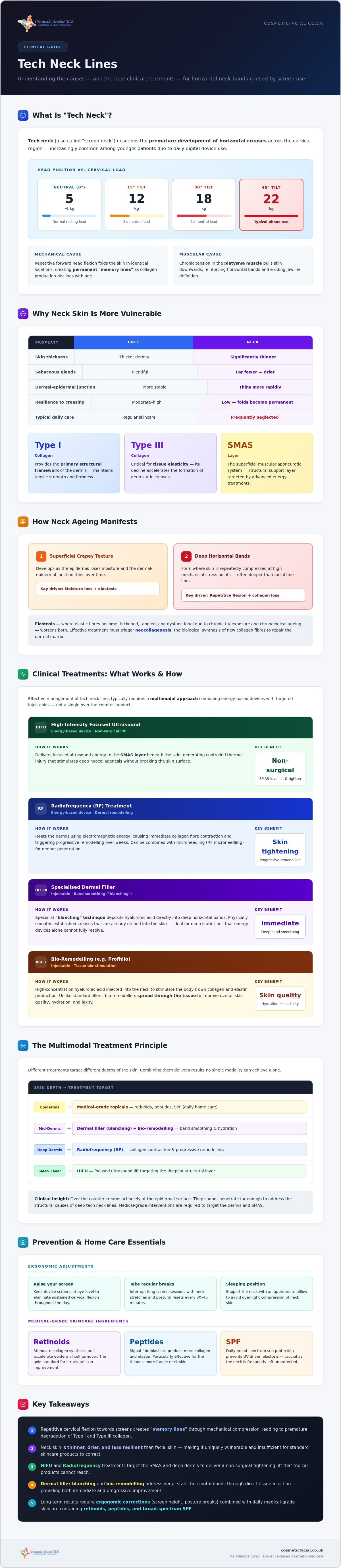
Tech neck, often referred to as "screen neck," describes the premature development of horizontal creases that span the cervical region. These lines are no longer exclusive to older demographics; they're increasingly visible in younger patients due to the ubiquity of digital devices. The condition is primarily a result of the mechanical strain caused by repetitive flexion and sustained forward head posture whilst using smartphones or laptops. Tech neck is a modern postural deformity leading to permanent dermal creasing. To determine the best treatment for tech neck lines, one must first appreciate how these mechanical stresses interact with the neck's delicate anatomy.
Whilst facial ageing is often a result of volume loss and UV exposure, neck ageing is uniquely influenced by physical habits. The constant downward gaze creates a cycle of compression and stretching that the skin eventually loses the ability to recover from. This process is often exacerbated by a lack of preventative care, as the neck frequently receives less attention than the face during daily skincare and sun protection routines.
The Mechanics of Repetitive Flexion
When you tilt your head forward to look at a screen, the weight supported by your cervical spine increases dramatically. At a 45-degree angle, the head exerts significantly more force than it does in a neutral, upright position. This sustained pressure forces the skin to fold in the same locations repeatedly, creating "memory lines." Initially, these lines are only visible during the movement itself. However, as collagen production slows with age, these dynamic folds transition into static, permanent indentations. The platysma muscle, a broad sheet of muscle extending from the chest to the jaw, further complicates this. Chronic tension in the platysma pulls the skin downwards, which reinforces the horizontal bands and contributes to a loss of definition along the jawline.
Why Neck Skin is More Vulnerable
The skin on the neck is anatomically distinct from the skin on the face. It's significantly thinner and possesses fewer sebaceous glands, which produce the oils necessary for skin hydration and barrier function. This lack of natural lubrication makes the neck more prone to dryness and less resilient to the creasing effects of repetitive motion. Additionally, the dermal-epidermal junction, which is the layer that provides structural support and facilitates nutrient exchange between skin layers, thins more rapidly in the neck area. This thinning leads to a visible loss of elasticity and a crepey texture. Because of these unique biological factors, standard facial moisturisers are usually insufficient for correcting established damage. Identifying the best treatment for tech neck lines involves addressing these specific structural deficits through clinical-grade technology that can penetrate the deeper dermal layers.
The Clinical Science of Neck Ageing: Beyond the Surface
Understanding the biological infrastructure of the neck is essential for selecting the best treatment for tech neck lines. Unlike the face, the neck's structural support relies on a significantly thinner dermis and a highly active superficial muscular aponeurotic system (SMAS). The degradation of Type I and Type III collagen within these layers reduces the skin's tensile strength and resilience. Type I collagen provides the primary structural framework, whilst Type III is critical for tissue elasticity. Their combined decline results in a visible loss of firmness that cannot be rectified by superficial hydration alone.
This biological breakdown manifests in two distinct ways. Superficial "crepey" texture develops as the epidermis loses moisture and the dermal-epidermal junction thins. Simultaneously, deep horizontal bands form where the skin has been repeatedly compressed. Addressing both textures is a core component of facial rejuvenation strategies that extend to the cervical region to ensure a harmonious aesthetic result.
Collagen and Elastin: The Infrastructure of Smooth Skin
Chronic UV exposure and chronological ageing lead to "elastosis," a condition where elastic fibres become thickened, tangled, and dysfunctional. Horizontal neck lines are often significantly deeper than fine lines on the face because they occur at points of high mechanical stress. Professional interventions aim to trigger "neocollagenesis," which is the biological process of synthesising new collagen fibres to repair the dermal matrix. Selecting the best treatment for tech neck lines requires a focus on this cellular repair to bridge the structural "gaps" within deep creases; you can read more about Hilda Demirjian Laser & Skin Care Center and how they utilise advanced laser technology to stimulate this essential collagen production.
The Role of the Platysma Muscle
The platysma muscle is a thin, superficial layer that influences the entire contour of the lower face and neck. When this muscle becomes hyperactive, it creates prominent vertical "platysmal bands" and exacerbates horizontal lines by pulling the skin downwards. This chronic tension contributes to "jowling," where the jawline loses its crisp definition and the skin of the neck appears more lax. The Nefertiti Lift is a specialised clinical technique that uses botulinum toxin to relax these bands, effectively reducing the downward pull and smoothing the neck profile. For those seeking a comprehensive solution, a clinical assessment with a dermatology expert can help determine the most appropriate multimodal approach for your specific anatomy.
Evaluating Professional Treatments: Which is Best for Your Neck Lines?
Determining the best treatment for tech neck lines requires a tailored approach that considers whether your primary concern is structural laxity, deep-set creases, or superficial texture. Clinical intervention usually falls into three main pillars: injectables, energy-based devices, and skin resurfacing. At Cosmetic Facial, these procedures are conducted under the clinical oversight of Dr Faramarz Didar, a GMC-registered doctor with an MSc in Dermatology. This level of expertise ensures that each protocol is medically sound and precisely adjusted to your unique skin thickness and anatomical requirements.
Injectable Solutions: Fillers and Skin Boosters
Hyaluronic acid fillers offer immediate structural support for deep horizontal creases that have become etched into the skin. A specific "blanching" technique is often employed, where a highly cohesive but low-viscosity filler is injected superficially into the line. This requires a precise "micro-droplet" approach to ensure the filler integrates seamlessly without creating a lumpy appearance in the thin neck skin. For a broader look at how these technologies are applied in the capital, you can consult our Dermal Fillers London guide.
Whilst traditional fillers address specific lines, selecting the best treatment for tech neck lines often involves improving the overall quality of the neck's dermal matrix through Profhilo. As a "bio-remodeller," Profhilo spreads throughout the tissues to stimulate collagen and elastin production rather than adding localised volume. This results in significantly improved hydration and skin resilience. Additionally, Botox for line and wrinkle treatment is used to relax the platysma muscle, reducing the tension that pulls the skin into deep folds.
Energy-Based Lifting: HIFU and Radiofrequency
Energy-based devices offer a non-surgical alternative for patients experiencing moderate skin laxity and "crepey" texture. High-Intensity Focused Ultrasound (HIFU) is particularly effective because it reaches the superficial muscular aponeurotic system (SMAS), which is the same layer targeted during a surgical facelift. By delivering focused thermal energy to this depth, HIFU triggers a contraction of the tissue and long-term collagen synthesis. Detailed insights on this procedure are available in our HIFU for Jowls & Neck London lifting guide.
Radiofrequency (RF) provides a complementary effect by targeting the more superficial layers of the dermis. RF energy heats the tissue to approximately 40 to 42 degrees Celsius, causing immediate collagen fibre contraction and improving skin texture. This is often the preferred choice for treating the fine, superficial lines that appear alongside deeper bands. You can review the clinical outcomes and timelines in our RF Skin Tightening guide. Combining these technologies often yields the most comprehensive results for patients seeking to restore a youthful neck profile.
How to Minimise and Prevent Tech Neck at Home
Clinical intervention remains the best treatment for tech neck lines that have already reached a static state, but it's essential to implement home-based strategies to halt further dermal degradation. A successful rejuvenation plan must address the mechanical and environmental factors that contribute to horizontal banding. Adhering to specific ergonomic adjustments and medical-grade topical care preserves the structural integrity of the neck skin. These habits extend the longevity of professional results and prevent new creases from forming over time.
Ergonomic Adjustments for Digital Use
Adhering to the "Eye-Level Rule" is the most significant lifestyle modification for cervical skin health. Positioning your screen directly in front of your eyes prevents the repetitive flexion that creates memory lines. You can achieve this through these five steps:
- Utilise laptop stands: Elevate your device so the top third of the screen is at eye level.
- External keyboards: Use a separate keyboard and mouse to allow the screen to be raised without wrist strain.
- Voice-to-text: Minimise time spent looking down at keyboards by using dictation features for messaging.
- Postural resets: Perform gentle neck yoga or cervical retractions every 30 minutes to counteract platysma tension.
- Device height awareness: Hold your smartphone up to your face rather than dropping your chin to your chest.
Topical Skincare and Sun Protection
The thin skin of the neck requires a targeted approach to topical application. High-strength retinoids should be introduced with caution to avoid irritation or retinoid dermatitis in this delicate area. Peptides are a safer alternative, acting as signalling molecules that encourage the dermis to synthesise new collagen and elastin fibres. Vitamin C also provides vital antioxidant protection against environmental pollutants whilst supporting overall skin health when applied every morning.
Sun protection is often the most neglected aspect of neck care. UV rays account for up to 80% of visible skin ageing in this region. Daily application of a broad-spectrum SPF 50 to the neck and décolletage is non-negotiable. Without this barrier, elastic fibres undergo solar elastosis, which makes any clinical attempt to find the best treatment for tech neck lines significantly less effective. Don't let environmental damage undo your clinical progress.
Bespoke Neck Rejuvenation at Cosmetic Facial London
The Cosmetic Facial Approach represents a synthesis of advanced medical technology and clinical artistry. In our Marylebone practice, we recognise that the neck is not an isolated anatomical feature but a functional continuation of the facial structure. Consequently, a non-surgical face lift often incorporates specific neck rejuvenation protocols to ensure a balanced and harmonious aesthetic result. This integrated strategy prevents the "aesthetic disconnect" that occurs when the face is treated whilst the neck is neglected. By treating the lower face and neck as a single unit, we achieve a more natural and comprehensive restoration of the profile.
Why a Multimodal Approach Delivers Superior Results
Optimal results in the cervical region are rarely achieved through a single modality. Our philosophy prioritises a multimodal framework, which addresses different structural layers in a logical sequence. Identifying the best treatment for tech neck lines often involves combining technologies to target various depths of the skin. For instance, we may utilise High-Intensity Focused Ultrasound (HIFU) to trigger deep tissue contraction at the SMAS layer before addressing superficial texture and pigmentation with medical-grade skin peels. This combination of deep lifting and epidermal resurfacing repairs both the infrastructure and the surface of the skin. You may review the efficacy of these combined protocols in our gallery of results.
The sequencing of these treatments is critical for safety and effectiveness. We typically prioritise energy-based lifting to establish a firm foundation before introducing injectables or resurfacing agents. This methodical progression allows the skin to recover and respond to each stimulus, ensuring that the final outcome is both significant and durable. Our clinical focus is on long-term dermal health rather than temporary superficial fixes.
Your Consultation in Marylebone
Every treatment plan begins with a comprehensive clinical assessment led by Dr Faramarz Didar. During your consultation in Marylebone, we evaluate specific metrics including skin laxity, platysmal muscle tone, and the precise depth of horizontal creases. This diagnostic phase is essential for London professionals who require efficient, evidence-based results that align with a demanding lifestyle. By identifying the exact biological cause of your creases, we can tailor a bespoke programme that delivers measurable improvement. We take the time to explain the science behind each recommendation, ensuring you're fully informed before your treatment commences.
Restoring Structural Integrity to the Neck Profile
To maintain these high standards of professional care, many clinics rely on integrated platforms like Bookivo, and you can discover more about SaaS Subscription for Booking and Business Management to see how it supports modern practice operations and client scheduling.
Addressing horizontal neck bands requires a dual focus on mechanical prevention and biological repair. Whilst ergonomic adjustments are vital to halt further creasing, established dermal folds demand clinical intervention to restore the skin's structural matrix. Identifying the best treatment for tech neck lines involves a transition from superficial topicals to medical-grade protocols that target the dermis and SMAS layers directly.
Cosmetic Facial provides a CQC-compliant environment in Central London for these advanced procedures. Led by Dr Faramarz Didar, who holds an MSc in Dermatology, our clinic specialises in non-surgical face and neck lifting. We ensure that every rejuvenation plan is tailored to the anatomical needs of the patient, delivering results that are both precise and enduring. It's our priority to provide thorough, evidence-based care that respects the complexity of the cervical anatomy.
It's possible to achieve a smoother, more defined neck profile through the correct combination of clinical expertise and consistent preventative care. We look forward to helping you restore confidence in your profile.
Frequently Asked Questions
What is the absolute best treatment for tech neck lines?
The absolute best treatment for tech neck lines is typically a multimodal strategy tailored to a patient's specific dermal thickness and crease depth. Clinical experience suggests that combining energy-based lifting, such as HIFU, with targeted dermal fillers provides the most comprehensive result. HIFU addresses the underlying structural laxity of the SMAS layer, whilst fillers bridge the physical gaps in deep horizontal bands. This combination ensures both immediate smoothing and long-term biological repair.
Can Botox really help with horizontal neck bands?
Botox is highly effective for relaxing the platysma muscle, which often exacerbates the appearance of horizontal bands. By reducing the downward pull of this muscle, the skin appears smoother and the jawline more defined. This technique, often referred to as the Nefertiti Lift, prevents the muscle from deepening existing creases during movement. However, Botox is a functional treatment and usually requires pairing with fillers if the lines are already static and etched.
How many sessions of HIFU are needed for tech neck?
Most patients require between one and three sessions of HIFU to achieve optimal structural lifting of the neck area. Initial results often become visible within several weeks, but the full effect of neocollagenesis typically peaks at the three to six-month mark. The exact number of treatments depends on the degree of skin laxity and the patient's age. Maintenance sessions are generally recommended every twelve to eighteen months to preserve the integrity of the lift.
Are horizontal neck lines permanent or can they be reversed?
Horizontal neck lines aren't necessarily permanent, but they can't be reversed through topical skincare alone once they've become static creases. Identifying the best treatment for tech neck lines often involves clinical interventions that diminish crease depth by stimulating new collagen production. Early intervention is key, as treating memory lines before they become deep dermal indentations yields the most successful outcomes. Professional maintenance is required to prevent their return and maintain a smooth profile.
Is there any downtime associated with neck filler treatments?
Downtime following neck filler treatments is minimal, though you might experience slight swelling or pinpoint bruising at the injection sites. Because the skin on the neck is thin and highly vascular, these minor side effects are common but usually resolve within three to five days. Most individuals return to their professional activities immediately after the procedure. We advise avoiding strenuous exercise and extreme heat for forty-eight hours to ensure the filler integrates smoothly into the tissue.
At what age should I start preventative tech neck treatments?
Preventative treatments are most effective when started in the mid-twenties to early thirties, which is when natural collagen production begins to decline. At this stage, non-invasive options like Profhilo or light radiofrequency treatments can maintain skin resilience and prevent the formation of static bands. Early intervention focuses on biological preservation rather than correction. Implementing ergonomic changes and consistent sun protection alongside these professional treatments will significantly delay the onset of structural neck ageing.
Can skincare alone get rid of deep neck creases?
Skincare alone is insufficient for eliminating deep neck creases once they've reached the dermal layer. Whilst ingredients like retinoids and peptides support the skin's barrier and improve superficial texture, they can't provide the structural lift or volume needed to fill established indentations. Topical products are best utilised as a supportive measure alongside clinical procedures. They help maintain the health of the epidermis and protect against environmental damage, but they can't replace medical-grade interventions.
How much do professional tech neck treatments cost in London?
The cost of professional tech neck treatments in London varies based on the specific modality used and the complexity of your requirements. Prices for energy-based lifting or injectable treatments reflect the clinical expertise of the practitioner and the quality of the technology employed. At our Marylebone clinic, we provide detailed pricing during a comprehensive consultation. This allows Dr Didar to assess your anatomy and recommend a bespoke protocol that aligns with your aesthetic goals.
Disclaimer
All content on cosmetic Facial website, including blogs, graphics, logos, images, and software, is the property of CosmeticFacial UK or its content suppliers and is protected by applicable copyright laws. Unauthorized use, reproduction, distribution, or modification of any content without prior written permission is strictly prohibited.


