


True structural lifting no longer requires a scalpel or the prolonged recovery period associated with traditional surgery. Many patients find that as they mature, the gradual loss of jawline definition and the development of crepey skin on the neck become significant aesthetic concerns. It's common to feel hesitant about dermal fillers due to the risk of an unnatural, overfilled appearance, or to feel anxious regarding the downtime required for surgical intervention. For those seeking HIFU for jowls and neck London, our Marylebone clinic provides a precise, medically-led solution designed to restore facial contours through non-invasive ultrasound technology.
This guide explores how High-Intensity Focused Ultrasound (HIFU) delivers targeted thermal energy to the deep structural layers of the skin, specifically the SMAS layer. You'll learn how this technology stimulates natural collagen synthesis to achieve a tighter, more defined profile. We will detail the clinical process, from the initial dermatological assessment to the expected outcomes, ensuring you understand how our specialist-led environment prioritises safety and precision in every treatment.
Key Takeaways
- Understand the anatomical causes of jowl formation, including the descent of malar fat pads and the modern impact of "Tech Neck" on skin laxity.
- Learn how medical-grade HIFU technology specifically targets the Superficial Muscular Aponeurotic System (SMAS) to stimulate natural collagen production.
- Discover the clinical advantages of choosing HIFU for jowls and neck London at our Marylebone practice, where treatments are performed in a controlled, specialist environment.
- Compare the outcomes and recovery profiles of ultrasound-based lifting against traditional surgical facelifts to determine the most appropriate intervention for your needs.
- Explore the importance of a bespoke dermatological consultation and precise mapping of vascular structures to ensure both safety and natural-looking results.
Addressing Sagging Jowls and Neck Laxity in London
The loss of jawline definition is a multi-factorial process involving both cutaneous and structural changes. As the face matures, the malar fat pads, which provide volume to the mid-face, gradually descend toward the mandible. This migration, coupled with a significant reduction in dermal elastin and collagen, creates the appearance of sagging jowls. Traditional skincare often addresses the epidermis, but it's unable to penetrate the deeper layers where this structural laxity originates. For patients seeking HIFU for jowls and neck London, understanding The Clinical Science of HIFU is essential, as this technology bypasses the surface to target the foundational tissues directly.
London’s urban environment introduces specific challenges to long-term skin health. High levels of particulate matter and pollutants generate oxidative stress, which accelerates the degradation of collagen fibres. This premature breakdown often manifests as early-onset neck laxity and a loss of sharpness along the jawline. Whilst topical antioxidants provide a degree of protection, they lack the capacity to reverse the gravitational shifts occurring at a deeper level. Effective correction requires a treatment that can stimulate the body's natural repair mechanisms within the deeper dermis and underlying fascia.
The Impact of "Tech Neck" on Jawline Definition
In 2026, the "Tech Neck" phenomenon has become a primary driver of premature ageing in the lower face. The repetitive strain caused by a constant downward gaze at digital devices places undue pressure on the platysma muscle. This posture-related stress leads to horizontal neck wrinkling and a softening of the mandibular border. London professionals often report the first signs of jowl formation as a lack of definition in photographs or video calls. Addressing this requires intervention that reaches the structural depths where the muscle and skin interface, providing a lift that topical creams cannot achieve.
Why Non-Surgical Solutions are Trending in Marylebone
The demand for discreet, effective treatments is rising amongst residents in the Marylebone area. Busy schedules dictate a preference for procedures with minimal recovery time. A non-surgical facelift using HIFU allows patients to return to their professional and social lives immediately. It offers a subtle yet significant lift without the risks or downtime of invasive surgery. This makes HIFU for jowls and neck London a preferred choice for those prioritising preventative care and natural-looking outcomes in a clinical setting. The ability to achieve structural lifting without visible scarring is particularly valued in our practice.
The Clinical Science of HIFU: Targeting the SMAS Layer
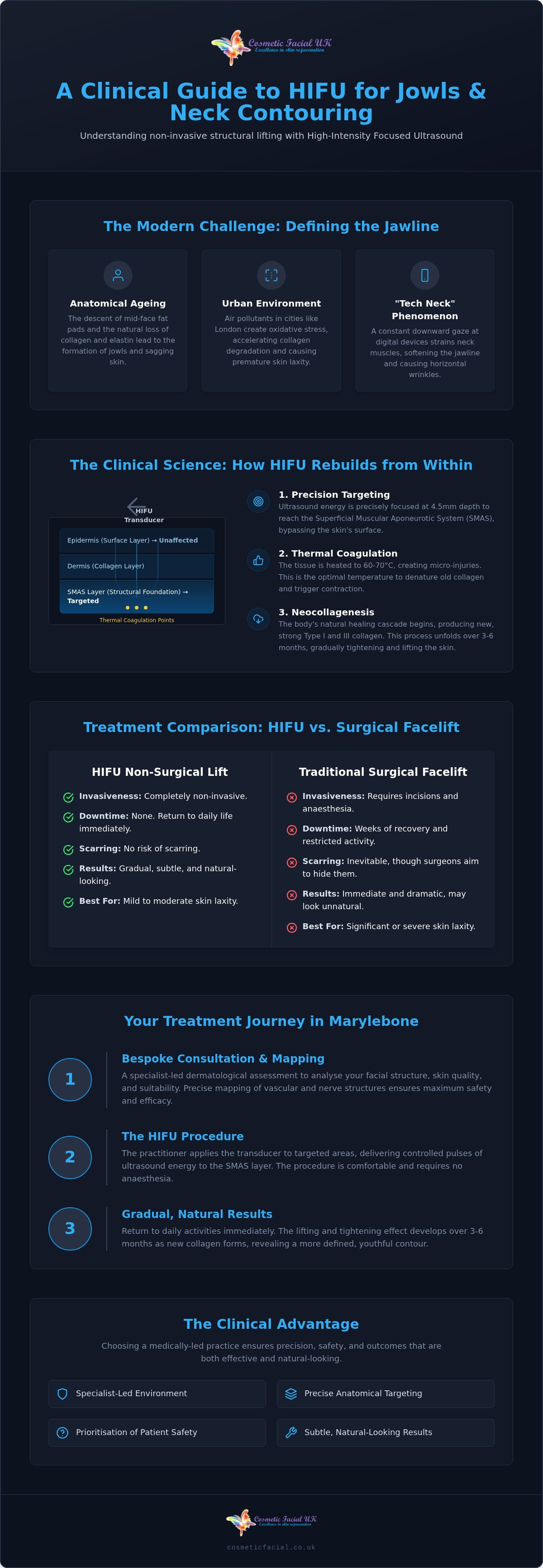
High-Intensity Focused Ultrasound (HIFU) represents a significant advancement in non-invasive tissue lifting. It functions by delivering concentrated ultrasound waves to specific depths without affecting the skin's surface. This precision allows for the creation of Thermal Coagulation Points (TCPs) within the targeted tissue. These micro-injuries trigger a natural healing cascade. The body responds by initiating neocollagenesis, which is the production of new Type I and Type III collagen fibres. This biological process typically unfolds over a period of three to six months, leading to a gradual and natural-looking tightening of the treated area. For those researching HIFU for jowls and neck London, it's vital to understand that the efficacy of the treatment relies on reaching these deeper structural layers.
The science behind a HIFU facial is fundamentally different from laser or radiofrequency treatments. Whilst those technologies often focus on bulk heating or surface resurfacing, HIFU bypasses the epidermis entirely. It delivers energy at a temperature of approximately 60 to 70 degrees Celsius to the foundational layers. This is the optimal temperature for collagen denaturation and subsequent contraction, providing a lift that was previously only achievable through surgical means.
Reaching the Depths of the Dermis and Fascia
The success of this procedure depends on the use of specific transducers that reach different anatomical levels. To address sagging jowls effectively, the ultrasound energy must reach a depth of 4.5mm. This allows it to interact with the Superficial Muscular Aponeurotic System (SMAS). The SMAS layer is the structural scaffolding of the face that HIFU uniquely tightens without incisions. For the neck, a 3.0mm depth is often utilised to target the deep dermis. This stimulates collagen where skin laxity is most prominent. By treating multiple depths, the procedure provides a comprehensive lift that addresses both the skin surface and the underlying support structures.
The Role of Dermatological Expertise in Treatment Precision
Delivering ultrasound energy requires a high degree of clinical precision. A practitioner with an MSc in Dermatology, such as Dr Didar, possesses the specialised knowledge required to assess individual skin thickness and tissue density. This is crucial because the focal point of the energy must be exactly positioned to avoid complications. One significant risk in unskilled hands is the unintended depletion of sub-mental or facial fat, which can lead to a hollowed appearance rather than a lifted one. Clinical expertise ensures that energy levels are calibrated to tighten the skin whilst preserving necessary fat volume. This methodical approach is why many patients choose to consult our Marylebone clinic for their aesthetic needs. Precision in focal point delivery ensures that the neovascularisation and collagen remodelling occur exactly where they are needed for maximum structural benefit.
HIFU vs. Surgical Facelifts: Evaluating Your Options
The decision to undergo a cosmetic procedure often rests on the balance between desired efficacy and acceptable downtime. Surgical facelifts and neck lifts involve the mechanical repositioning of tissue through incisions, providing a definitive structural change. Whilst surgery offers long-term results, it also requires general anaesthesia and carries the risks inherent to invasive procedures. In contrast, HIFU for jowls and neck London offers a biological lift. It stimulates the body's endogenous repair systems to tighten the skin from within. This makes it an ideal choice for patients with mild-to-moderate laxity who are not yet candidates for, or are hesitant about, the operating theatre.
Longevity is a frequent point of comparison for our Marylebone patients. A surgical procedure may provide results that last a decade, but the physiological cost and financial investment are significant. Clinical evidence suggests that the effects of a single HIFU session typically persist for 12 to 18 months. Maintenance treatments can be scheduled to sustain these outcomes, effectively slowing the visible progression of ageing. This cost-benefit ratio appeals to those seeking a sustainable, non-invasive rejuvenation strategy that prioritises natural-looking results over dramatic alterations.
Recovery and Downtime: London Lifestyle Considerations
Surgical interventions in the neck and jawline area usually necessitate a recovery period of two to four weeks. During this time, patients experience significant bruising, swelling, and discomfort. For the busy London professional, such a prolonged absence from social and work commitments is often impractical. HIFU is frequently referred to as a "lunchtime lift" because it leaves the epidermis completely intact. There's no requirement for bandages or post-operative medication. Most patients return to their professional duties in Marylebone immediately after their session, as any slight erythema or redness typically subsides within a few hours.
Comparing HIFU to Other Energy-Based Devices
Patients often ask why ultrasound is preferred over Radiofrequency (RF) for lifting the lower face. The primary distinction lies in the depth of penetration. RF technology is highly effective at heating the superficial dermis to improve skin texture and fine lines. However, ultrasound energy reaches the deeper structural layers, such as the SMAS, which is essential for correcting sagging jowls. This difference in depth is also a key factor when treating other areas of the body, as explored in our comparison of HIFU vs Radiofrequency: Best Stomach Treatment?. At our clinic, we often incorporate ultrasound lifting into broader facial rejuvenation programmes to ensure both the skin's surface and its underlying foundations are addressed simultaneously.
The Patient Journey: What to Expect During Your Marylebone Treatment
The patient journey at our Marylebone clinic is designed to ensure clinical safety and anatomical precision. Every procedure for HIFU for jowls and neck London follows a methodical four-step process to achieve the most effective structural lifting. This unhurried approach allows for a thorough assessment of the patient's unique facial architecture before any energy is delivered.
Step one involves a clinical consultation and bespoke skin analysis with Dr Didar. This initial assessment allows the clinician to evaluate skin laxity and tissue thickness using dermatological expertise. Once candidacy is confirmed, the second step is the mapping of the treatment area. This is a critical safety measure where the skin is marked to identify specific zones; this ensures ultrasound energy avoids superficial nerves and vascular structures. The third step is the delivery of the ultrasound energy pulses, during which the transducer is moved across the mapped areas to target the SMAS and dermal layers. The final step involves immediate post-treatment observations and the provision of tailored aftercare guidance to support the skin's healing response.
Consultation: The Foundation of Clinical Safety
A thorough medical history is an essential prerequisite for any HIFU face lift. This allows us to identify any contraindications and ensure the patient's skin quality is sufficient to respond to the ultrasound energy. During this phase, we also manage expectations regarding the timeline of neocollagenesis. It's vital that patients understand the biological nature of the lift, which relies on the body's natural production of collagen over several months. This consultation ensures the long-term success of your HIFU for jowls and neck London treatment by aligning the procedure with your specific physiological needs.
Aftercare and Maximising Your Results
Post-treatment care is focused on protecting the skin whilst it begins the remodelling process. We advise patients to avoid extreme heat, such as saunas or steam rooms, for at least 48 hours after the procedure. The daily application of a high-factor SPF is mandatory to protect the newly stimulated dermal layers from ultraviolet damage. Maintaining high levels of hydration is also recommended, as water is a necessary component for the metabolic processes involved in collagen synthesis. Whilst some lifting is visible immediately, the final jawline contour emerges after 12 weeks.
Why Choose Cosmetic Facial for HIFU Jowls & Neck London?
Choosing a provider for HIFU for jowls and neck London requires careful consideration of the practitioner's medical background and clinical environment. Our practice is led by Dr Faramarz Didar, a GMC-registered physician with over 30 years of medical experience. This extensive clinical history provides a foundation of safety and anatomical knowledge that is vital when performing energy-based treatments. Dr Didar holds an MSc in Dermatology Skills and Treatment with Commendation from the University of Hertfordshire, alongside a Postgraduate Diploma in Non-Surgical Facial Aesthetics. These academic credentials ensure that every treatment is informed by a deep understanding of cutaneous biology and structural ageing.
Unlike high-street aesthetic centres, our Marylebone clinic offers a boutique environment prioritising individualised medical care. This clinical focus allows for the seamless integration of aesthetic procedures with essential dermatology services. Patients can address concerns such as mole checks or acne management during the same period as their rejuvenation plan. This holistic approach ensures that the health of the skin is never compromised for aesthetic gain. We focus on providing a thorough, unhurried experience that prioritises clinical excellence over high-volume throughput.
The Advantage of a GMC-Registered Practitioner
The delivery of High-Intensity Focused Ultrasound requires precise calibration to avoid underlying structures whilst ensuring the energy reaches the correct depth. Having a medically qualified practitioner oversee the procedure provides an essential layer of safety. Dr Didar is a member of the European College of Aesthetic Medicine & Surgery, which reflects a commitment to maintaining the highest standards of international clinical practice. His expertise allows for a bespoke approach where energy levels are adjusted based on a real-time assessment of tissue response. This level of oversight gives patients peace of mind that their treatment is both effective and medically sound.
Centrally Located in Marylebone, London
Our clinic is situated in the heart of Marylebone, providing easy access for those living or working in Fitzrovia, Mayfair, and Central London. The environment is designed to be professional and reassuring, moving away from the hurried atmosphere often found in commercial aesthetic chains. We prioritise a quiet, unhurried pace to ensure every patient feels fully informed throughout their journey. This methodical approach is why many patients return for subsequent treatments and maintenance. For those ready to discuss their options, please visit our contact page to arrange a formal consultation.
Restoring Your Profile with Clinical Precision
High-Intensity Focused Ultrasound offers a scientifically grounded method for addressing tissue laxity at the structural level. By targeting the SMAS layer and initiating natural neocollagenesis, patients can achieve a sharper jawline and firmer neck without the requirements of invasive surgery. It's a sophisticated process that relies on the body's own regenerative capabilities to produce lasting structural changes. The success of this procedure depends on the precision of the clinical mapping and the expertise of the practitioner overseeing the treatment.
Choosing HIFU for jowls and neck London at our Marylebone clinic ensures your care is managed by Dr Faramarz Didar, who holds an MSc in Dermatology with Commendation. Our GMC-registered facility (5200505) provides a professional environment where safety and long-term skin health are the primary objectives. This medically-led approach allows for natural results that respect your unique facial anatomy.
We look forward to supporting you in achieving a more defined and youthful profile through evidence-based aesthetic care.
Frequently Asked Questions
Is HIFU for jowls and neck painful?
Patients typically experience a mild prickling sensation or a feeling of warmth during the procedure. This discomfort is temporary and occurs only whilst the ultrasound energy is being delivered to the deeper tissue layers. Most individuals find the treatment tolerable without the need for topical anaesthesia. We monitor patient comfort levels throughout the session. Any residual sensitivity usually subsides shortly after the transducer is removed from the treatment area.
How many sessions of HIFU are needed for the neck?
Most patients require only a single session of HIFU for jowls and neck London to achieve visible structural improvement. Because the treatment initiates a biological healing response that lasts for several months, the full effects aren't immediate. We assess the results after 12 weeks to determine if a secondary session would provide additional benefit. Maintenance treatments are typically recommended every 12 to 18 months to sustain the lifting effect.
Can HIFU replace a surgical neck lift?
HIFU isn't a direct replacement for surgery but serves as an effective non-invasive alternative for mild-to-moderate laxity. Whilst a surgical neck lift involves the mechanical excision of excess skin, HIFU stimulates internal collagen synthesis to tighten existing tissue. It's an ideal choice for patients who wish to avoid the risks and downtime associated with general anaesthesia. Individuals with severe skin sagging may still require surgical intervention for optimal correction.
Are there any side effects of HIFU on the jawline?
Common side effects include temporary erythema, which is a slight reddening of the skin, and mild swelling along the jawline. These reactions typically resolve within a few hours or days. Some patients report a slight tingling sensation or tenderness to the touch in the treated area for one to two weeks post-procedure. Serious complications are rare when the treatment is performed by a medically qualified practitioner who understands the underlying anatomy.
How long do HIFU results last for jowls?
Results from a single treatment usually persist for 12 to 18 months. The longevity of the lift depends on the individual's rate of collagen degradation and lifestyle factors, such as sun exposure and skincare routines. Since the procedure creates new structural support within the SMAS layer, the improvements are integrated into the tissue. Periodic maintenance sessions help to counteract the ongoing effects of gravity and the natural reduction in skin elasticity.
Can I combine HIFU with Botox or dermal fillers?
Yes, combining energy-based lifting with injectables is a common clinical strategy for comprehensive facial rejuvenation. We recommend a structured timeline where HIFU is performed first to establish a tighter foundation. Botox or dermal fillers can then be administered several weeks later to address dynamic wrinkles or volume loss. This multi-modality approach allows us to target different layers of the facial structure, providing a more balanced and natural-looking outcome.
What is the recovery time after a HIFU treatment in London?
There's effectively zero downtime required after this procedure. Patients can return to their social and professional activities in London immediately. Unlike surgical options, the epidermis remains entirely intact, meaning there's no need for dressings or special recovery protocols. We simply advise avoiding vigorous exercise and extreme heat for 48 hours. This convenience makes it a popular choice for busy professionals who can't afford a prolonged absence from their daily routine.
Is HIFU safe for all skin types and colours?
HIFU for jowls and neck London is safe for all skin types and tones. Because ultrasound energy bypasses the melanin-producing layers of the epidermis to target deeper structures, there's no risk of post-inflammatory hyperpigmentation. This is a significant advantage over certain laser treatments that can be problematic for darker skin tones. Every patient undergoes a thorough dermatological assessment at our clinic to ensure the treatment parameters are safely calibrated.
Disclaimer
All content on cosmetic Facial website, including blogs, graphics, logos, images, and software, is the property of CosmeticFacial UK or its content suppliers and is protected by applicable copyright laws. Unauthorized use, reproduction, distribution, or modification of any content without prior written permission is strictly prohibited.


