


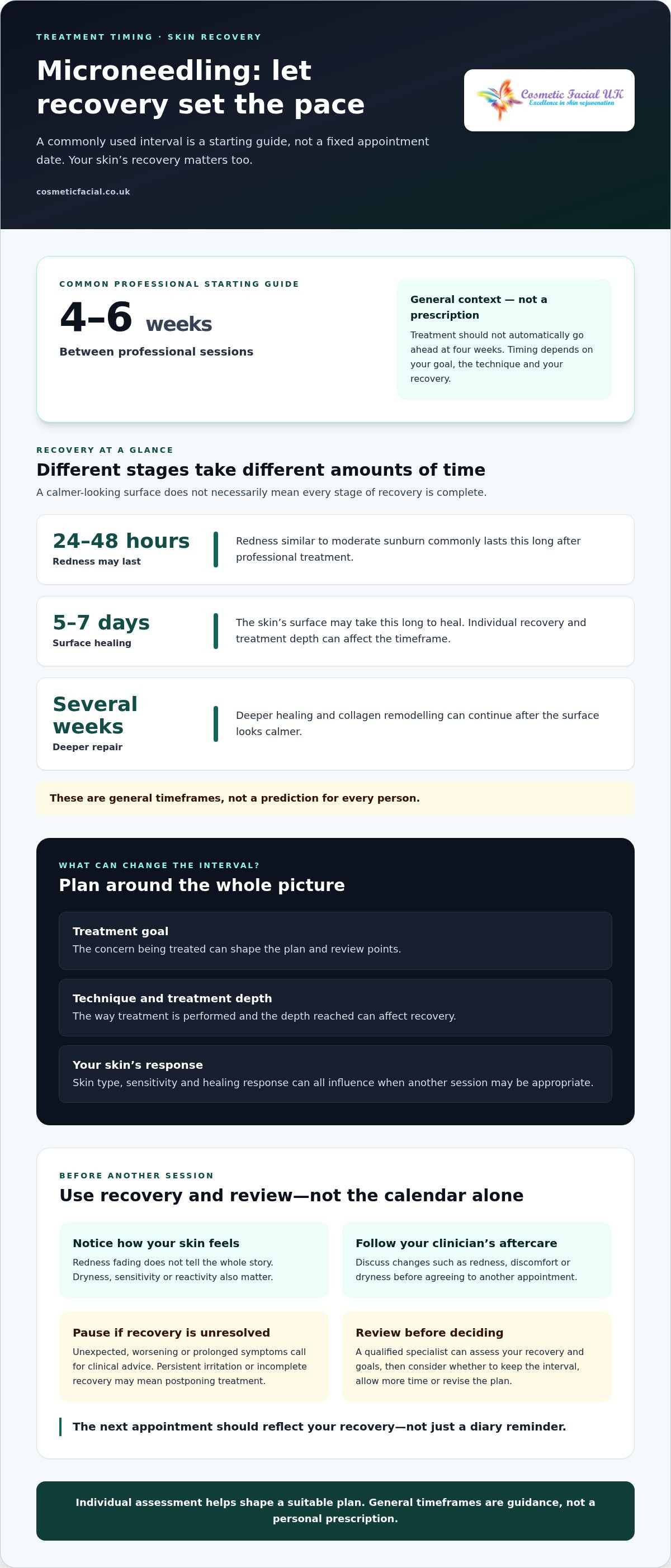
If you’re asking how often should you get microneedling, a common starting point for professional treatments is to leave around four to six weeks between sessions. That interval is general guidance, not a fixed rule: your treatment goal, the technique used and your skin’s recovery all influence when another session may be appropriate.
Recovery is part of the schedule. Redness may last 24 to 48 hours, and the skin’s surface can take five to seven days to heal. Deeper repair and collagen remodelling continue for several weeks. A calmer-looking surface does not necessarily mean that every stage of recovery is complete.
This guide explains typical intervals, what can change them and how to plan around recovery. Use the information to prepare for a discussion with a qualified specialist, rather than treating a general timeframe as a personal prescription.
Key Takeaways
- For how often should you get microneedling, use commonly quoted intervals as general guidance, not a fixed prescription. An individual assessment helps shape a suitable plan.
- Plan around recovery, not just visible redness, and follow your clinician’s aftercare instructions before considering another session.
- Your skin concern, treatment depth, skin type and healing response can all affect timing. Radiofrequency microneedling is distinct from standard microneedling.
- Take a measured approach: begin with an assessment, observe your skin’s recovery and review it before deciding on another session.
- Cosmetic Facial offers microneedling in Marylebone, London, with an individual approach to treatment goals and recovery.
How often should you get microneedling? Typical intervals explained
Microneedling frequency is the interval between sessions, planned around the treatment goal and how your skin responds. For professional treatment, around four to six weeks is a commonly used starting guide. It is not a prescription or a guarantee that everyone will be ready for another session at that point.
The next appointment date depends on more than the calendar. The concern being treated, the technique and treatment depth, your skin’s response and the time it takes to recover can all affect the interval. A qualified specialist can assess these factors and adapt the plan at review.
What is a typical gap between microneedling sessions?
For many professional treatment plans, four to six weeks is a reasonable reference point. It allows time for recovery and for changes following treatment to develop before the skin is assessed again. It does not mean that treatment should automatically go ahead at four weeks. If your skin has not recovered or remains sensitive, the timing may need to change.
Microneedling, also called collagen induction therapy, uses controlled punctures to stimulate a skin response. The process and its applications are outlined in Collagen induction therapy (microneedling). A professional plan is based on the treatment and your skin. It should not be used as a timetable for repeated at-home needling. Home devices and professional treatments may differ in design and use, so do not assume the same intervals apply to both.
How many microneedling sessions might a course involve?
A course may involve several sessions, but there is no single suitable number for everyone. The plan depends on the reason for treatment and how your skin responds over time. For example, someone seeking to improve the appearance of scarring may have different priorities from someone addressing overall skin texture, so the course and review points may differ.
Rather than treating a fixed number of sessions as a commitment, use each review to assess recovery, discuss progress towards your agreed goal and decide whether another session is appropriate. You may continue at a similar interval, allow more time between treatments or revise the plan. This avoids treating a commonly quoted course length as a promise of a particular result.
In short, use four to six weeks as general context, not a deadline. The most useful schedule reflects the treatment purpose and your observed response, with the next appointment considered after recovery and review.
Why microneedling sessions need time apart for skin recovery
Microneedling creates controlled punctures in the skin, prompting a local response as the tissue repairs itself. This response is part of the treatment process, but it does not guarantee a particular cosmetic outcome. Your skin needs time to recover before it is assessed for another session.
Wait until your skin has had adequate time to recover before repeating microneedling. Do not base the decision only on whether redness has faded or a diary reminder has appeared. Visible changes at the surface may settle before deeper repair is complete. If you’re considering how often should you get microneedling, this is one reason an individual review is more useful than relying on a fixed date alone.
What happens to the skin after microneedling?
The epidermis is the outermost layer of skin, whilst the dermis lies beneath it and contains structures involved in skin support. The effect of microneedling depends partly on how the treatment is performed and the depth reached. In response to controlled needling, the skin initiates repair processes that can involve collagen production. They do not guarantee a particular change in texture, scarring or appearance.
After professional treatment, redness similar to moderate sunburn commonly lasts 24 to 48 hours. The skin surface may take five to seven days to heal, whilst deeper healing and collagen remodelling can continue for several weeks. These are general timeframes, not a prediction for every person. Treatment depth and individual response can affect recovery.
How recovery affects the next appointment
Redness and sensitivity are useful to note, but they do not give a complete picture of recovery. Your skin may look calmer whilst still feeling unusually dry or reactive, and the surface may appear settled before deeper processes have finished. An assessment should take into account your symptoms, the treatment performed and how your skin has behaved since the session.
Some short-term redness or sensitivity can occur after treatment. If symptoms are unexpected, worsening or prolonged, seek clinical advice rather than proceeding with another session. Persistent irritation or incomplete recovery may be a reason to postpone treatment. Allowing more time is preferable to treating through an unresolved reaction. Follow the aftercare instructions given by your clinician, as they relate to your treatment.
Before agreeing to another appointment, discuss any changes you have noticed, including redness, discomfort or dryness. The review can help determine whether your skin is ready, whether to extend the interval or whether to reconsider the plan. A schedule should respond to recovery, not override it.
At Cosmetic Facial, an individual assessment can help inform planning for microneedling treatment in London, taking recovery and treatment goals into account.
What changes how often you should get microneedling?
There is no single interval that suits everyone or every microneedling treatment. How often should you get microneedling depends on your treatment goal, the technique used and how your skin responds. Consider these factors together: wanting to address a different concern does not automatically mean sessions should be closer together.
The overview below is educational, not diagnostic. It explains what may affect scheduling, but cannot determine whether a particular treatment is suitable for you or when to book another session.
Factor
Possible effect on planning
Treatment depth and intensity
A more intensive treatment may require a different recovery and review plan.
Technique or device
The method affects how treatment is delivered, so do not assume intervals transfer between techniques.
Skin concern and treatment goal
The clinician considers the area being treated and the intended objective when planning and reviewing sessions.
Current skin condition and response
Irritation, an active skin problem or slower-than-expected recovery may prompt reassessment or a delay.
Does treatment depth or technique change the interval?
It can. Needle depth, treatment intensity and the device or method used influence how the skin is treated and may affect recovery. Standard microneedling and radiofrequency microneedling are distinct procedures: radiofrequency microneedling combines needling with radiofrequency energy. They are not interchangeable, and an interval used for one should not automatically be applied to the other. Scheduling should reflect the actual treatment plan, rather than an assumed conversion between methods.
How do skin condition and treatment goals affect timing?
A clinician will consider why you’re seeking treatment, the area involved and how your skin responded to any previous session. The plan may differ according to the concern, but wanting faster progress is not a reason on its own to shorten the gap. The aim is to balance your treatment objective with an appropriate approach to recovery.
Current irritation or another active skin problem may affect whether treatment is appropriate at that point. Individual healing also varies, so the same planned date may not suit everyone. These considerations call for clinical assessment rather than a general rule for a particular skin concern. If your skin changes between appointments, mention it at your review so the plan can be reconsidered.
For a personalised schedule, an assessment should account for the technique, your treatment goal and your skin’s observed response. Cosmetic Facial offers microneedling in Marylebone, London, with individual assessment informing treatment planning.
How to plan microneedling sessions around recovery
Plan a treatment course so that each next step depends on the previous one. Instead of relying on a recurring diary reminder, use the clinician’s proposed review point as a guide, then consider your skin’s response before confirming another appointment. This helps balance treatment goals with recovery and everyday commitments.
Use this sequence to organise your plan:
- Begin with an assessment. Discuss your skin, treatment aim, relevant medical history and current concerns. This gives the clinician context to assess whether microneedling is suitable and how to approach the plan.
- Agree the initial plan. The treating clinician can explain the proposed treatment and when your skin should be reviewed. Treat this as a checkpoint, not an automatic commitment to another session.
- Attend the treatment and follow its aftercare. Use the instructions provided by your clinician rather than a routine found online. If you’re planning around work, travel or an important event, allow flexibility in case your skin needs more time to settle.
- Observe your skin’s response. Note how it feels and changes during recovery, and keep track of concerns to raise. Do not use a calendar date or fading redness alone to decide that your skin is ready.
- Review before deciding. Discuss your recovery and progress with the clinician. The next step may be to proceed according to the plan, allow more time or reconsider the approach.
A practical way to organise a treatment course
Keep the proposed review date separate from a confirmed treatment booking. That leaves room to decide based on recovery. If your goal relates to overall appearance or skin quality, discuss it alongside the clinic’s facial rejuvenation information. Clear goals make reviews more useful, without assuming that every concern calls for the same course or timing.
Revisit how often should you get microneedling at each review. The plan can change as the clinician considers your response, rather than continuing unchanged because a series was pencilled into the diary.
When should you delay a planned session?
Pause and seek clinical advice if irritation is ongoing, symptoms are unexpected or your skin has changed since the last appointment. Tell the clinician about illness, new medicines or other relevant changes before treatment, as these may affect the assessment. Do not try to diagnose the cause yourself or proceed over skin that appears compromised. The appropriate next step should be decided with clinical guidance.
Planning with flexibility is practical, not a sign that a course has gone off track. Leave enough space in your schedule for a review and aftercare, then let your observed response inform the next decision.
Plan microneedling in London with an individual clinical assessment
A useful microneedling schedule balances your reason for treatment with how your skin recovers. General interval guidance can help frame the discussion, but cannot account for every treatment approach, skin concern or individual response. An assessment and review give the clinician a basis for planning and adjusting the next step if recovery or circumstances call for it.
Cosmetic Facial offers microneedling at its Marylebone, London clinic. Qualified specialists provide personalised care, so planning can focus on your skin and aims rather than a universal timetable.
What to expect from an individual assessment
An assessment can consider your current skin condition, treatment goals, relevant history and response to previous treatment. These details help inform whether microneedling is appropriate and what factors to take into account when planning a course. They also provide a reference point for later reviews, so decisions can reflect how your skin has responded rather than rely only on an expected date.
Cosmetic Facial’s Dr Faramarz Didar holds an MSc in Dermatology Skills and Treatment with Commendation. If your goals relate to broader skin rejuvenation, the clinic’s facial rejuvenation treatment information can help you consider the treatment context alongside your assessment. You can also explore treatment options before deciding on a next step.
How to take the next step in Marylebone
Appointments for microneedling at Cosmetic Facial can be booked online or by phone. Use your appointment to describe what you hope to address and discuss any concerns about recovery or timing. A suitable plan should allow for review, rather than assume that every later session will take place on a fixed date.
As you consider how often should you get microneedling, keep the central principle in view: your schedule should reflect your treatment goals and observed recovery. If your skin needs more time, revisit the plan with clinical guidance. There is no need to rush the decision.
Make your next step a considered one
Before deciding how often should you get microneedling, consider what you want treatment to address and what would make a plan manageable for you. A clear priority gives your clinical discussion direction, whilst room to review progress helps keep expectations realistic. You do not need to commit to a course before understanding how the plan will be assessed and adapted.
Use an appointment to discuss your aims, relevant concerns and questions. A considered decision accounts for both the intended treatment and your comfort with the proposed approach. If you’re still weighing up your options, taking time to understand them is a constructive next step.
With a plan that reflects your priorities, you can move forward with greater clarity.
Frequently Asked Questions
Can you have microneedling every two weeks?
For professional microneedling, two weeks is generally shorter than the commonly used four-to-six-week interval, so do not assume it is suitable. A shorter gap may not allow enough time for recovery and review, particularly after a more intensive treatment. If a session has been suggested at this interval, discuss the treatment method and your skin’s response with the clinician before proceeding. The schedule should be based on your individual assessment, not a desire to accelerate results.
Is microneedling once a month too often?
Not necessarily. A monthly appointment is roughly four weeks apart, at the shorter end of commonly used guidance for professional microneedling. That does not make it suitable for everyone or mean you should book automatically each month. If your skin is still irritated or unusually sensitive at the review point, your clinician may recommend waiting longer. Consider the proposed interval alongside the technique used and your recovery, rather than judging timing by the calendar alone.
How long does skin take to recover after microneedling?
Initial redness may last around 24 to 48 hours, and the skin surface may take five to seven days to heal. These are general timeframes, not guarantees: treatment depth and individual response can affect recovery. Skin that remains uncomfortable or reactive after surface redness has settled still deserves attention. Follow your clinician’s aftercare instructions, and seek clinical advice if symptoms are unexpected, worsening or prolonged rather than relying on a standard timeline.
Can you do microneedling at home between professional sessions?
Do not use at-home needling to fill the gap between professional sessions without clinical guidance. Home devices and professional treatments may differ, and adding another needling routine can increase skin irritation or make it harder to assess your response. If you’re concerned that progress is slow, raise this at your review rather than increasing treatment yourself. A clinician can discuss whether the plan or timing should change based on your skin and treatment goals.
How many microneedling sessions are usually needed to see a difference?
There is no single session number that guarantees a visible difference. A course may involve several treatments, and some general guidance describes an initial series of three to six, but the appropriate plan depends on the concern, technique and individual response. Changes may also develop over time rather than being apparent immediately after a session. Use review appointments to assess progress against your original goal and decide whether further treatment is appropriate.
When should you avoid or postpone microneedling?
Postpone a planned session if your skin has ongoing irritation, an unexpected reaction or another active problem, and seek clinical advice before rescheduling. Tell the clinician if you become unwell, notice a change in your skin or start a new medicine, as this information may affect the assessment. Do not try to diagnose the cause yourself or proceed over skin that appears compromised. The clinician can advise whether treatment should wait or whether further assessment is needed.
Can microneedling be combined with a chemical peel?
Microneedling and a chemical peel may both form part of a wider skin treatment plan, but their timing and suitability need individual clinical assessment. Combining procedures too closely could increase irritation, depending on the peel and microneedling technique. Do not assume they should be performed in the same appointment or that a standard waiting period applies. Discuss your treatment history, skin response and goals with the clinician, who can advise on an appropriate sequence or whether to use one treatment alone.
Disclaimer
All content on cosmetic Facial website, including blogs, graphics, logos, images, and software, is the property of CosmeticFacial UK or its content suppliers and is protected by applicable copyright laws. Unauthorized use, reproduction, distribution, or modification of any content without prior written permission is strictly prohibited.


