


A PDO thread lift is not suitable for every degree of facial laxity. If you’re researching pdo thread lift for sagging skin london, the useful question is whether the treatment could address your particular concerns, not whether it promises a dramatic lift. Thread lifts may be considered for selected cases, but an individual assessment is needed to discuss realistic outcomes and alternatives.
Before considering a procedure, it’s reasonable to want clear information about discomfort, recovery and possible complications. Comparing a thread lift with options such as HIFU, radiofrequency or surgery can also be challenging because each approach works differently and may suit different concerns.
This guide explains how PDO threads work, who may be suitable and what to discuss at a consultation, including risks, aftercare and expectations. It also covers questions to ask when assessing a London provider. At a consultation in Marylebone, you can discuss your goals and alternatives, and whether a thread lift is appropriate for you. A consultation does not mean treatment is the right choice.
Key Takeaways
- A PDO thread lift may be considered to support selected areas of tissue, but it does not remove excess skin or replace surgery.
- Understand how threads differ from HIFU and radiofrequency before comparing options. Their approaches and limitations are not interchangeable.
- Whether a thread lift is appropriate depends on an individual assessment of your skin laxity, concerns and treatment goals.
- When considering a pdo thread lift for sagging skin london, ask who will perform the procedure, what relevant training they have and how risks, aftercare and follow-up are managed.
- Use the consultation to discuss realistic expectations and alternatives, and assess the provider’s credentials before deciding.
What is a PDO thread lift for sagging skin, and what can it address?
A PDO thread lift uses absorbable polydioxanone threads placed beneath the skin to support selected areas of facial tissue. It is a minimally invasive procedure, not a surgical facelift. It does not remove excess skin or produce the same degree of change as surgery. Unlike HIFU or radiofrequency, which use energy to heat tissue, a thread lift uses threads. For a general introduction, see this overview of thread lifts.
For someone researching a pdo thread lift for sagging skin london, the key distinction is between a treatment that may support localised laxity and one that addresses more extensive skin changes. The proposed effect and its suitability depend on facial anatomy, skin condition and the treatment plan. Ask the practitioner to explain the intended degree of change for your concerns rather than assuming a particular result.
For a brief visual introduction to PDO mono threads, watch this video. It’s general educational material, not a substitute for an individual clinical assessment.
How does a PDO thread lift differ from a surgical facelift?
A thread lift involves placing threads beneath the skin, while a surgical facelift is an operation that can address more extensive changes to facial tissues. They are not equivalent options, and a thread lift should not be presented as a replacement for surgery. At consultation, ask what degree of change the proposed treatment is intended to achieve and whether another approach may better address your concerns.
Which areas of facial laxity might prompt a consultation?
People may seek advice about lower-face laxity, including early jowling or changes in tissue support around the cheeks. These are reasons to discuss treatment, not a guarantee that threads can improve them. A practitioner needs to assess your facial anatomy and skin quality in person, then explain whether a thread lift is appropriate. Cosmetic Facial also lists a non-surgical facelift treatment for readers comparing related options.
More pronounced laxity, substantial excess skin or concerns extending beyond localised support may call for a different treatment discussion. Suitability and likely improvement vary between individuals, so an assessment should cover alternatives as well as the limitations of threads. The aim is to identify an appropriate option for your anatomy and goals, not to fit every concern to one procedure.
How PDO threads work, and who may be suitable in London
PDO stands for polydioxanone, an absorbable material used in medical sutures. In a thread lift, a practitioner places threads beneath the skin to support selected facial tissues. The intended effect depends on the thread design and placement. Ask the practitioner to explain the approach proposed for your anatomy rather than relying on general descriptions of the procedure.
Some explanations also describe a tissue response, including collagen production as the threads are absorbed. This is a proposed secondary effect, not a predictable result for every person. The American Society of Plastic Surgeons’ explanation of how thread lifts work provides further general context, but cannot predict what an individual patient may experience.
What happens beneath the skin during treatment?
The threads are placed under the skin with the intention of supporting targeted tissue. Ask the treating practitioner to explain the planned placement, the type of thread and the purpose of that approach. Avoid assuming that a general description of mechanical support or collagen response predicts the degree of lift, visible change or duration for you.
Who may need another treatment or further assessment?
Suitability is a clinical decision based on your goals, facial anatomy, skin condition and relevant medical history. A thread lift may not adequately address more marked laxity or substantial excess skin, and another option may be more appropriate. Before deciding, provide a complete account of your health conditions, medicines, allergies and previous facial treatments. Ask which factors affect your suitability and why.
For a pdo thread lift for sagging skin london, a consultation at Cosmetic Facial’s Marylebone clinic can be an opportunity to discuss whether the approach fits your concerns, alongside alternatives. Location alone does not establish suitability or clinical quality. Ask the treating practitioner to explain their assessment and the reasoning behind any proposed plan.
If you’re comparing approaches for several concerns, the clinic’s facial rejuvenation options provide a starting point for broader treatment planning. You can also review Cosmetic Facial’s clinic information before deciding whether to discuss your concerns with the practice.
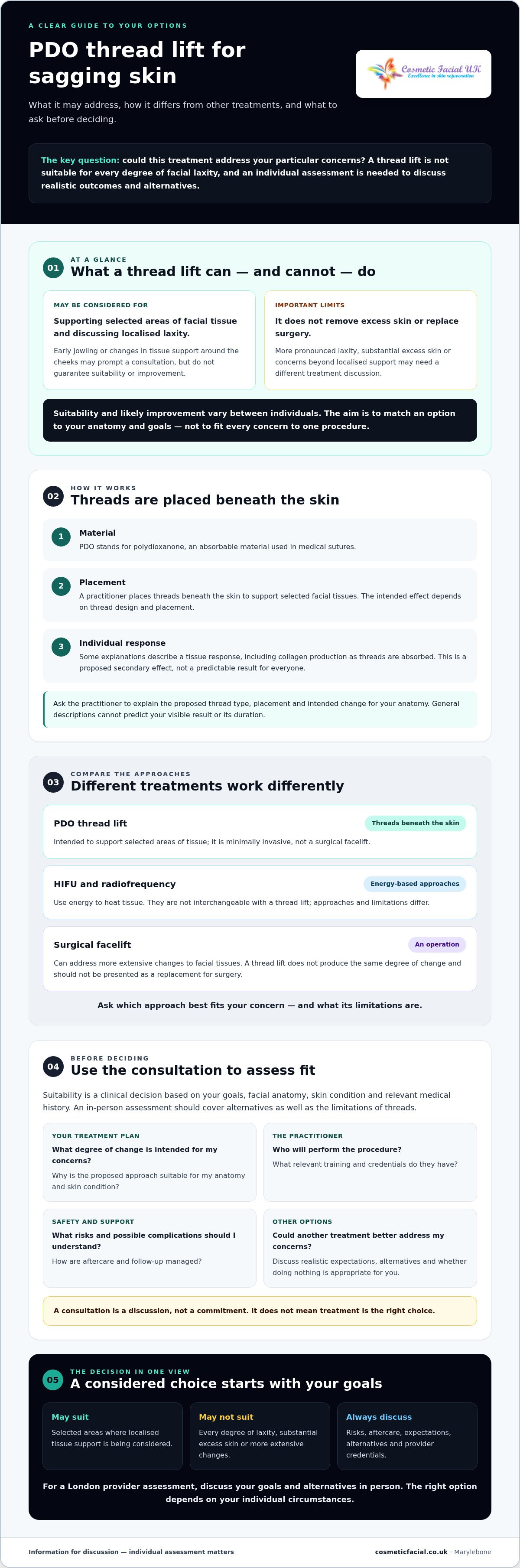
PDO thread lift versus HIFU, radiofrequency and surgery
These treatments approach facial laxity in different ways, so one cannot be treated as a direct substitute for another. PDO threads are placed beneath the skin to support selected tissue. HIFU and radiofrequency use energy to heat deeper skin layers, with the aim of stimulating a gradual tightening response. Surgery involves an operation and may be discussed for more pronounced changes. A treatment is not automatically suitable or risk-free because it is described as non-surgical.
The comparison below describes broad differences, not a ranking or a prediction of results. Your clinician should explain the proposed treatment, its limitations, risks and alternatives in light of your anatomy and goals.
- PDO thread lift: Threads are placed under the skin for targeted tissue support. It requires an individual assessment and discussion of procedure-specific risks. It does not remove excess skin.
- HIFU: Uses focused energy to heat deeper tissue. Cosmetic Facial lists a HIFU Face Lift, but its suitability should be assessed separately from a thread lift.
- Radiofrequency: Uses energy to heat tissue and is intended to support skin tightening over time. Ask how the particular treatment differs from HIFU and what it can realistically address.
- Surgical facelift: An operation that may be considered for more extensive concerns. It involves a different level of intervention and requires a separate surgical assessment.
When might a thread lift be considered instead of HIFU or radiofrequency?
A clinician may discuss threads where the concern involves selected areas of tissue support, while HIFU or radiofrequency may be considered for energy-based treatment goals. These are general distinctions, not guarantees of a particular result. Ask what the practitioner expects the proposed treatment to address, why it may suit your case and what alternatives are available. Cosmetic Facial’s HIFU service should be considered only after its own suitability assessment.
When should a reader discuss surgical options?
If you have pronounced laxity or substantial excess skin, ask whether a non-surgical option is likely to meet your aims. Cosmetic Facial does not offer surgical cosmetic procedures, including surgical facelifts. A suitably qualified clinician can explain whether a surgical assessment or referral is appropriate and help clarify realistic alternatives.
When comparing a pdo thread lift for sagging skin london with other approaches, focus on treatment fit, not on which option sounds most advanced. Ask about the evidence and limitations relevant to the specific procedure being proposed. A responsible discussion should make clear that “non-surgical” does not mean risk-free, and that benefits and risks vary between treatments and individuals.
Consultation, treatment and recovery: questions to ask a London provider
A thorough consultation should help you decide whether a PDO thread lift is appropriate, not assume that treatment will go ahead. If you’re considering a pdo thread lift for sagging skin london, use the appointment to understand the proposed plan, its limitations and how any concerns would be managed.
Consultation and treatment planning
Ask how the practitioner will assess your facial anatomy, skin condition, goals and medical history. Give a full account of relevant health conditions, medicines, allergies and previous procedures, and ask whether any of these affect suitability. The practitioner should explain what the treatment is intended to address, what it may not change and whether another option, or no treatment, is reasonable.
Before proceeding, clarify who will perform the procedure and what procedure-specific training and experience they have. If the treatment is proposed by a clinician, check their current registration through the relevant UK register, such as the GMC register for doctors. Ask the provider how to verify the clinic’s registration and what clinical arrangements are in place to manage complications.
Consent and treatment details
Consent should follow a clear discussion of expected benefits, uncertainties, risks and alternatives. Ask for time to consider the information and request written details of the proposed treatment plan. Make sure you understand which areas are being treated, why that approach has been recommended and what could lead the practitioner to change or defer the plan. You should have the opportunity to raise questions before making a decision.
Aftercare and recovery
Recovery and aftercare advice should be specific to the procedure planned and your circumstances. Ask what discomfort, swelling, bruising or other effects may occur, what activities or skincare you may need to avoid, and for how long. Do not rely on a universal recovery timetable or generic online checklist. Request written instructions, including which symptoms need prompt clinical advice, whom to contact and what to do if the clinic is unavailable.
Follow-up and support
Before treatment, confirm whether a review is planned, how to raise concerns afterwards and who is responsible for responding. Understand what support is available if healing differs from the practitioner’s expectations, and whether further assessment or referral may be needed. These arrangements are part of informed decision-making, not an afterthought.
A consultation at Cosmetic Facial’s Marylebone clinic can provide an opportunity to discuss your goals, alternatives, risks and aftercare. Treat it as an assessment, not a commitment to proceed.
Considering a PDO thread lift at Cosmetic Facial in Marylebone
Cosmetic Facial lists PDO Thread Treatment among its services at its Marylebone clinic. This makes it an option to discuss, not a recommendation before an individual assessment. If you’re considering a pdo thread lift for sagging skin london, the consultation should establish whether your concerns and expectations align with what the treatment may reasonably address, and whether another approach or no treatment is more appropriate.
What can readers expect from an informed treatment discussion?
A useful discussion should start with your priorities, such as changes in the lower face or the degree of support you’re seeking. The practitioner should assess your facial anatomy and skin, explain the proposed treatment’s limitations and risks, and discuss suitable alternatives. You should be able to ask questions and take time to consider the information. There’s no obligation to proceed simply because you’ve attended a consultation.
For broader planning, Cosmetic Facial’s guide to full-face rejuvenation may help you consider how different concerns and treatment options fit together. A treatment plan should be individual rather than based on a standard package or assumed outcome.
The supplied profile records that Dr Faramarz Didar received an MSc in Dermatology Skills and Treatment with Commendation in 2015 and attended an International Fellowship in Advanced Aesthetic Science non-surgical face-lift master class in 2018. These details indicate education and course attendance. Attendance at a master class is not, by itself, specialist accreditation or proof of a particular treatment outcome. Before deciding, confirm who would perform the procedure and ask about their current registration and relevant, procedure-specific training.
How can readers prepare before contacting the clinic?
Make a brief note of the areas you’d like assessed, what you hope to change and any previous facial treatments. Be ready to share relevant medical history, medicines and allergies. Prepare questions about the proposed plan, possible risks, recovery, written aftercare and follow-up. Ask whom to contact if concerns arise after treatment, and what arrangements are in place to assess or manage complications.
A clear provider discussion should leave you with an understanding of the reasoning behind any recommendation, as well as its alternatives and uncertainties. If the treatment is not considered suitable, ask what other options may be relevant and why. You can raise these questions with Cosmetic Facial without committing to a procedure.
Make an informed decision about your next step
A PDO thread lift is an option to assess for selected concerns, not a universal answer to sagging skin. Threads, HIFU and radiofrequency use different approaches, and more pronounced laxity may call for a discussion of other options. Suitability depends on your anatomy, skin condition, health history and expectations. A clear consultation should cover risks, alternatives, aftercare and the possibility that treatment is not appropriate.
Cosmetic Facial lists PDO Thread Treatment at its Marylebone clinic. The supplied profile records Dr Faramarz Didar’s MSc in Dermatology Skills and Treatment with Commendation, awarded in 2015, and attendance at a non-surgical face-lift master class in 2018. These details describe education and course attendance, not a guaranteed outcome. Confirm the treating practitioner’s current credentials and procedure-specific training before deciding.
If you’re researching pdo thread lift for sagging skin london, use your questions to guide an unhurried discussion about whether the treatment fits your concerns. Consider the information, compare alternatives and decide in your own time.
A considered decision begins with clear information and an individual assessment.
Frequently Asked Questions
Is a PDO thread lift suitable for sagging skin?
It may be suitable for some people, but only an individual assessment can establish whether it fits your concerns. A practitioner should consider the location and degree of laxity, skin quality, facial anatomy, medical history and the change you hope to achieve. Threads may not address pronounced excess skin or every facial concern. Ask about limitations and alternatives, including the option of no treatment, before deciding.
Can PDO threads lift jowls or sagging skin on the lower face?
A practitioner can assess lower-face laxity, including jowling, but the area alone does not predict an individual result. Facial anatomy, skin quality and the degree of change sought all influence whether threads may be appropriate. Ask what improvement is realistic in your case and what the treatment may not address. General claims or photographs of other patients should not be treated as a prediction of your own outcome.
How long do PDO thread lift results last?
There isn’t a single duration that can be promised for every patient. Longevity may vary with the treatment plan, individual factors and how the result is assessed. Ask the practitioner what evidence supports any estimate, what they mean by a result and whether follow-up is planned. They should explain uncertainty clearly and discuss factors that may affect the outcome rather than present a general timeframe as a personal guarantee.
What is recovery like after a PDO thread lift?
Recovery varies according to the person and the procedure, so ask the treating practitioner what after-effects to expect and what aftercare applies to your plan. Before treatment, clarify activity guidance, when to seek clinical advice and whom to contact if a concern arises. Request written instructions. Avoid relying on a fixed recovery timetable or assuming that a particular symptom is normal without advice from the clinic.
Is a PDO thread lift safer than a surgical facelift?
These are different procedures and should not be treated as equivalent or ranked as universally safer. Each has distinct approaches, risks, recovery considerations and potential outcomes. A non-surgical procedure is not automatically risk-free or suitable for everyone. Ask a qualified practitioner to explain the relevant risks and alternatives for your circumstances. If your concerns may be better addressed surgically, seek an appropriate surgical assessment.
How do I choose a PDO thread lift provider in London?
Check who will perform the procedure, their current registration and their relevant, procedure-specific training. For a pdo thread lift for sagging skin london, discuss suitability, alternatives, risks, limitations, aftercare and follow-up before consenting. Confirm how to contact the clinic if a concern arises. A clear consultation should give you time to consider the information, answer your questions and avoid promises of a particular result.
What should I ask at a PDO thread lift consultation?
Ask how the practitioner will assess your facial anatomy, goals and medical history, and whether a thread lift is appropriate for you. Discuss their relevant training, the realistic scope and limitations of the proposed treatment, material risks and possible alternatives. Clarify aftercare, planned follow-up and whom to contact if concerns arise. You should receive clear information and have time to decide whether to proceed.
Disclaimer
All content on cosmetic Facial website, including blogs, graphics, logos, images, and software, is the property of CosmeticFacial UK or its content suppliers and is protected by applicable copyright laws. Unauthorized use, reproduction, distribution, or modification of any content without prior written permission is strictly prohibited.


