


Effective neck rejuvenation is often less about tightening the skin and more about modulating the underlying musculature. If you've noticed vertical cords or 'tech neck' lines appearing, you might assume that a surgical lift is the only viable solution. It's understandable to feel self-conscious about these changes, especially when they appear to contradict a youthful facial appearance. Many patients seeking botox for neck bands central london do so because they want to address these prominent platysmal bands without the downtime or risks associated with invasive surgery.
This clinical guide explains how botulinum toxin type A targets the platysma muscle to relax the tension that creates visible cords. You'll understand the precise anatomical mechanism behind the treatment and why a GMC-registered doctor with dermatology expertise is essential for achieving a natural, subtle result. We will explore the differences between injectable treatments and surgical options, whilst outlining the specialist process at our Marylebone clinic to help you determine the most appropriate clinical pathway for your profile.
Key Takeaways
- Understand how Botulinum Toxin Type A inhibits acetylcholine to relax the platysma muscle, effectively smoothing vertical cords without the need for invasive surgery.
- Learn about the Nefertiti Lift technique, which specifically targets the lower face and jawline to restore a more defined and youthful contour.
- Compare the clinical efficacy and recovery times of botox for neck bands central london against alternative modalities like HIFU and traditional surgical lifts.
- Discover what to expect during a professional clinical assessment and the subsequent 20-30 minute injection procedure at our Marylebone clinic.
- Recognise the importance of specialist oversight by a GMC-registered doctor with advanced dermatology qualifications to ensure safety and natural-looking results.
Botox for Neck Bands: Addressing the Platysma in Central London
Patients in the capital are increasingly prioritising subtle, preventative measures over invasive surgery to maintain a dignified profile. At our Marylebone practice, we observe a growing demand for botox for neck bands central london as individuals seek to address the aesthetic impact of 'tech neck' and the natural maturation of the lower face. Our clinical environment is designed to provide a composed, medical-led experience for those navigating these changes. By focusing on the underlying muscular causes of ageing, we can achieve results that are both effective and refined.
What are Platysmal Bands?
The platysma is a broad, superficial sheet of muscle that originates in the pectoral and deltoid fascia, extending upwards across the collarbone to the borders of the mandible and the corners of the mouth. A detailed understanding of Platysma muscle anatomy reveals that this muscle is responsible for various facial expressions, such as pulling down the lower lip or tensing the skin of the neck. Over time, the muscle can become hyper-dynamic or begin to separate into distinct vertical cords known as platysmal bands.
These bands often become most prominent during speech or physical exertion. It is vital to distinguish these muscular cords from skin laxity or submental fat. Whilst skin-related issues may require energy-based devices or topical interventions, vertical bands are a muscular concern. Targeting these bands with Botulinum Toxin Type A allows for a targeted relaxation of the muscle, which smooths the neck profile without altering the patient's natural character.
The Rise of the Nefertiti Lift Technique
The Nefertiti Lift is a specialised non-surgical procedure named after the Egyptian Queen Nefertiti, who was celebrated for her exceptionally sharp and elegant jawline. This technique has become a staple of non-surgical rejuvenation amongst Central London professionals who require effective results with minimal downtime. The procedure involves precise injections along the lower jawline and into the vertical platysmal bands.
By relaxing the parts of the platysma muscle that pull downwards on the lower face, the upward-pulling muscles are allowed to work more effectively. This creates a subtle lifting effect that redefines the jawline and smooths the neck simultaneously. Many patients choose this approach because it addresses the transition between the face and neck, ensuring a cohesive appearance. It is an excellent alternative for those who aren't ready for a surgical neck lift but want to correct the early signs of 'turkey neck' or persistent vertical cording.
Choosing botox for neck bands central london at a clinic led by a dermatology expert ensures that the dosage and placement are tailored to your specific anatomy. This bespoke approach is what distinguishes clinical excellence from standard aesthetic applications.
The Clinical Mechanism: How Botulinum Toxin Relaxes Neck Cords
The efficacy of botox for neck bands central london relies upon a sophisticated understanding of neuromodulation. Botulinum Toxin Type A acts as a temporary block at the neuromuscular junction. Specifically, it inhibits the release of acetylcholine, the neurotransmitter responsible for signalling muscles to contract. When the toxin is introduced into the platysma, the muscle's ability to pull into tight, vertical cords is diminished. This process does not just mask the appearance of the bands; it addresses the physiological cause of the tension itself.
Clinical research into How Botulinum Toxin Treats Neck Bands demonstrates that precise dosing is required to achieve a visible softening of the neck profile without compromising functional movement. Because the platysma is a wide, thin muscle, the treatment must be highly localised. At our Marylebone clinic, Dr Didar utilises his MSc in Dermatology to map the unique muscular dynamics of each patient, ensuring the toxin is distributed effectively across the hyper-dynamic areas.
Understanding the Platysma Muscle Anatomy
The platysma is a superficial, sheet-like muscle that sits just beneath the skin. Its over-activity is a primary driver of facial ageing in the lower third of the face. Constant contraction, often exacerbated by the modern habit of 'tech neck' where the head is frequently tilted downwards, leads to the development of both horizontal 'necklace lines' and prominent vertical cords. These vertical bands occur when the medial borders of the muscle lose their youthful tone and begin to protrude.
This muscle also acts as a depressor, meaning it pulls the lower face and jawline downwards. By relaxing this downward force, the opposing elevator muscles in the mid-face can function more effectively. This creates the lifting effect seen in the Nefertiti Lift. Understanding this delicate balance between muscle groups is essential for any specialist performing botox for neck bands central london, as it prevents the 'frozen' or unnatural look often associated with less precise applications.
Precision Injection Techniques
Safety and natural outcomes are predicated on anatomical precision. During the clinical assessment, patients are asked to contract the neck muscles to make the bands clearly palpable. This allows for the identification of the most active segments of the muscle. Dr Didar’s background in surgical dermatology informs a strategy that prioritises depth and concentration, avoiding deeper structures such as the muscles involved in swallowing or speech.
The practitioner administers the toxin at multiple points directly into the palpable muscle cord, ensuring the product remains within the superficial muscular layer to achieve optimal relaxation. This methodical approach ensures that the treatment remains confined to the target area. If you are concerned about the appearance of vertical cords, you may wish to book a clinical consultation to discuss a bespoke treatment plan. By focusing on the specific tension points of your platysma, we can restore a smoother, more contoured neck profile that remains entirely expressive and natural.
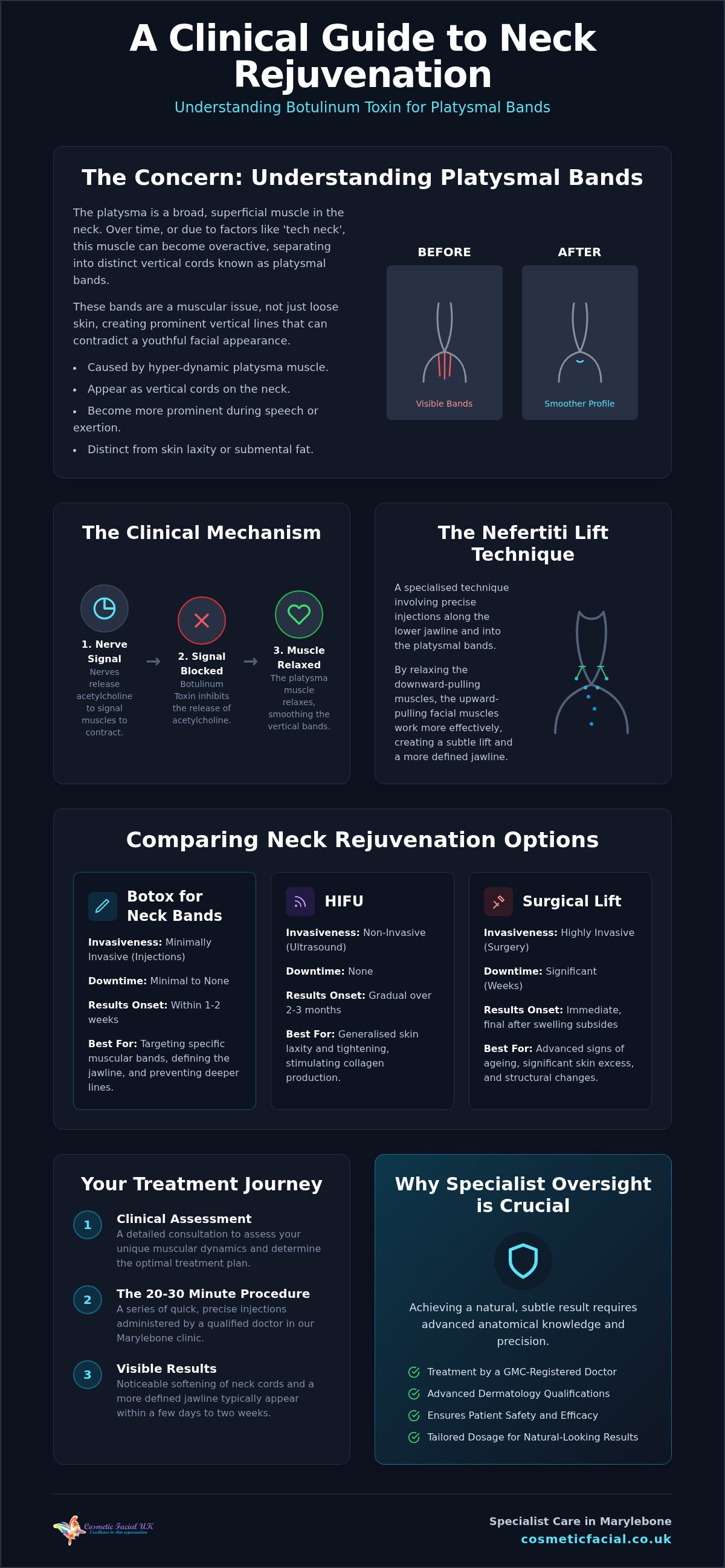
Comparing Non-Surgical Options: Botox vs HIFU vs Surgical Intervention
Selecting the correct modality for neck rejuvenation requires a clear distinction between muscular activity and dermal laxity. For many seeking botox for neck bands central london, the primary concern is the prominence of vertical cords during expression. Whilst Botox provides a targeted solution for these dynamic bands, other technologies like HIFU (High-Intensity Focused Ultrasound) address a different physiological layer. A comprehensive facial rejuvenation plan often involves assessing which of these factors contributes most to the patient's aesthetic concerns.
Botox vs. Energy-Based Devices (HIFU)
Botox and HIFU serve complementary but distinct purposes. Botox is a neuromodulator that relaxes the platysma muscle, providing relatively rapid results within 7 to 14 days. Conversely, HIFU is an energy-based treatment that targets the Deep Muscular Aponeurotic System (SMAS) to stimulate collagen production. This results in gradual skin tightening over three to six months. It doesn't affect muscle contraction directly but rather improves the structural integrity of the skin.
Combining line and wrinkle treatments with HIFU is often the most effective strategy for patients exhibiting both muscle cording and skin sagging. This dual-action approach ensures the underlying muscle is relaxed whilst the overlying skin is firmed. Central London professionals typically prefer this combination because it avoids the prolonged recovery periods associated with surgical alternatives. It allows for a staged improvement that looks natural and progresses over time.
Non-Surgical vs. Surgical Neck Lifts
A surgical neck lift remains the definitive solution for patients with significant excess skin or platysmal diastasis that cannot be corrected by injectables alone. However, surgery involves general anaesthesia, incisions, and weeks of recovery. In contrast, botox for neck bands central london is a 20-minute clinical procedure with virtually no downtime. The treatment is performed in a clinical setting and patients can return to work immediately after their session.
For patients in their 30s and 40s, Botox serves as an excellent maintenance programme. It prevents the deepening of vertical cords and manages early signs of ageing before they require surgical intervention. The risk profile is also significantly lower; minor bruising is the most common side effect, compared to the potential complications of invasive theatre procedures. This makes non-surgical options highly attractive for those who must return to their professional or social commitments without delay. It's a matter of clinical suitability rather than just preference.
Your Treatment Journey: From Consultation to Rejuvenation
Embarking on a treatment for botox for neck bands central london begins with a structured clinical pathway at our Marylebone practice. We prioritise a methodical approach to ensure that every patient understands the technical nuances of their procedure before any injections occur. This journey is designed to be transparent and professional, reflecting our commitment to clinical excellence and patient-centred care.
Your Specialist Consultation
The process starts with a comprehensive clinical assessment led by Dr Didar. During this session, we perform a detailed skin analysis and evaluate the contractile strength of the platysma muscle. This allows us to determine the precise dosage required to achieve a smoother profile without compromising natural expression. We also review your medical history to identify any contraindications and discuss realistic outcomes for your specific anatomy. A thorough clinical consultation serves as the essential foundation for patient safety and procedural efficacy. By the end of this assessment, you will have a bespoke treatment plan tailored to your aesthetic goals.
The Procedure: What to Expect
The actual injection session typically lasts between 20 and 30 minutes, making it a convenient option for those with busy professional schedules. We utilise fine-gauge needles to ensure precision and minimise discomfort, which is particularly important for patients with sensitive skin. For a full Nefertiti Lift, multiple injection points are carefully mapped along the lower jawline and directly into the palpable vertical bands. Because the procedure is non-invasive, there is virtually no downtime. Most patients find they can return to their daily activities or professional commitments in Central London immediately after leaving the clinic.
Aftercare and Result Longevity
Post-treatment care is vital for ensuring the toxin settles correctly and provides the intended results. For the first 48 hours, we advise patients to avoid strenuous exercise, saunas, and intense heat treatments. You should also avoid lying flat or massaging the treated area for at least four hours following the procedure. Results typically begin to manifest within three to five days, with the full effect visible after two weeks.
The longevity of the treatment generally ranges between three and six months, depending on individual metabolism and muscle activity. To maintain a smooth, rejuvenated neck contour throughout 2026, we recommend scheduling maintenance appointments at regular intervals. Our team will provide a personalised follow-up schedule to ensure your results remain consistent and refined.
Specialist Care in Marylebone: Why Choose Cosmetic Facial
Selecting a clinic for botox for neck bands central london requires a focus on medical accountability and anatomical precision. In an aesthetic landscape that is often under-regulated, our Marylebone practice stands as a centre for clinical excellence. We prioritise patient safety through rigorous adherence to medical standards and peer-validated competence. Every treatment programme is bespoke, designed to address the specific muscular dynamics and skin quality of the individual patient. This methodical approach ensures that interventions are both safe and effective, providing reassurance to those seeking professional rejuvenation.
Expert Care by Dr Faramarz Didar
Dr Faramarz Didar (GMC 5200505) leads the clinic with a substantial background in both general medicine and specialised dermatology. He holds an MSc in Dermatology Skills and Treatment, which was awarded with Commendation. This academic rigour informs every aspect of our injectable protocols, from initial assessment to post-treatment review. As a member of the European College of Aesthetic Medicine & Surgery, Dr Didar remains at the forefront of global advancements in non-surgical rejuvenation. Our clinical philosophy centres on a "less is more" approach. We believe that the most successful outcomes are those that remain undetectable to the untrained eye, ensuring that the neck and jawline are refined whilst maintaining natural facial harmony.
Booking Your Treatment in Marylebone
Situated in the heart of Marylebone, our clinic offers convenient access for Central London residents and professionals seeking a discreet, medical-led environment. Patients can access our online booking system to arrange an initial consultation at a time that suits their professional commitments. Our facility is equipped to handle a broad range of clinical needs beyond aesthetic injectables. We provide same-day dermatology services, including comprehensive mole checks and skin analysis, which are often essential for patients with multifaceted skin health concerns. This integrated approach allows for a holistic evaluation of the face and neck. By choosing botox for neck bands central london at a clinic that prioritises evidence-based care and professional integrity, you ensure that your rejuvenation journey is managed by experienced, GMC-registered hands.
Achieving a Refined Profile through Clinical Precision
Addressing vertical neck cords and jawline laxity requires a nuanced understanding of muscular dynamics. By utilising Botulinum Toxin Type A to relax the platysma, patients can achieve a more contoured and youthful profile without the significant downtime or risks associated with invasive surgical procedures. This clinical guide has outlined the biological mechanism of neuromodulation and the specific benefits of the Nefertiti Lift for those seeking refined results. It's a reliable pathway for patients who prioritise subtle, effective rejuvenation over drastic changes.
Selecting botox for neck bands central london at our Marylebone clinic ensures your care is managed by a specialist with advanced dermatological training. Dr Faramarz Didar, a GMC-registered doctor (5200505) with an MSc in Dermatology with Commendation, creates bespoke treatment plans that prioritise safety and natural facial harmony. Our practice is dedicated to providing evidence-based aesthetic interventions in a composed, professional setting located in the heart of the capital.
We look forward to assisting you in restoring a smoother, more dignified neck profile through clinical excellence.
Frequently Asked Questions
How many units of Botox are typically needed for neck bands?
The number of units required varies based on the prominence and number of the platysmal bands. Typically, between 20 and 50 units of Botulinum Toxin Type A are administered across the vertical cords. A patient with two distinct bands will require a different concentration than one with four or more. During your consultation for botox for neck bands central london, Dr Didar will determine the specific dosage to ensure effective muscle relaxation whilst maintaining natural movement.
Is Botox for neck bands safe for all skin types?
Botulinum toxin treatments are safe and effective for all skin types and ethnicities. Because the injection targets the underlying platysma muscle rather than the dermis or epidermis, there's no risk of pigmentary changes or scarring associated with skin tone. Patients with darker skin tones, specifically Fitzpatrick scales IV-VI, can undergo this procedure without the concerns often associated with certain laser or chemical treatments. The primary focus remains on the anatomical structure of the neck muscles.
How long does it take to see the full results on the neck?
Initial muscle relaxation usually becomes apparent within three to five days following the procedure. However, the full clinical effect on the neck bands typically takes up to 14 days to manifest. During this period, the toxin gradually inhibits acetylcholine release, allowing the vertical cords to soften and the jawline to appear more defined. We schedule a follow-up review at the two-week mark to assess the final outcome and ensure the desired level of rejuvenation is achieved.
Can Botox for neck bands help with horizontal "tech neck" lines?
Botox is primarily used to treat the vertical cords, but it can also soften horizontal "necklace lines" by reducing the overall tension of the platysma muscle. If these horizontal lines are deeply etched into the skin from repetitive folding, a combination approach may be necessary. Whilst botox for neck bands central london addresses the muscular pull, additional treatments such as skin boosters or dermal fillers may be recommended to restore volume and smooth the skin's surface.
Are there any risks of swallowing difficulties after neck Botox?
Dysphagia, or difficulty swallowing, is an extremely rare side effect that only occurs if the toxin migrates to the deeper muscles of the neck. This risk is effectively mitigated by choosing a practitioner with advanced anatomical knowledge, such as a GMC-registered doctor. By utilising precise injection techniques and maintaining a superficial depth within the platysma, we ensure the treatment remains localised. Dr Didar’s expertise in surgical dermatology provides the necessary precision to avoid affecting deeper functional structures.
How does the Nefertiti Lift differ from a standard Botox treatment?
A standard treatment often focuses on a single area, whereas the Nefertiti Lift is a comprehensive technique designed to redefine the entire lower face and neck. It involves a specific pattern of injections along the mandible and the platysmal bands to create an upward lifting effect. By relaxing the downward-pulling muscles, the jawline becomes more sculpted. This differs from simple band relaxation by intentionally balancing the muscular forces between the lower face and the neck.
Can I combine neck Botox with dermal fillers for the jawline?
Combining neuromodulators with dermal fillers is a common clinical practice for achieving total lower-face rejuvenation. Whilst Botox relaxes the platysmal bands to smooth the neck, dermal fillers can be used to restore lost volume and structural definition to the chin and jawline. This multi-modal approach addresses both muscular activity and bone resorption or fat loss. At our Marylebone clinic, we often create integrated plans that utilise these different modalities to achieve a cohesive, natural result.
What is the recommended age to start treating platysmal bands?
There's no fixed age to begin treatment, as the development of platysmal bands depends on genetics, lifestyle, and individual anatomy. Most patients begin to notice prominent vertical cords in their late 30s or early 40s. However, individuals who frequently engage in activities that strain the neck, or those concerned with "tech neck," may seek preventative treatment earlier. A clinical assessment is the only way to determine if the muscle activity warrants intervention to prevent deeper lines from forming.
Disclaimer
All content on cosmetic Facial website, including blogs, graphics, logos, images, and software, is the property of CosmeticFacial UK or its content suppliers and is protected by applicable copyright laws. Unauthorized use, reproduction, distribution, or modification of any content without prior written permission is strictly prohibited.


