


Fat-dissolving injections are intended to contour localised areas, not to provide weight loss. For people considering non-surgical fat-dissolving injections in London, Aqualyx is one option: it uses deoxycholic acid to break down fat cells, which the body then processes through the lymphatic system. Treatment commonly involves 2 to 4 sessions, depending on the area and the response.
It’s understandable to want a clear idea of what a treatment involves before deciding whether it suits you. Aqualyx may be used for areas such as the chin, abdomen, thighs, bra rolls and flanks, but it is not designed to remove larger volumes of fat or replace liposuction.
This article explains how Aqualyx works, what treatment involves, how many sessions may be needed and when results may become visible. It also covers factors that can affect how long results last, helping you weigh potential benefits and limitations with realistic expectations.
Key Takeaways
- Aqualyx is intended to contour localised areas rather than support weight loss or remove larger volumes of fat.
- The number of sessions depends on the treatment area and individual response; the article explains what to expect from a course.
- Learn when changes may become visible and why the longevity of results can vary.
- Understand the recovery period and the temporary reactions that may follow treatment.
- Consider the potential benefits and limitations of injections when deciding whether this approach suits your goals.
What are Aqualyx fat dissolving injections?
Aqualyx is an injectable treatment intended to reduce localised fat pockets and refine body contours. It contains deoxycholic acid, which disrupts fat-cell membranes. The body then processes the treated fat through the lymphatic system.
Treatment areas
Areas considered for treatment include the chin and jawline, arms, back, abdomen, thighs and buttocks, as well as bra rolls and flanks. A practitioner assesses the location and amount of localised fat, because suitability depends on the area being treated, not on a general goal of weight reduction.
Aqualyx is not intended for every part of the body. For example, it should not be administered around the eyes. An assessment helps determine whether injections are appropriate for the area or whether another approach, such as fat freezing, better fits the desired contouring outcome.
Expected results and sessions
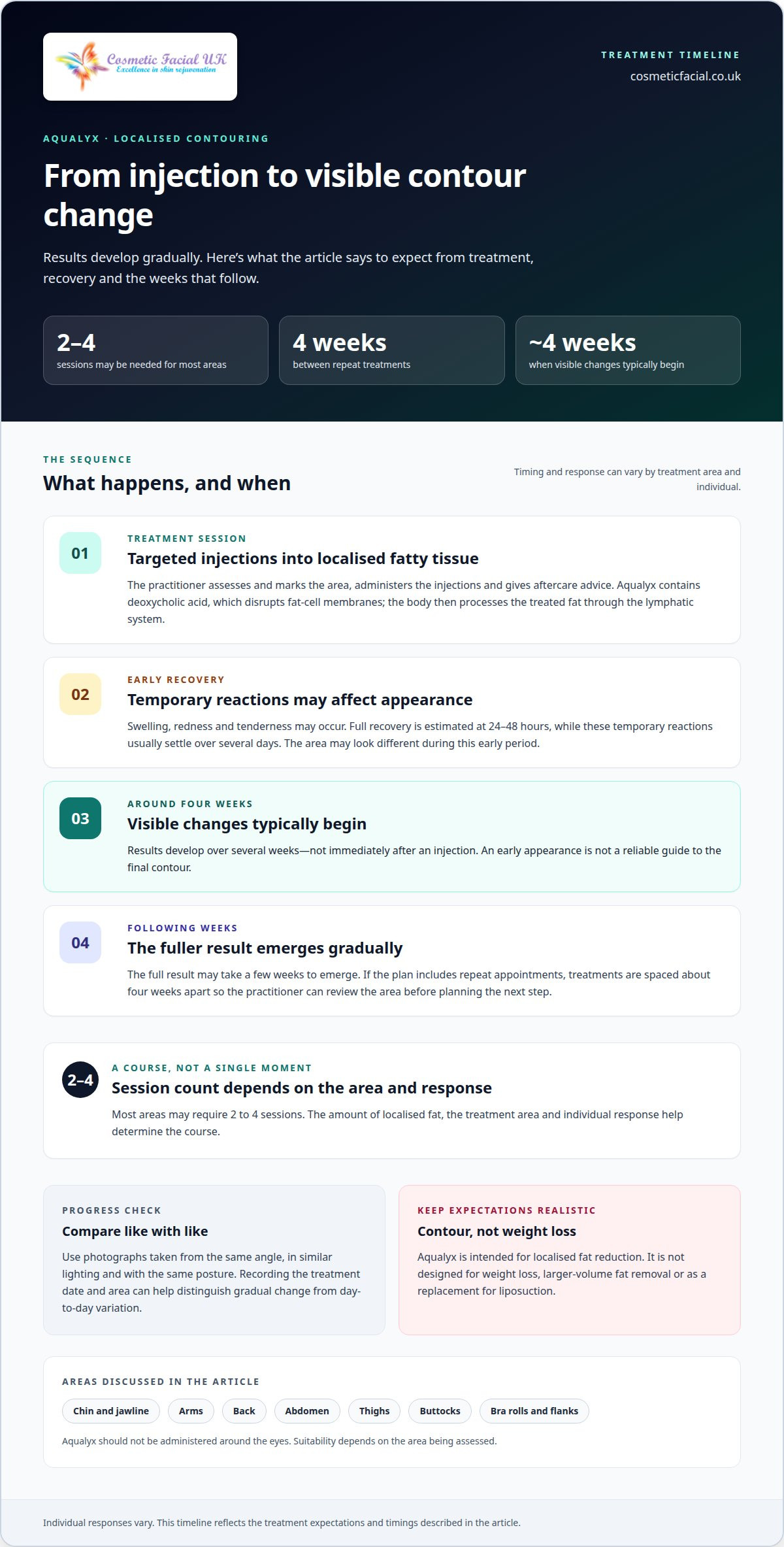
Fat-dissolving injections are generally used for localised fat reduction, not weight loss or larger-volume fat removal. Most areas may require 2 to 4 sessions, with repeat treatments spaced 4 weeks apart. The amount of fat, treatment area and response help determine the course; results develop over time rather than immediately after an injection.
Swelling can occur after treatment and may temporarily change the area’s appearance. A practitioner can explain the expected stages of change for the area being assessed, such as the chin or abdomen, and how progress will be reviewed between sessions.
Treatment price: The price depends on the product, treatment area, amount required and number of sessions, and is provided after a quote request. A treatment plan may involve more than one appointment, so the total cost depends on the plan rather than a single injection session.
Fat freezing is a separate, non-injectable fat-reduction treatment, while Aqualyx is injected into localised fatty tissue. The methods differ, so relevant considerations include the area, treatment process and intended outcome. A consultation can clarify which approach suits the specific concern.
In the UK, requirements for providing and advertising injectable treatments depend on the product and the practitioner’s professional status. Advertising should accurately describe the treatment and its expected outcomes, including its limitations. London clinics offering injections vary, so assess the named practitioner’s relevant clinical qualifications, injectable-treatment training and experience with the area being considered.
How long will my results last?
Aqualyx results develop over several weeks, with visible changes typically beginning around four weeks after treatment. How long the contour remains depends partly on changes in body weight and the area treated.
Results longevity
There is no single duration that applies to every treated area. Aqualyx targets localised excess fat, so the resulting contour change is different from weight loss across the body. Changes in body weight can alter areas such as the abdomen or thighs, affecting how noticeable the original result remains.
Think of the result as a change in one area, not a permanent barrier to future weight changes. Keeping a consistent weight can help preserve the overall contour, while substantial weight changes may alter it. This distinction matters when deciding whether injections suit your goals.
Timing of visible results
Visible results typically begin around four weeks after treatment, while the full result may take a few weeks to emerge. An early appearance is therefore not a reliable guide to the final contour. For example, the abdomen may look different immediately after treatment than it does several weeks later, as changes develop.
Use consistent before-and-after photographs to assess progress: take each image from the same angle, in similar lighting and with the same posture. Recording the treatment date and area also helps distinguish gradual change from ordinary day-to-day variation.
Gradual results and maintenance
Change is gradual, so set expectations accordingly. A treatment session does not produce an instant final result, and follow-up assessment should allow time for visible changes to develop. If the plan includes repeat appointments, spacing sessions roughly four weeks apart allows the practitioner to review the treated area before planning the next step.
Maintenance does not follow one schedule for everyone. It depends on the contour achieved, changes in weight and whether excess fat remains in the area. A practitioner can review these factors alongside photographs rather than judging progress from swelling or appearance soon after an appointment.
Recovery also shapes when you can assess the result. Swelling, redness and tenderness may occur and usually settle over several days; full recovery is estimated at 24-48 hours. These temporary reactions can affect the treated area’s appearance, so compare photographs after the initial recovery rather than immediately. For a structured assessment of your aesthetic goals, you can explore treatment options.
How Aqualyx works
Aqualyx is injected into localised fatty tissue as a non-surgical contouring procedure. It contains deoxycholic acid, which disrupts fat-cell membranes. The body then processes the treated fat through the lymphatic system.
During treatment, the practitioner assesses and marks the target area, administers the injections and provides aftercare advice. A consultation helps define the area and establish whether the goal is localised contouring. Aqualyx is not a weight-loss treatment or an alternative to liposuction for larger volumes of fat.
The process is gradual, not an immediate change in shape. After the fat-cell membranes are disrupted, the body naturally processes the treated material, so visible results develop over time. Responses vary by area and individual. This is targeted fat reduction, not general weight loss.
Aqualyx, Lemon Bottle and Deso have different stated ingredients. Lemon Bottle contains riboflavin, bromelain and lecithin, while Deso, also called Desoface or Desobody, contains sodium deoxycholate. Aqualyx contains deoxycholic acid. These differences mean the names should not be treated as interchangeable descriptions of one product.
Aqualyx has more established clinical evidence than Lemon Bottle injections. This comparison concerns the evidence base, not a promise of a particular outcome. Belkyra is another named injectable treatment, but an association with fat reduction does not establish that it has the same formulation, evidence or procedure as Aqualyx. Brand names alone do not provide a clinical comparison.
The UK licensing or regulatory status must be considered for the specific injectable product and its intended use. A brand name alone does not establish whether a product is licensed or regulated in the UK. Aqualyx, Lemon Bottle and Deso should not be labelled licensed or unlicensed without product-specific evidence.
For a localised area such as the chin or abdomen, the consultation and assessment determine the treatment plan. The practitioner explains the injection process and aftercare. The distinction between injections and surgery also matters: Aqualyx is intended for localised fat, not larger-volume removal. The choice of procedure depends on the area and the amount of fat being addressed.
The clinic says ultrasound machine enhances medication penetration into fat cells, and lidocaine can be added before injection for comfort. It says itching, slight burning, slight oedema and reddening can last 1-3 days; avoid anti-inflammatory drugs, direct heat and severe cold.
How many sessions and what results can I expect?
The treatment course and recovery both affect what to expect from fat-dissolving injections. Most areas require 2 to 4 sessions, usually spaced four weeks apart, with the practitioner reviewing the treated area between appointments.
Swelling, tenderness, redness and bruising are common temporary effects. Itching, slight burning, slight oedema and reddening can also occur after Aqualyx treatment. Before injections, suitability and contraindications are assessed in light of medical history, the treatment area and the proposed plan.
Recovery is estimated at 24-48 hours, although swelling and tenderness may take several days to settle. This distinction helps explain why the initial recovery period does not necessarily mean every visible reaction has disappeared. A patient should allow the treated area to settle before judging the cosmetic result or arranging another session.
Aftercare supports recovery. Avoid physical exercise for about 4 to 5 days after treatment, and protect the treated skin from sun exposure with sunscreen of at least SPF 30. Avoid direct heat and severe cold on the area after treatment. Anti-inflammatory medicines such as ibuprofen are also advised against after treatment.
These steps matter when addressing a localised area of stubborn fat, whether the chin or another body area is being treated. Follow the practitioner’s specific aftercare advice, particularly if the treated area is tender or bruised. The aim is controlled sculpting, not immediate fat loss across the body.
- Swelling and tenderness: These can affect the appearance of treated fat cells for several days.
- Redness and bruising: These are possible injection-site reactions, alongside itching or slight burning.
- Activity: Avoid exercise for about 4 to 5 days after treatment.
- Skin protection: Use sunscreen with at least SPF 30 and avoid direct heat or severe cold.
For a useful progress record, take photographs before treatment and compare them after the area has settled. Keep the camera angle, posture and lighting consistent to make changes easier to assess than relying on memory. The practitioner can use the same area-focused approach to review whether another session fits the treatment plan.
Allow time between appointments for the response to develop and temporary reactions to subside. The next session is generally considered at the planned interval, rather than brought forward because swelling has changed the area’s appearance. This staged approach helps the patient and practitioner assess contouring progress with clearer expectations.
Benefits of fat-dissolving injections
The main aesthetic benefit of fat-dissolving injections is targeted contouring of localised fat deposits. For example, Aqualyx may be considered for a defined pocket beneath the chin or around the abdomen. This may suit someone concerned about a specific area, rather than overall body weight or a broad change in shape.
An injection-based procedure offers a non-surgical option for addressing stubborn fat. That distinction matters, but it does not mean injections and liposuction achieve the same result. Aqualyx is intended for localised fat reduction, not larger-volume removal. Its practical benefit is a treatment approach focused on a defined area, with expectations matched to that purpose.
Another advantage is that the treatment plan can be considered area by area. A practitioner assesses the location and amount of fat before deciding whether injection-based sculpting is appropriate. This helps distinguish a local contour concern from a goal such as weight loss, which fat-dissolving injections are not designed to provide. For example, a small pocket beneath the chin can be assessed separately from general fullness across the body.
The gradual nature of change is also relevant to planning. Instead of expecting an immediate transformation, you can review the treated contour as it develops and discuss progress at follow-up. Before-and-after photographs taken from consistent angles can make subtle changes easier to assess. Keeping a clear record helps focus decisions on the original concern rather than day-to-day variation.
Weigh potential benefits against the treatment’s limitations and recovery considerations. Injections are still a procedure, and temporary swelling, redness, tenderness or bruising can affect the treated area. “Non-surgical” does not mean symptom-free or without aftercare. A consultation should connect the intended contour and treatment area with realistic expectations.
Fat-dissolving injections are most relevant when the goal is localised contouring and the area is suitable for treatment. They are less appropriate for general weight reduction or larger volumes of fat. For individuals whose priority is broader weight management, specialised clinics such as Medi Slim provide physician-supervised medical weight loss options. Liposuction is a separate surgical option for larger-volume concerns; injections should not be presented as an equivalent substitute. Their benefit is a focused purpose, not a promise of a particular degree of fat reduction.
- Targeted focus: A defined area, such as the chin, can be assessed independently.
- Non-surgical approach: Injections offer an alternative procedure for selected localised concerns.
- Measured review: Follow-up and consistent photographs help track contour changes.
- Clear limits: The treatment is not intended for weight loss or larger-volume fat removal.
Cosmetic Facial
Cosmetic Facial offers non-surgical fat removal for people considering treatment for localised fat. An assessment can help clarify the area of concern, explain the treatment approach and discuss whether this option fits your goals. It is also an opportunity to consider realistic expectations, possible recovery effects and the difference between targeted contouring and weight loss. If you are exploring aesthetic treatments for other concerns, Cosmetic Facial also offers Botox Treatment, HIFU Face Lift, IPL Hair Removal Treatment and HIFU Body Treatment. The appropriate next step is a discussion focused on your treatment area and priorities. Contact Cosmetic Facial to discuss your options.
Choose your next step with confidence
Choosing a cosmetic treatment is a personal decision. Start by connecting your goal with the area you want to address. If you are considering non-surgical fat-dissolving injections in London, a focused discussion can help clarify whether localised contouring aligns with your priorities and expectations. It can also help you consider how treatment fits alongside other aesthetic goals, without treating every concern as a reason for intervention.
Cosmetic Facial offers a range of aesthetic treatments, including Botox Treatment, HIFU Face Lift and IPL Hair Removal Treatment. If you are weighing up options or want to discuss your goals, contact the London clinic to take the next step. You can make an informed decision at your own pace, with a clearer understanding of the approach that best suits your needs.
Frequently Asked Questions
Are there any side effects?
Yes. Temporary swelling, tenderness, redness and bruising can occur after fat-dissolving injections. Some people also experience itching or a slight burning sensation. These reactions can change the treated area’s appearance during early recovery, so avoid judging the cosmetic result immediately. Follow the aftercare advice provided for your treatment, and contact the treating clinic if a reaction concerns you or worsens.
How Does Aqualyx Work?
Aqualyx works by disrupting fat-cell membranes in the injected area. Treatment involves assessing and marking the target, administering injections, then providing aftercare guidance. The body processes the treated fat through the lymphatic system, so visible changes develop gradually. Aqualyx is intended for localised contouring, not general weight loss or removal of larger volumes of fat.
What areas can be treated?
Common treatment areas include the chin, abdomen, thighs, bra rolls and flanks. Arms, back and buttocks may also be discussed, but suitability depends on the location and treatment plan. The practitioner assesses the specific contour and amount of localised fat. Aqualyx should not be administered around the eyes, so that area is not suitable for treatment.
What can I treat with Aqualyx®?
Aqualyx is used for selected localised pockets of fat, not cellulite, visceral fat or overall body weight. Visceral fat is different from a superficial pocket that can be targeted for contouring. For example, a defined area beneath the chin may be considered, while reducing general abdominal weight is a different goal. Aqualyx is not a substitute for liposuction for larger volumes.
Is there any downtime?
Recovery is estimated at 24-48 hours, although bruising, swelling or tenderness may last several days. Plan for the treated area to feel sensitive, and avoid physical exercise for about 4 to 5 days after treatment. Protect the area from direct sun with sunscreen of at least SPF 30. Follow the aftercare instructions about heat, cold and medicines after your appointment.
Lipolysis - Removing Cellulite Visceral Fat - How does it work?
Lipolysis describes the breakdown of fat, but that does not mean injections can treat every type of body fat or skin texture. Aqualyx is used for selected localised fat deposits; it is not a weight-loss treatment or intended for larger-volume removal. Cellulite and visceral fat are different concerns and should not be assumed to respond to a local contouring injection.
What non-surgical fat-dissolving injections are available in London?
Names discussed in London include Aqualyx, Lemon Bottle, Deso and Belkyra. These products are not interchangeable: their ingredients and available clinical evidence differ. Aqualyx contains deoxycholic acid, while Lemon Bottle contains riboflavin, bromelain and lecithin, and Deso contains sodium deoxycholate. A brand name alone does not establish a product’s UK regulatory status or suitability for an individual.
How much do fat-dissolving injections cost in London per session and treatment area?
There is no single price for every session or treatment area. The price depends on the case and is provided after a quote request. Factors include the product, area treated and number of sessions in the plan. A small area and a broader treatment plan may require different approaches, so the overall cost depends on the proposed treatment.
Disclaimer
All content on cosmetic Facial website, including blogs, graphics, logos, images, and software, is the property of CosmeticFacial UK or its content suppliers and is protected by applicable copyright laws. Unauthorized use, reproduction, distribution, or modification of any content without prior written permission is strictly prohibited.


