


What if the most natural-looking result is not the most dramatic one? If you’re considering Botox, dermal fillers or a non-surgical face lift, it’s understandable to want visible rejuvenation without looking overtreated. Managing expectations for non-surgical treatments starts with being clear about what a subtle result can achieve, how it differs from an invisible result, and where each procedure’s limits lie.
Outcomes vary according to the treatment, your anatomy and the changes you hope to address. Non-surgical procedures can refresh or enhance specific features, but they can’t reproduce the effects of surgery, particularly where skin laxity is pronounced. Understanding likely results, recovery and longevity before treatment can help you make a considered decision.
This guide explains how to assess realistic outcomes, what treatment timelines may look like, and why results differ between injectables, energy-based treatments and skin procedures. At Cosmetic Facial in Marylebone, London, consultations are led by Dr Faramarz Didar, a GMC-registered doctor with an MSc in Dermatology Skills and Treatment with Commendation. The focus is on informed choices and natural-looking rejuvenation, guided by clinical assessment rather than marketing promises.
Key Takeaways
- Non-surgical treatments are intended to rejuvenate and refine, not replicate surgical changes.
- Factors such as skin condition, smoking and UV exposure may influence treatment response and longevity.
- Identify your main concern before choosing a procedure to make managing expectations for non-surgical treatments more practical.
- Allow time for early swelling to settle before assessing results, particularly after dermal fillers.
- A doctor’s GMC registration and dermatology training can inform a clinically grounded treatment plan.
The Clinical Boundaries: Non-Surgical vs. Surgical Outcomes
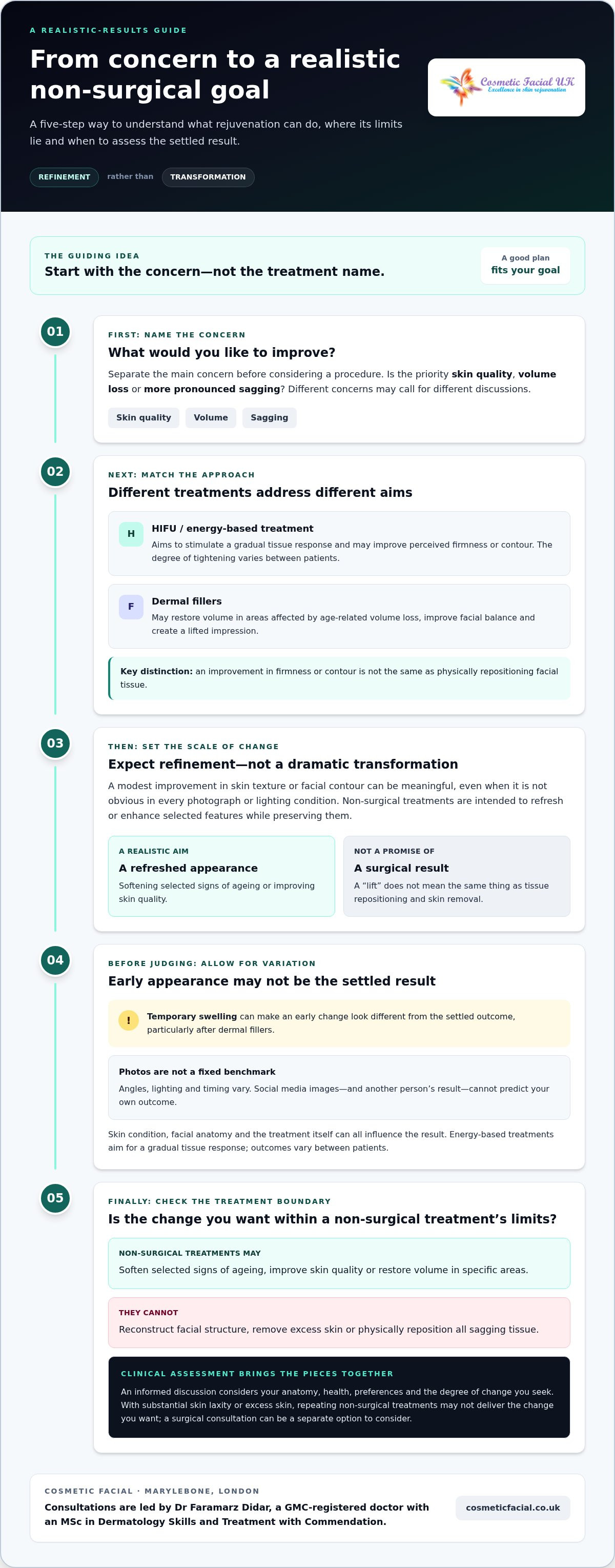
Managing expectations for non-surgical treatments begins with understanding their purpose and limits. Non-surgical aesthetics can soften selected signs of ageing or improve skin quality, but they cannot reconstruct facial structure or remove excess skin. The term “lift” may describe an improvement in perceived firmness or contour, but it does not mean the same thing as the tissue repositioning and skin removal involved in a surgical rhytidectomy.
Understanding Rejuvenation vs. Transformation
A non-surgical face lift may use approaches such as HIFU or dermal fillers to improve firmness or restore volume. The right approach depends on the concern: skin quality, volume loss or more pronounced sagging may call for different discussions. The aim is generally a refreshed appearance that preserves your features, rather than a dramatic transformation. Aesthetic medicine covers a broad range of procedures, so expected outcomes need to be considered treatment by treatment.
Non-surgical change is usually better understood as refinement than transformation. A modest improvement in skin texture or facial contour can be meaningful, but it may not be obvious in every photograph or lighting condition. Social media can make it harder to judge results because angles, lighting and the timing of photographs vary. An early change, including temporary swelling, may not represent the settled outcome.
The Limits of Tissue Lifting
Energy-based devices such as HIFU deliver focused energy to targeted tissue, with the aim of stimulating a gradual tissue response. They cannot remove redundant skin, and the degree of tightening varies between patients. Dermal fillers may restore volume in areas affected by age-related volume loss, improving facial balance and creating a lifted impression. They do not physically reposition all sagging tissue or replace skin excision.
These limits matter most when substantial skin laxity or excess skin is the primary concern. Repeating non-surgical treatments may not deliver the scale of change someone wants. A responsible clinical discussion should explain what the treatment can achieve and where it is unlikely to meet the goal. A surgical consultation may be a separate option to consider, but non-surgical technology cannot promise a surgical outcome.
There is no universal point at which someone must move from non-surgical care to surgery. The decision depends on anatomy, health, preferences and the degree of change sought. A clear assessment helps distinguish a suitable aim for rejuvenation from a request for structural correction, so you can make an informed choice without relying on exaggerated claims.
Biological Variables: Why Results Vary Between Patients
The same treatment can produce different outcomes in different people. Age, skin condition, facial anatomy, muscle activity and lifestyle can affect how a procedure works and how long its effects remain visible. Managing expectations for non-surgical treatments means considering your own starting point, rather than treating a friend’s result or an online photograph as a prediction.
Skin Quality and Baseline Health
Skin condition is an important consideration for many treatments. Age-related changes in collagen and elastin can affect firmness and resilience, while cumulative UV exposure may contribute to uneven pigmentation, rough texture and reduced elasticity. Sun damage can influence the skin’s response to resurfacing procedures, including chemical peels. An assessment can help establish whether the priority is skin quality, volume or another concern before deciding on an approach.
Smoking and frequent UV exposure can undermine skin health and may affect how refreshed results look over time. Nutrition and hydration support general wellbeing and skin function, but they can’t guarantee a particular outcome or determine exactly how long dermal filler will last. Treatment longevity varies between individuals, so it is more useful to discuss a realistic range than expect a fixed duration.
Metabolic and Genetic Factors
Botulinum toxin results depend partly on the muscles treated, their strength and movement, as well as the treatment plan. Two people treated in a similar area may see different degrees of softening or different durations. Fillers also vary in how they settle and persist, depending on the area treated, product characteristics and individual tissue response. A high metabolism alone doesn’t explain every difference in longevity.
Genetic factors can influence bruising and swelling, while individual anatomy affects where these effects appear and how noticeable they are. These temporary responses can make early results look different from the settled outcome. Collagen-stimulating treatments such as Sculptra develop gradually as the body responds, rather than producing an immediate final result.
Facial rejuvenation may be planned in stages. A clinician can consider skin quality alongside other concerns over time, rather than attempting to change everything in one session. Cosmetic Facial’s facial rejuvenation treatments can be discussed in relation to your skin and goals. For broader preparation principles, the ASPS patient safety guidance highlights informed preparation for surgical care; its recommendations should not be mistaken for UK non-surgical treatment rules.
At Cosmetic Facial’s Marylebone practice, Dr Faramarz Didar’s consultations draw on his MSc in Dermatology Skills and Treatment with Commendation and Postgraduate Diploma in Non-Surgical Facial Aesthetics. Read more about Cosmetic Facial’s clinical approach.
The Patient Checklist: Preparing for Realistic Results
A useful consultation starts with your concern, medical history and expectations, not a predetermined list of procedures. This gives the clinician a basis to assess suitability, discuss alternatives and explain what a treatment can reasonably achieve. It also makes managing expectations for non-surgical treatments more practical: you can leave with a clearer understanding of the likely process, limitations and ongoing commitment.
Prepare before your consultation
Bring a complete medical history, including relevant medication, allergies, previous aesthetic treatments and any complications or side effects. Note when previous procedures took place and, if known, what was used. Before attending, identify one primary concern, such as a particular line, an area of volume loss or a change in skin texture. A broad aim like “fix everything” is difficult to assess; a focused concern makes it easier to discuss options and likely outcomes.
Review the clinic’s aesthetic treatment FAQs to familiarise yourself with common considerations, including possible side effects. Write down anything that remains unclear, and consider your social calendar when planning treatment. Bruising, swelling or visible redness can occur after some procedures, and recovery differs by treatment and individual. Avoid scheduling an important event so close to treatment that normal recovery becomes a source of avoidable anxiety.
Use the consultation as a clinical checklist
Credentials matter because aesthetic procedures require clinical judgement as well as technical skill. Cosmetic Facial is led by Dr Faramarz Didar, a GMC-registered doctor (5200505) with an MSc in Dermatology Skills and Treatment with Commendation from the University of Hertfordshire and a Postgraduate Diploma in Non-Surgical Facial Aesthetics. His consultations include an individual assessment informed by dermatology training.
- Clarify the plan: What is the main concern being addressed, why is this approach suitable, and what result is realistic for your anatomy and skin?
- Understand the treatment: Which product or device is proposed, what is known about its safety profile, and what risks and aftercare considerations are relevant?
- Discuss individual factors: How might your skin type, medical history or previous treatment affect the plan and your response?
- Consider visual examples carefully: If you review before-and-after images, ask whether the cases are comparable in concern, treatment and starting features. Images show individual outcomes, not a guarantee of yours.
- Plan for maintenance: Ask what follow-up or repeat treatment may be appropriate, and consider whether the ongoing commitment fits your priorities. No treatment schedule or result duration is identical for everyone.
A clear plan should leave room for questions and informed decisions. You don’t need to proceed simply because you attended a consultation. Take time to consider whether the proposed outcome, recovery and maintenance align with your goals.
Timeline Realities: From Immediate Effects to Long-Term Maintenance
Results develop at different rates depending on the treatment. Some changes are visible soon after a procedure, while others depend on a gradual biological response. Managing expectations for non-surgical treatments means allowing time for that process and distinguishing temporary post-treatment effects from the settled result.
The Injectable Timeline
Botulinum toxin doesn’t work instantly. Effects commonly begin to appear over 3 to 10 days, with the result approaching its peak at around two weeks. Judging movement or symmetry on day three may be premature. The 14-day point is a useful guide for assessing the developing effect, although individual responses vary.
Dermal fillers can cause temporary swelling and tenderness as the tissue responds to injection. The initial inflammatory response is often most noticeable during the first 48 hours, so the appearance straight after treatment may not reflect the settled result. For more information about what to expect, read this clinical guide to dermal fillers in London.
Descriptions such as “up to 12 months” indicate a possible duration, not a guarantee for every patient. Longevity depends on the treatment, area, individual biology and other factors. Your clinician can explain what range is realistic for your plan and when a review may be appropriate.
Energy-Based and Laser Timelines
HIFU treatments work through a gradual tissue response, including collagen synthesis. Visible changes may develop over a 3-to-6-month window rather than immediately. This slower progression is one reason early photographs may not show the eventual effect.
Laser resurfacing, including fractional CO2 laser treatment, can involve redness, sensitivity and peeling as the skin recovers. The recovery experience and treatment plan depend on the individual and the clinical indication. Some patients may require multiple sessions to work towards their desired result. The number and spacing should be determined through clinical assessment, not assumed from another person’s experience.
Plan for possible downtime. If you have an important event, discuss timing in advance and allow for recovery rather than expecting to conceal every visible effect. Treatment planning may include two stages: an investment phase, when an initial course may be undertaken, and a maintenance phase, when future treatment may be considered to support results. The schedule and ongoing commitment vary, so include them in your decision before starting.
Clinical Excellence: Why Expertise Matters in Managing Expectations
Managing expectations for non-surgical treatments is a clinical task, not simply a discussion about preferred results. A practitioner needs to assess whether a concern is suitable for treatment, explain likely benefits and limitations, and consider how different features of the face relate to one another. A broader facial rejuvenation plan can help avoid treating a line or area of volume loss in isolation when that does not address the overall concern.
Diagnosis and treatment suitability
Skin symptoms can have causes that need assessment before aesthetic treatment is considered. Dermatology knowledge supports careful evaluation of skin quality and visible changes, and helps inform whether a procedure is appropriate. Dr Faramarz Didar holds an MSc in Dermatology Skills and Treatment with Commendation from the University of Hertfordshire, alongside a Postgraduate Diploma in Non-Surgical Facial Aesthetics. For example, Botox treatment options should be considered in relation to your anatomy, concerns and medical history.
Dr Didar is GMC-registered (5200505). GMC registration relates to his status as a doctor and the professional standards expected of doctors; it is not a guarantee of a particular aesthetic result. Clinical expertise helps shape a reasoned plan, but outcomes still vary. A full-face assessment can consider balance and proportion alongside the specific area that prompted the consultation, rather than automatically recommending several procedures.
Clinical setting and safety discussions
CQC registration, where applicable to a provider’s regulated activities, concerns the service and those activities. It is distinct from a doctor’s GMC registration and is not a blanket endorsement of every cosmetic procedure. Understanding what each form of oversight covers can help put credentials in context. A clinical discussion should also explain relevant risks, aftercare and how concerns or complications would be managed, without implying that any procedure is risk-free.
Ethical practice includes recognising when a requested treatment is unsuitable or unlikely to meet the patient’s stated goal. A doctor may recommend a different approach, suggest addressing a skin condition first, or advise against treatment. That response can be an important part of informed care. The aim is to align the clinical plan with your needs, anatomy and realistic expectations, not to fit every concern to a procedure.
Make Your Next Step an Informed One
Realistic expectations start with recognising that non-surgical treatments can refresh and refine, but cannot reproduce every surgical outcome. Results vary with your anatomy, skin and treatment choice, and may take time to develop. Allowing for recovery and understanding potential maintenance can help you assess the result calmly rather than judging it too soon.
A clinical consultation gives you space to discuss your primary concern, medical history and desired outcome before considering a treatment plan. At Cosmetic Facial in Marylebone, London, Dr Faramarz Didar is a GMC-registered doctor (5200505) with an MSc in Dermatology Skills and Treatment with Commendation and a Postgraduate Diploma in Non-Surgical Facial Aesthetics. His specialist training informs a measured approach focused on natural-looking results and clinical suitability.
Frequently Asked Questions
How do I know if I'm a good candidate for non-surgical treatments?
A clinical assessment is the best way to determine whether a treatment suits your health, anatomy and goals. Be ready to discuss your medical history, medicines, previous procedures and the specific change you hope to see. A practitioner should explain likely benefits, limitations and alternatives, including when treatment may not be appropriate. Managing expectations for non-surgical treatments means choosing a plan for your concern, not simply selecting a popular procedure.
Can non-surgical treatments look natural, or will I look 'done'?
Non-surgical treatments can look natural when the plan is tailored to your features and aims for proportionate change. The outcome depends on factors such as the treatment, technique, anatomy and degree of enhancement. A natural result may still be noticeable to you, even if it isn’t obvious to others. Discuss what “refreshed” means to you, and make sure the proposed result preserves the features you want to retain.
What happens if I am not happy with my non-surgical results?
If you’re unhappy, contact the clinician who treated you and arrange a review rather than seeking an immediate additional procedure. Some results need time to settle, and temporary swelling or bruising can affect how they appear. Explain what concerns you and when you first noticed it. If you develop severe or rapidly worsening symptoms after treatment, seek urgent medical attention. The appropriate next step depends on the procedure and clinical findings.
Is there any permanent non-surgical treatment available?
Most non-surgical aesthetic treatments aren’t permanent, and they don’t stop the natural ageing process. Effects may fade or change over time, so some people consider maintenance. Certain procedures intended to remove a specific lesion or unwanted tissue have different aims from rejuvenation, and permanence depends on the condition and treatment. Your clinician can explain the expected course and limitations for the procedure being considered, without treating longevity as guaranteed.
How much downtime should I really expect for a 'lunchtime' lift?
“Lunchtime lift” is a marketing phrase, not a reliable promise of no downtime. Recovery depends on the procedure, treatment area and your individual response. Injectables may cause temporary swelling, redness, tenderness or bruising, while energy-based treatments can involve skin sensitivity or redness. Before scheduling treatment, discuss what visible effects are possible, how long they may last and whether you should avoid particular activities. Leave flexibility around important social or work commitments.
Why do results vary so much between different clinics in London?
Results vary because patients, treatment plans and practitioners’ clinical judgement differ. Assessment, technique, product selection, device settings and aftercare can all influence the experience and outcome. In London, consider the treating clinician’s registration, relevant training and experience with your concern, rather than relying on marketing claims alone. Cosmetic Facial is led by Dr Faramarz Didar, a GMC-registered doctor (5200505) with an MSc in Dermatology Skills and Treatment with Commendation.
Can I combine multiple non-surgical treatments in one session?
Sometimes treatments can be combined, but suitability depends on the procedures, areas treated, your medical history and the intended result. Combining treatments isn’t automatically more effective, and doing several at once may affect recovery or make it harder to identify the cause of a reaction. A clinician should assess whether to treat in one session or stage procedures over time, and explain the reasoning, expected downtime and aftercare for the proposed plan.
How often will I need to return for maintenance appointments?
There’s no single maintenance schedule that applies to every treatment or patient. The timing depends on the procedure, how your body responds, the area treated and the result you want to maintain. Ask for an individual estimate during your consultation, including whether review or repeat treatment may be appropriate. Maintenance is a choice, not an obligation, and your plan can be reconsidered as your priorities or clinical needs change.
Disclaimer
All content on cosmetic Facial website, including blogs, graphics, logos, images, and software, is the property of CosmeticFacial UK or its content suppliers and is protected by applicable copyright laws. Unauthorized use, reproduction, distribution, or modification of any content without prior written permission is strictly prohibited.


